


Description
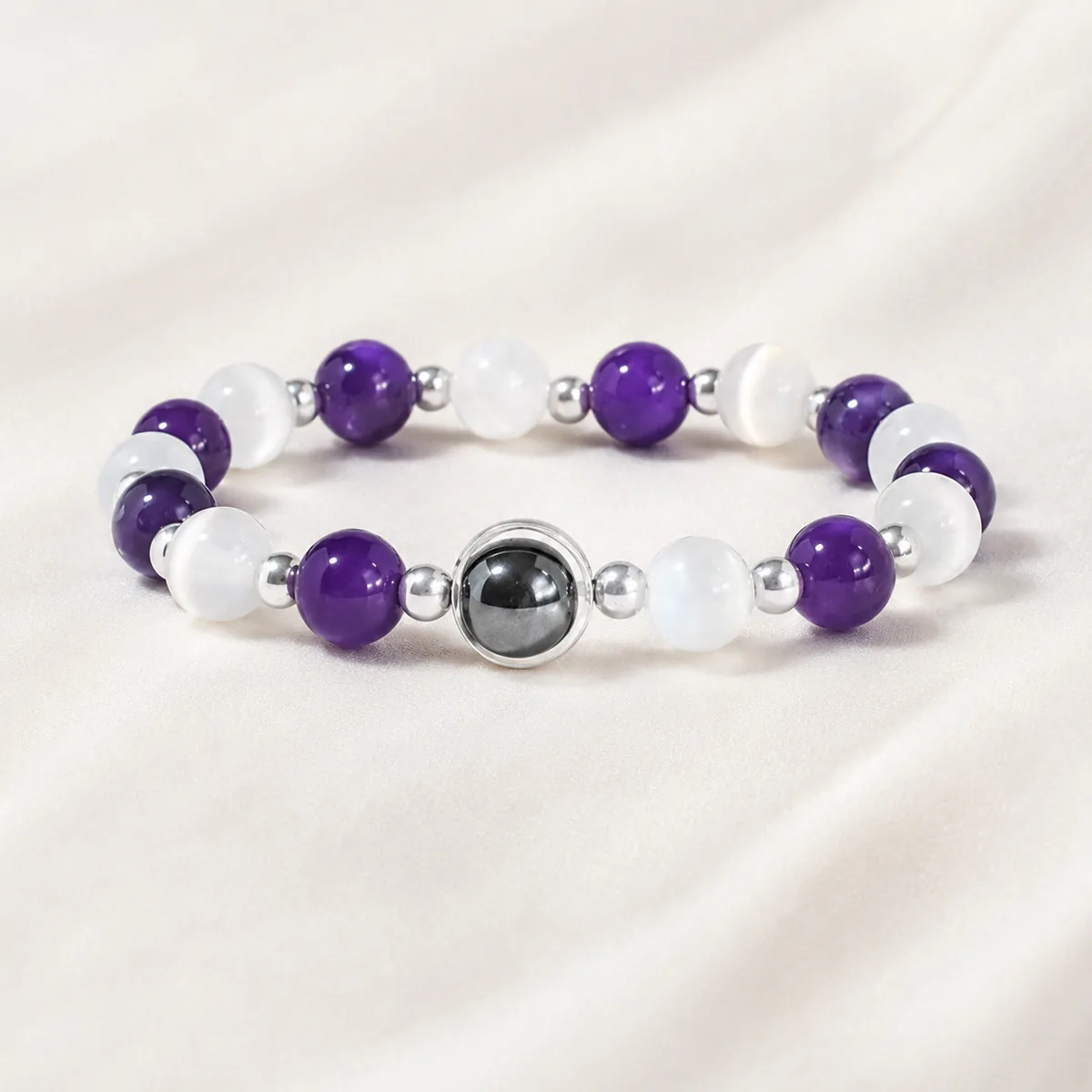
A deep violet alternating with milky white, punctuated by tiny silver balls, with a dark mirror-polished bead ringed in silver at the centre. Four materials on one cord, and the fourth is not in the product name. Might as well start with it.
What is really on this cord
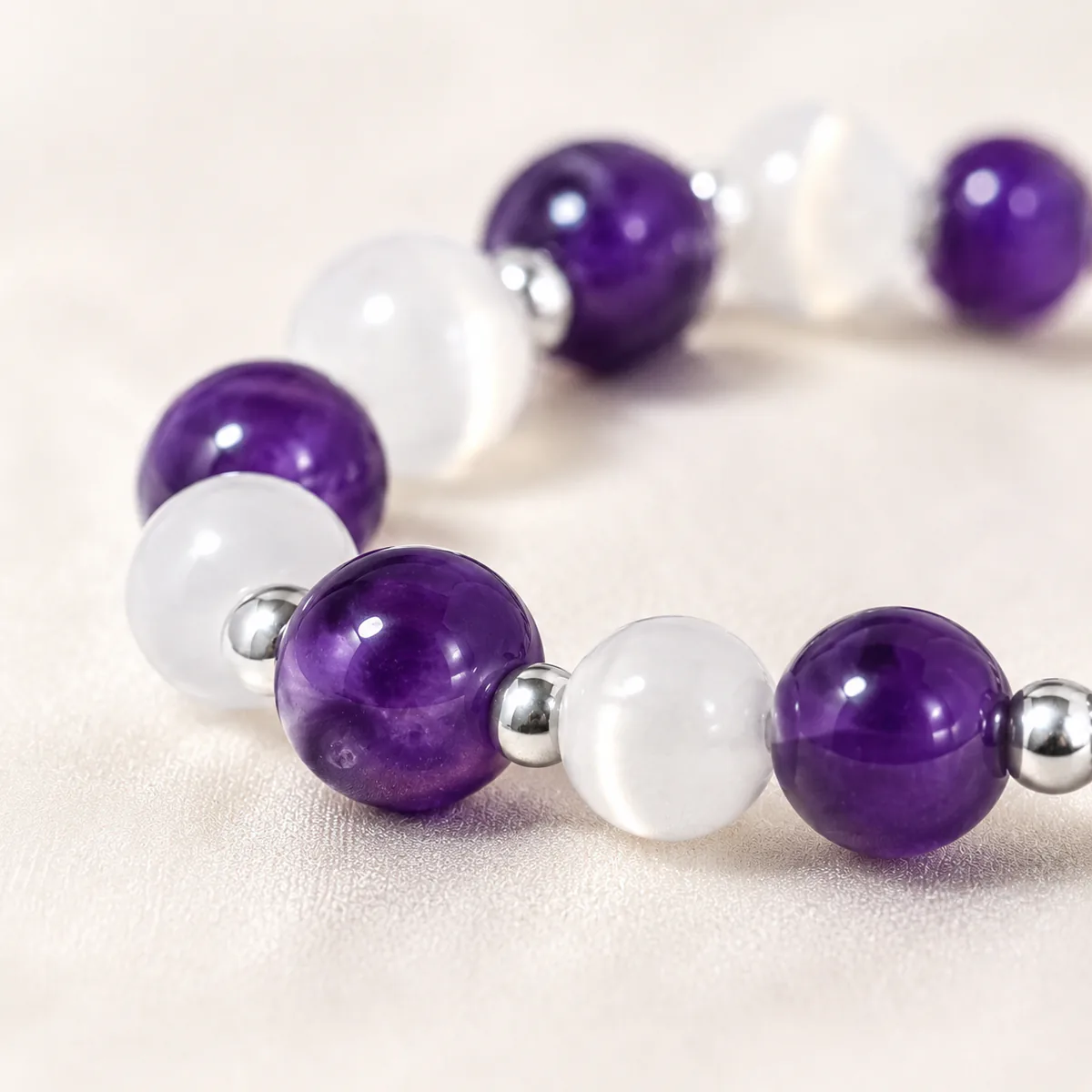
The violet beads are amethysts, a steady, saturated tone. The white ones are moonstone, milky, whose glow shifts as the wrist turns. Between them, small silver balls separate the materials.
And at the centre, a grey, opaque bead, polished like a mirror and set in a silver ring: it is haematite. It is not a dark moonstone or onyx. Haematite is an iron oxide, the same chemical family as rust, and that is what gives it a metallic gleam no other stone has. Here it acts as a visual full stop in the middle of a bracelet that, without it, would be a plain alternation.
Two details worth knowing about it. It weighs about twice as much as the other beads. Haematite has a density near 5, against 2.6 for quartz: at equal diameter, this one bead weighs roughly as much as two amethysts. That is noticeable in the hand, and it is what gives this bracelet the sense of heft the others lack. Its name comes from the Greek haima, blood, because ground to powder it turns red even though it looks grey.
Three hardnesses, and the most fragile is not the one you would guess
It is the question worth asking of any multi-stone bracelet. Here there are three, and the ranking is surprising: amethyst is a quartz, so around 7 on the Mohs scale. Moonstone, a feldspar, sits around 6 to 6.5. And haematite, despite its polished-metal look, is the softest of the three, between 5 and 6.
The consequence is concrete. On a flexible cord where beads roll against each other all day, it is the amethyst that marks the other two. And haematite is the most exposed of all, because a mirror polish shows the slightest scratch: a matte surface absorbs and hides wear, a mirror surface records everything. The silver balls placed on either side of each material are therefore not just decorative, they keep beads of different hardness from touching directly.
I have gathered elsewhere the pairings that work and the ones to avoid, where this question comes up every time. The shop’s other bracelets are here.
This bracelet does not make you lose weight
It needs to be said, because some people will land on this page searching for exactly that. The amethyst and moonstone pairing is sold in many places as a slimming bracelet, complete with wear protocols, durations and promised results.
That is false, and it is not a matter of opinion. No stone has any effect on metabolism, appetite, water retention, or fat mass. Nothing of the sort has ever been shown, for these two stones or for any other, and selling jewellery on that promise is an unfounded health claim. You will find none here, nor anywhere else in this shop.
If weight is a genuine concern for you, the person to talk to is a doctor or a dietitian. The full disclaimer is here.
What to know before ordering
The white beads do not all look alike: a moonstone’s sheen depends on the orientation of its internal layers, which nobody chooses when drilling a bead, and a perfectly uniform batch would not be real stone. Amethyst beads, by contrast, vary little, since their colour is spread through the whole mass.
The stretch cord is a wearing part, one to three years before restringing, and it wears fastest when stretched to full width to put it on rather than rolled over the hand. Moonstone also has perfect cleavage: it chips on impact without scratching easily.
Tradition ties moonstone to cycles and intuition, amethyst to calm and clarity, haematite to grounding. It is that combination of reputations, and nothing else, that explains the trio’s success. I will not go further: none of this is proven and no piece of jewellery heals anything. Beyond that, I have gathered what tradition attributes to this stone and what is said about which wrist to wear it on.
- Amethyst, white moonstone, and a central haematite bead ringed in silver.
- Haematite weighs twice as much as the other beads: the bracelet has a heft the others lack.
- Three hardnesses on one cord: the silver balls keep the materials from touching.
- No slimming effect, no medical virtue. It is a piece of jewellery.
The specifications
- Stones
- Amethyst, white moonstone, haematite
- Centre bead
- Haematite set in a silver ring
- Spacers
- Small silver balls between materials
- Construction
- Stretch cord, no clasp
- Hardness
- Amethyst around 7, moonstone 6 to 6.5, haematite 5 to 6
- Wrist size
- 14 to 20 cm
- Gender
- Women and men
- Brand
- Melissa Moon
The bracelet I refuse half the sales of
This is the only piece in the catalogue where I know in advance that some of the people who open the box are looking for something other than what it is. The amethyst and moonstone duo has become attached to weight-loss promises, and that reputation sticks to it. I could say nothing, let the page sell itself and cash in. I would rather write a paragraph that will cost me orders, because the alternative is profiting from a belief I know to be false.
What remains after that paragraph is a very pretty bracelet, dense, with a deep violet and a dark point at the centre. That is more than enough reason to buy it. The rest of the shop is here, including what I have removed from the catalogue and why.
There are sales I do not want to make. This is one of them, and it is not virtue, it is arithmetic: a disappointed customer costs more than a missed sale.
No salt, no ultrasonic tank, no hot water: moonstone is a feldspar, and all three damage it for good. A bracelet is treated according to its most fragile stone, never its toughest. Lukewarm water, a soft cloth, drying thoroughly between the beads. No paste or abrasive cloth on the haematite: its mirror polish scratches on first contact and cannot be undone. Take the bracelet off before the shower: soap does not attack the stones but it wears the cord and dulls the silver. The detail is in cleaning a moonstone piece, and the safe methods in caring for it without harming it.