Moonstone Pendants
The stone alone, bezel set on 925 sterling silver, to hang on the chain of your choice. It is the simplest family in the catalogue and the freest, provided you check one measurement before you order.
Showing all 12 results
-
-20 %

Black Moonstone Pendant
Original price was: 57,90 €.45,90 €Current price is: 45,90 €. Add to basket -
-20 %
Blue Moonstone Pendant
Original price was: 44,90 €.35,90 €Current price is: 35,90 €. Add to basket -
-20 %
Gold Moonstone Pendant
Original price was: 57,90 €.45,90 €Current price is: 45,90 €. Add to basket -
-20 %
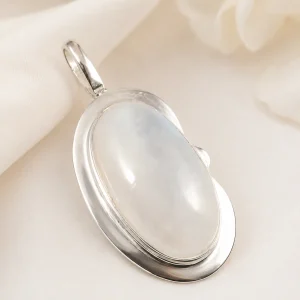
Large Moonstone Pendant
Original price was: 62,90 €.49,90 €Current price is: 49,90 €. Add to basket -
-20 %
Men’s Moonstone Pendant
Original price was: 32,90 €.25,90 €Current price is: 25,90 €. Add to basket -
-20 %
Moonstone Cabochon Pendant
Original price was: 37,90 €.29,90 €Current price is: 29,90 €. Add to basket -
-20 %
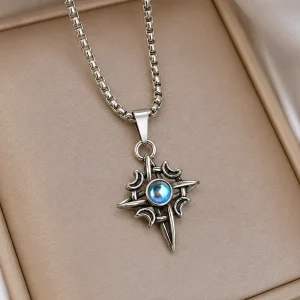
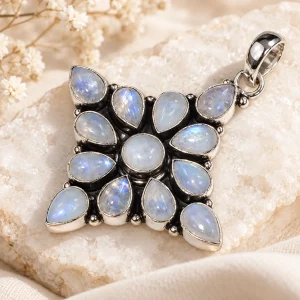
Moonstone Four Pointed Star Pendant
Original price was: 51,90 €.40,90 €Current price is: 40,90 €. Add to basket -
-20 %
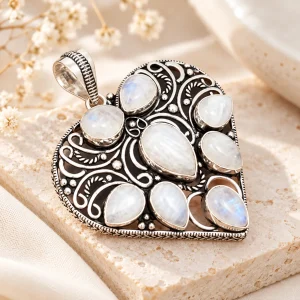
Moonstone Heart Pendant, Seven Stones
Original price was: 51,90 €.40,90 €Current price is: 40,90 €. Add to basket -
-20 %
Moonstone Teardrop Pendant
Original price was: 37,90 €.29,90 €Current price is: 29,90 €. Add to basket -
-20 %
Rainbow Moonstone Pendant
Original price was: 42,90 €.33,90 €Current price is: 33,90 €. Add to basket -
-20 %
Real Moonstone Pendant
Original price was: 32,90 €.25,90 €Current price is: 25,90 €. Add to basket -
-20 %
Sterling Silver Moonstone Pendant
Original price was: 32,90 €.25,90 €Current price is: 25,90 €. Add to basket
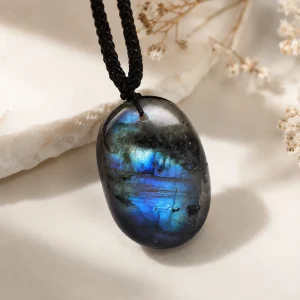
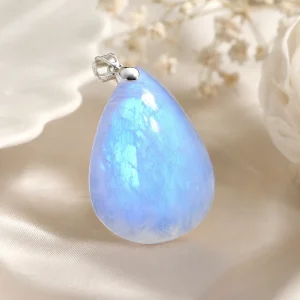
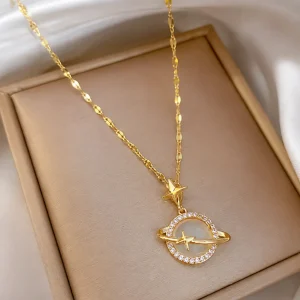
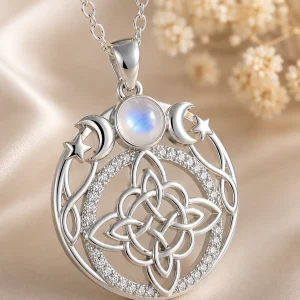
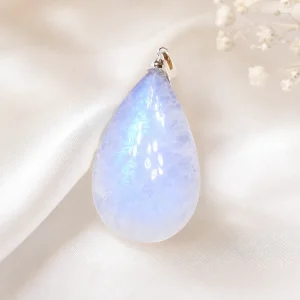
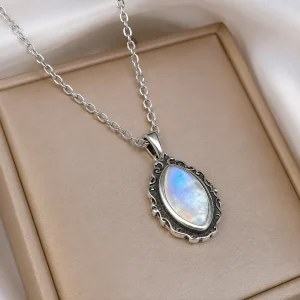
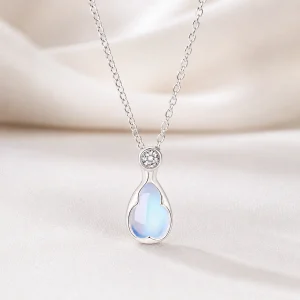
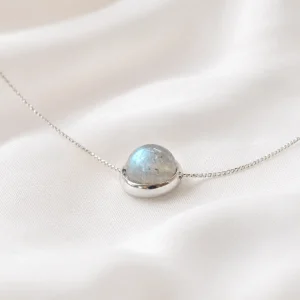
A pendant is sold without its chain
That is the difference from a necklace, and it is not only a matter of price. A pendant lets you choose the length, the metal and the thickness of the chain, so the way the stone falls and what it sits beside.
Both families share the same symbolism and the same use: I have gathered what this stone is said to mean worn at the neck in an article common to the two.
The bail decides which chain you can thread through it
It is the measurement nobody looks at and it causes almost every disappointment with this format. The bail is the loop soldered above the stone, the one the chain passes through. What matters is not its apparent size but its inner opening, and a wide flat bail may well have only a narrow slot.
The check takes ten seconds: look at the thickness of the links on the chain you mean to use, and compare it to the opening given on the listing. A fine cable chain goes through anything; a snake chain, a thick curb or a leather cord want a distinctly more open bail. If in doubt, measure the link with a ruler rather than trusting its look, or write to me with a photo and I will tell you whether it fits.
The pendant that turns. If your pendant keeps sitting sideways or back to front through the day, it is not an assembly fault: the bail is too wide for the chain, and the stone pivots freely around it. A slightly thicker chain fixes it better than anything else.
Why all my pendants are bezel set
A bezel is a band of metal folded over the whole rim of the stone, millimetre by millimetre, turning as it goes. Here it is nothing decorative. Moonstone has perfect cleavage: it does not scratch easily, but it chips under impact, and a chip always starts from an exposed edge or corner. Prong settings, standard elsewhere, leave exactly four edge points bare.
On a pendant the argument weighs more than on a ring. A pendant swings, it knocks into shirt buttons, zips and the edge of tables when you lean. The metal that wraps around absorbs what the stone cannot take. I have set out the different settings and what they really protect.
Teardrop, cabochon or large volume
The varieties are worth here what they are worth everywhere: white lights up a complexion, blue and rainbow are noticed from afar, black plays contrast with the skin.
What you will not find here
No glued stone. It is the most common mount on cheap pendants: the stone sits in a cup with a dab of glue, and the metal does not hold it, it surrounds it. You can spot it by a shiny line under the edge of the stone. A glued stone comes loose one day, usually in heat or after a pass under hot water, and it cannot be reset. There is no tube of glue in this workshop, and that is not a figure of speech.
No stone drilled right through. The other shortcut is to drill a hole in the stone and pass a ring through it. It is faster and cheaper than setting, but on a stone with perfect cleavage, a hole is exactly the place it will eventually split from.
And no imitation. Opalescent glass is sold everywhere under this name, and the pendant format, where a single isolated stone is all you see, lends itself to it better than any other. Here is how to tell them apart, and the six criteria I apply.
Unsure about your chain? Send me a photo of the clasp and a link, I answer myself within 48 working hours and I will tell you whether the pendant will go through. And you have fourteen days to change your mind.
Hesitating between a pendant and a necklace? The necklaces arrive ready to wear, and the ways to wear the stone are gathered separately.