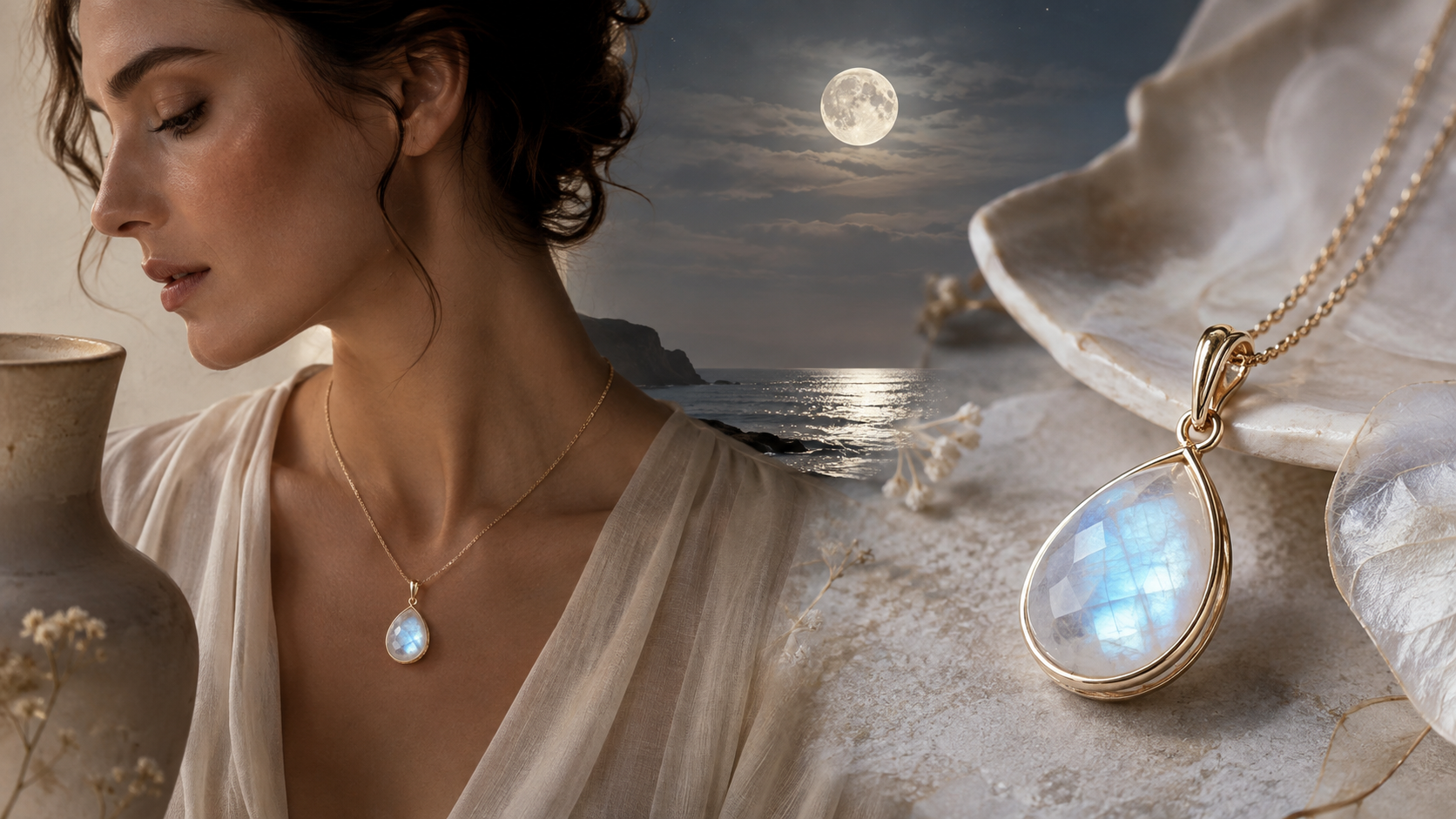
Moonstone Necklace Meaning and How to Wear It
This is the piece least exposed to knocks and the one people lose most. The danger never comes from the stone, it comes from the bail and the clasp, two parts nobody looks at before buying. Here is what tradition assigns to this piece of jewellery, where the idea of wearing it close to the heart comes from, and the chain length that suits you.
A necklace is the only jewel its wearer does not see. She feels it, she knows it is there, but she never looks at it without a mirror. That changes the relationship you have with it completely, and it explains a good part of what follows.
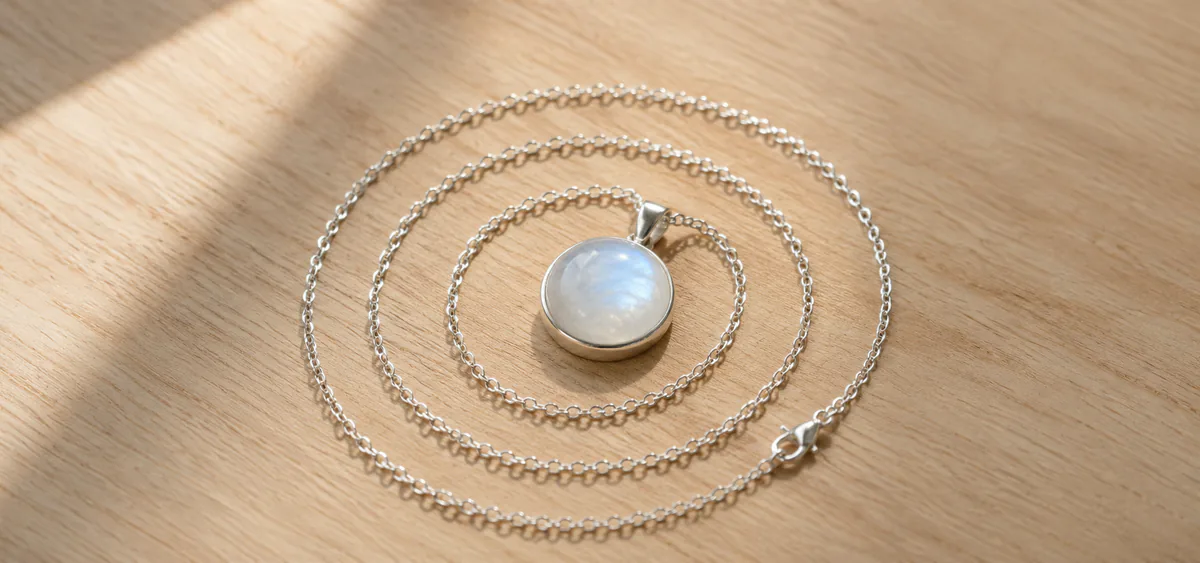
The short version, if you are in a hurry
- The meaning assigned to the stone comes down to three words: softness, intuition, new beginnings. On a necklace, the idea of a jewel worn close to the heart is added to that.
- That idea is a convention, not a fact. It comes from the chakra charts that spread from the 1970s onward.
- This is the family least exposed to knocks, along with earrings. A pendant hangs, it does not hit things.
- The real weak point is the bail, the ring that joins the stone to the chain. If it is simply closed rather than soldered, it spreads open and the pendant drops off.
- The most versatile length is 42 to 45 cm, just below the collarbone. 50 cm to wear over a jumper, 60 cm and up for a long chain.
- Allow 1.2 to 1.5 mm of chain width under a bezel-set cabochon. A fine chain gives way at the first snag.
- It is the safest gift: no size to know, no social code like the one a ring carries.
Necklace, pendant, long chain: not the same thing
Let us start with vocabulary, because the three words get used for one another and that complicates the search as much as the purchase.
The chain is the link on its own, with nothing on it. It is sold separately and it can be replaced, which is good news: a broken chain does not condemn the stone.
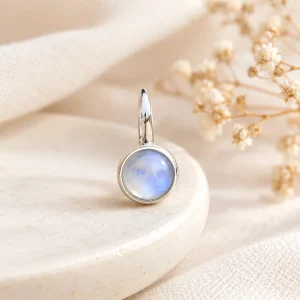
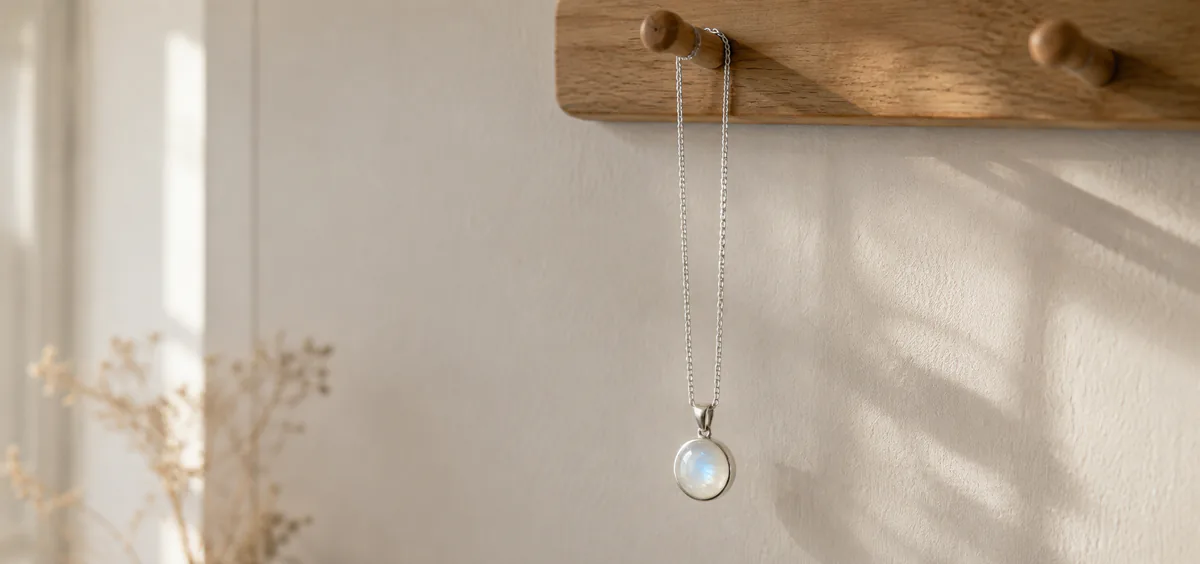
The pendant is the suspended element, the stone and its setting, with its bail. That is what you buy from a maker, and it can move from one chain to another.
The necklace means the assembled whole, chain and pendant together, or a piece whose design is built into the neckline itself.
The long chain is a long necklace, from roughly 70 cm up, which falls onto the chest and is sometimes worn doubled.
The distinction has an immediate practical consequence. If you are buying a pendant, check what comes with it: plenty of sellers advertise a necklace and deliver a mounted stone on a very fine makeshift chain that will not last six months.
What a moonstone necklace means
The attributions are the same as for the other pieces of jewellery made with this stone, and I report them in the conditional, as I do everywhere on this site.
Softness, understood as a calming of sharp reactions. Intuition, the idea of feeling before reasoning, tied to the veil you watch move without being able to fix it. And new beginnings, by analogy with the lunar phases.
The necklace adds a shade the other pieces do not have, and there is nothing mystical about it. It is the only jewel its wearer does not see. A bracelet is in your field of vision all day, a ring gets looked at while you talk, a pendant is felt against the skin and disappears under a collar.
That detail changes what you expect from it. A bracelet works as a visual reminder; a pendant works as an object of contact. It is the one difference in meaning I defend without reservation, because it assumes no belief at all.
The general meaning is covered in the meaning of moonstone, and the case of the ring in the moonstone ring.
"Close to the heart": where the idea comes from, and since when
This is the phrase you read everywhere about pendants, and it deserves a close look.
It comes from two sources that got mixed together. On one side the anatomical position: a pendant rests on the sternum, therefore above the heart, which is factually true and implies nothing more. On the other side the chakra charts, in which the throat area and the heart area are each given assigned stones, moonstone generally being filed under the throat or the plexus depending on the author.
On the dating, it is best to be blunt. These stone-to-chakra charts, in the form we find them today, spread through the West from the 1970s onward, then were fixed by the crystal literature of the 1980s and 1990s. They borrow their vocabulary from older traditions, but assigning a precise stone to a precise zone is a recent construction, and it varies from one author to the next.
In other words: wearing the stone close to the heart is an accurate image and an unproven claim. I report it because it explains the success of the pendant, not because it demonstrates anything. The subject is covered in detail in moonstone and the chakras.
These correspondences belong to crystal healing, an approach founded on traditions and beliefs. They are not a medical claim and never replace the advice of a healthcare professional. Read the full disclaimer.
The least exposed piece, and the risk that remains
Good news first. The pendant is, along with earrings, the family where a moonstone lives best.
The reason is mechanical. Moonstone sits at 6 or 6.5 on the Mohs scale and above all has perfect cleavage: it splits on impact. And a pendant hits nothing. It hangs, it swings, it rests on fabric. The head-on impacts that destroy rings never reach it. The full ranking is in how to wear moonstone.
The risk lies elsewhere, and it is twofold.
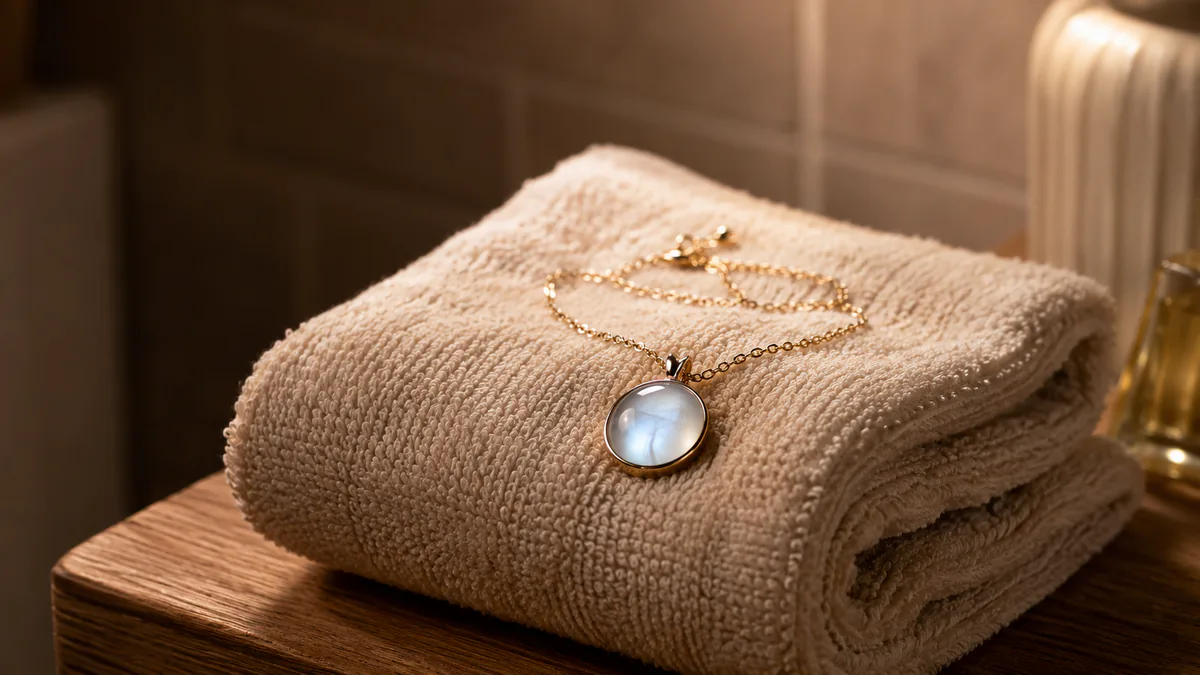
The drop at the moment you take it off. By far the leading cause of broken pendants I see coming back. You unhook the clasp over a sink, the chain slips, and the cabochon lands on tile. Always take a pendant off over a soft surface, a bed, a folded towel, never over a hard floor.
Loss. A bail that spreads open or a clasp that gives way, and the stone leaves without a sound. Nobody notices at the time, and that is what makes this risk more serious than breakage: a broken stone can be replaced, a lost stone is lost.
Lengths, and where the pendant falls
Length is what decides the look, and it is chosen before the stone. Here are the reference points I use, in centimeters and for an adult.
| Length | Where it falls | What it gives you |
|---|---|---|
| 38 to 40 cm | Base of the neck, choker | Always on show, awkward under a closed collar |
| 42 to 45 cm | Just below the collarbone | The most versatile, works with almost everything |
| 50 cm | Top of the sternum | Sits well over a jumper, common length for men |
| 55 to 60 cm | Middle of the chest | Needs a low neckline or a plain garment |
| 70 to 90 cm | Long chain, below the chest | Worn doubled, swings a great deal |
Two remarks product listings never make. The stated length is that of the whole chain, clasp included: a bulky pendant therefore hangs lower than the figure suggests, sometimes by two centimeters.
And the same length does not fall in the same place depending on the neck. If you are hesitating, take a piece of string, run it around the neck and mark where you want the stone to sit: that is more reliable than any guide.
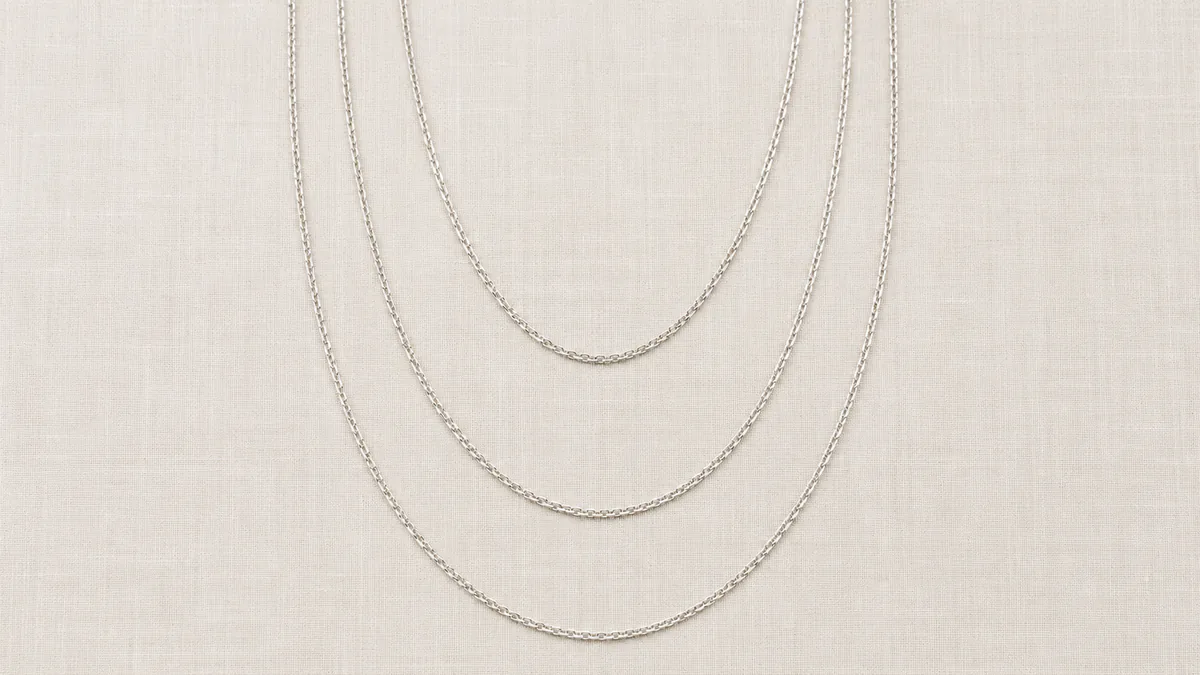
The chain: width, link, clasp
This is the part people look at least and the one that breaks most. Three points are enough.
Width. Under a bezel-set cabochon, allow 1.2 to 1.5 mm. A 0.8 mm chain suits a small charm, not a stone set in a silver bezel: it gives way at the first snag on a scarf or a car door.
Link type. Solid links, cable or box, hold better than hollow tube chains, which are very supple but fragile, and than snake chains, which kink permanently the moment you step on one. A solid-link chain can be repaired, a crushed hollow chain cannot.
The clasp. Prefer a lobster clasp to a spring ring: the second opens more easily under tension and is also harder to work one-handed. Check the jump ring that joins the clasp to the chain as well, which is sometimes a plain open ring.
One telltale sign: if the clasp migrates round to the front during the day, the pendant is heavy for that chain or the length is wrong. That is not just a matter of looks, it is extra wear on the same few links.
The bail, the breaking point nobody looks at
Here is the heart of this page, and it is almost absent from the web.
The bail is the part that joins the setting of the stone to the chain. It takes everything: the weight of the pendant, every movement, every rub. It is the only element of a necklace that works without a break.
Two constructions exist, and they have nothing in common.
A soldered bail forms a closed ring, made in one piece with the setting or brazed onto it. It cannot open. That is what to look for.
A simply closed ring, unsoldered, is a wire bent into a circle whose two ends touch without being joined. Under sideways pull it spreads open, and the pendant leaves the chain. It does not happen all at once: the ring opens by a few tenths of a millimetre with every snag, over months.
The check takes five seconds. Look at the ring closely, in good light: if you can see a parting line where the two ends meet, it is not soldered. That is the first question to ask a seller, before even the species of the stone.
On the necklace I make, the cabochon is set in an openwork silver circle and the suspension is built into the setting. The other questions to ask when buying are in where to buy moonstone jewellery.
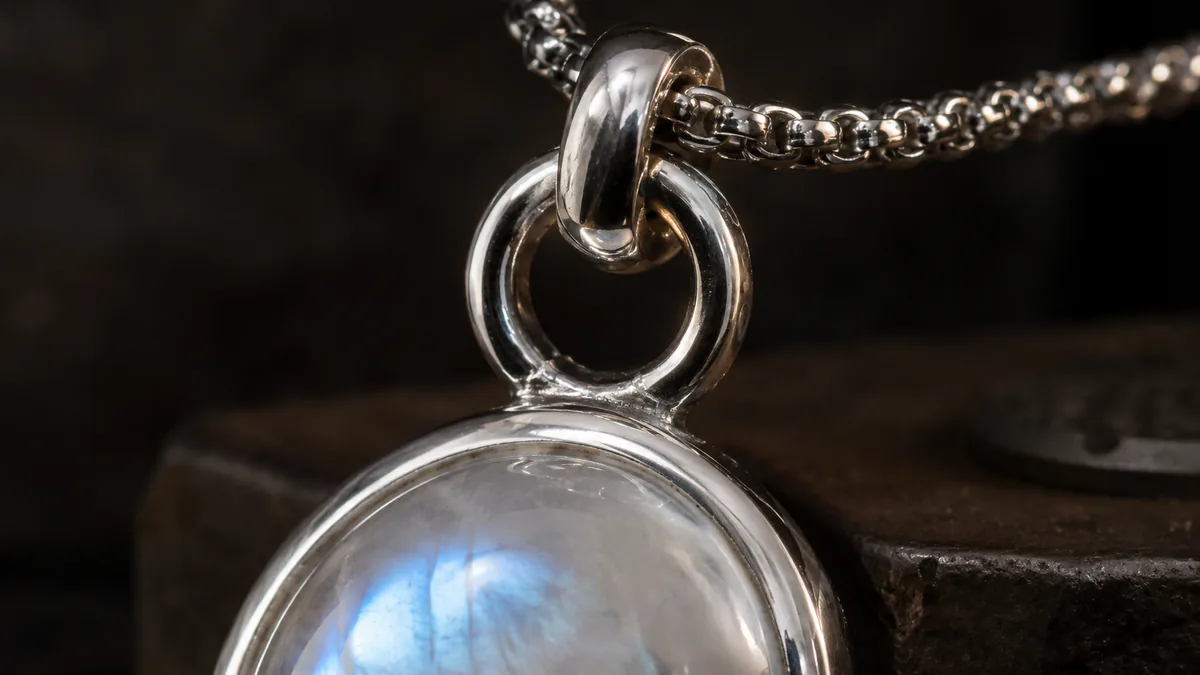
The workshop necklace, and the cabochons I set
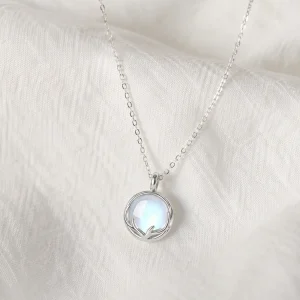
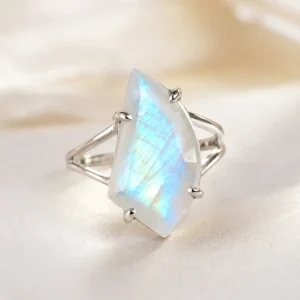
Which necklace with which neckline
A question of looks, but also of the survival of the piece: a pendant that rubs constantly against fabric loses its polish, and the veil is read through the polished surface.
Round neck, T-shirt. 42 to 45 cm, the stone sits just below the collarbone, above the fabric. It is the simplest combination.
V-neck, low neckline. 45 to 50 cm, so the pendant stays inside the opening rather than on the edge of the fabric, where it catches.
Polo neck, heavy jumper. 50 to 60 cm, over the garment. Watch out for wool: a cabochon resting permanently against knitwear dulls faster than you would think.
Buttoned shirt. The pendant goes underneath, and it is the one case where I recommend a slightly longer chain so it does not ride up into the collar.
Scarves and shawls. That is where chains break. A scarf you pull off tugs at the necklace without your realizing it. Take off the necklace or the scarf, but not both together in one movement.
Layering several chains
Layered chains are everywhere, and they raise two distinct problems.
Tangling. Two chains of lengths that are too close twist into each other all day. Allow at least 5 cm between two lengths, more if the pendants are bulky.
Hardness. This is the point that concerns moonstone directly. A quartz, amethyst or garnet pendant, all at 7 and above on the Mohs scale, scratches a moonstone cabochon by simple rubbing. Metals, gold and silver, sit around 2.5 or 3 and present no danger at all.
The rule is the same as at the wrist: nothing harder than moonstone should touch it. If you layer, space the lengths far enough apart that the two pendants never meet. The subject is covered on the bracelet side in which wrist to wear a moonstone bracelet on and on the stone side in which stone to pair it with.
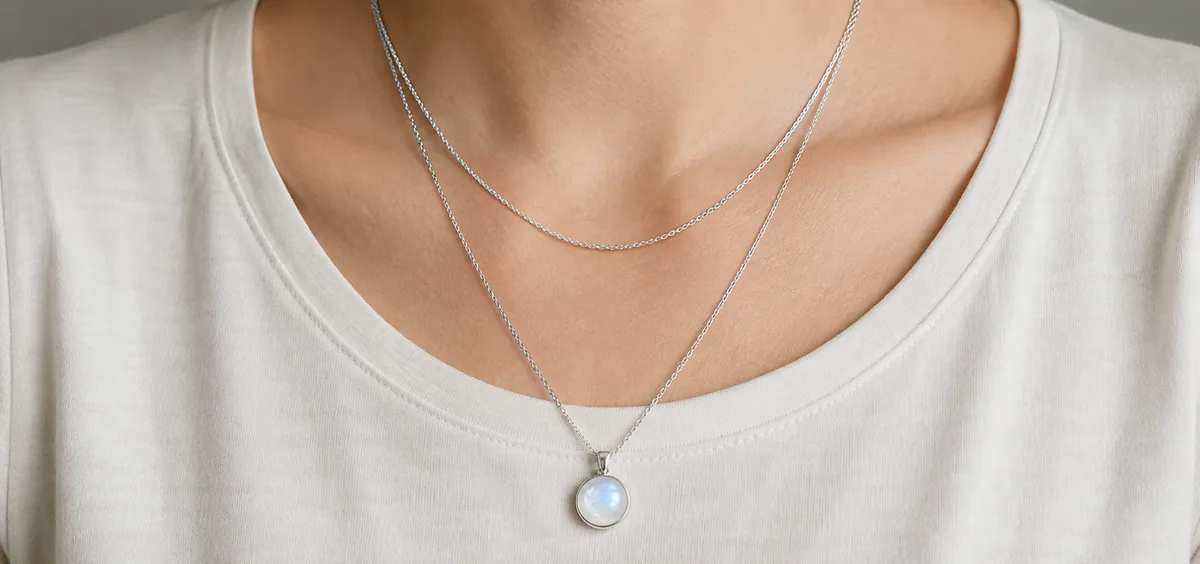
The easiest piece to give
If you are giving a gift and hesitating between the families, this is the one to choose, for three concrete reasons.
No size to know. That is the first problem with a gift of jewellery, and it disappears completely. At most you have to choose a length, and 42 to 45 cm suits almost everyone.
No social code. A ring is interpreted, a pendant is not. You can give one to a friend, to your mother, to a partner, without the gesture carrying a message you did not intend.
No constraint from the job. A ring is a bad idea for anyone who works with their hands; a pendant can be worn in almost any situation, manual trades included.
The one real trap is length for men: the reference is closer to 50 cm for a man against 42 to 45 cm for a woman, and being ten centimeters out shows immediately. Occasions and the words that go with them are in giving moonstone as a gift, and the men's case in moonstone for men.
What ruins a pendant
Four habits, and each fits in one sentence.
Last on, first off. The necklace goes on after the cream, the perfume and above all the hairspray. It is the family of jewellery most exposed to hair products, since it sits right under the head, and those are what tarnish silver and clog the bezel.
Take it off over a soft surface. A bed, a towel. Never over a sink or a tiled floor: that is where most pendant cabochons break.
Do not sleep in it. A chain twists, catches under a shoulder and breaks at a link, often without the stone being found in the morning. The subject is covered in can you sleep with moonstone.
Store it hanging or flat, never in a ball. A chain put away folded knots itself and wears at the same points. Cleaning is done with lukewarm water and mild soap, with a very soft brush, and never with ultrasound: see how to clean a moonstone jewel.
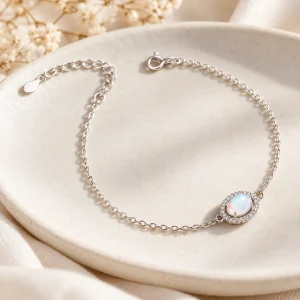
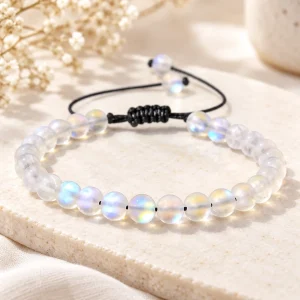
What can also be given without knowing any size
Frequently asked questions
What is the meaning of a moonstone necklace?
Tradition assigns the stone softness, intuition and new beginnings, and the necklace adds the idea of a jewel worn close to the heart. These are recent attributions, spread from the 1970s onward. Its concrete particularity is something else: it is the only jewel its wearer does not see.
Which chain length should I choose?
42 to 45 cm is the most versatile length: the pendant falls just below the collarbone and works with almost anything. Allow 50 cm to wear over a jumper or for a man, 55 to 60 cm over a low neckline, and 70 cm and up for a long chain.
Why is it said to be worn close to the heart?
Because a pendant rests on the sternum, which is true and implies nothing more, and because the chakra charts spread since the 1970s assign stones to areas of the body. It is an accurate image and an unproven claim, and I report it as such.
What is a bail and why does it matter?
It is the ring that joins the setting of the stone to the chain, and it is the only element that works without a break. A soldered bail forms a closed circle and holds for years. A simply closed ring spreads open little by little with each snag, and the pendant ends up leaving the chain.
What chain width for a moonstone pendant?
1.2 to 1.5 mm under a bezel-set cabochon. A 0.8 mm chain suits a small charm, not a stone set in a silver bezel. Prefer solid links, cable or box, to hollow or snake chains.
Can it be worn every day?
Yes, it is even the family of jewellery that suits this stone best, along with earrings: a pendant takes no head-on impact. Take it off to sleep, to shower and for sport, and always remove it over a soft surface.
Can several chains be layered?
Yes, with at least 5 cm between the lengths to avoid tangling. Avoid letting a second pendant in quartz, amethyst or garnet touch the moonstone: those stones are at 7 and above on the Mohs scale and scratch it by rubbing.
Is it a good gift?
It is the safest of all. No size to know, no social code like the one a ring carries, and no constraint from the job. The one trap is length: allow closer to 50 cm for a man against 42 to 45 cm for a woman.
Where to go next
This page covers the necklace and the pendant. For the rest:
- The other jewellery: the ring, the bracelet and the wrist, earrings.
- Wearing and protecting: how to wear it day to day, is it fragile, cleaning it, sleeping in it.
- The meaning: the meaning of the stone, moonstone and the chakras, the myths and legends.
- Choosing and giving: colours and varieties, judging quality, where to buy it, giving moonstone as a gift.
- The big picture: the complete guide.
On the workshop side, I have only one necklace in the catalog for now, in the necklace collection. The rest of what I make is in rings and bracelets. A question about a chain or a bail, even one bought elsewhere? Write to me, I am glad to take a look.
My sources
The hardness of 6 to 6.5, the perfect cleavage, the comparative hardnesses of quartz and precious metals and the cleaning prohibitions follow the public data sheets of the GIA, of Mindat and of the International Gem Society.
Chain lengths, link widths and clasp reference points are trade and workshop conventions, not published standards. I give them because they work, and I say so rather than dressing them up as an official measurement.
The symbolic attributions and the chakra charts are reported from the most widely circulated crystal healing books and sites, with their dates where those are known. None has scientific validation and I do not present it as such.
The diagnosis of the bail, the drop over the sink and the clasp that migrates come from my workshop and from the pieces people bring me to repair.
Last updated: 19 August 2026. If you find an error in this article, let me know: I correct it and I note it.
✦ À porter, à offrir
Découvrez mes créations