

Description
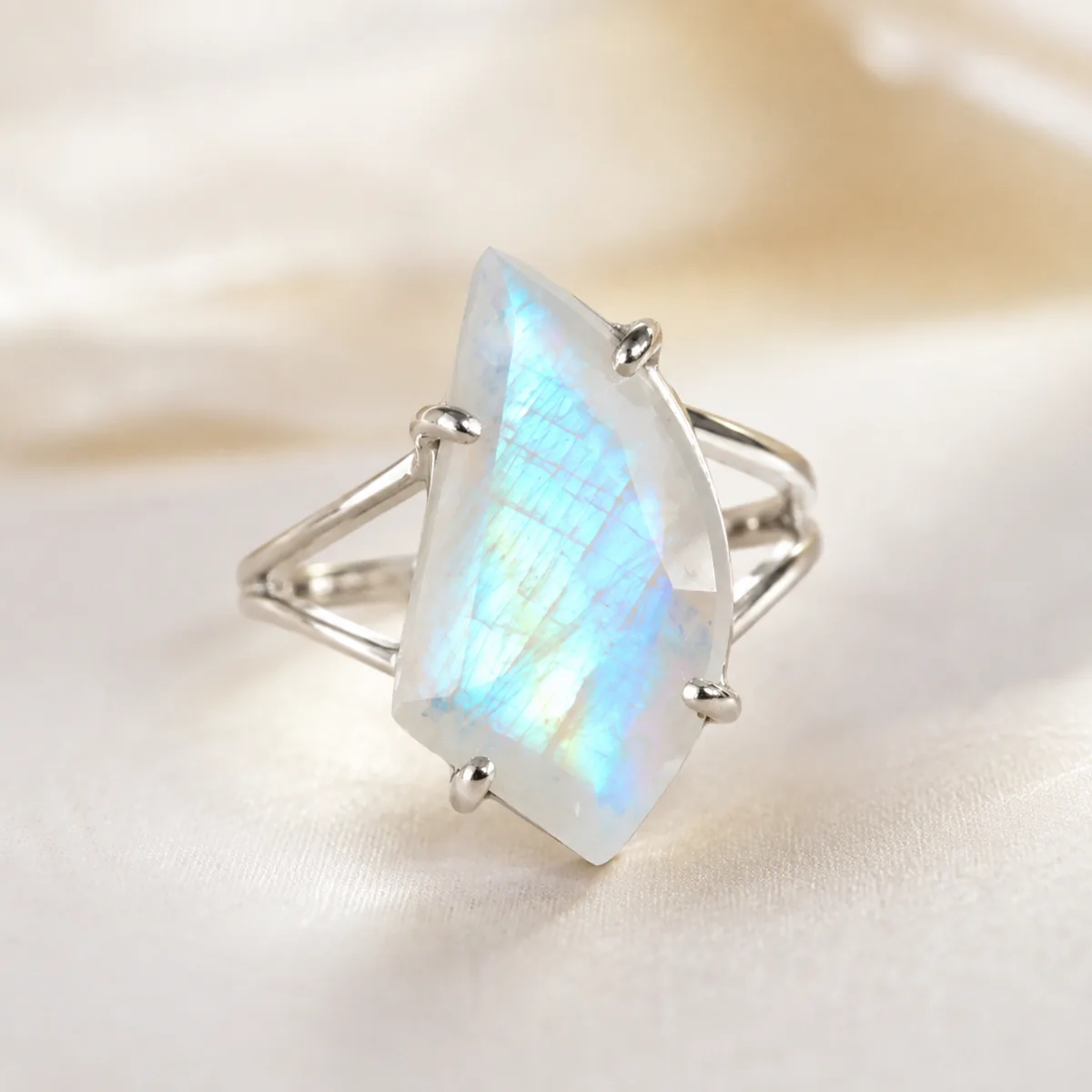
It is the largest stone in the catalogue, the bluest, and the only one cut with facets. A kite shape with sharp edges, crossed by turquoise sheets that tip from one border to the other as the hand turns, held by four claws on a split band. It is the one you cannot wear discreetly.
Why this one can be faceted
Everywhere else in the catalogue I repeat that a moonstone is cut in a dome and never with facets. That is true of adularia, whose sheen is a veil needing a continuous surface to float on: faceting it amounts to cutting it into pieces. But not every moonstone is adularia. The varieties with a strong blue flash most often belong to the plagioclases, like labradorite, and in them the phenomenon is different: light bounces off clean internal planes, and a facet does not cut that, it gives it one more angle to come out by. That is why this one flashes instead of veiling, and it is the only stone in the catalogue where a faceted cut is a coherent choice rather than a mistake.
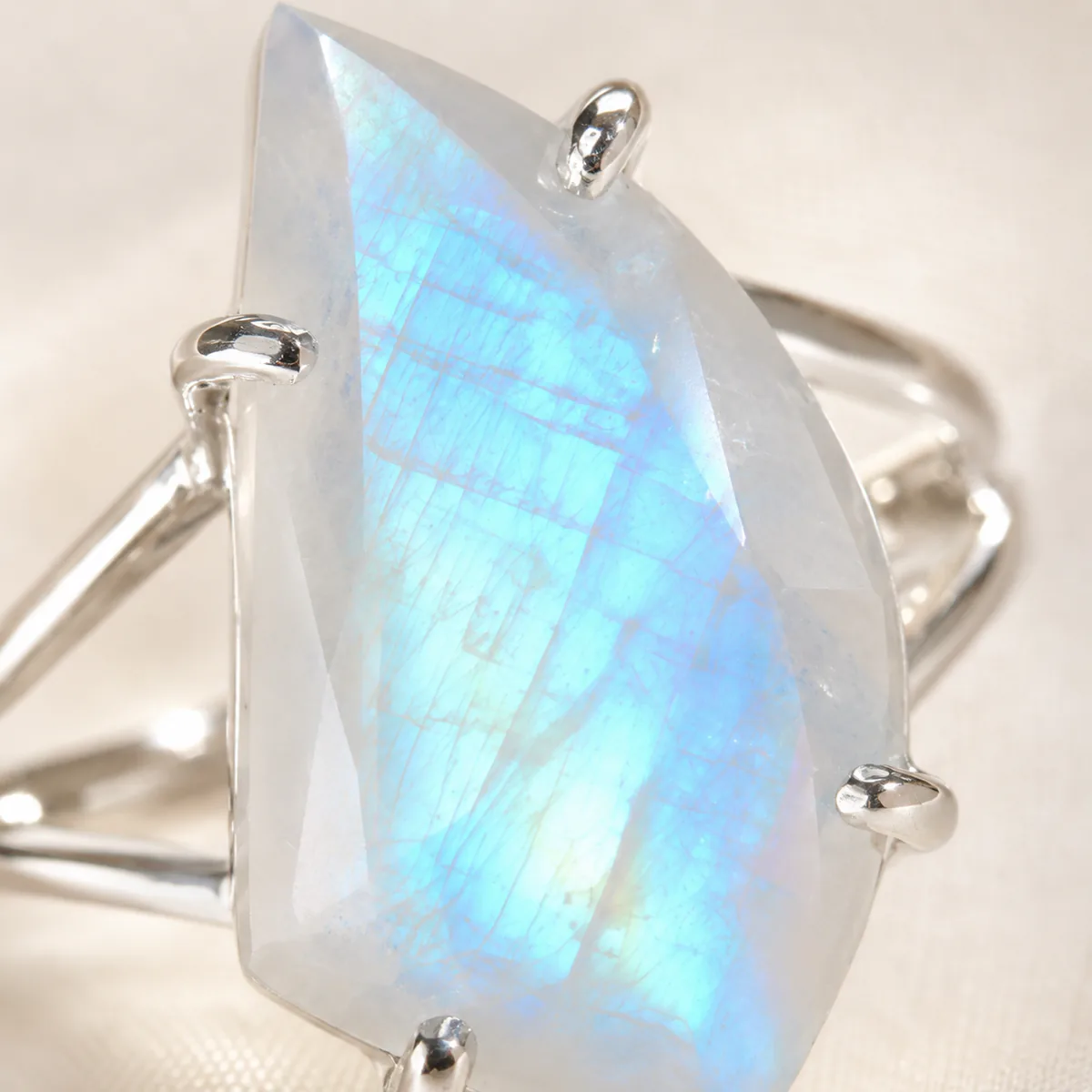
Now look inside the stone, in the light. You will see fine parallel lines crossing in a ladder, like a mesh caught in the mass. The trade calls them centipedes, and they are not faults: they are cleavage planes, which is to say the very structure of the mineral. An imitation never has any, because it is manufactured clean. On this stone they are visible to the naked eye, which is rather rare and rather reassuring. I have set out elsewhere the six criteria I judge a stone by and how to recognise a real one.
Blue and rainbow are often the same stone, sorted
A word on the name. Blue and rainbow very often designate the same stone, sorted: depending on whether the dominant flash leans towards a frank blue or sweeps several colours, the dealer files the parcel on one side or the other. The pure, deep blue, the one that made the stone’s reputation, comes historically from Sri Lanka, and that deposit is running out. Where these stones come from is set out here, and everything the shop offers in rainbow is there.
The reservation, more serious on this one
Now the reservation, and on this ring it is more serious than elsewhere. A cut with sharp angles on a stone with perfect cleavage puts the weak point exactly where the knocks land. Moonstone does not scratch easily, but it chips on impact, and a chip always starts from an edge or a point, never from the middle of a surface. This shape has four of them, and the claws sit on top. It is not a ring for washing up, for sport or for moving house, and if you knock one of its corners against a door frame it will not be bad luck but mechanics. The sizing guide will also save you a return: this mounting is not easily resized.
Crystal healing tradition lends blue stones correspondences distinct from those of the pale varieties, and I have put them apart below. I will go no further: none of it is demonstrated and no piece of jewellery heals anything. Separately, I have gathered what tradition lends this stone.
- The largest stone in the catalogue, faceted kite cut, sheets of blue and turquoise.
- Ladder inclusions visible to the naked eye, what the trade calls centipedes.
- 925 sterling silver, four claws on the points, split band.
- Sizes I½ to T½. Delivered in two weeks, with a cotton pouch, a handwritten note and a care card.
The specifications
- Stone
- Blue moonstone, faceted kite cut
- Mineral species
- Plagioclase, and not orthoclase like adularia
- Inclusions
- Cleavage planes in a ladder, visible and characteristic
- Metal
- 925 sterling silver
- Setting
- Four claws laid on the points, no glue
- Band
- Split
- Sizes
- I½ to T½
- Gender
- Women
- Brand
- Melissa Moon
What I accept losing on this one
Every other ring in the catalogue is bezel set, because on a stone that chips on impact, metal running all the way round absorbs what the stone cannot take. Here that is impossible: a continuous collar on a shape with sharp angles would mean thickening the metal at the points, and that would mask precisely the zones where the flash is widest. I chose to keep the stone entirely visible and to accept that this ring is worn with care. It is the only model where I make that choice, and I would rather write it down than let anyone believe four claws are worth a bezel.
On the centipedes, though, I will not give ground the other way. Many sellers present them as a fault and discount stones that show too many. It is exactly the opposite: a moonstone with not the slightest inclusion, at this price, should make you raise an eyebrow. The rest of the shop is here.
Someone once asked whether I could find the same one without the little lines inside. Yes, but it would no longer be moonstone.
No salt, no ultrasonic tank, no hot water: moonstone is a feldspar, and all three damage it for good. The ultrasonic tank is particularly to be banned here: on a stone with perfect cleavage already run through with internal planes, the vibrations work exactly where they should not. Lukewarm water, a soft cloth, and careful drying around the claws. Run a fingernail over the four points once a year: on an angular cut, a claw that lifts is more serious than elsewhere. The detail is in cleaning a moonstone piece, and the safe methods in caring for it without harming it.