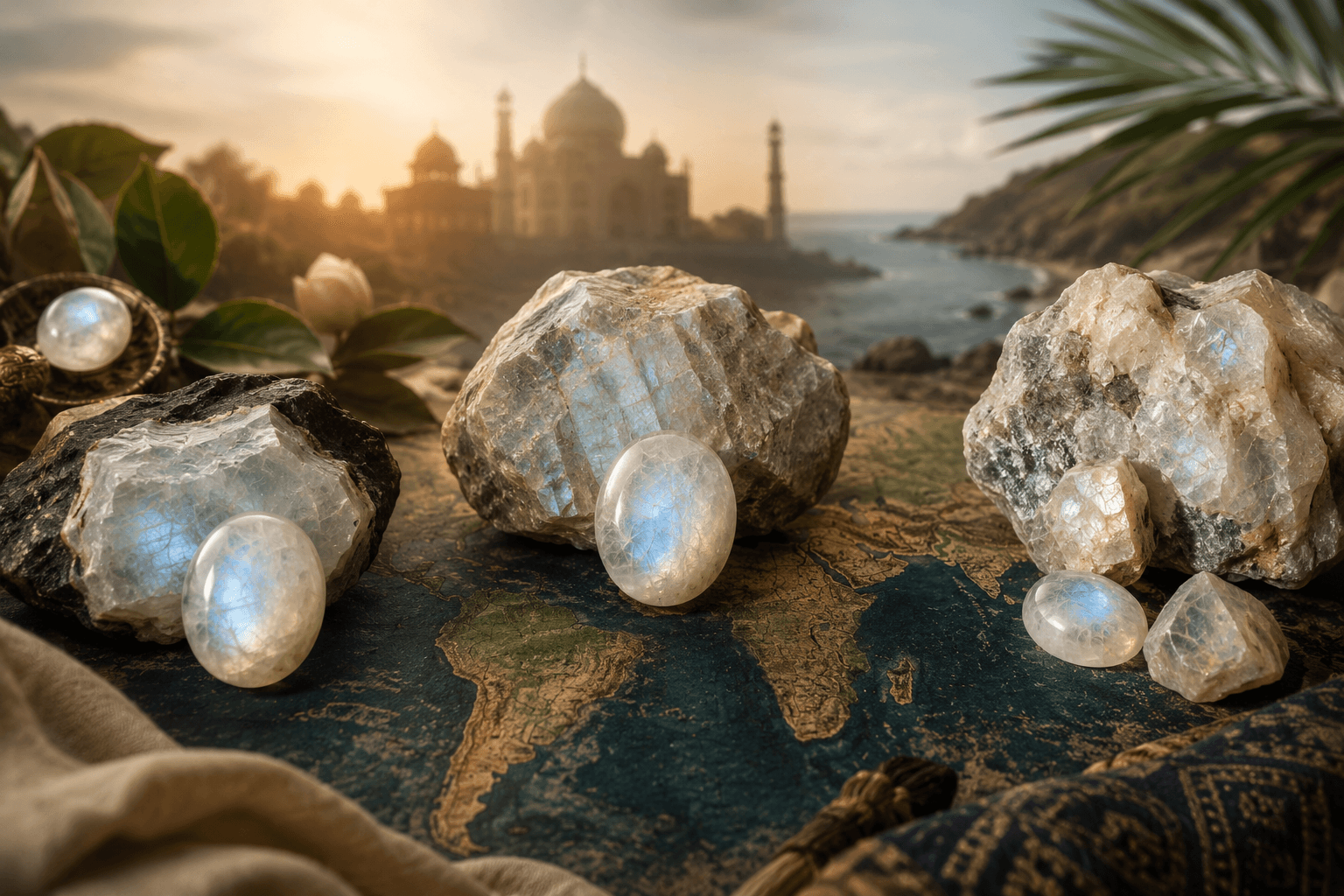
Where Moonstone Comes From: Sri Lanka, India, Madagascar
Three countries supply most of what sells in the US, and they do not supply the same thing. Sri Lanka gives the blues, India gives the volume and the rainbows, Madagascar has been climbing fast for two years. Here is where it is mined, how, and why origin actually changes the quality of the stone.
I work with two cabochon suppliers and I know which regions they buy in. That is not much, and it is already more than most shops can say. This article explains why it is so hard to know more than that, and what origin actually tells you about the stone you are holding.
The short version, if you are in a hurry
- Sri Lanka gives the finest blues, almost all from a single deposit, Meetiyagoda, near Ambalangoda, discovered in 1906.
- It is the country's geological exception: every other Sri Lankan gem comes from alluvial gravel, while moonstone is dug in place, in weathered pegmatite.
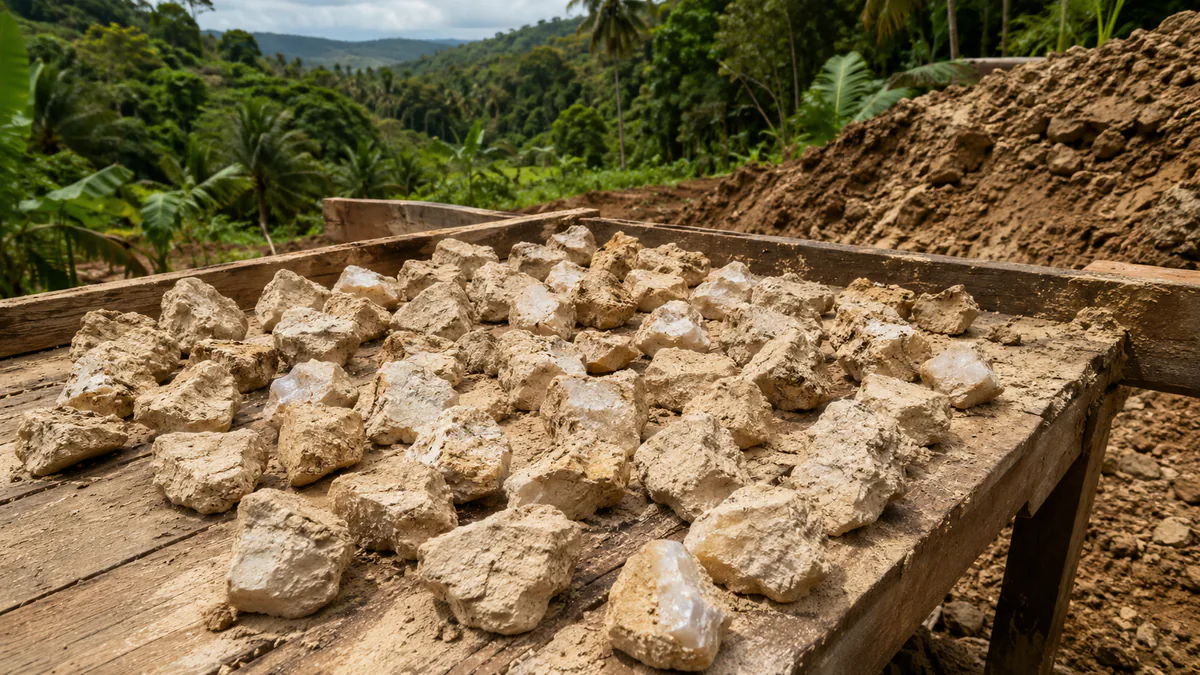
- India supplies the volume, from Bihar to Tamil Nadu, and nearly all of the rainbow stones, which are labradorite, not adularia.
- Madagascar stepped up a level in 2023, with transparent material from Andilamena reported by the GIA, sold at record prices.
- Jaipur cuts almost everything, no matter where the rough came from. The cutting location is not the mining location, and the two get blurred everywhere.
- Origin is a clue, not a guarantee. It describes an average quality. A poor Sri Lankan stone is still worse than a fine Indian one.
- About 80% of coloured stones come from artisanal mines, largely informal. There is no equivalent of the Kimberley Process for coloured stones.
The map, in one minute
Before the detail, here is the overview. The column that matters is the second one: several of these countries produce a stone sold under the name moonstone that is not adularia.
| Country | What it produces | Species |
|---|---|---|
| Sri Lanka | Transparent blues, the world reference | Orthoclase |
| India | The bulk of the volume, rainbow, peach, grey, green | Both |
| Madagascar | Rainbow, and since 2023 a rare transparent variety | Both |
| Tanzania | Light stones, silvery sheen, good clarity | Orthoclase |
| Myanmar | Pronounced sheen, problematic supply chain | Orthoclase |
| United States | Small quantities, subtle sheen | Orthoclase |
| Switzerland, Austria | The original adularia, for collectors | Orthoclase |
"Both" means the country produces both adularia, a potassium feldspar, and labradorite, a plagioclase feldspar sold as rainbow or black moonstone. That is not a deception, it is an established trade usage, but it is worth knowing what you are buying: the full breakdown is in moonstone or labradorite.
Sri Lanka and the Meetiyagoda pits
Sri Lanka is the country of blue moonstone, and that reputation essentially comes down to one village.
Meetiyagoda, in Galle District, on the south coast, near Ambalangoda. The deposit was discovered in 1906 during farming work, and it has dominated the local market ever since. A second area, around Matale, in the central hills, produces larger but less consistent stones.
Here is how it is worked, because it is rarely described. The pit descends through a layer of white kaolin clay, roughly fifteen to twenty meters, until it reaches the weathered surface of a pegmatite. There, miners open horizontal galleries in four directions, locally called donava. The walls are held up with coconut-tree trunks and fern leaves. A pump drains the water, and that is about the only machine on site: all the digging is done by hand, with methods that have not changed much since the eighteenth century.
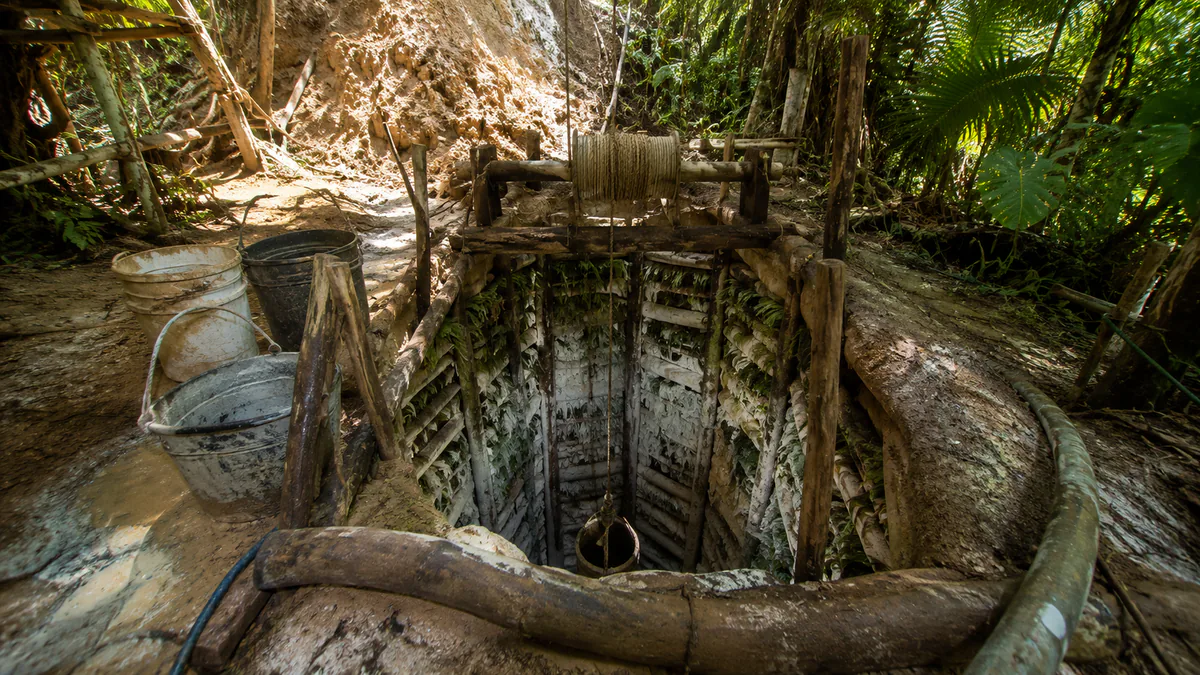
The point I find most interesting, and that I had not read anywhere before looking into it: moonstone is Sri Lanka's geological exception. Every other gem from the country, sapphires above all, comes from alluvial gravel called illam, around Ratnapura: stones torn from their parent rock by erosion, carried by rivers, then washed and sorted in gravel pits. Meetiyagoda moonstone, by contrast, is dug in place, in its own rock. It has never traveled.
That has a concrete consequence: an alluvial stone has taken knocks during its journey, and a stone with perfect cleavage handles knocks poorly. Meetiyagoda rough therefore arrives less fractured than erosion would otherwise leave it.
This deposit is thinning out, and that is a story of its own: it is told in moonstone from Sri Lanka, along with what that does to the price.
How Sri Lanka grades its stones
The country has an official grading scale, published by its export promotion body, and it is worth knowing because it describes exactly what you will see in a display case.
| Category | What it means | Rarity |
|---|---|---|
| Blue | Blue crystal, blue, cloudy blue | Rare |
| Semi-blue | Superior semi-blue, normal, cloudy | Common |
| White | White crystal, silvery, pearly, normal, cloudy | Very common |
Two things to take from this scale. First, the absolute top is a transparent stone with a sky-blue to deep-blue sheen: that is the rare combination, because transparency and sheen strength do not naturally go together. Second, the trade has a word for dull stones, muddy, applied to burnt-out grays, greens and browns. You will never see it on a label, but it exists, and it shapes prices.
The detailed sorting criteria are in judging the quality of a moonstone, and the special case of blue in blue moonstone.
India: the volume, and the rainbows
If Sri Lanka builds the reputation, India builds the market. Most of what is actually worn comes from there.
The deposits are scattered. Bihar, around Patna, gives stones with a strong blue sheen. Tamil Nadu, notably the Coimbatore and Tiruppur districts, produces stones that are often brown or reddish, sometimes white. Karnataka, Jharkhand and Rajasthan round things out. India also supplies nearly the entire rainbow market, along with the soft colours, peach, grey, green, which I cover in the colours and varieties.
A reminder worth repeating: rainbow moonstone is not adularia. It is white labradorite, a plagioclase, and its play of colour does not share the same mechanism as adularescence. Almost every shop gets this wrong. The optical mechanism of real adularescence is explained in the article devoted to it.
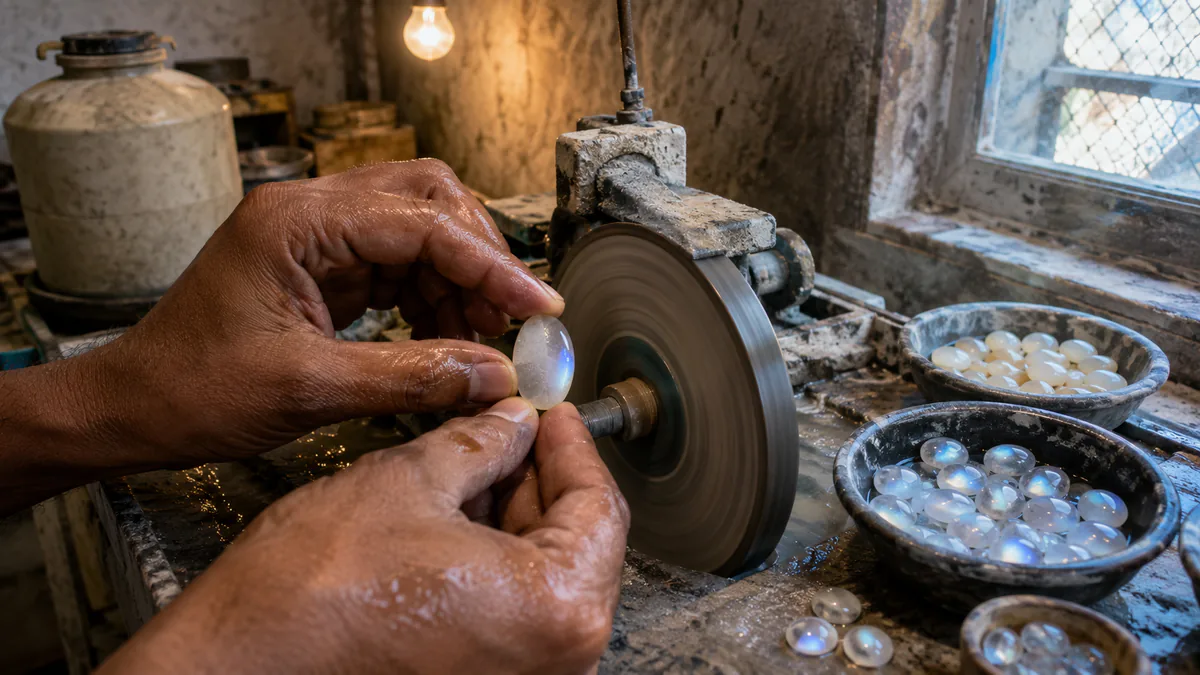
But India's decisive role is not mining, it is industrial. Jaipur cuts coloured stones for the entire world, along with Bangkok. Rough from Madagascar arrives here by the container, so does rough from Tanzania, and it leaves as calibrated cabochons, mixed into lots, sold by weight.
Hence a confusion that lingers everywhere: "Indian moonstone" does not mean the same thing depending on who says it. It can refer to a stone mined in India, or simply a stone cut in India. Many listings mix the two without realizing it, and this is the first place where a claimed origin stops being reliable.
Madagascar, the 2023 surprise
Madagascar is the newcomer to this story, and its rise has been fast.
The country has long produced labradorite, mostly in the south, around Maniry, Bekily and Toliara. A good share of what sells as rainbow moonstone comes from there, and the most spectacular material, with blue and gold flashes, is cut as cabochons. Mining is artisanal, and the rough goes almost entirely to India and Thailand for cutting.
Then, in 2023, a new material emerged from Andilamena, in the Alaotra-Mangoro region, in the northeast. The GIA reported it in its spring 2024 bulletin: a transparent moonstone showing both a clean blue adularescence and an orange flash, which is unusual. Only a few kilos of rough, sold at record per-carat prices. In a rare move for this stone, some of it was faceted rather than cut as cabochons, because the transparency allowed it and faceting showed off the orange flash better.
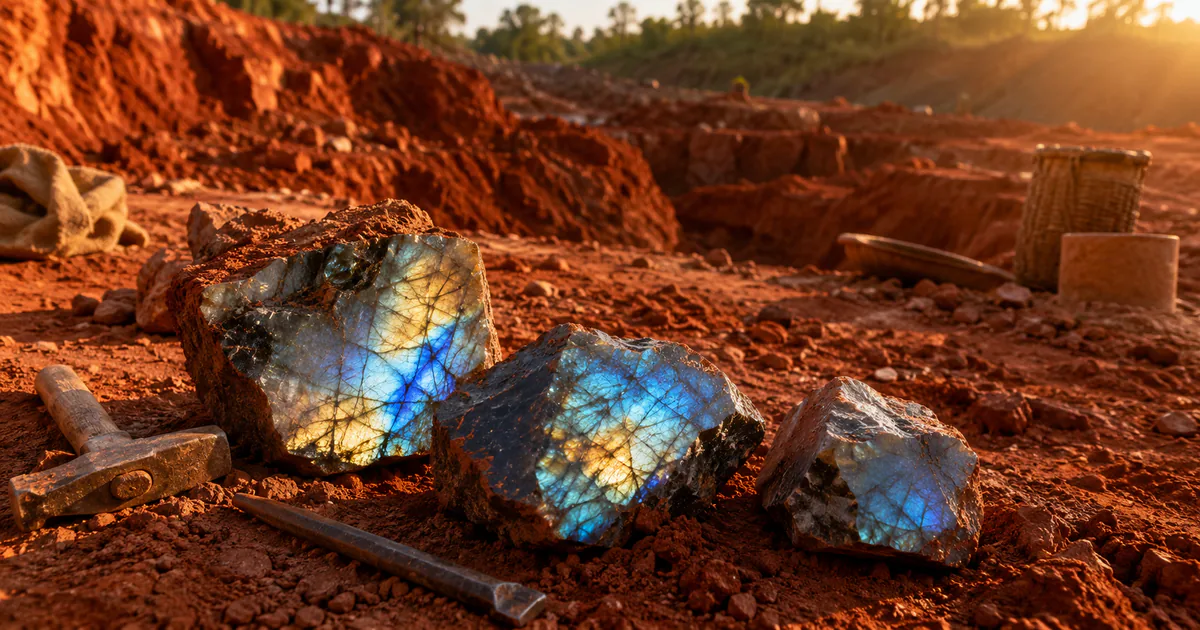
I do not have any of this Andilamena material, and I do not plan to: it sells by the carat at levels that have nothing to do with what I offer. I mention it because it is a sign that a deposit can still emerge out of nowhere, and because it shows how fast an origin can change status.
The other countries, and what they are worth
The rest is marginal in volume, but not all of it is a footnote.
Tanzania has grown in importance in recent years, with good clarity and a silvery-to-white sheen, less dramatic than a blue but very clean. It is a solid, honest origin for an everyday piece.
Myanmar produces stones with a pronounced sheen, and I avoid them. The Burmese gem trade has faced a financing and oversight problem since 2021 that remains unresolved anywhere, and my two suppliers work Sri Lanka, India and Madagascar regardless. I would rather say why an origin is missing than leave it off the table with no explanation.
The United States supplies small quantities, in Virginia, New Mexico and North Carolina, generally with a more subtle sheen. Brazil, Australia and Mexico also appear, without weighing on the market.
And there is the case of the Alps, which is a historical curiosity. It was there, in the Adula massif in Switzerland, that adularia was first described, in 1781. Alpine crystals from hydrothermal fissures are gorgeous and sought after, but by mineral collectors, not jewelers: they are too small, too valuable as specimens, and no one cuts them. The birthplace of the name has never been a supplier.
One last anecdote, and it is telling. In 1970, Florida made moonstone its official state gem, in tribute to the Apollo flights launched from Cape Canaveral. Not a gram of it can be found in Florida, and there is no more of it on the Moon. The subject is covered in moon rock or moonstone.
Why origin changes quality
This is the useful question, and the answer has nothing mystical about it. Origin is not a badge of prestige, it is an indirect description of formation conditions.
Adularescence arises from alternating lamellae of orthoclase and albite, formed as the crystal cools slowly and the two separate. The fineness and regularity of these lamellae decide everything: very fine and regular, they scatter mostly blue and give a sharp, centred veil; thicker or irregular, they give a diffuse milky white. And these conditions, cooling rate, fluid chemistry, duration, are specific to each deposit. A deposit that formed under favorable conditions delivers a higher proportion of fine stones, year after year.
That is why a fine Sri Lankan blue commonly sells for a third to half more than a comparable stone from elsewhere. What you are paying for is not nationality, it is probability. The other pricing criteria are detailed in the price of moonstone.
The honest nuance, now: origin is an average, not a guarantee. Meetiyagoda also produces dull stones, and I have seen Indian cabochons whose veil beat plenty of Sri Lankan ones. If you have to choose between two stones, look at the sheen, the transparency and the centering of the veil, not the country label. The method is in the six quality criteria.
What you can actually know about a stone
Here is the part most shops would rather not write, and it is the one that should interest you the most.
About 80% of the world's coloured stones come from small-scale artisanal mines, often informal, with no registry or invoice at the start of the chain. The stones then pass through a collector, a trader, a cutter, a wholesaler, and at every step lots from different origins get mixed and recalibrated. This is not organized fraud, it is how a fragmented trade normally works.
Second thing to know: there is no equivalent of the Kimberley Process for coloured stones. That scheme only covers rough diamonds. A seller who tells you a moonstone is "Kimberley certified" is either mistaken or misleading you, take your pick.
Third thing: laboratory origin determination does exist, but for ruby, sapphire and emerald, where the price gap between origins justifies the analysis. No one runs it routinely on moonstone, and an expert assessment would cost more than the cabochon itself. That is an economic limit, not a scientific one.
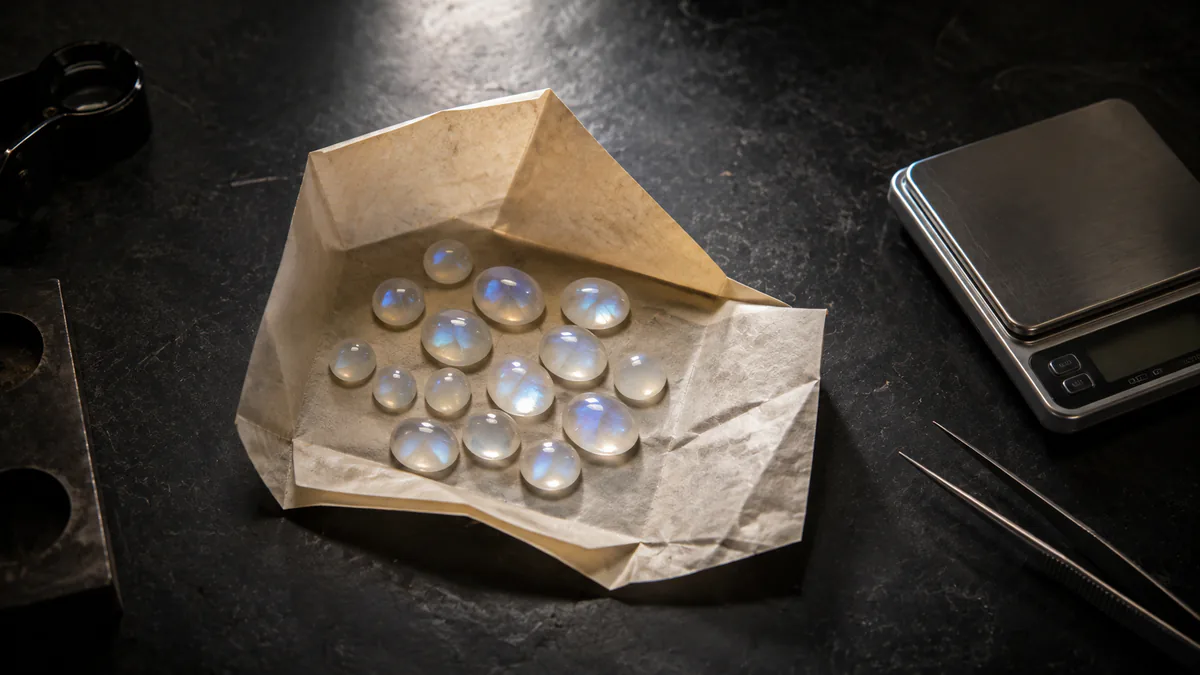
Practical takeaway: be wary of an overly precise origin. A seller who names the exact mine on a thirty-euro cabochon is telling you a story. A seller who says "Sri Lanka, according to my supplier" is telling you the truth about what they actually know. The difference between those two sentences is worth more than any in-house certificate.
Where my stones come from
Since this whole article asks for caution, might as well apply the rule to myself.
I buy my cabochons from two suppliers I know. I know which regions they work in: Sri Lanka for the whites and blues, India and Madagascar for the rainbows and blacks, which are labradorite. I stop there.
I will never tell you a stone comes from a specific pit, because I cannot verify that and I refuse to claim what I cannot verify. What I can do, on the other hand, is name the mineral species on every product page, adularia or labradorite. That is verifiable, it matters more for your jewellery, and almost no one does it.
On raw stones and what cutting changes, see raw or cut moonstone. On treatments a stone may have gone through before arriving, is moonstone treated. And if you want to know how I work, it is all on the about page.
Cabochons chosen one by one, species named on every page




Frequently asked questions
Where does moonstone come from?
Mainly from Sri Lanka, India and Madagascar. Tanzania, Myanmar, the United States, Brazil and Australia supply smaller quantities. Sri Lanka concentrates the finest blues, India the bulk of the volume.
What is the best origin?
Sri Lanka, if you are talking about the odds of finding a fine, transparent blue stone. But that is an average: a poor Sri Lankan stone is still worse than a fine Indian one. The sheen is judged on the stone, not the country.
What is the Meetiyagoda mine?
The main moonstone deposit in Sri Lanka, discovered in 1906 near Ambalangoda, in Galle District. Pits are dug there roughly fifteen to twenty meters through kaolin clay, down to a weathered pegmatite, then horizontal galleries in four directions.
Why is moonstone not alluvial in Sri Lanka?
Because it is mined directly from its parent rock, a pegmatite weathered in place. That is the country's exception: sapphires and most other Sri Lankan gems come from river gravel, the illam, around Ratnapura.
Does rainbow moonstone come from the same deposits?
No, and it is not even the same stone. Rainbow moonstone is white labradorite, produced mainly in India and Madagascar, while blue adularia comes from Sri Lanka. Two species, two geologies, two supply chains.
Can moonstone origin be certified?
Technically yes, in a lab. In practice no: origin determination is reserved for ruby, sapphire and emerald, where the price gap justifies the analysis. On moonstone, the expert assessment would cost more than the stone.
Is there a Kimberley Process for moonstone?
No. The Kimberley Process only covers rough diamonds. No equivalent scheme exists for coloured stones. A "Kimberley certified" moonstone makes no sense.
Why are so many stones cut in India?
Because Jaipur is, along with Bangkok, the world's major cutting centre for coloured stones. Malagasy, Tanzanian or Sri Lankan rough arrives there, comes out calibrated, and lots get mixed together. That is also why "Indian stone" sometimes means mined, sometimes means cut.
Is the Sri Lankan deposit really running out?
Meetiyagoda's yield is declining and fine blues are getting noticeably more expensive. It is a topic that deserves its own article: it is detailed in moonstone from Sri Lanka.
Should you pay more for a claimed origin?
Only if the seller explains where they got the information. An origin claimed with no source, on a stone worth a few dozen euros, is worthless. Look instead at the sheen, the transparency and the centering of the veil.
Where to go next
- The deposits in detail: the Sri Lankan deposit, how the stone forms, moon rock or moonstone.
- What origin changes: the six quality criteria, the price, treatments.
- The varieties: the colours and varieties, the blue, moonstone or labradorite.
- The stone itself: the mineral data sheet, adularescence, recognising a genuine stone.
- The bigger picture: the complete guide to moonstone.
The jewellery itself is in the shop. And if you know a deposit I have not mentioned, or you have visited one of these, tell me about it: I still have a lot to learn on this subject.
My sources
For Sri Lanka: the Sri Lanka Export Development Board for the 1906 discovery of the Meetiyagoda deposit, the Matale sectors and the official three-category grading scale. The National Gem and Jewellery Authority for the licensing regime and the artisanal share of mining. Descriptions of pits, donava galleries and coconut-trunk shoring come from field surveys published by Mindat and by visiting gemmologists. The distinction between the alluvial illam of Ratnapura and Meetiyagoda's in-place mining is an established fact in the country's gemmological literature.
For Madagascar: the GIA note published in Gems & Gemology in spring 2024, on the transparent Andilamena material mined in 2023, its orange flash and its faceting. The southern labradorite deposits, Maniry, Bekily and Toliara, are documented by the country's mining directories.
For India: Mindat localities for Bihar, Tamil Nadu and Karnataka, and the GIA study on Jaipur as the world's cutting centre for coloured stones.
For traceability: work by the IGF and Pact on artisanal mining, which puts the share of coloured stones coming from small-scale artisanal mining at around 80%, and the text of the Kimberley Process itself, which only covers rough diamonds.
What I could not source, I did not write. In particular, I give no annual production figures by country: such figures circulate, but none is established on a reliable basis for this stone, and copying them would have been more convenient than honest.
Last updated: August 19, 2026. If you find a mistake in this article, tell me about it: I correct it and I note it.
✦ À porter, à offrir
Découvrez mes créations