Is Moonstone Treated or Enhanced?
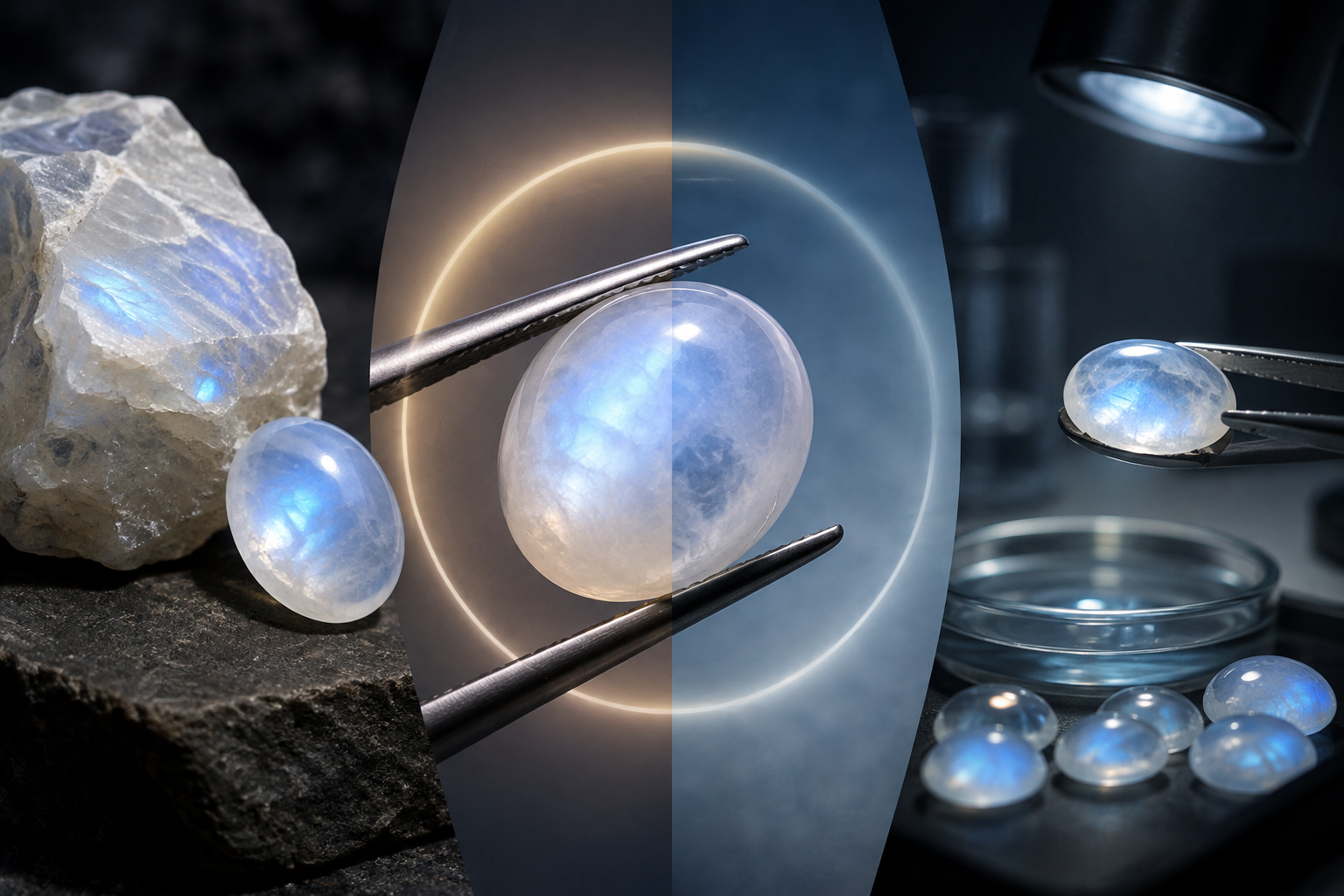
No, and it is one of the few gems you can say that about without qualification: a moonstone is not heated, not dyed, not irradiated. There is nothing to improve, because its sheen comes from an internal structure that no treatment reaches. On the other hand, a good share of the rainbow moonstone sold online is coated quartz, and that is a different problem.
This article follows on from the six authenticity tests and the opalite file. The question of treatment sits between the two: neither a flawless real stone nor a crude fake, but natural material made more saleable.
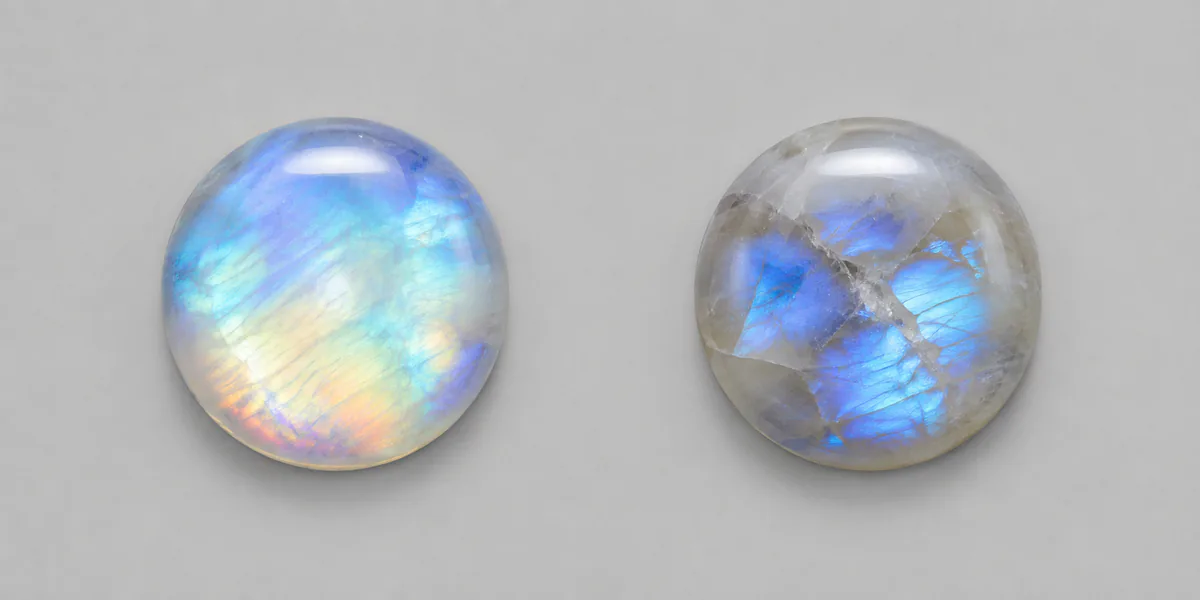
The short version, if you are in a hurry
- Moonstone is not treated. Not heated, not dyed, not irradiated, not oiled. That is an exception in the world of gems.
- Its sheen comes from an internal structure, settled as the crystal cooled. No treatment reaches it.
- The real problem is elsewhere: quartz covered with an iridescent film, sold as rainbow moonstone.
- The film can be recognised by colours that are too bright, too uniform, and present across the whole surface.
- It wears off at the edges, and that shows under a loupe after a few months of wear.
- The doublet exists too: a thin slice of stone glued onto a base. A profile photo unmasks it.
- In France, a treatment has to be declared. Failing to do so counts as a misleading commercial practice.
The answer, and why it is categorical
In the gem trade, the question "is it treated" almost always calls for a qualified answer. One sapphire in two is heated. Most emeralds are oiled. A large share of the citrine on the market is heated amethyst.
On moonstone, the answer is no. There is no common treatment, no established practice, no standard enhancement. An adularia sold today is, barring fraud, exactly what it was coming out of the ground, give or take the cutting and the polish.
That is good news for the buyer, and it is worth knowing why: it is not a matter of the trade's ethics, it is a matter of physics. Nobody treats this stone because it would not work.
Why no treatment works
Let us run through the four great treatments of the gem world, and see what each would do here.
Heating. It changes colour by altering the oxidation state of elements present in the crystal lattice. On a moonstone, the colour that counts is not in the lattice: it is an optical phenomenon produced by internal lamellae. Heating can do nothing about it. Worse: a feldspar with cleavage takes temperature swings very badly, and an attempt would end in a split stone. The mechanism is in adularescence.
Dyeing. It soaks a porous stone in a colorant. A moonstone is not porous, unlike turquoise or an agate: the colorant stays on the surface and leaves with the first cleaning.
Irradiation. It creates colour centres in the lattice. Same obstacle as heating: it would not touch the lamellae, and therefore not the sheen.
Oiling and fracture filling. They hide fractures by filling the gap with a resin or an oil of similar refractive index. Technically possible on a fractured stone, but of no commercial interest: moonstone is worth too little, fine blues aside, to justify the operation.
What these four failures have in common fits into one sentence: what makes this stone valuable is an internal nanometre structure, not a chemical colour. And a structure cannot be retouched.
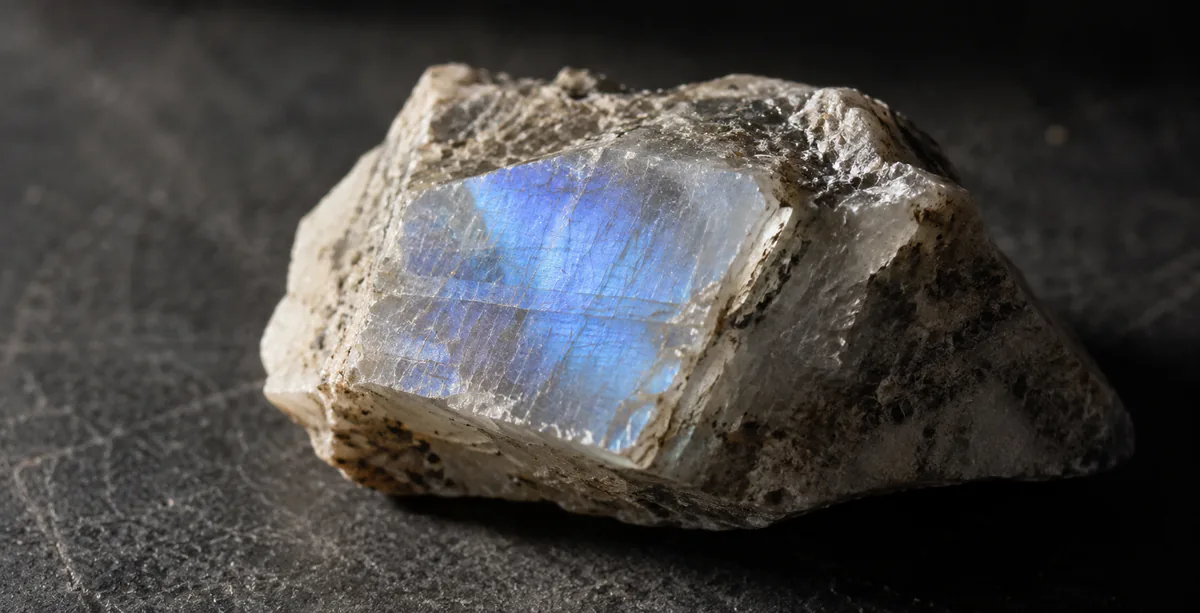
Coated quartz, the real subject of this page
Since the stone itself cannot be treated, the market did something else: it treated another stone to make it look like this one.
The process is industrial and goes by several names, among them aura coating and vacuum deposition. Cabochons of quartz, colourless and cheap, are placed in a chamber where an extremely thin metallic layer is vaporized onto them, often titanium- or gold-based. That layer diffracts light and produces a spectacular iridescence, leaning towards pink, green and blue.
The result looks, from a distance and in a photo, like a rainbow moonstone. Enormous quantities are sold under that name, as well as under the labels aura stone, angel aura, titanium quartz and synthetic fire opal.
What it is not. It is not a moonstone, it is not a labradorite, and it is not a natural phenomenon. It is quartz plus a film. Real rainbow moonstone is a labradorite, a feldspar, whose flashes come from internal lamellae: the subject is covered in moonstone or labradorite.
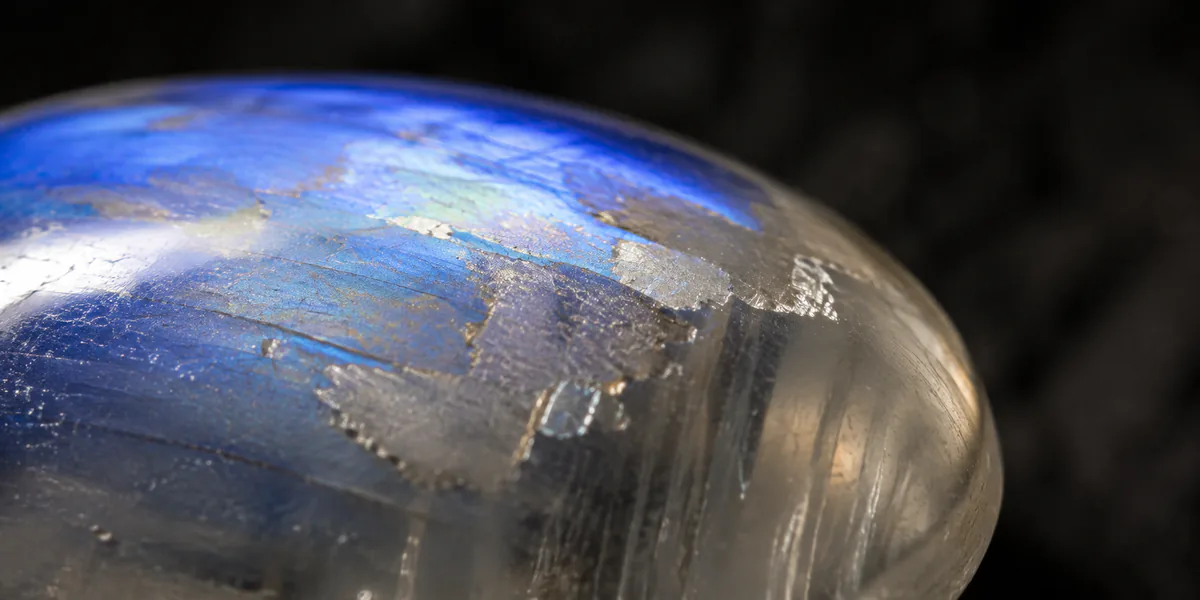
And the flaw that condemns the process: the film is on the surface, so it wears off. On a ring in wear it starts leaving the edges after a few months, revealing the colourless quartz underneath. A real stone, by contrast, does not lose its colour: its sheen is on the inside.
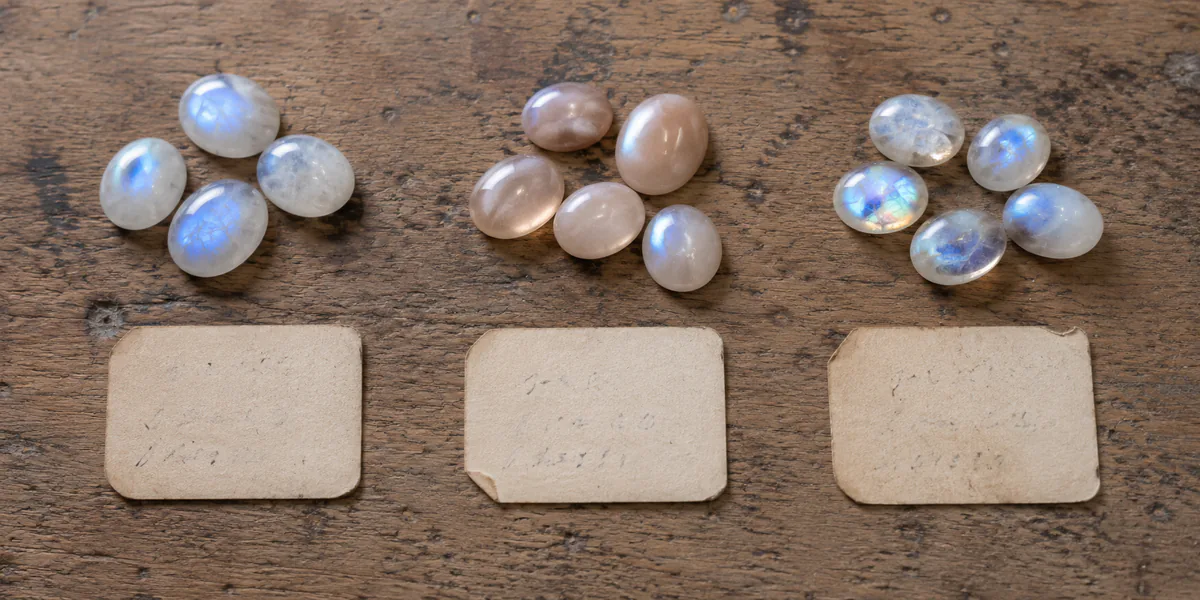
Stones whose sheen comes from the inside
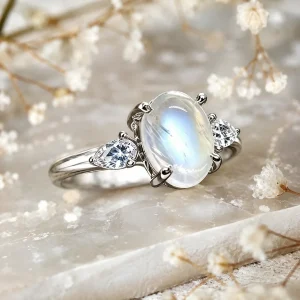
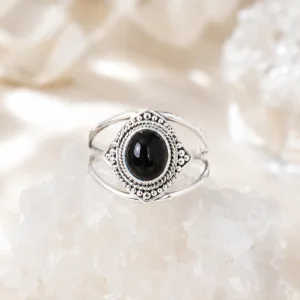
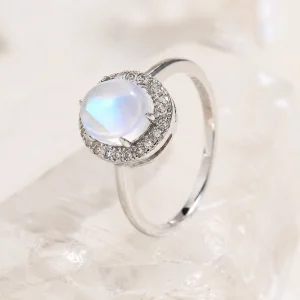
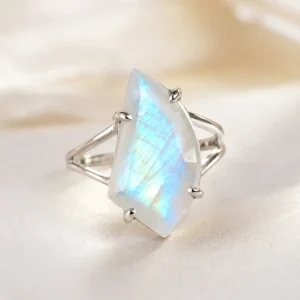
Recognising an iridescent film
Five signs, from the simplest to the most technical. The first two are almost always enough.
1. The colours are too bright. A labradorite shows blues, greens and sometimes golds, but matte and a little muted. An iridescent film gives saturated pinks, purples and turquoises, almost fluorescent. If it looks like a soap bubble, it is one.
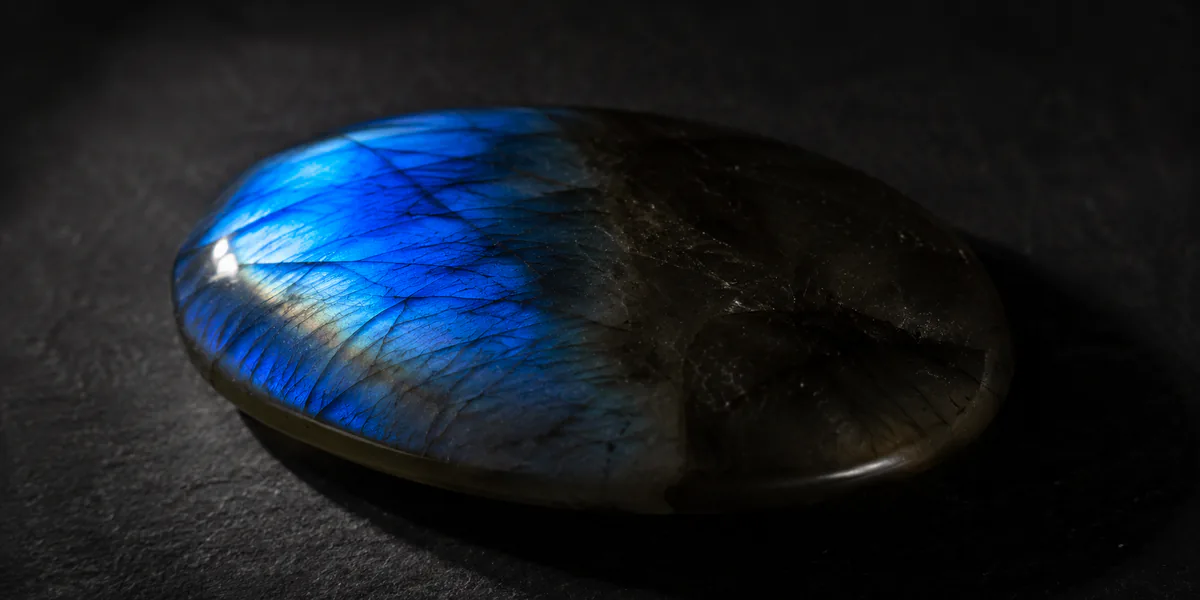
2. The iridescence covers the whole surface. This is the most reliable sign. On a real labradorite the flash appears in patches and fades elsewhere: part of the stone stays dark while another lights up. A film colours uniformly from edge to edge, at every angle.
3. The pattern follows the surface, not the structure. Tilt the stone: on a labradorite the coloured patches appear and disappear according to the internal orientation of the crystal. On coated quartz the iridescence slides along the dome, like a reflection on a windowpane.
4. Look for wear at the edges. Under a 10x loupe, on a piece that has been worn, the film is often missing at the edges, the corners and the points of contact with the setting. The colourless quartz shows through.
5. Look at the back. Many of these cabochons are coated only on the dome, to save money. Turn the stone over, if the setting allows: a perfectly colourless underside beneath an iridescent top settles the question.
The six general authenticity tests, centipedes and bubbles included, are in how to recognise genuine moonstone.
The other manipulations you will come across
Three practices circulate besides the iridescent film, and they are not of the same nature.
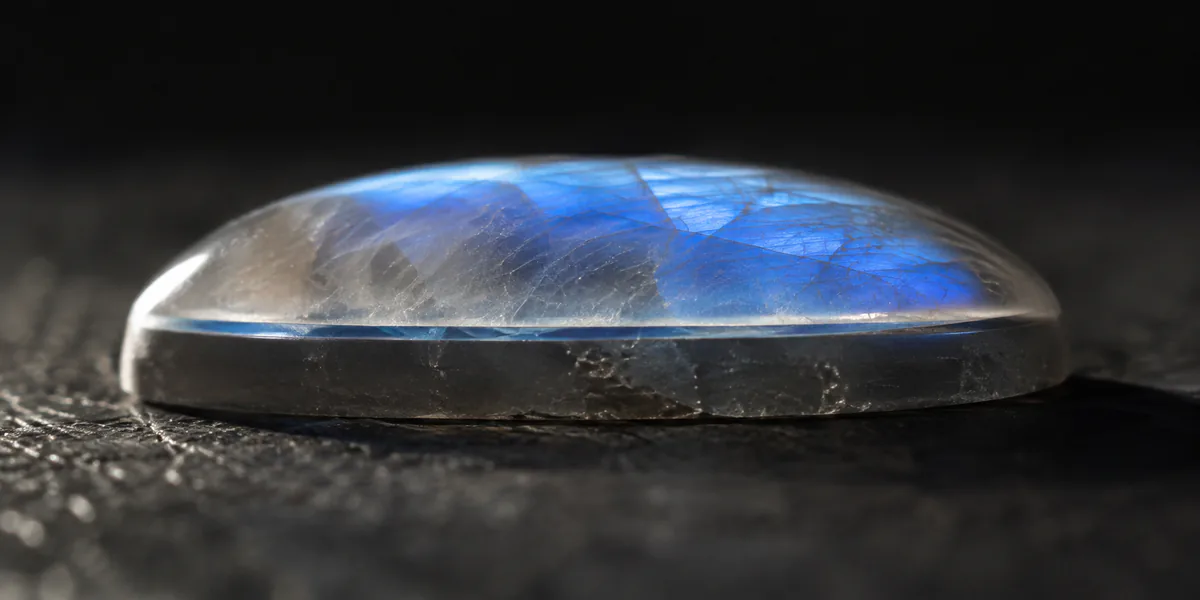
The doublet. A thin slice of real moonstone, glued onto a base of quartz, glass or even resin, to give volume at low cost. Seen from above it is indistinguishable. Seen in profile, a glue line appears. The profile photo is the move that unmasks it, and it is also the one I supply on request for any piece.
The painted back, or dark backing. On cheap black moonstone, a dark backing is sometimes glued under a pale stone to create the contrast that brings out the sheen. That is not a treatment of the stone, it is a manipulation of the mounting, and it shows only on taking the piece apart, so rarely.
Plain aggressive polishing. This is not fraudulent, but it is worth knowing about: a cabochon polished to a near-mirror can give the illusion of a livelier sheen than the material deserves. It does not last: the polish dulls with use, and the real sheen reappears, often a disappointment.
What exists, and what does not
The summary, for deciding quickly.
| Practice | What it would do | Does it exist? |
|---|---|---|
| Heating | Nothing, and the stone risks splitting | No |
| Dyeing | Nothing, the stone is not porous | No |
| Irradiation | Nothing, the sheen is not chemical | No |
| Oiling | It would hide a fracture | Marginal |
| Iridescent film on quartz | An imitation of rainbow moonstone | Very common |
| Doublet | Volume at low cost | Common |
| Glued dark backing | A false contrast | Occasional |
Read the right-hand column: the first three rows are noes, and they are precisely the three treatments people fear. What needs watching is at the bottom of the table, and those are not treatments of the stone at all: they are substitutions and mountings.
What the law requires of a seller
A useful point, because it changes what you can insist on.
In France, a commercial claim has to be accurate and justifiable by whoever makes it. Selling coated quartz under the name moonstone is an inaccurate description, and it can amount to a misleading commercial practice. That is the position of the DGCCRF, the French consumer protection authority, developed in the properties of moonstone.
More broadly, professional practice in gemmology holds that a treatment must be declared. A heated sapphire is sold as a heated sapphire, an oiled emerald as an oiled emerald. There is no shame in it, it is normal, and it shows in the price.
The practical consequence. A seller who writes "aura quartz" or "titanium quartz" is doing the job properly, even if the product is not worth much. A seller who writes "rainbow moonstone" on coated quartz is not, whether they know it or not. And many do not: the resale chain is long and the name degrades at every step, as I explain in moonstone or opalite.
A word on correct naming, because it comes up in every dispute. The trade name "moonstone" covers several mineral species, and that is legitimate: it is an old and recognised usage. What is not legitimate is extending it to material that is not a feldspar. Coated quartz is not a lower-grade variety of moonstone: it is another mineral species, plus a surface deposit. The difference is not one of degree, it is one of kind.
The questions to ask
Three questions, and they work as well in a shop as in a message.
"What is the exact mineral species?" The right answer is "orthoclase, known as adularia" for a white, a blue or a peach, and "labradorite" for a rainbow or a black. If the answer is "quartz", or if there is no answer, you know.
"Has the stone had any surface treatment?" Put that way, it is hard to dodge, and it aims true: it is a surface treatment, not a treatment of the stone. A seller who answers "no treatment" about coated quartz is saying something false, and it can be demonstrated.
"Can you send me a profile photo and one of the underside?" The first unmasks a doublet, the second a film applied only to the dome. A serious seller sends them without argument.
On choosing a seller in general, there is where to buy moonstone jewellery. And once authenticity is settled, quality is judged with the six criteria.
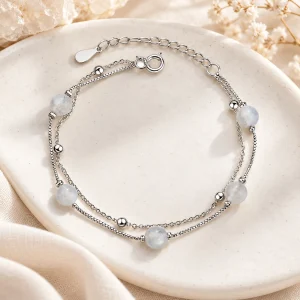
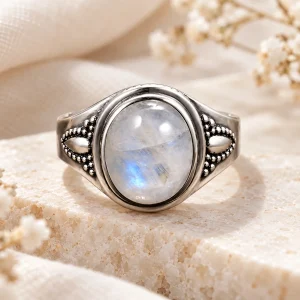
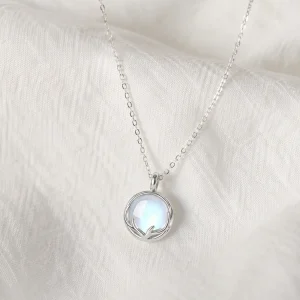
The workshop rings, not one stone treated or coated




Frequently asked questions
Is moonstone treated?
No. Not heated, not dyed, not irradiated. It is an exception in the world of gems, and not out of virtue: its sheen comes from an internal nanometre structure that no treatment reaches.
Why is it not heated like a sapphire?
Because heating changes a chemical colour, and the colour that counts here is an optical phenomenon produced by internal lamellae. On top of that, a feldspar with cleavage takes temperature swings very badly.
What is coated quartz?
A colourless quartz cabochon covered in a vacuum with an extremely thin metallic layer, often titanium-based, which produces a vivid iridescence. It is sold under the names aura stone, titanium quartz, and unfortunately rainbow moonstone.
How do you recognise an iridescent film?
The colours are too bright and cover the whole surface uniformly, whereas a real labradorite shows flashes in patches with dark zones. Look also for wear of the film at the edges, under a loupe.
Does the film really wear off?
Yes, that is its fatal flaw. It is on the surface, so friction takes it off, first at the edges and at the points of contact with the setting, often within a few months of wear. A real stone does not lose its colour.
What is a doublet?
A thin slice of real stone glued onto a base, to give volume at low cost. Invisible from above, it is spotted on a profile photo, where the glue line appears.
Does a treatment have to be declared?
Yes. Professional practice holds that a treatment must be disclosed, and in France a commercial claim has to be accurate. Selling coated quartz under the name of a natural gem can amount to a misleading commercial practice.
Is rainbow moonstone treated?
The real thing, no: it is a natural labradorite whose flashes come from internal lamellae. But a good share of what sells online under that name is coated quartz, and that is the whole subject of this page.
Can a stone be tested in a laboratory?
Technically yes, a gemmological laboratory identifies a surface film without difficulty. In practice the analysis costs more than most cabochons, and nobody runs it routinely on this stone.
Did my seller know it was treated?
Often not. The resale chain is long and the name degrades at every step: plenty of small sellers bought a parcel already labelled "rainbow moonstone". That does not excuse it, but it explains it.
Where to go next
- Checking what you have: the six authenticity tests, opalite, the six quality criteria.
- Species and names: moonstone or labradorite, the colours and varieties, the glossary.
- Understanding the sheen: adularescence, the mineral profile.
- Buying: the price, where to buy, bezel or prongs.
- The whole picture: the complete guide to moonstone.
The jewellery is in the shop, and every listing names the mineral species. If you have a doubt about a piece seen elsewhere, send me the photo, preferably in profile: it is the view that tells you the most and the one nobody ever offers you.
My sources
For the absence of treatment: the GIA pages on moonstone, which mention no common treatment, unlike those on sapphire, emerald or citrine. For the mechanism of the sheen, which explains that absence, the same body of work and Mindat, developed in adularescence.
For metallic vacuum deposition on quartz, this is a documented industrial process, marketed under the trade names aura quartz, titanium quartz and their neighbours. The thinness of the deposit and the fact that it sits on the surface explain how it wears away with friction.
For the legal framework, the position of the DGCCRF, the French consumer protection authority, that any claim must be justified by whoever makes it, and that an inaccurate description can amount to a misleading commercial practice.
One limit I want to flag: oiling appears in the table as marginal and not as non-existent. I have found no source establishing that it is practised on this stone, and I class it that way out of caution, because nothing technically prevents filling a fracture on a valuable fine blue. If anyone has documented a case, I would be glad of it.
Last updated: 19 August 2026. If you find an error in this article, let me know: I correct it and I note it.
✦ À porter, à offrir
Découvrez mes créations