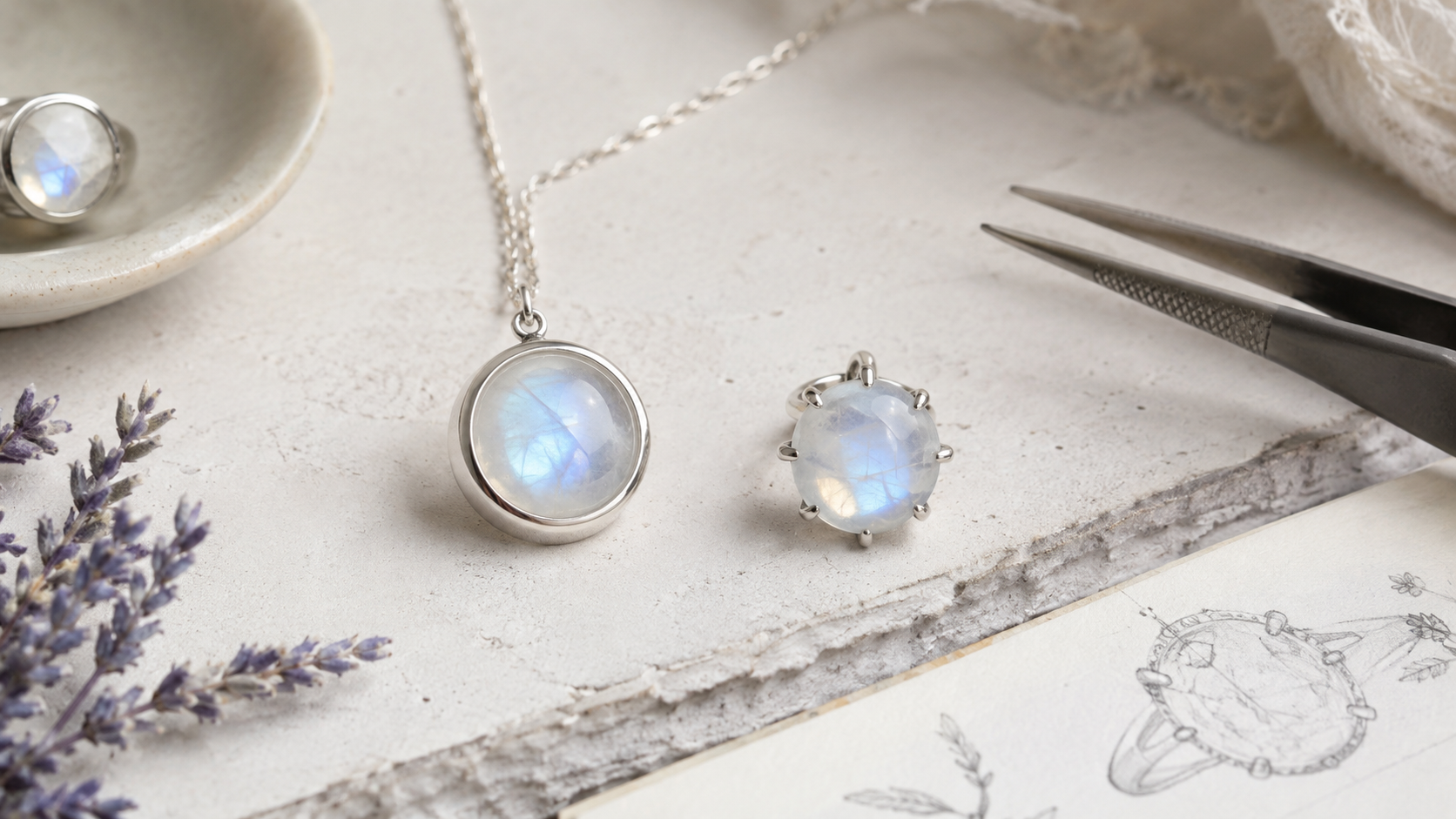
Bezel or Prong: Which Setting for a Moonstone
On most gems this is a question of style. On a moonstone it is a question of survival: a feldspar with perfect cleavage breaks at the girdle, and the girdle is precisely what a bezel protects. Here is what a jeweller looks at, and the three cases where prongs remain the right choice.
I set most of my rings in bezels, and I explain here why rather than presenting it as an aesthetic preference. The fragility that governs everything is detailed in is moonstone fragile.
The short version, if you are in a hurry
- The bezel is the default choice on this stone, and for a mechanical reason, not an aesthetic one.
- A moonstone breaks at the girdle, where the cleavage comes out. The bezel covers exactly that zone.
- Prongs leave the girdle exposed and catch on clothing, which produces the kind of strain that works a cleavage.
- Prongs let more light through and show the stone better. That is a real advantage, not a sales argument.
- On a pendant or earrings, the gap in risk narrows a great deal: the hand is what knocks into things, not the neck.
- A bezel holds water behind the stone, which is its one genuine drawback in care.
- A moving prong is an emergency. It is the only check to run regularly yourself.
Why the question genuinely arises here
On a sapphire, the choice of setting is almost entirely aesthetic. On a moonstone it is not, and here is why.
This stone is a feldspar, hardness 6 to 6.5 on the Mohs scale, which is decent. But the GIA gives it poor toughness and two directions of cleavage, planes of atomic weakness along which the crystal separates cleanly. It does not wear down, it does not scratch easily: it splits all at once.
Now, on a cabochon, those planes come out at the edge. The girdle is the geometric weak point: that is where the material is thinnest, most exposed, and closest to where a cleavage plane emerges. A lateral knock on the girdle is the scenario that breaks the most stones, by a long way.
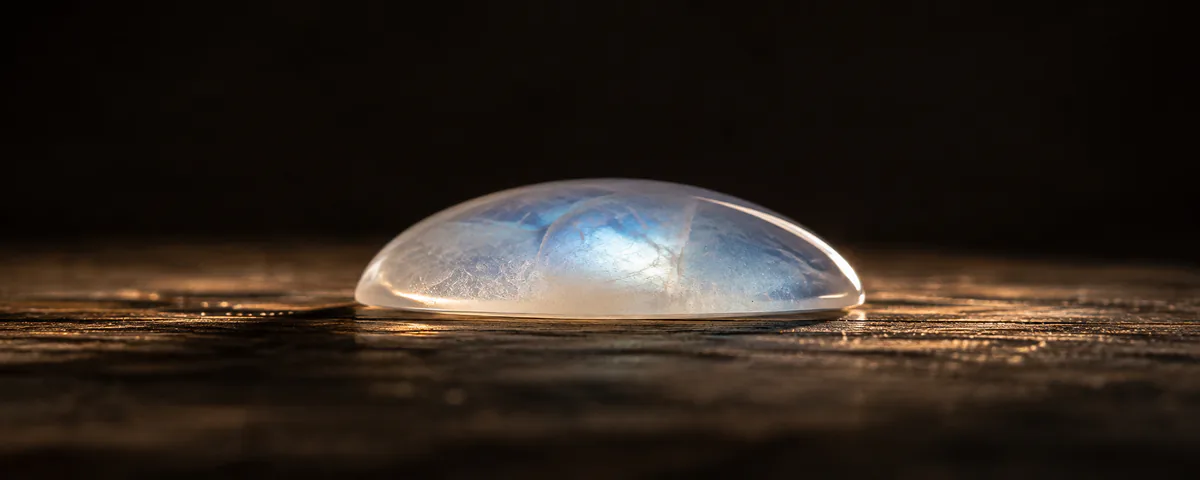
The question of the setting therefore becomes very concrete: does it cover the girdle, yes or no? Everything else follows from that.
The bezel, and what it actually does
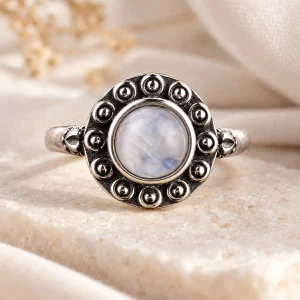
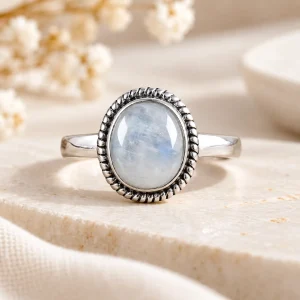
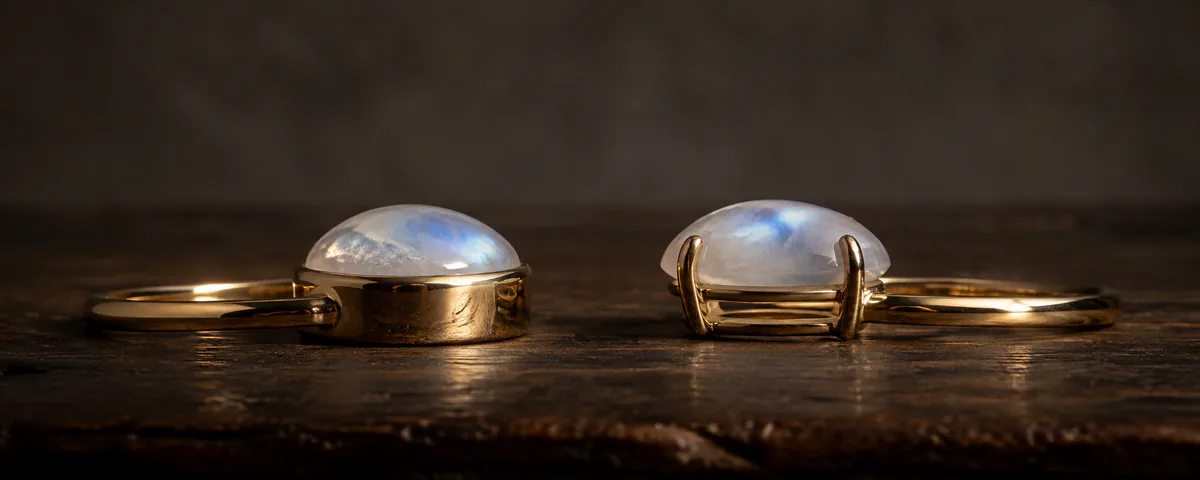
A bezel surrounds the stone with a continuous rim of metal, which rises slightly onto the edge of the dome and holds it by pressure.
What it brings, in order.
It covers the girdle. The metal takes lateral knocks instead of the stone. On a ring, which spends its day banging into door handles and the corners of furniture, that is the most useful protection there is.
It does not catch. A smooth, continuous rim slides over clothing and hair. A bezel-set ring does not pull on a jumper, and therefore never takes the jolt of catching on something.
It holds better over time. Pressure spread around the whole rim does not loosen the way a prong does, being a single point of support that can bend.
It hides a small edge flaw. That is not a sales argument, it is a fact: a slight chip on the girdle disappears under the metal. An honest seller mentions it, and I do.
Its two drawbacks, and they are real. It holds water behind the stone, in the dead space of the cup, which calls for longer drying and explains part of the settings that go black, as in can you put moonstone in water. And it lets less light through from the sides, which genuinely counts on a transparent stone.
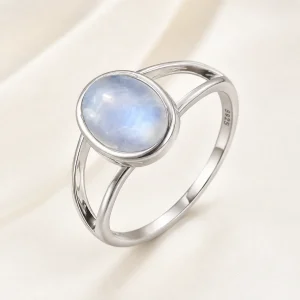
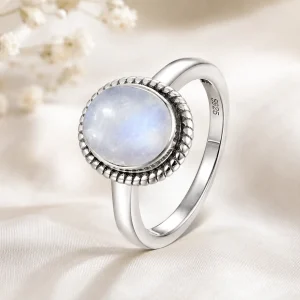
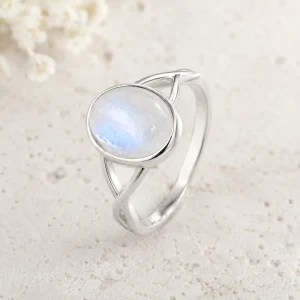
The workshop rings, mostly set in bezels




Prongs, and what they cost
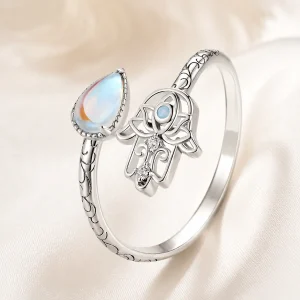
A prong setting holds the stone with three, four or six points of metal folded over the dome.
What it brings. It shows the stone, almost entirely, sides included. It lets light in around the girdle, which makes a transparent cabochon breathe and can widen the spread of the sheen. And it raises the stone, which gives a more classical, more jeweller-like look.
What it costs, on this stone in particular.
The girdle is bare. No metal between it and the world. A lateral knock lands directly on the weakest point of the cabochon.
Prongs catch. On jumpers, scarves, hair, pockets. And catching is not harmless: it applies a sudden pull to a single point, which is exactly the kind of strain that works a cleavage.
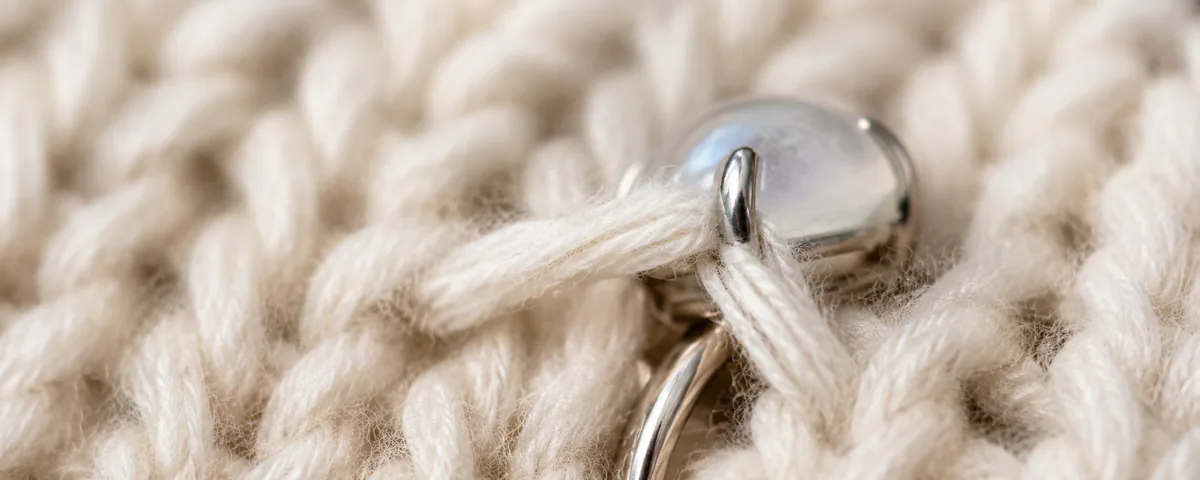
Prongs loosen. The metal fatigues, bends, wears down with friction. A prong that moves means a stone that plays in its seat, and therefore taps with every movement.
None of these three points is specific to moonstone. What is specific is that on a stone with cleavage, each of them can end in a break rather than a scratch.
The two settings side by side
| Criterion | Bezel | Prongs |
|---|---|---|
| Protection of the girdle | The metal covers the whole rim | None |
| Catching | Smooth rim, it slides | Frequent |
| Side light | Blocked by the metal | Free |
| Holding over time | Pressure spread out | To be watched |
| Drying after washing | Dead space behind the stone | Quick |
| Visible surface | The dome alone | Dome and sides |
| Verdict on a ring | Recommended | Reserve it |
Only one row gives prongs a clear advantage, the one on light, and another gives it a relative one, drying. On a ring, that is not enough to make up for the first row.
The other settings you will come across
Two systems turn up besides the two main ones, and it is worth knowing how to recognise them.
The half bezel, or partial channel. The metal covers the girdle on two sides and leaves the other two open. It is an honest compromise: protection on the most exposed zones, light on the rest. You see it mostly on rings with a wide band.
Glue setting. The cabochon is simply glued into a cup, with no mechanical setting at all. It is quick, it is cheap, and it is the most fragile mounting there is: the glue ages, takes soaking badly, and the stone ends up moving. You recognise it by the absence of any rim folded onto the dome. It is not a swindle, it is a price bracket, but it has to show in the price.
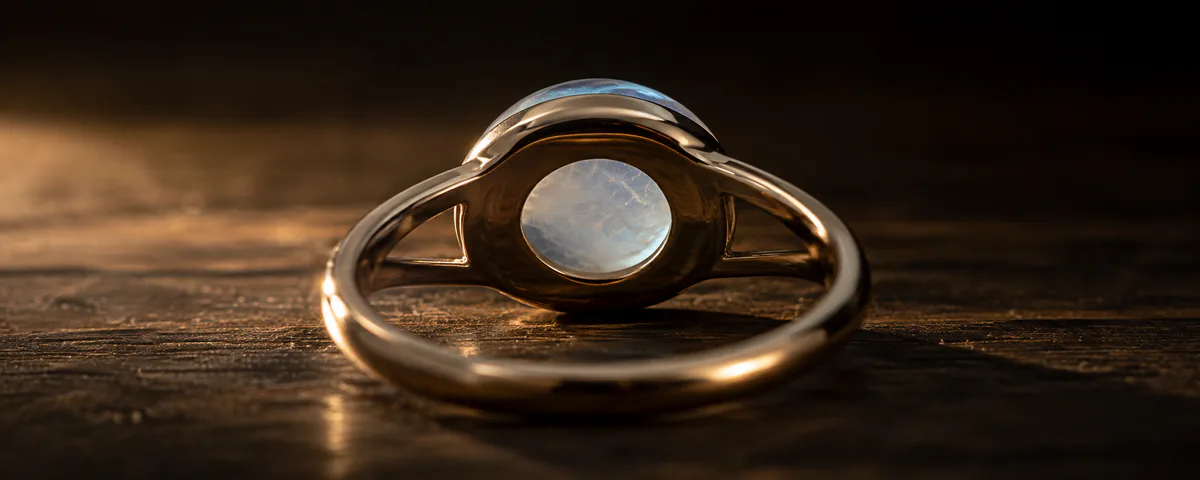
A word on the solid bezel against the open-back bezel. Some bezels are open underneath, a window cut into the bottom of the cup. That is the best of both worlds on a transparent stone: the girdle stays protected, and light enters from below. You can see it by turning the ring over, and it is a sign of careful making.
What the type of piece changes
Everything above holds first of all for rings, and it needs qualifying elsewhere.
The ring. The hand is the part of the body that knocks into things, by a distance. The bezel is the sensible choice there, and it is the only family where I say so this firmly.
The bracelet. Less exposed, but the wrist meets tables and desks. The bezel remains preferable on a bangle; on a bead bracelet the question does not arise, there is no setting.
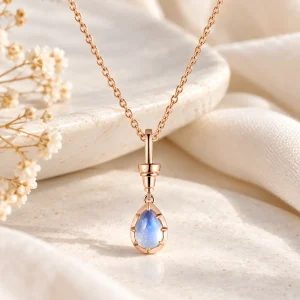
The pendant and the necklace. Almost no risk of impact in normal wear. Prongs are perfectly reasonable there, and they show the stone in the best possible conditions. That is where a fine transparent cabochon deserves prongs.
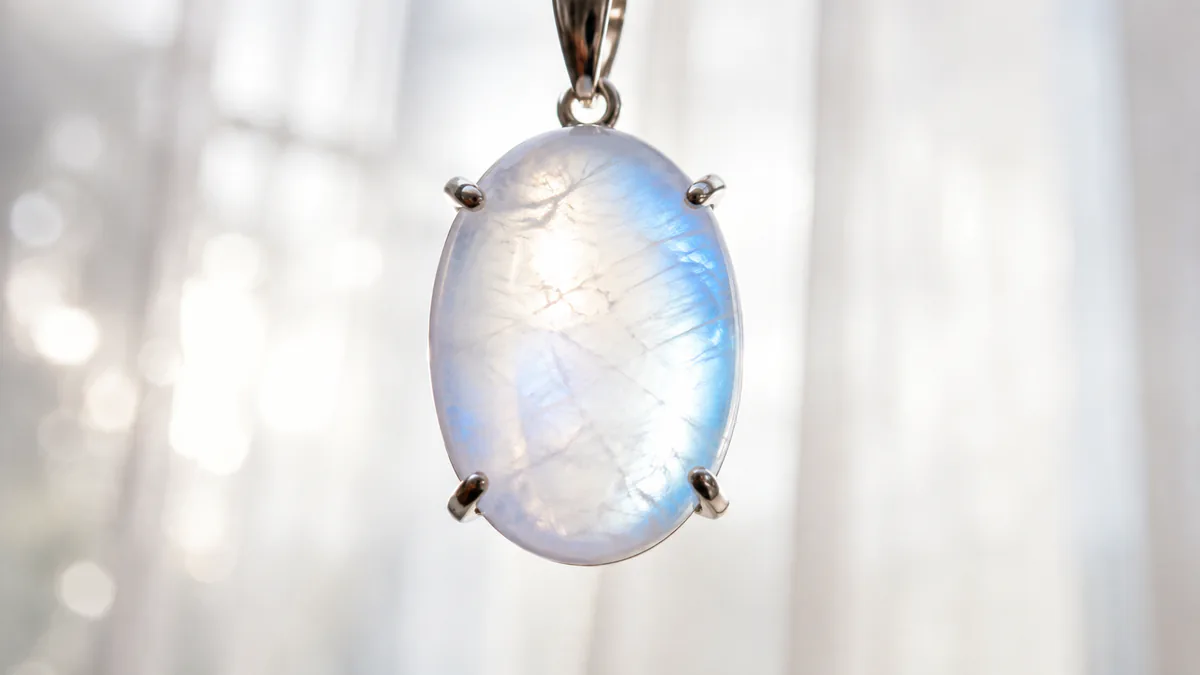
Earrings. Few impacts, but a risk of dropping them while taking them off, and prongs that catch in hair and scarves. A bezel avoids catching, which here is more a comfort than a protection. The subject is covered in how to wear moonstone earrings.
How to wear each family is detailed in how to wear moonstone.
The three cases where I choose prongs
An article that recommended only one setting would be lazy. Here are the situations where I set in prongs without hesitating.
A transparent stone of fine quality. On a limpid cabochon with a well-spread sheen, a bezel blocks the side light and kills part of what you paid for. Prongs let the stone breathe, and the effect is visible. It is the one case where the aesthetic argument plainly wins.
A pendant. The risk of impact is low and the visual gain is real. It is the setting I recommend to anyone who wants to see their stone rather than protect it.
A thick, high-domed stone. A very high cabochon sets badly in a bezel: the metal would have to rise a long way to hold it, and it would eat into the dome. Prongs hold better, and the girdle of a thick cabochon is a little less exposed than a thin one.
In these three cases, the trade-off is a habit to take up: take the piece off for sport, housework and gardening, and check the prongs twice a year.
Checking a setting before you buy
Four moves, three of which can be done on a photo if you are buying online.
Ask for a profile photo. It is the only view that shows whether the metal covers the girdle and how far it rises. A serious seller sends it without argument, and it also serves to spot a doublet, as how to recognise genuine moonstone explains.
Ask for a photo of the underside. It reveals an open-back bezel, a glue setting, or a rushed base. It is the face nobody photographs, and it is often the most informative.
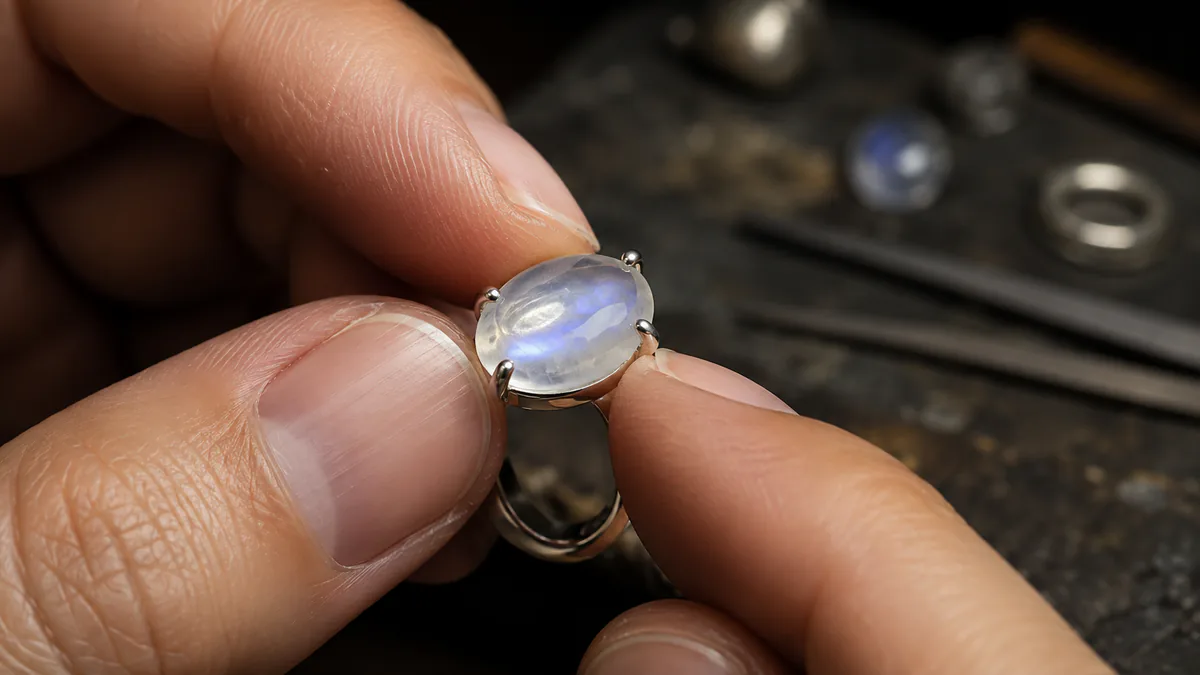
Count the prongs. Four is the norm on an oval cabochon, six on a round one of decent size. Three prongs on a wide stone is not many.
And once the piece has arrived, test it. Run a fingernail gently over each prong: it must not move, nor make the slightest sound. A stone playing in its seat can be heard when you shake the ring gently near your ear. That check takes ten seconds and it is worth repeating twice a year.
On what to look at in the stone itself, independently of the setting, there is the six quality criteria.
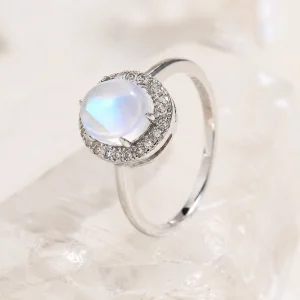
Four different settings, on the same stone
Frequently asked questions
Bezel or prongs for a moonstone?
Bezel on a ring, without hesitation: it covers the girdle, which is the point at which a stone with cleavage breaks. Prongs remain a good choice on a pendant, where the risk of impact is low and the gain in light is real.
Why is the girdle the weak point?
Because that is where the material is thinnest and where the cleavage planes come out. A lateral knock on the girdle is the scenario that breaks the most moonstones, far ahead of the others.
Does a bezel have drawbacks?
Two, and they are real. It holds water in the dead space behind the stone, which calls for longer drying after cleaning. And it blocks the side light, which shows on a transparent cabochon.
What is an open-back bezel?
A bezel whose base is pierced with a window. The girdle stays protected and light enters from below. It is the best compromise on a transparent stone, and a sign of careful making. You can see it by turning the ring over.
How do you tell whether a stone is glued?
No rim of metal folds onto the dome: the stone simply sits in a cup. It is a price bracket, not a swindle, but the glue ages, takes soaking badly, and it has to show in the price.
How many prongs are needed?
Four on an oval cabochon, six on a round one of decent size. Three prongs on a wide stone spread the hold badly and leave a stretch of girdle very exposed.
How do you check that the prongs hold?
Run a fingernail gently over each one: none should move. Shake the ring gently near your ear: a stone playing in its seat can be heard. Repeat that check twice a year.
Can a stone be reset in a bezel?
Yes, a jeweller can reset a cabochon in another mount. Be clear that it must not go through the ultrasonic tank during the operation: that is the default cleaning in most workshops.
Does a bezel protect other stones too?
It protects every stone, but the gap is spectacular here. On a sapphire, a prong that exposes the girdle changes almost nothing. On a feldspar with cleavage, it changes the type of damage: a break instead of a scratch.
A moonstone engagement ring, in which setting?
Bezel, if you are set on it, and knowing that the stone stays risky for a piece worn daily for decades. I have written what needs weighing in a moonstone engagement ring.
Where to go next
- Why the setting matters so much: is it fragile, the mineral profile, adularescence.
- Choosing the piece: the six quality criteria, the price, recognising a genuine stone, the engagement ring.
- Wearing and caring: how to wear it, earrings, cleaning a piece, the question of water.
- The whole picture: the complete guide to moonstone.
The jewellery is in the shop, and every listing states the setting. If you want a piece from the catalogue in the other setting, ask me: it is often possible, and I will tell you frankly whether I think it is a good idea.
My sources
For the properties that underpin the argument: the Moonstone Care and Cleaning page of the GIA, which places the stone between 6 and 6.5 on the Mohs scale, gives it poor toughness and credits it with two directions of cleavage, noting that a cleavage is a direction of atomic weakness that makes a crystal more liable to break.
For the setting techniques, bezel, prongs, half bezel and glue, these are ordinary jewellery-making knowledge, described the same way across the trade.
One limit I want to flag: the ranking in the table and the hierarchy of risks come from the workshop and from what I see coming back for repair, not from a published study. Nobody measures moonstone breakage by type of setting statistically, and if someone did I would be glad of it.
Last updated: 19 August 2026. If you find an error in this article, let me know: I correct it and I note it.
✦ À porter, à offrir
Découvrez mes créations