Adularescence: Where Moonstone's Glow Comes From
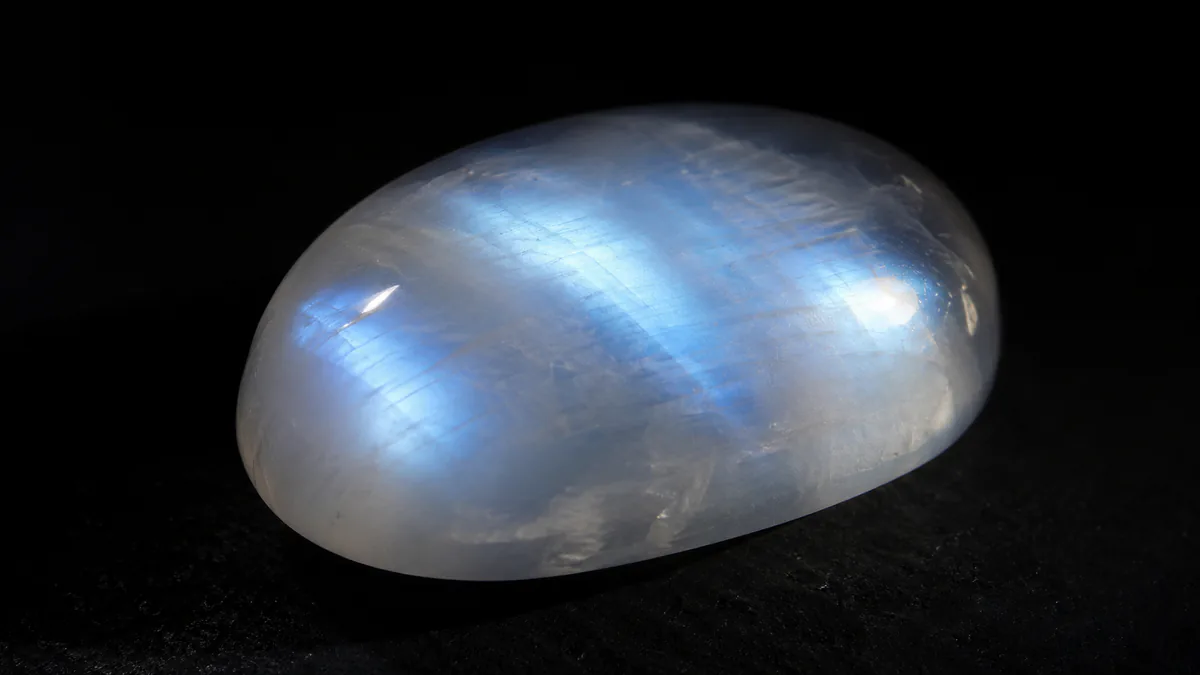
That bluish sheen sliding under the surface is not a reflection, not a colour, and not an inclusion. It is light scattered by microscopic lamellae stacked inside the crystal, whose thickness is close to the wavelength of blue. Here is the full mechanism, and why no imitation can reproduce it.
This is the phenomenon that gives the stone its name, its value and its interest. Everything else on this site follows from it: the price, the authenticity tests, the way it is cut. If you were to read only one technical article in this journal, it would be this one.
The short version, if you are in a hurry
- The word comes from a mountain, not from the Moon. Adularia was described after the Adula massif, in the Swiss Alps.
- The sheen is born of alternating lamellae of orthoclase and albite, stacked inside the crystal.
- Those lamellae come from unmixing. At high temperature the two feldspars coexist; on slow cooling, they separate.
- It is blue when the lamellae are fine, around a few hundred nanometres. Thicker, and the sheen turns milky white.
- It seems to float because it forms deep inside the stone, and not at its surface.
- It moves when you tilt the stone. No imitation can reproduce that movement.
- The lapidary does not create it, they orient it. A botched cut can lose it for good.
What the word actually means
Let us start with the vocabulary, because it is misused everywhere.
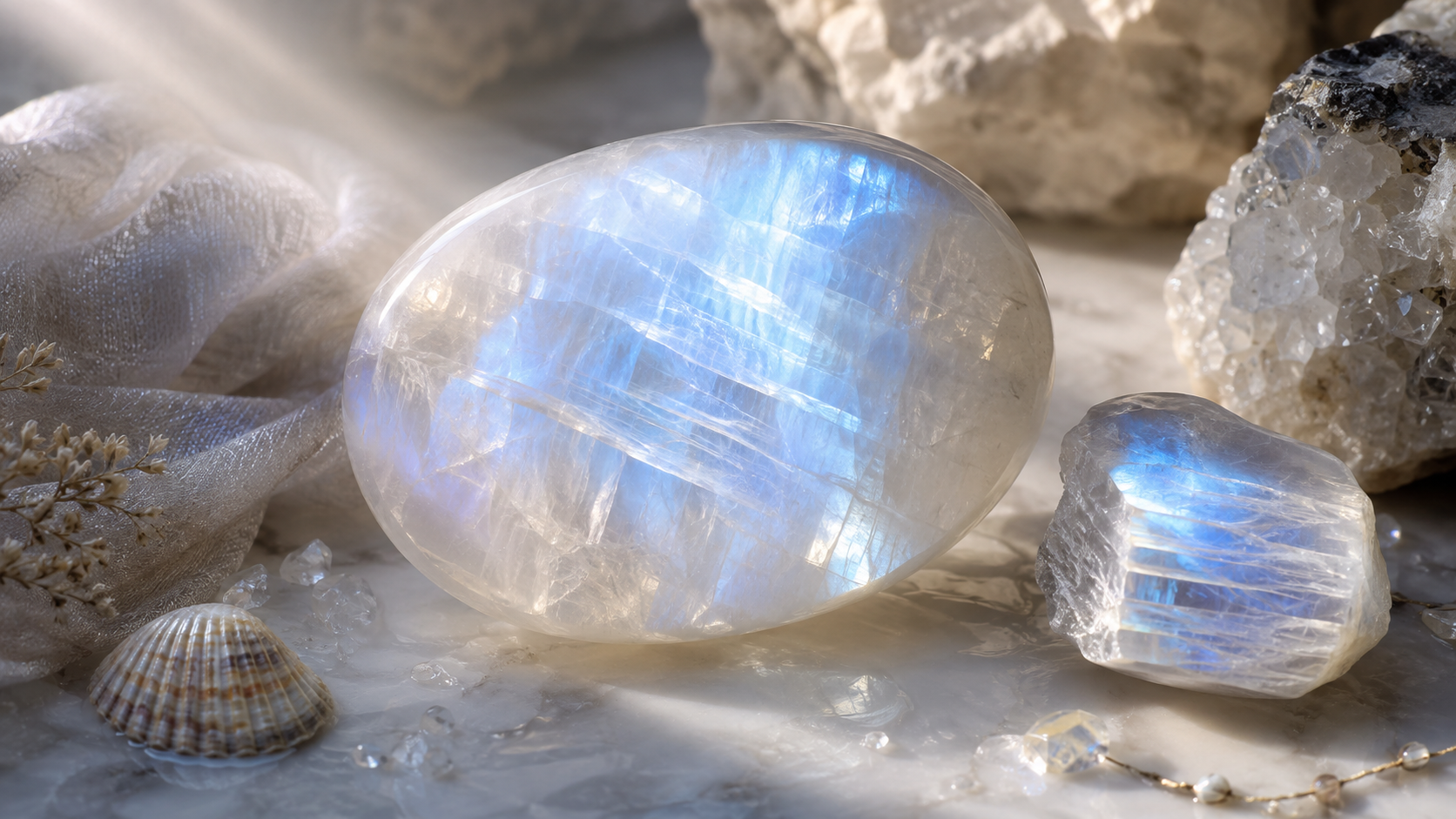
Adularescence describes a precise optical phenomenon: a soft, diffuse glow that seems to come from inside a stone and to move across its surface as the angle changes. It is not a reflection, it is not brilliance, and it is not a colour.
The word comes from adularia, a name given to a variety of orthoclase described in 1781 by the Italian mineralogist Ermenegildo Pini, after the Adula massif in the Swiss Alps, where it was found in hydrothermal fissures. In other words: the scientific term for this phenomenon names a mountain, not the celestial body that the stone's trade name refers to. The question of the name is covered in a piece of the Moon, or moonstone.
A broader word also circulates, schiller, borrowed from German and meaning roughly shimmer. It covers more ground than sheen does: adularescence, but also other effects of internal lamellae, labradorescence included.
The lamellae, and how they form
Here is the mechanism, in three stages, and they have to be taken in order.
First stage: the magma. At high temperature, alkali feldspars form a solid solution. Potassium and sodium coexist in the same crystal lattice, substituting for one another almost freely. At this stage the crystal is chemically homogeneous.
Second stage: slow cooling. Below a certain temperature, that coexistence becomes unstable. The two components separate, rather like a vinaigrette coming apart, but on an atomic scale and without the crystal breaking. This is called exsolution, or unmixing.
Third stage: the stacking. The separation does not happen just anywhere. It follows the planes of the crystal lattice and produces a stack of alternating lamellae: a potassium-rich layer, orthoclase, then a sodium-rich layer, albite, then orthoclase again, and so on across thousands of layers.
The decisive point is this: those lamellae do not have the same refractive index. Light entering the stone therefore meets an alternation of slightly different media, and at every interface part of it is deflected instead of carrying on.
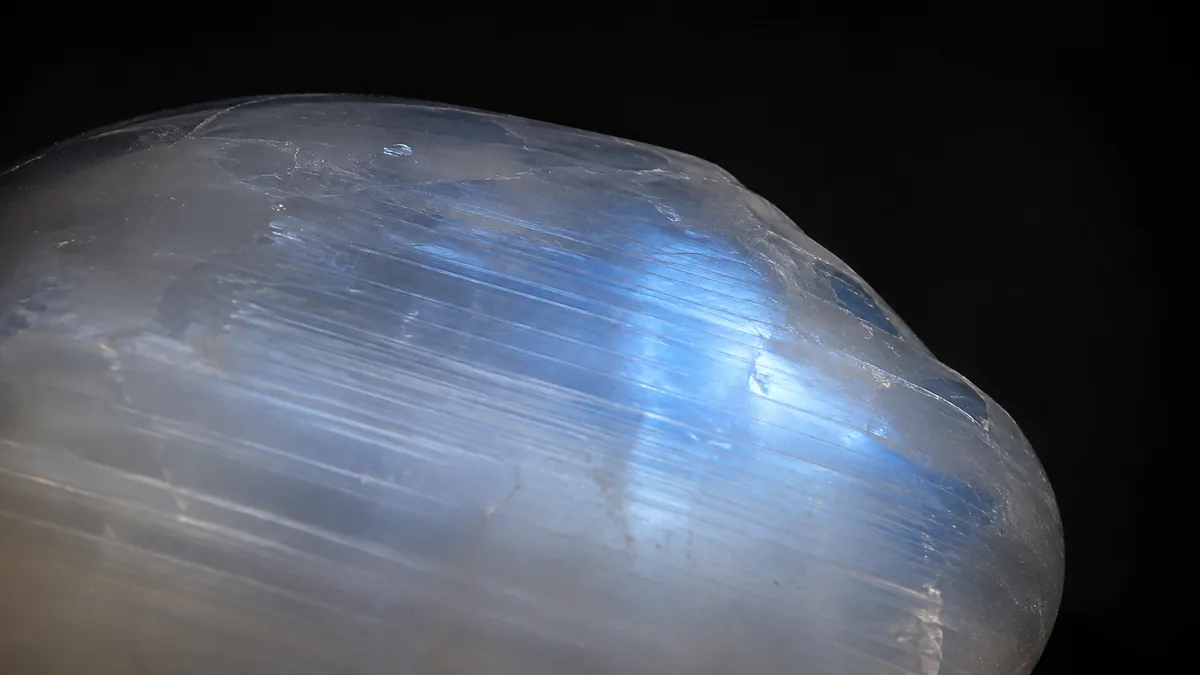
Everything that follows comes down to the thickness of those layers, and that is the subject of the next section. The geological formation as a whole is told in how moonstone forms.
Why the sheen is blue
This is the most interesting question, and the answer rests on a coincidence of scale.
Visible light spans wavelengths from about 400 nanometres for violet to 700 for red. A nanometre is a millionth of a millimetre.
Now, when a feldspar cools slowly in the right conditions, the lamellae it produces have a thickness of the same order: a few hundred nanometres. They are therefore on the scale of light itself, and that is where everything happens.
At that scale, scattering does not treat all colours alike: short wavelengths are scattered more than long ones. Blue is sent back towards the observer, red and orange carry on through the stone. It is the same principle that makes the sky blue, except that here the scatterers are mineral lamellae and not air molecules.
From which a simple, checkable rule follows:
| Lamellae | What happens | Resulting sheen |
|---|---|---|
| Very fine and regular | Blue is strongly scattered | Clear blue |
| Fine | Scattering still selective | Soft blue |
| Medium | All wavelengths leave together | Milky white |
| Thick or irregular | Disordered scattering | Grey, dull |
| Absent | No internal scattering | None |
That is why blue costs so much: it is not a pigment you can add, it is a regularity of formation that cannot be had on demand. The price ranges that follow from it are in the price of moonstone.
From clear blue to milky sheen, four degrees of scattering
Why it seems to float below the surface
This is the most unsettling impression, and it has a simple explanation.
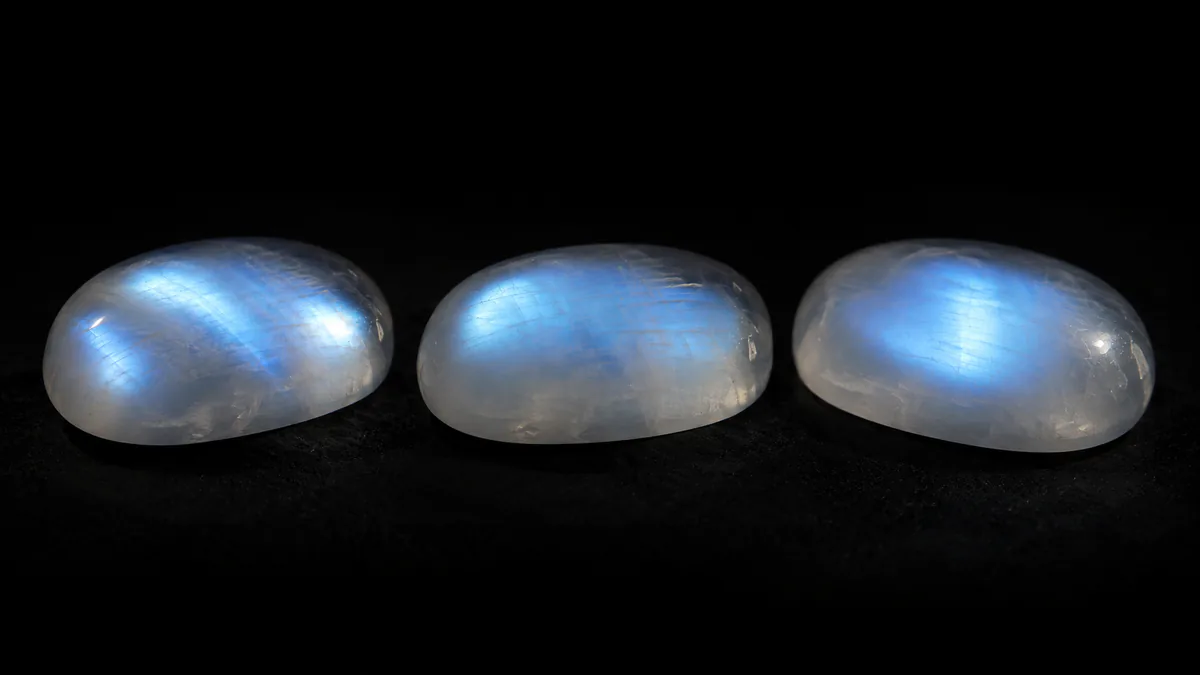
The sheen is not born at the surface, unlike an ordinary reflection. Light enters the stone, travels a certain distance, meets the stack of lamellae, scatters within it, then comes back out. The point it appears to come from therefore sits inside the volume, a few millimetres below the dome.
Our eye reads that for exactly what it is: a light source at depth. Hence the impression of floating, and hence the old image of moonlight caught inside the stone, reported in the myths and legends of moonstone.
And why does it move? Because the angle you look from changes the path light takes through the stone, and therefore which part of the stack sends the blue back to you. Tilt the cabochon and the sheen slides: it is a direct geometric consequence, not an effect of the material.
That mobility is the number one authenticity test, and it is developed in how to recognise genuine moonstone.
What the lapidary can and cannot do
Here is the workshop knowledge I find most poorly explained elsewhere.
The lapidary does not create adularescence. It is there or it is not, decided millions of years earlier by the rate of cooling. No cut, no polish and no treatment manufactures it.
What they do is orient it. The lamellae lie in a precise plane inside the rough crystal. For the sheen to appear centred on the dome and well spread, the cabochon has to be cut parallel to that plane. That is the decisive move, and it is settled before the first pass of the wheel.
One error of orientation, and the same stone gives an off-centre sheen, a partial one, or one that only appears at a grazing angle. The material is identical, the value is divided several times over. It is also why moonstone is almost always cut as a cabochon and rarely faceted: a smooth dome lets the sheen spread, facets chop it up.
Two practical consequences for the buyer. A centred sheen is the sign of a careful cut, and it is one of the six criteria in judging the quality of a moonstone. And a stone cut too thin to save weight loses depth, and therefore intensity: the question of shapes is covered in rough or cut moonstone.
The neighbouring phenomena, and how not to confuse them
Several stones show a moving glow, and they are too often filed together. Yet these are distinct mechanisms.
Labradorescence. That of labradorite, and therefore of rainbow moonstone and the black one. The same family of cause, internal lamellae, but thicker lamellae of a different composition, which produce coloured flashes in patches rather than a diffuse sheen. The sorting is done in moonstone or labradorite.
Opalescence and the play of colour in opal. There the mechanism changes completely: silica microspheres stacked in a regular array diffract light, like an optical grating. That gives sharp multicolored fire, unrelated to a diffuse sheen. The full comparison is in moonstone or opal.
Chatoyancy. The cat's eye effect, produced by parallel fibrous inclusions that concentrate light into a single band. Some moonstones show it, and it is rare.
Aventurescence. Reflective platelets, as in sunstone, giving point flashes rather than a sheen. The two feldspars are compared in moonstone and sunstone.
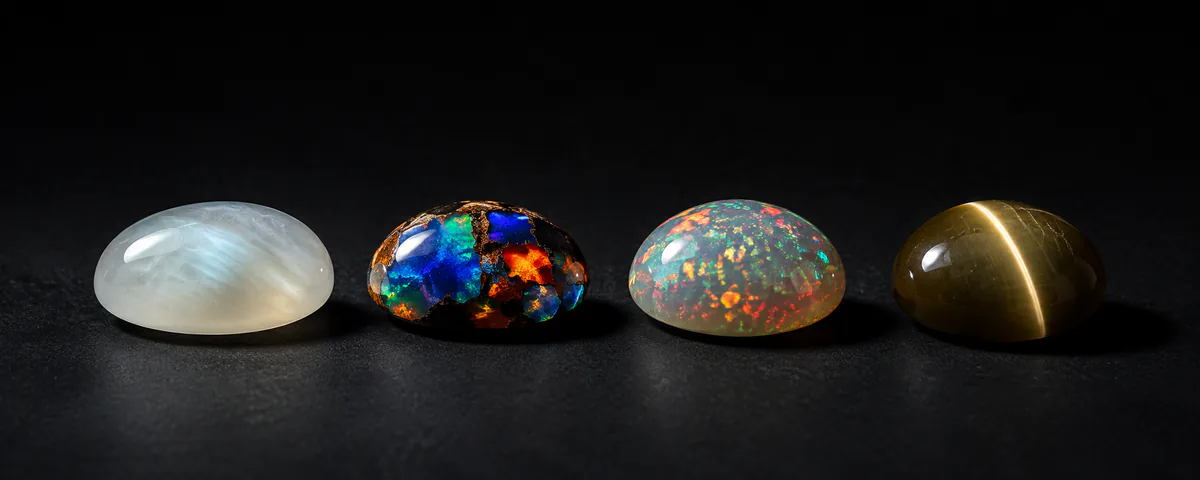
All these terms are taken up and defined in the moonstone glossary.
Why nobody can imitate it
This is the most useful consequence of everything above.
To reproduce adularescence you would have to manufacture a material containing thousands of alternating lamellae of nanometre thickness, parallel, and of slightly different refractive indices. Nothing sold as an imitation comes anywhere near it.
The imitations do something else. Opalite, which is glass, scatters light in a homogeneous mass: that gives a milky luminosity, but a static one, which does not travel when you tilt it. Coated quartz carries an iridescent film on the surface: the reflection follows your eye instead of crossing the stone. Resin makes do with a pearlescent pigment.
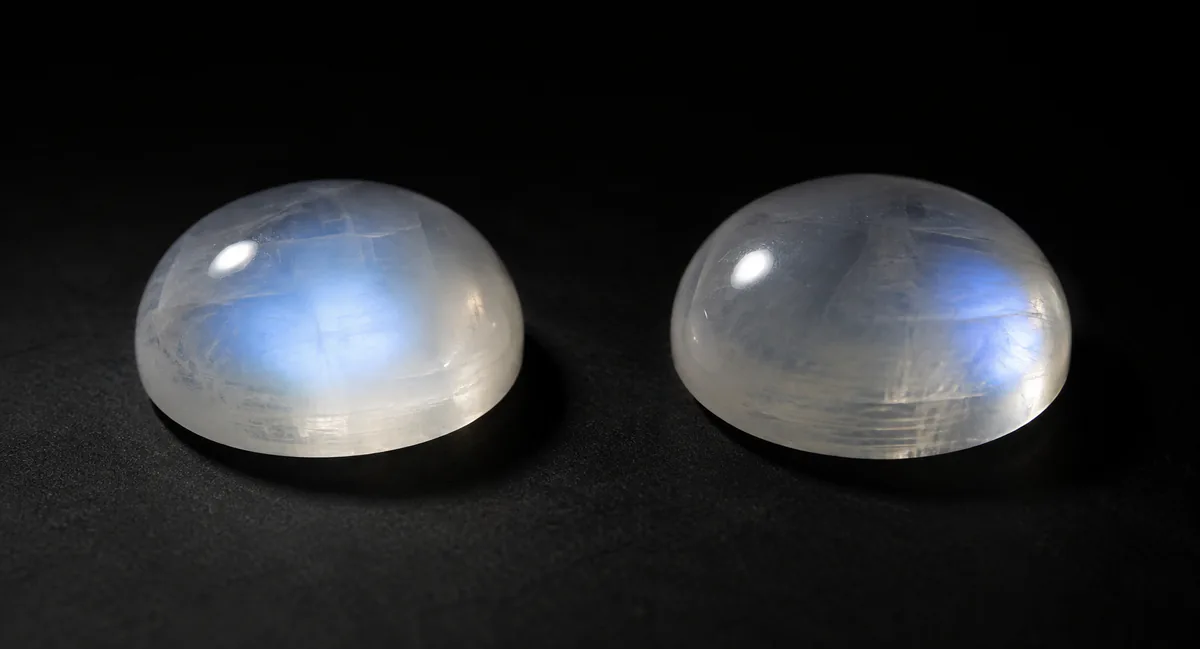
Hence the rule that structures this whole site: it is not the colour you should judge, it is the movement. A sheen that slides, intensifies and then fades is adularescence. A luminosity identical from every angle is not. The six tests are in how to recognise genuine moonstone, and the number one imitation in moonstone or opalite.
How to see it properly at home
Plenty of people write to tell me their stone "does not shine any more". Nine times out of ten it is a question of lighting, not of the stone.
A single directional source. That is the main condition. A window, a desk lamp, an unlit candle at the edge of a worktop. Under a diffuse ceiling light or on an overcast day, adularescence almost entirely disappears, because it needs a direction in order to occur.
Move, or move the stone. The sheen is mobile by nature. A stone set down and looked at head-on shows only one position out of the infinity it can take.
The background counts. A dark background brings out a blue sheen, a light one kills it. That is why sellers' photos on black velvet flatter, and why the same stone looks dull on a white worktop.
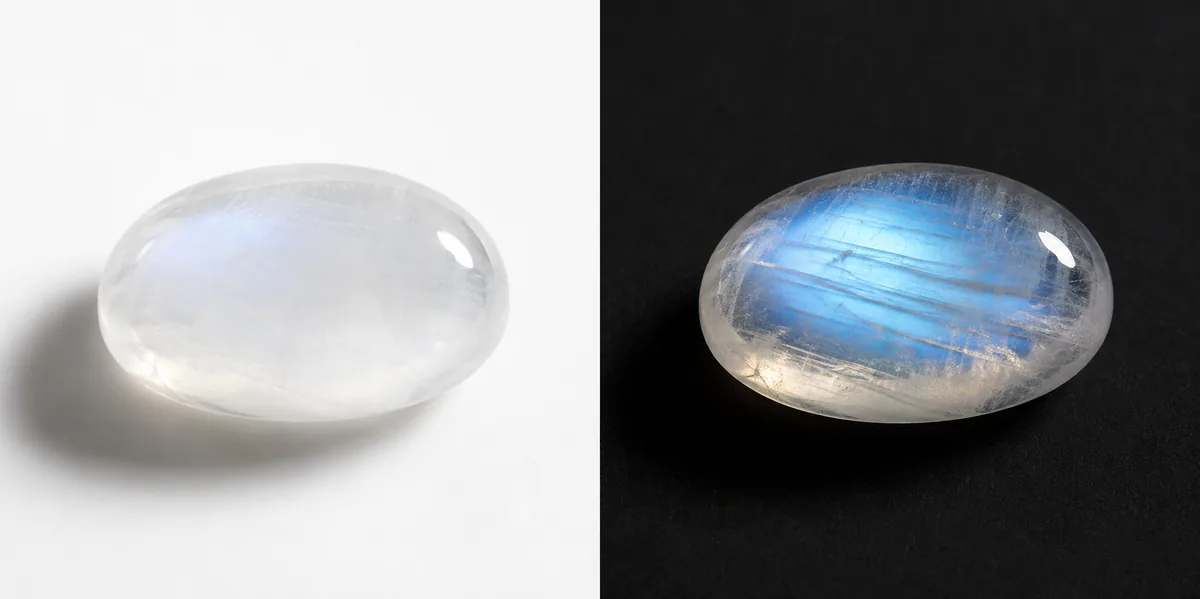
And if the sheen really has weakened, the cause is almost always a film of cream or soap on the polish, or a deposit of limescale. That is sorted in four minutes, with the method in how to clean a moonstone piece. A sheen that has turned white and fixed inside is something else, an opened cleavage, and that is explained in is moonstone fragile.
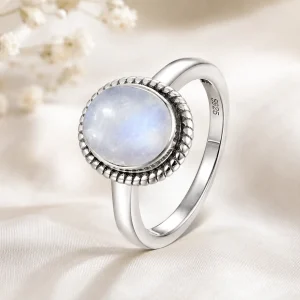
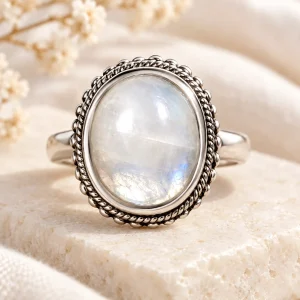
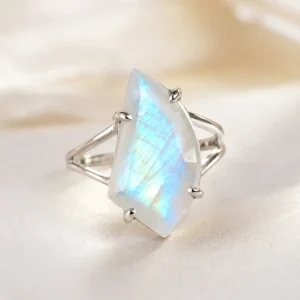
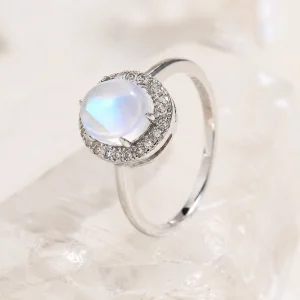
The workshop rings, chosen on the movement of the sheen




Frequently asked questions
What is adularescence?
An optical phenomenon: a soft glow that seems to come from inside a stone and to move as the angle changes. It is born of microscopic alternating lamellae of orthoclase and albite that scatter light inside the crystal.
Where does the word come from?
From adularia, a variety of orthoclase described in 1781 after the Adula massif in the Swiss Alps. The scientific term therefore names a mountain, and not the Moon that the stone's trade name refers to.
Why is the sheen blue?
Because the internal lamellae have a thickness close to the wavelength of visible light, a few hundred nanometres. At that scale short wavelengths are scattered more: blue comes back to the eye, red passes through.
Why do some stones have a white sheen and not a blue one?
Because their lamellae are thicker or less regular. Scattering then stops being selective and sends all the wavelengths back together, which gives a milky white. It is the main cause of price differences.
Why does the reflection seem to move?
Because changing angle changes the path of light through the stone, and therefore which part of the stack sends the blue back to you. It is a geometric consequence, and it is the most reliable authenticity test.
Can adularescence be created by a treatment?
No. It is settled when the crystal forms, by the rate of cooling. No cut, no treatment and no coating manufactures it. The lapidary can only orient it at the moment of cutting.
What is the difference from labradorescence?
The same family of cause, internal lamellae, but thicker and of a different composition. The result: coloured flashes in patches instead of a diffuse sheen. Rainbow moonstone and the black one show labradorescence, not adularescence.
My stone seems to have lost its glow, why?
Almost always a film of cream, soap or limescale on the polish, and that cleans off. Check your lighting too: without a directional source, adularescence barely occurs at all.
Do you need a dark background to see it well?
It helps a great deal for a blue sheen. That is also why sellers' photos on black velvet are flattering, and why a stone looks duller on a light worktop.
Do all moonstones have it?
No. Some stones sold as moonstone have no moving sheen at all, either because the cut is badly oriented or because the material does not have the lamellae. A genuine stone without adularescence is still a moonstone, but it is worth next to nothing.
Where to go next
- The stone itself: the mineral profile, how it forms, the colours and varieties, the glossary.
- The neighbouring phenomena: moonstone or labradorite, moonstone or opal, moonstone and sunstone.
- What it changes when buying: recognising a genuine stone, the six quality criteria, the price, opalite.
- The whole picture: the complete guide to moonstone.
The jewellery is in the shop, and I choose my cabochons on exactly this criterion: the movement of the sheen, not its colour in a still photo. If you cannot manage to see yours, write to me and I will tell you which lighting to try.
My sources
For the mechanism: the GIA and Mindat for the exsolution of alkali feldspars into alternating lamellae of orthoclase and albite, and for the relation between the thickness of those lamellae, on the order of a few hundred nanometres, and the selective scattering of short wavelengths that gives the blue sheen.
For the etymology: adularia is a low-temperature variety of feldspar described after the Adula Alps in Switzerland, and its first description is attributed to Ermenegildo Pini in 1781 by Mindat.
For the neighbouring phenomena, labradorescence, play of colour in opal, chatoyancy and aventurescence, the gemmological definitions in ordinary use, taken up and detailed in the moonstone glossary.
One limit I want to flag: the remarks on cutting orientation and on the centring of the sheen come from the workshop and from what my suppliers explain to me, not from a publication. The principle itself follows directly from the geometry of the lamellae.
Last updated: 19 August 2026. If you find an error in this article, let me know: I correct it and I note it.
✦ À porter, à offrir
Découvrez mes créations