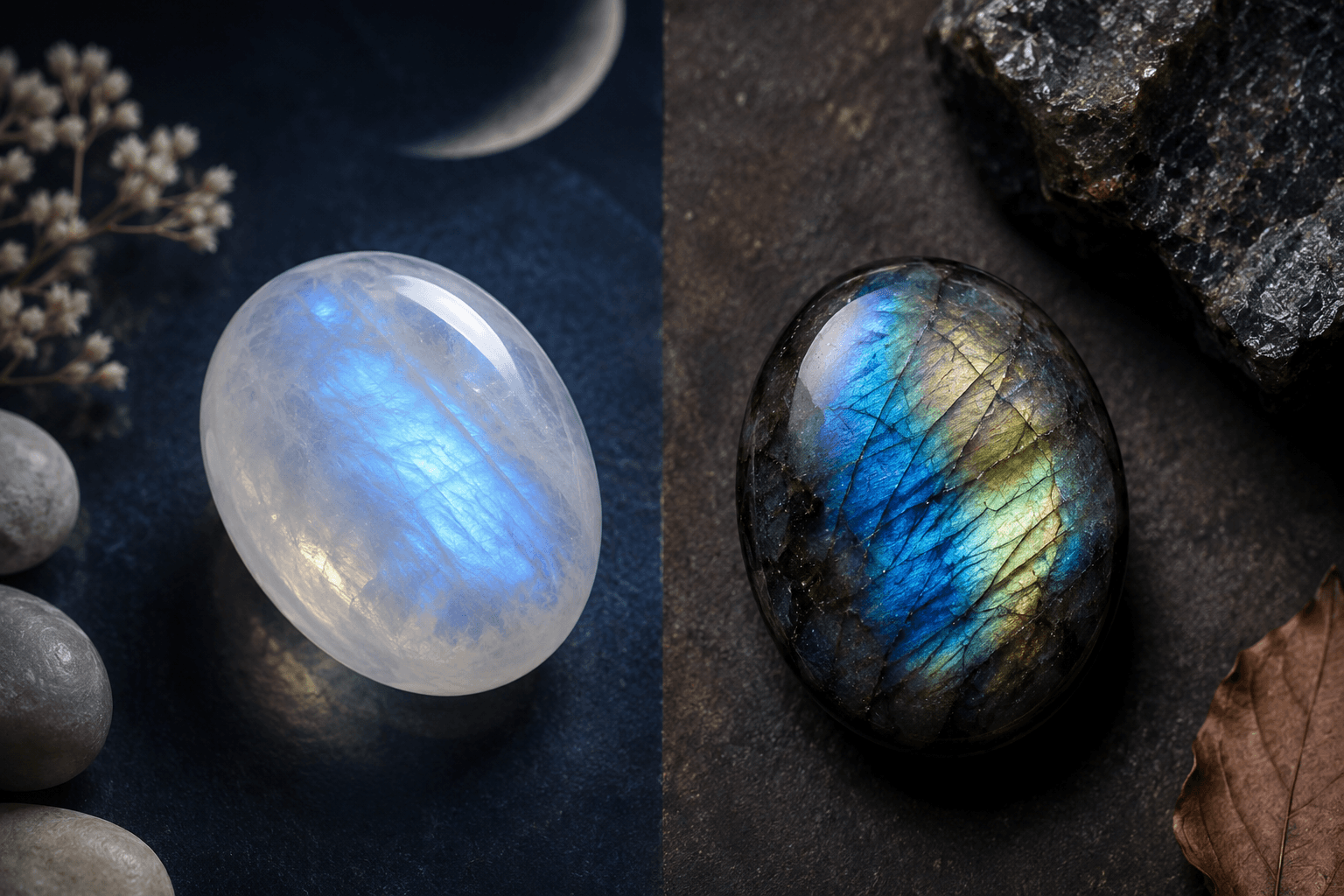
Moonstone or Labradorite: How to Tell Them Apart
Two feldspars, two kinds of sheen, and a trade vocabulary that does everything to blur the line. Rainbow moonstone and black moonstone are labradorite: that is not a wording detail, it is a different mineral species. Here is how to tell them apart, with the naked eye and in the lab.
I sell both. Adularia, and labradorite that the trade calls moonstone. I could settle for the trade name like everyone else, but a buyer who pays for adularia and receives labradorite did not get what they thought they were buying. This page is therefore written against part of my own catalogue.
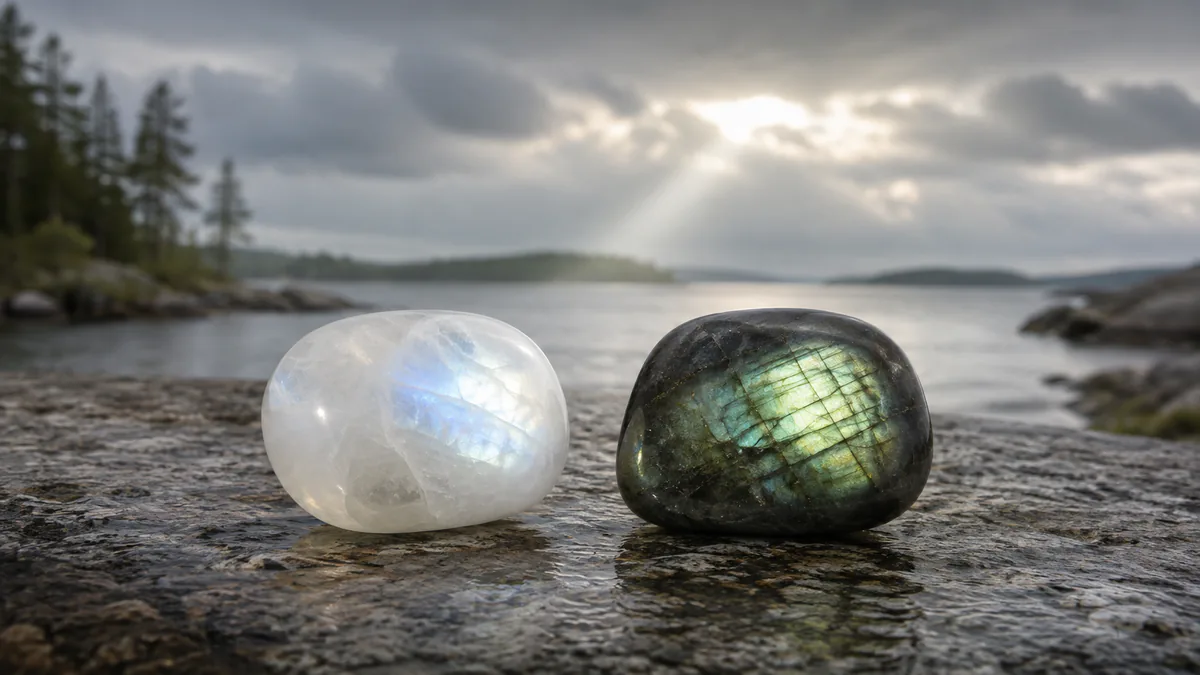
The short version, if you are in a hurry
- These are two different species. Moonstone is most often an orthoclase, an alkali feldspar. Labradorite is a plagioclase.
- The sheen does not behave the same way. A continuous blue veil that glides, that is adularescence. Coloured patches that switch on separately, that is labradorescence.
- The test that settles it: look for fine parallel striations on a cleavage plane. Labradorite has them, orthoclase does not.
- Density separates them clearly: 2.55 to 2.63 for adularia, 2.68 to 2.72 for labradorite.
- Two trade names to know. "Rainbow moonstone" and "black moonstone" both refer to labradorite.
- The genuinely hard case is peristerite, a plagioclase with a blue sheen almost identical to adularia.
The real problem is the vocabulary
Before the mineralogy, the words need untangling. The confusion between these two stones is not primarily optical, it is commercial.
The stone trade uses moonstone as a broad family name, applied to any feldspar that shows a sheen. At least three different things sit under that label:
- Adularia, an orthoclase. This is moonstone in the strict sense, the one that gave its name to all the others.
- Light labradorite, sold as rainbow moonstone. It is the most widespread trade name, and the most misleading.
- Dark labradorite, sold as black moonstone.
Conversely, the word labradorite is reserved in the trade for the dark stones with spectacular flashes, the ones from Finland or Madagascar. Light labradorite is almost never sold under its real name: it becomes a moonstone.
The result: two mineralogically identical stones can carry two different names depending on their tone, and two stones of different species can carry the same name. That is not fraud, it is a usage settled for decades. It becomes fraud when the price follows the prestigious name instead of following the material.
Two branches of the same family
Feldspars make up about 60% of the volume of the earth crust, and they split into two branches.
On one side the alkali feldspars, rich in potassium, including orthoclase, formula KAlSi₃O₈. It crystallises in the monoclinic system. This is the branch of classic moonstone.
On the other the plagioclases, which form a continuous series between a sodium pole, albite, and a calcium pole, anorthite. Labradorite sits in the middle of that series, with 50 to 70% anorthite. It crystallises in the triclinic system.
This difference in symmetry is not a textbook abstraction: it is what produces the striations I discuss further down, and it is what explains the gaps in density and refractive index. The full classification is in the properties of moonstone.
Adularescence and labradorescence
Both stones play with light, but not the same way, and it is the most accessible criterion.
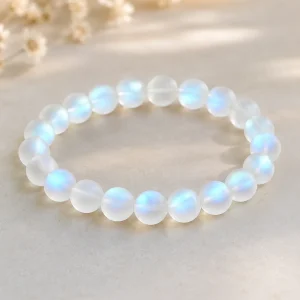
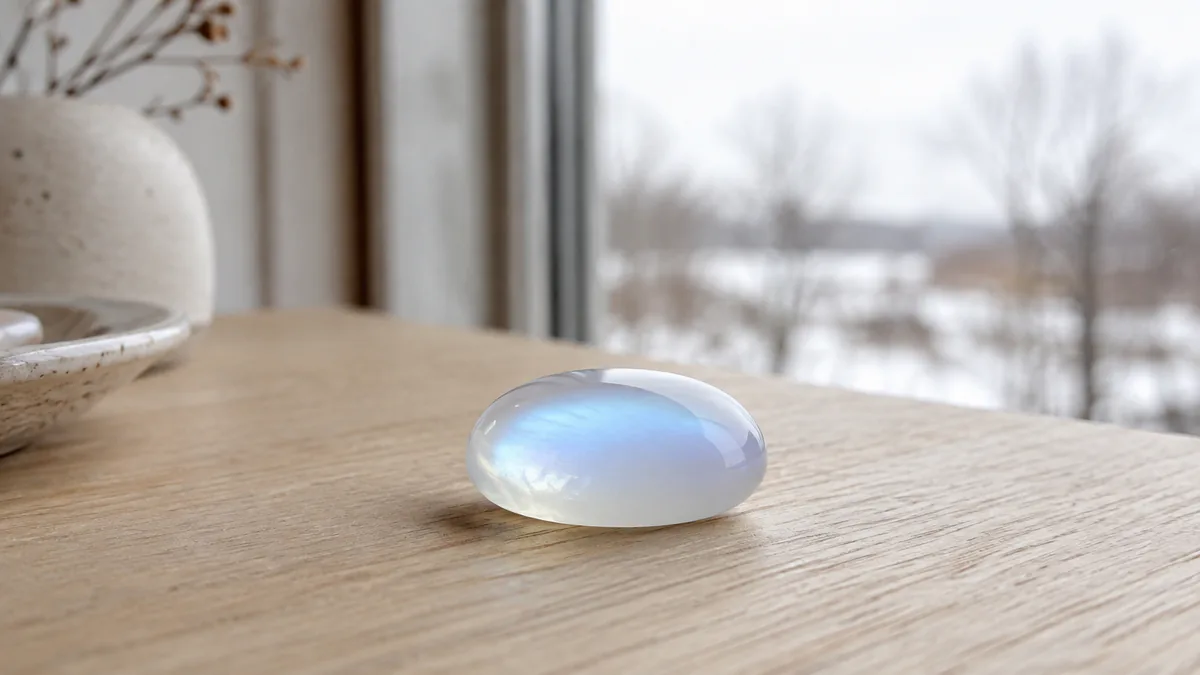
Adularescence. As it cooled, the crystal separated into alternating microscopic lamellae of orthoclase and albite. Light scatters in there and comes back out as a diffuse, bluish, continuous veil that seems to float beneath the surface and glide in one piece when you tilt the stone.
Labradorescence. The mechanism is related but the scale differs: the lamellae are thicker and more contrasted, and they throw back colours in patches. The sheen does not glide, it switches on and off zone by zone, in green, gold, deep blue, sometimes violet or orange.
The difference comes down to two words: continuous versus discontinuous. A veil that sweeps, or patches that flicker.
The detailed mechanism of adularescence is in the article devoted to it.
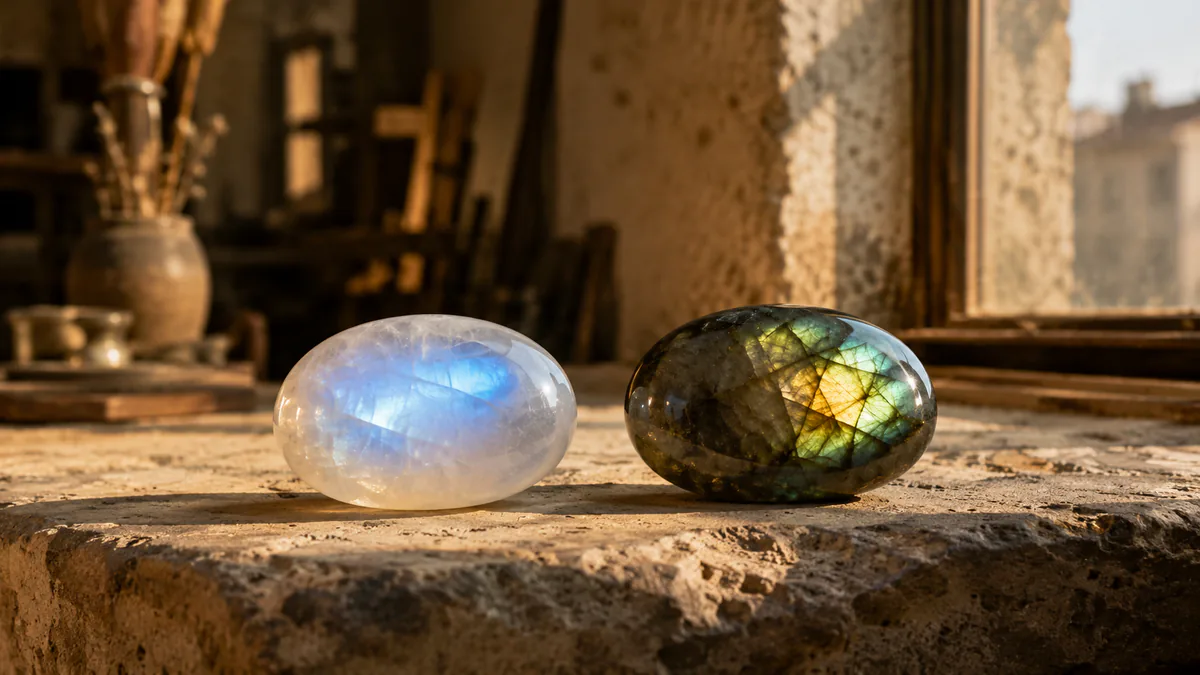
Telling them apart by eye, in three looks
First look: the colour of the sheen. Blue or silvery alone, with no other tint, points to adularia. Green, gold or violet in the same sheen points to labradorite. Adularescence almost never produces green.
Second look: the way it moves. Tilt slowly. The veil of an adularia moves continuously, like a sheet. The colours of a labradorite appear and disappear in blocks, with sharp boundaries.
Third look: the body of the stone. Adularia is translucent to nearly transparent, often colourless or milky. Labradorite is more opaque, with a grey, brown, dark green or plainly black body, and its transparency is rarely good.
These three looks are enough in the vast majority of cases. They fail on a single type of stone, peristerite, which I discuss further down.
The striation test nobody tells you about
Here is the most reliable criterion available without an instrument, and I have never seen it explained in a mainstream article.
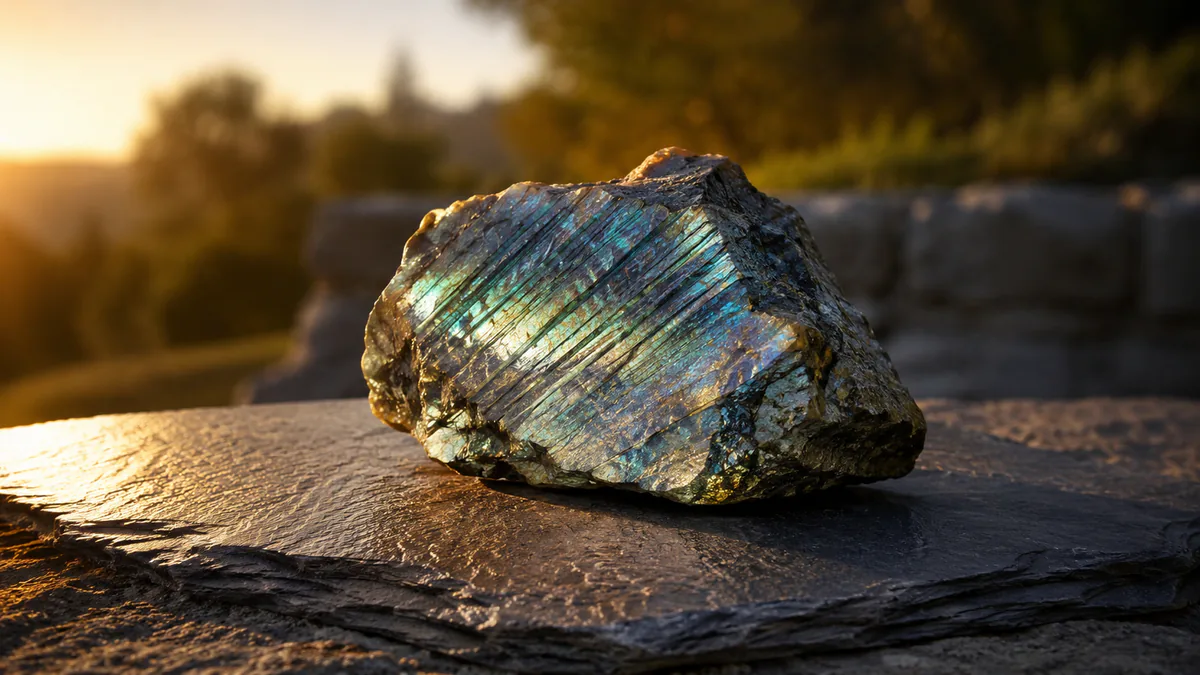
Plagioclases almost always show polysynthetic twinning: the crystal grew as fine alternating lamellae, rotated relative to one another following the albite law. On a cleavage plane, this structure shows up as fine parallel striations, regular, like a very fine comb.
They are often visible to the naked eye, and systematically under a loupe. And above all: orthoclase does not have them. This is the criterion mineralogists have always used to separate the two feldspar branches, and it works as well on a field rock as on the edge of a cabochon.
How to do it in practice: find a flat, glossy surface, on a chip or on the unpolished edge of the stone, and view it under raking light. If parallel lines appear then disappear as you turn the stone, it is a plagioclase, so a labradorite if the sheen is coloured.
An honest limit: on a fully polished and set cabochon, no cleavage surface is accessible. The test mostly applies to a loose stone, to rough material, or to an edge left visible by the setting.
The two data sheets side by side
| Criterion | Moonstone | Labradorite |
|---|---|---|
| Branch | Alkali feldspar | Plagioclase |
| Species | Orthoclase (adularia) | Labradorite, 50 to 70% anorthite |
| Crystal system | Monoclinic | Triclinic |
| Phenomenon | Adularescence | Labradorescence |
| Sheen appearance | Continuous veil, blue or silvery | Coloured patches, green, gold, violet |
| Body | Translucent, colourless to milky | More opaque, grey to black |
| Twinning striations | Absent | Present |
| Hardness (Mohs) | 6 to 6.5 | 6 to 6.5 |
| Density | 2.55 to 2.63 | 2.68 to 2.72 |
| Refractive index | 1.518 to 1.526 | 1.559 to 1.573 |
| Cleavage | Perfect | Perfect |
Two lines deserve a comment. The refractive indices do not overlap at all: a refractometer settles it in seconds, without harming the stone. And the hardness is identical, as is the perfect cleavage: both stones need exactly the same precautions, no ultrasonic cleaning, no salt, no thermal shock.
The hard case: peristerite
There is one stone that defeats all three looks, and it is the most frequent good-faith source of error among serious sellers.
Peristerite is a sodium-rich plagioclase, close to albite, that produces a soft, continuous, bluish sheen very close to that of adularia. Light body, blue veil that glides: to the naked eye, it looks like moonstone.
Two things give it away. Its refractive indices, around 1.53 to 1.54, higher than those of adularia. And its twinning striations, since it is a plagioclase.
A good share of the stones sold as budget moonstone, particularly the large, very even white cabochons, are actually peristerite. There is nothing wrong with that as such, the stone is pretty and honestly sold, but it is not worth the price of quality adularia.
What the confusion costs you
This is where the vocabulary becomes a real issue, not a specialist quarrel.
A fine-quality adularia, colourless and translucent, with a clean, centred blue sheen, sells for several tens of euros per carat, and quite a bit more for Sri Lankan blues. A light labradorite of comparable size sits around a few euros to about twenty euros per carat.
Paying top price for the second is a gap of five to ten times. And the confusion is all the easier because light labradorite, sold as rainbow moonstone, is often more spectacular in a display case than a fine adularia: its colours jump out, while adularescence asks you to take the time to tilt the stone.
The full price breakdown is in the price of moonstone, and the criteria behind it in judging quality.
Which one to choose
The right question is not which one is the real thing, but which one suits you.
Choose adularia if you want discretion, a piece of jewellery that reveals itself up close, and a stone that never goes out of style. The blue veil on a light body is what people picture when they say "moonstone," and it goes with everything.
Choose labradorite if you want colour and character, a piece that reads from a distance, and a contained budget. Green and gold flashes on a dark body are spectacular, and the black variety works very well in men's jewellery.
What matters is knowing what you are buying. On my product pages, the species is named: when a piece is labradorite, including under the rainbow or black name, it says so. The matching collections are rainbow, black and white.
The full tour of varieties is in the colours of moonstone.
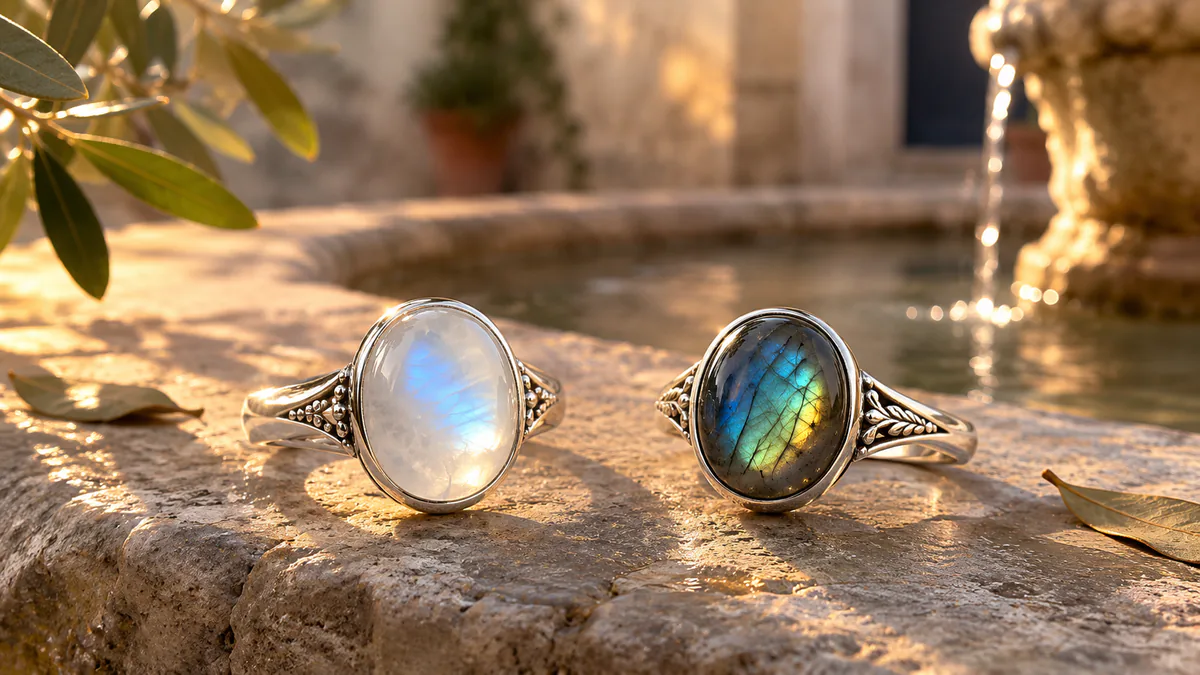
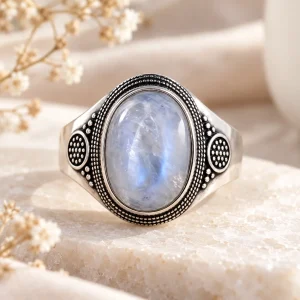
Rings from the workshop, species named on every page




Frequently asked questions
Is rainbow moonstone a labradorite?
Yes. It is light labradorite, so a plagioclase feldspar, and not adularia. The trade name has long been accepted in the stone business. What is not accepted is selling it at adularia prices without saying so.
How can you recognise labradorite in three seconds?
Tilt the stone. If the colours switch on and off in patches, with sharp boundaries, it is labradorite. If a bluish veil glides in one piece, it is adularia. Green and gold in a sheen point almost always to labradorite.
What are the striations you mention?
Fine parallel lines visible on a cleavage plane, under raking light. They come from the polysynthetic twinning specific to plagioclases. Labradorite has them, orthoclase does not: it is the most reliable criterion without an instrument. You do need access to an unpolished surface, though, which is impossible on a fully set cabochon.
Which one is sturdier?
Neither one. Both have a hardness of 6 to 6.5 and perfect cleavage, so they chip on impact rather than scratch. Same prohibitions for both: no ultrasonic cleaning, no salt, no hot water, and a bezel setting preferred on a ring.
Which one is more expensive?
Adularia, clearly, at comparable quality. A fine translucent adularia with a centred blue sheen sells for several tens of euros per carat, a light labradorite a few euros to about twenty. Watch for the paradox: labradorite is often more spectacular in a display case, because its colours jump out.
My stone has a blue sheen but no green, which one is it?
Probably adularia, or peristerite. The latter is a plagioclase with a soft blue sheen very close to it, which defeats the naked-eye test. Only refractive indices or twinning striations settle it with certainty.
Can you wear both together?
With no technical issue at all, they share the same mechanical properties. On the aesthetic side, the contrast between a discreet veil and coloured flashes is marked: either you embrace it on separate pieces, or you choose a light labradorite, closer to adularia in intensity.
Where to go next
- Not mixing it up: with sunstone, with selenite, with opalite.
- Understanding: the mineral data sheet, adularescence, the colours and varieties.
- Buying: recognising a genuine stone, judging quality, the price.
- The bigger picture: the complete guide.
Everything I set is in the shop, with the species named on every page. Not sure about a stone you already own? Write to me with two photos from two angles, I answer myself within 48 working hours.
My sources
The feldspar classification, the optical constants and the polysynthetic twinning of plagioclases follow the public data sheets of the GIA, Mindat and the International Gem Society. The price ranges come from my own purchases and readings on trading places: there is no official price list for these stones. The trade usages described here are the ones I observe with my suppliers.
Last updated: August 19, 2026. If you find a mistake in this article, tell me about it: I correct it and I note it.
✦ À porter, à offrir
Découvrez mes créations