

Description
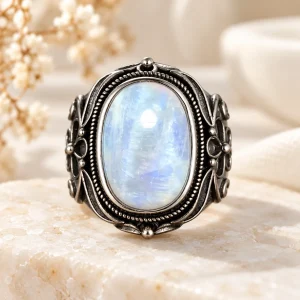
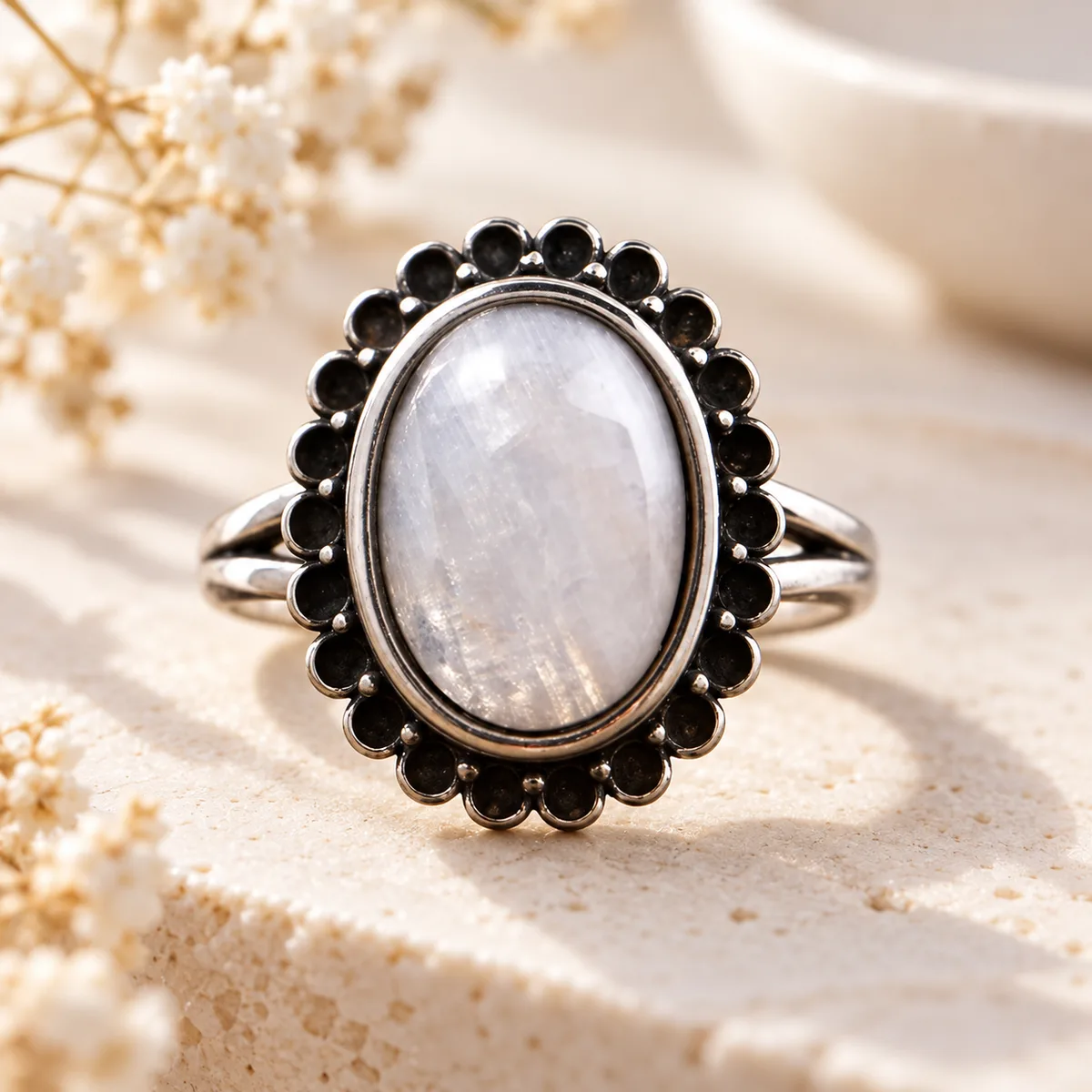
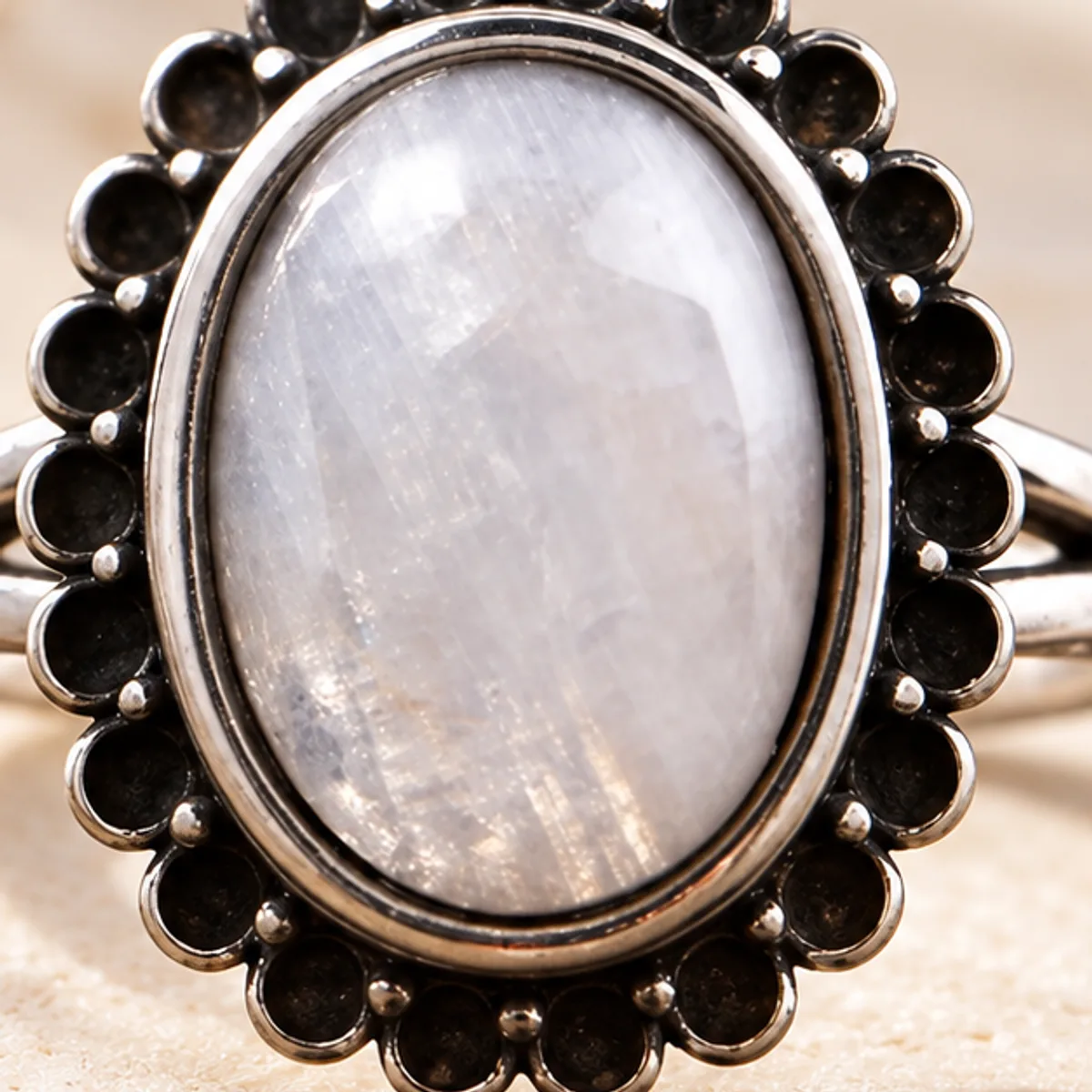
A large oval cabochon ringed by heavy granules, all of them blackened, so that the surround sits back and the pale stone comes forward.
Dark recedes, light advances
This is one of the few rules of perception that works every time and costs nothing to use. Put two objects of equal height side by side, make one dark and one light, and the light one will look nearer. Painters have relied on it for centuries and jewellers use it without naming it. Here the granules are blackened and the stone is pale, so the ring of metal reads as a step down into shadow and the cabochon reads as sitting on top of it. In fact they are almost the same height.
The effect is stronger with large elements than small ones. A blackened milgrain edge just looks like a dark line; a ring of blackened granules a millimetre and a half across gives the eye enough surface to judge depth by, and the illusion holds even close up. That is the reason for using large granules here rather than the fine beading used elsewhere in the collection.
There is a second gain, which is the one I actually designed for. A large moonstone is pale and can look washed out against bright silver, because the two are close in tone. Against black, the same stone reads a full step brighter without anything being done to the stone at all. Combine the two effects, depth and contrast, and a modest cabochon looks like a better one. I would rather tell you that than let you think the stone is exceptional.
The stone sits in a closed bezel inside the blackened ring. The blue veil is what all of this is arranged around. The other rings are here, and the size guide takes two minutes.
- Large oval moonstone cabochon, closed bezel inside a ring of blackened granules.
- 925 sterling silver hallmarked S925, heavy granules, blackened.
- Dark metal recedes and the pale stone advances: depth and contrast at once.
- UK sizes I 1/2 to T 1/2, that is 48 to 62 mm. Delivered in two weeks.
The specifications
- Stone
- Real moonstone (adularia), large oval cabochon
- Origin
- India
- Metal
- 925 sterling silver, S925 hallmark
- Setting
- Closed bezel, no glue
- Decoration
- Ring of large soldered granules, blackened
- Finish
- Blackened granules, band rubbed back with a cloth
- Sizes
- UK I 1/2 to T 1/2 (48 to 62 mm)
- Gender
- Women
- Brand
- Melissa Moon
Making an ordinary stone look its best
Most of what a setting does is manage the comparison. A stone has no absolute brightness; it has only the brightness of whatever is next to it. Blacken the surround and it gains. Polish the surround and it loses. Put it next to a diamond and it disappears. None of this changes the stone, and all of it changes what you see, which is why the same cabochon can look quite different in two settings from the same workshop.
The honest line to hold is that managing the comparison is legitimate and misdescribing the stone is not. I will happily blacken a frame to make a pale moonstone look luminous. I will not photograph it at the one angle where the veil is widest and call that the piece. The first is craft, the second is a lie told with a camera, and the trade does a great deal of the second.
A setting cannot improve a stone. It can only decide what the stone is compared against, and that is most of the job.
No salt, no ultrasonic tank, no hot water: moonstone is a feldspar, and all three damage it for good. No silver dip either: the black on the granules is the whole design here, and a dip takes it off in seconds and leaves you with a bright surround. Lukewarm water, a soft cloth on the band only. The detail is in cleaning a moonstone piece, and the safe methods in caring for it without harming it. The granules stand above the stone and take knocks first, which helps a stone that chips.