

Description
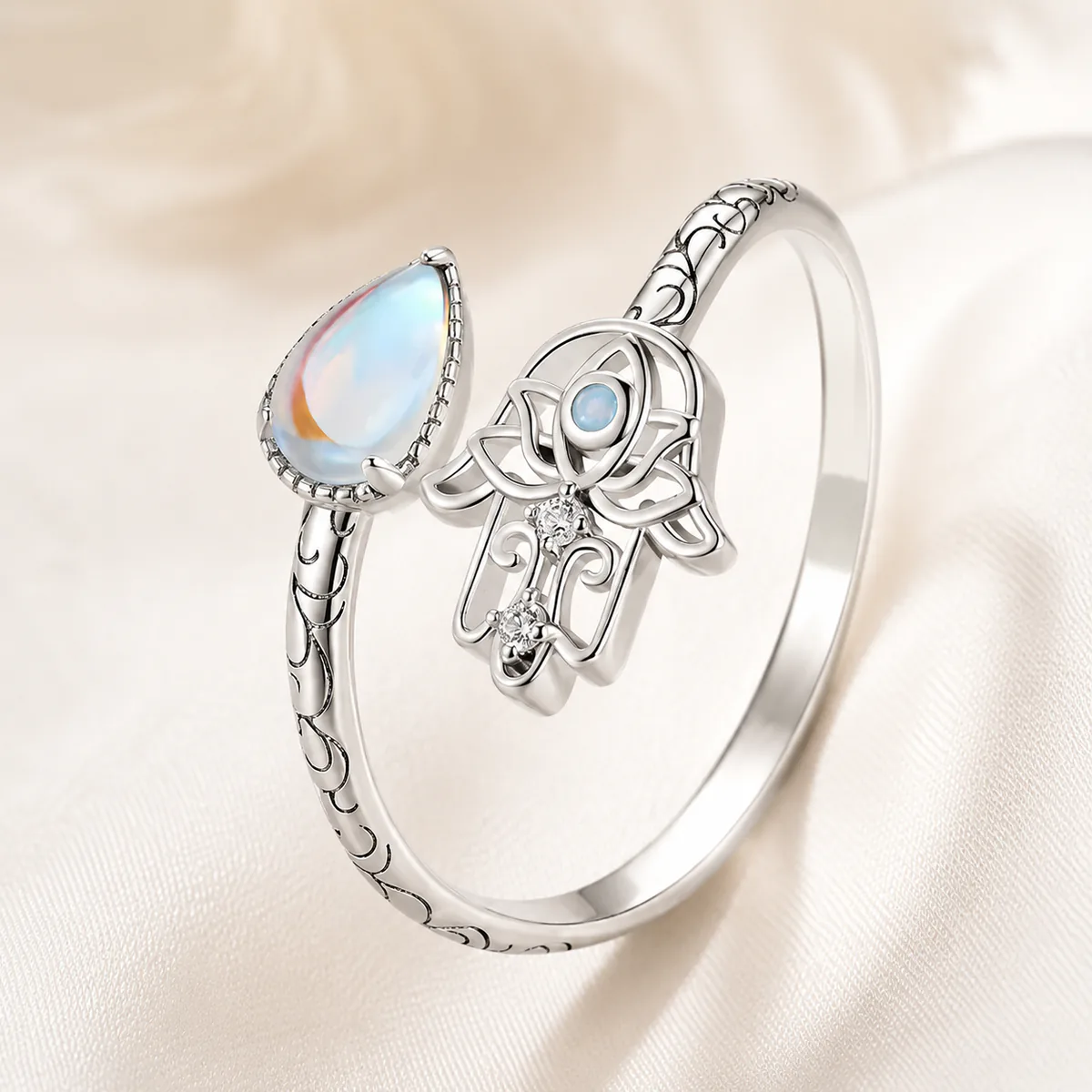
It is the only ring in the shop that does not ask for your size. The band does not close: it opens onto a moonstone drop on one side and an openwork hand of Fatima on the other, and it spreads by just what is needed to go on. This is the one you give when you do not know the hand it is for.
An open band, an openwork hand
The two ends do not meet and cross slightly, which lets the band widen by a few millimetres without deforming. It is an old construction, found on rings from every period, and it settles at a stroke the most ordinary problem of online selling: nobody knows their ring size, and many people do not have the same one from one day to the next depending on heat or tiredness.
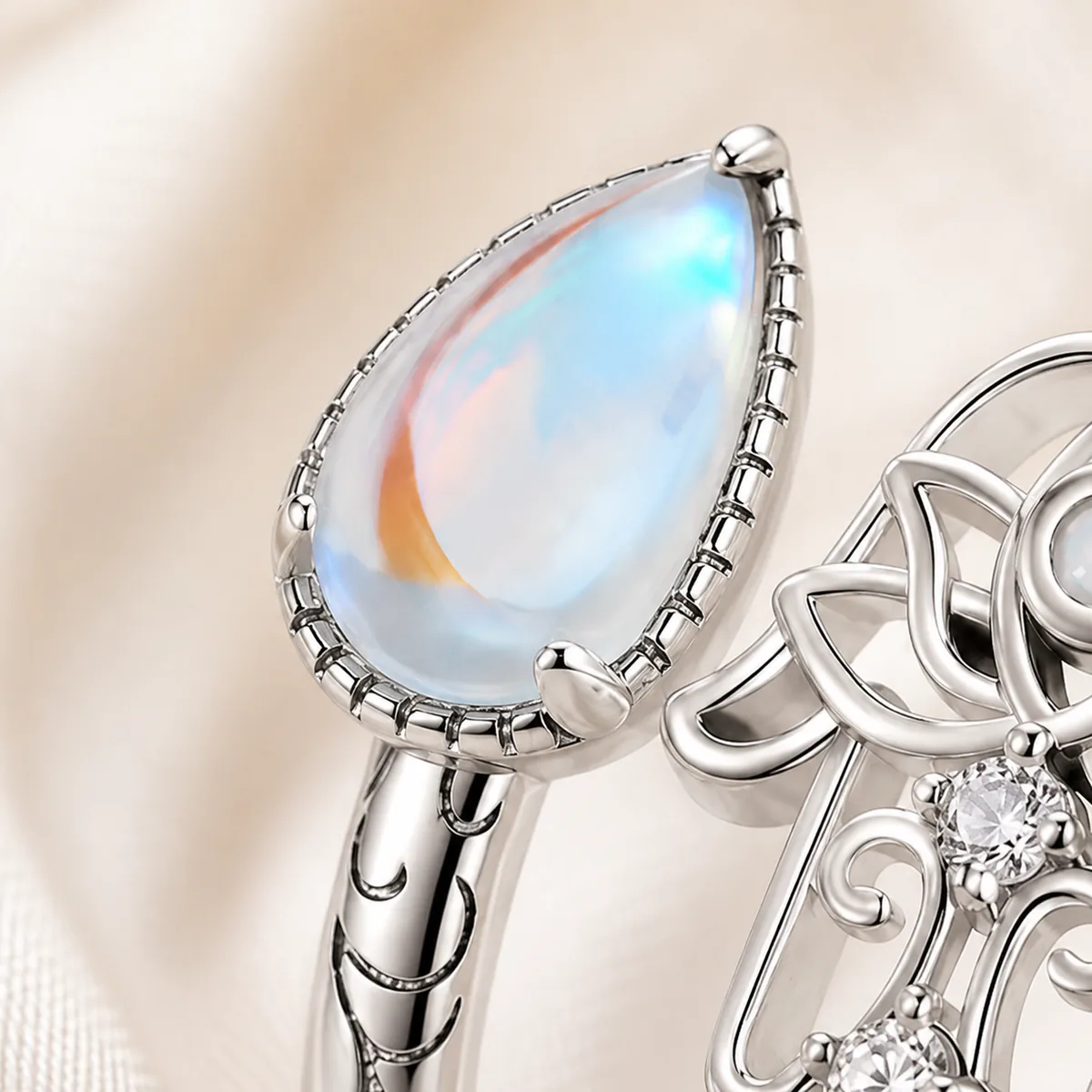
On one side, a moonstone drop set in a beaded bezel, whose reflections shift from blue to gold depending on the angle. On the other, the open hand, pierced, carrying in its palm a lotus flower, a three-branched knot, a small cabochon standing in for an eye and two zircons. The band itself is not plain: it is engraved with blackened scrollwork along its whole length, which is an elegant way of saying that even the part nobody looks at has been worked.
In the catalogue it occupies a place apart. The other rings are chosen to the exact size. This one does the opposite: it adapts, and that is its whole argument. If you are after a larger stone and a mount that does not move, the others are here. You will not need the sizing guide for this one, but it will serve you for the next.
What to know before buying it, and nobody writes
An open band tires if you open and close it constantly. Silver hardens as it is worked, then it breaks. The right way is to adjust it once, at the start, to the width that suits you, then to slide it on rather than spreading it every time. Set that way, it lasts for years. Adjusted five times a week, it will eventually split at the thinnest point.
Moonstone also has perfect cleavage, it chips on impact without scratching, and on an open band the drop protrudes a little: that is the point that takes the knocks.
Three symbols that do not come from the same place
I would rather say it plainly, because I get asked: the open hand is a khamsa, from the Near East and North Africa; the flower at its centre is a lotus, from India; the three-branched knot comes from Irish insular art. These three traditions have nothing to do with one another, and no serious symbolist will tell you that together they make a system. It is a contemporary decorative vocabulary, very widespread, and I would rather call it by its name than sell you a coherence that does not exist.
That takes nothing away from the ring. An object can be well drawn without being learned, and the people who buy it know this perfectly well: they are choosing a shape they like, not a treatise. What I refuse is the product page that invents a thousand-year-old meaning for an assembly of three cultures. The rest of the shop is here, including what I removed from the catalogue.
- Open, adjustable band. No size to choose, no risk of getting it wrong as a gift.
- Moonstone drop in a beaded bezel, openwork hand of Fatima with lotus, knot and two zircons.
- 925 sterling silver. Band engraved with blackened scrollwork along its whole length.
- Delivered in two weeks with a cotton pouch, a handwritten note and a care card.
The specifications
- Stone
- Moonstone, drop cut, in a beaded bezel
- Accent stones
- One round cabochon and two white zircons
- Metal
- 925 sterling silver
- Setting
- Bezel set, no glue
- Band
- Open, adjustable, engraved with blackened scrollwork
- Sizes
- One adjustable size
- Gender
- Women
- Brand
- Melissa Moon
The one ring you can give without knowing a size
Every other ring in this shop forces a decision you often cannot make: the size of someone else’s finger. This one removes that decision entirely, and that is not a minor detail when a piece is meant as a gift. It is also why it stays in the catalogue although its stone is smaller than on the other models.
What I ask of an adjustable band is that it be thick enough at the crossing point not to fatigue at the first adjustment, and that the stone sit low enough not to catch on everything. Those two things are checked by hand, and they are the only real quality criteria on this construction. The rest of the shop is here.
An adjustable ring is the only piece you can give to someone you know nothing about, except that you care.
No salt, no ultrasonic tank, no hot water: moonstone is a feldspar, and all three damage it for good. Lukewarm water, a soft cloth, and no silver polish on the band: the scrollwork is only visible thanks to the black laid at the bottom of the engraving, and those pastes remove it. Store it flat rather than loose: an open band deforms in a pouch full of other things. The detail is in cleaning a moonstone piece, and the safe methods in caring for it without harming it.