

Description
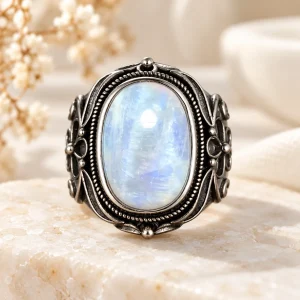
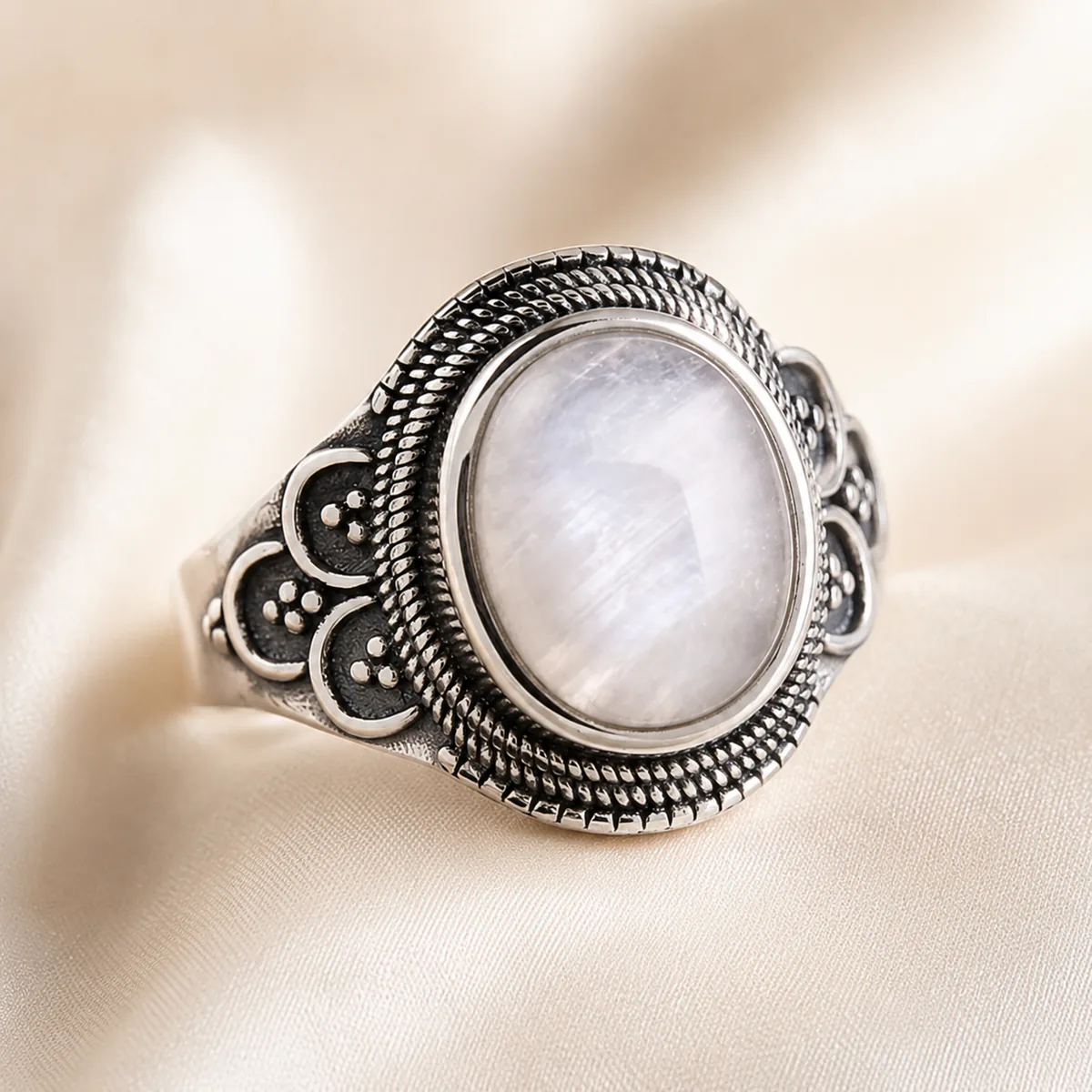
This is the largest stone in the catalogue, and the whitest. A wide milky cabochon, run through with silky fibres that move with the light, encircled by twisted wire and granulation, with four silver crescents set on the shoulders. It is the one you wear alone, because it tolerates nothing else beside it.
Four crescents around a white stone
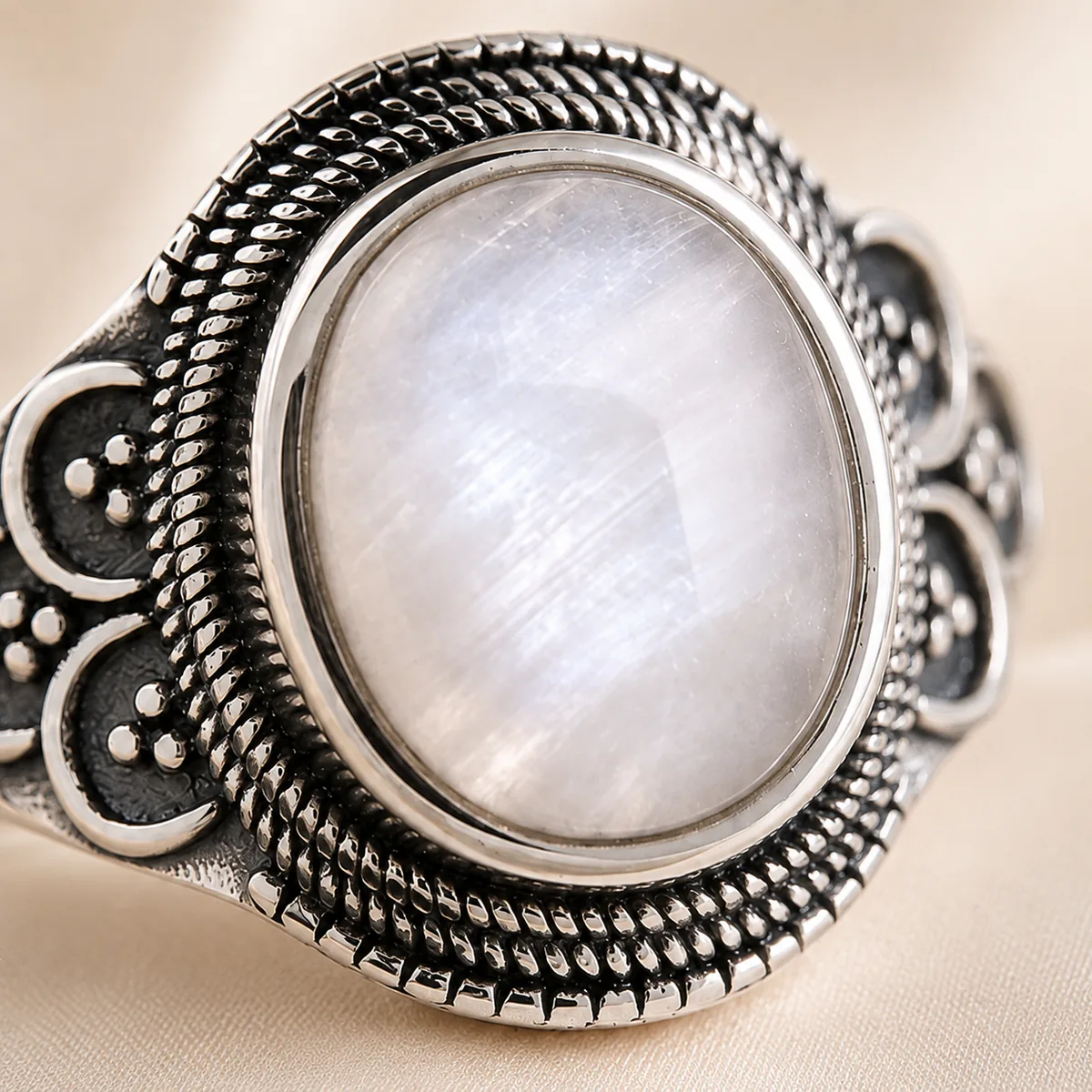
Look at the shoulders of the ring. On each side of the setting, two silver crescents on a blackened ground, each holding three small soldered beads. In a shop that sells nothing but moonstone, this motif falls so neatly into place that it could pass for an easy trick, and yet it has nothing to do with the moon: it is an ornament of Balinese tradition, where the crescent and granulation have been combined for generations. It simply happens to rhyme with what it surrounds.
Around the stone, two successive crowns. A twisted wire first, then a row of granulation following the whole outline of the cabochon. The ground between the reliefs is blackened and grainy, which is not an ageing effect but the condition for seeing anything at all: on a surface this worked, polished silver would throw light everywhere and the relief would disappear in the glare.
The stone is milky, without blue. It is the white variety, the most classic and the least spectacular of the three, the one that plays on a silky surface rather than on a coloured flash. On a mounting this busy, that is a coherent choice: a stone with a strong blue sheen would have fought with the decoration. The white variety is detailed here, and the shop’s other rings are there.
A large ring is not a wide ring
A word on the shape, because it changes everything about comfort. This ring is thick on top and tapers markedly under the finger: it is the silhouette of a signet ring. A ring that is wide all the way round grips permanently; this one puts its mass only on top and lets the underside breathe. Concretely, it asks for less margin than a uniformly wide band, generally a quarter to half a size more than your habit, no more. The sizing guide details the measurement.
People confuse the two, and it costs returns. A wide ring is wide everywhere: it encircles the finger over its whole circumference, it heats up, and you have to give it an extra size. A large ring like this one concentrates its mass on top and tapers underneath: it shows just as much, it weighs just as much, but it does not grip the same way. That is why it is worn longer through the day than its width would suggest, and why you must not order two sizes up as a precaution.
The nuisance nobody writes about
The blackened hollows of a ring this worked hold on to everything. Hand cream, soap, dust: it accumulates in the granulation and between the twists, and after a few months the decoration loses its contrast. The natural reflex would be to brush it. Above all do not: the black is at the bottom of the hollows, a brush removes it and you will end up with a uniformly grey ring, which is to say the opposite of what you wanted. The right method is further down, in the care section.
Add that moonstone has perfect cleavage, it chips on impact, and that a cabochon this size sits proud: on a ring you inevitably knock more often, that deserves saying.
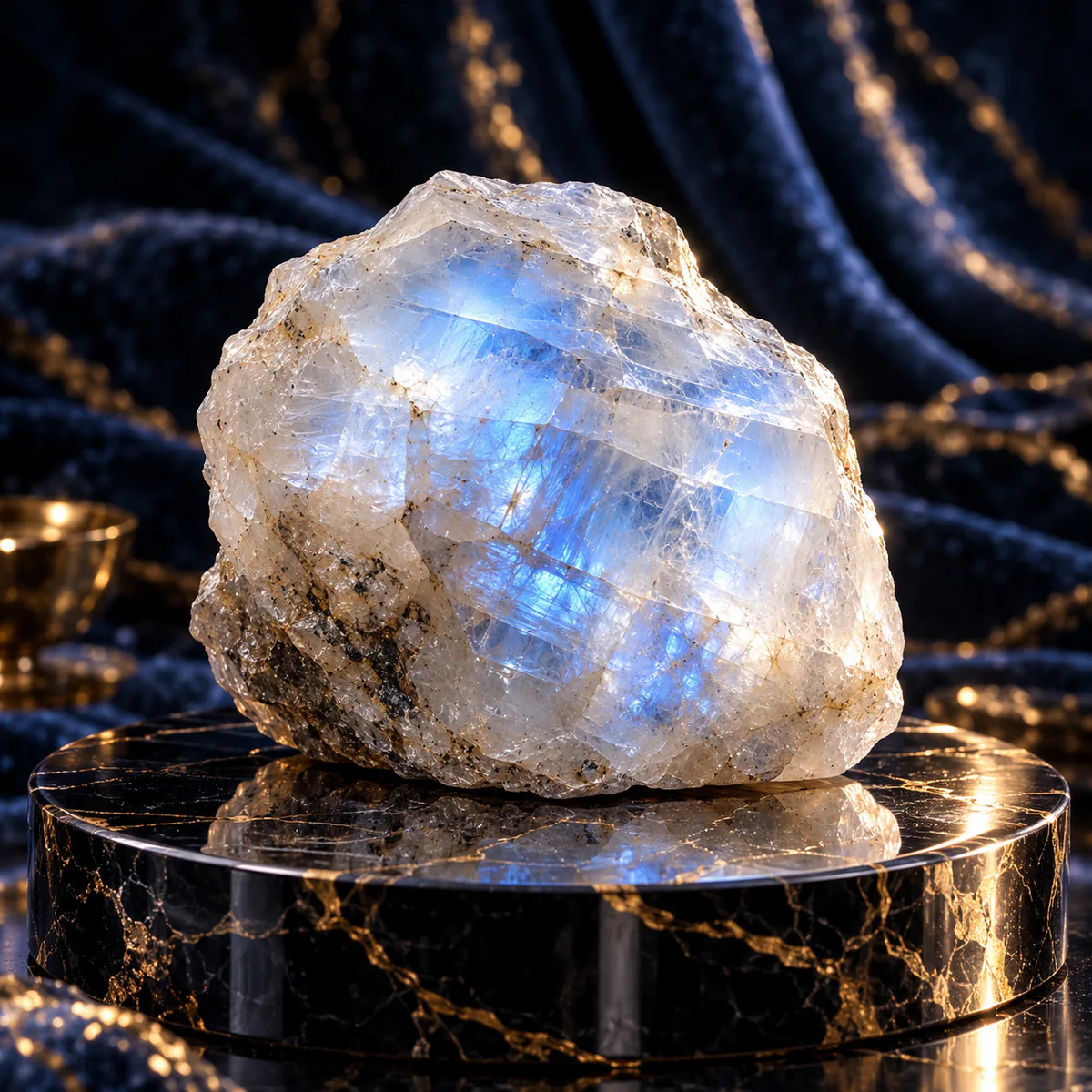
Crystal healing tradition makes moonstone a stone of cycles, of intuition and of the return to calm; it is said to accompany periods of change rather than to bring them about. I will go no further: none of it is demonstrated and no piece of jewellery heals anything. Separately, I have gathered what tradition lends it and what a moonstone ring is said to mean when it is given.
- The widest cabochon in the catalogue, white variety, silky surface with no blue flash.
- Solid silver. Twisted wire and granulation around the stone, four crescents on the shoulders.
- Signet silhouette: thick on top, tapered under the finger. A quarter to half a size more.
- Delivered in two weeks with a cotton pouch, a handwritten note and a care card.
The specifications
- Stone
- White moonstone, oval cabochon cut
- Metal
- Solid sterling silver
- Setting
- Plain bezel setting, no glue
- Decoration
- Twisted wire, granulation, crescents on the shoulders, blackened ground
- Profile
- Signet, thick on top and tapered under the finger
- Sizes
- I½ to T½
- Gender
- Women and men
- Brand
- Melissa Moon
Where this ring comes from
I do not claim to set this one myself. This type of decoration, granulated and twisted on a blackened ground, comes out of workshops that have done nothing else for several generations, and my part stops at the choice of the stone and the mounting. The rest of the shop is here, including what I took out of the catalogue.
A white stone on a busy decoration is the only case where I advise against looking for the blue flash. It would have gained nothing by fighting. That is also why this ring is worn alone: put a second piece on the same hand and the eye no longer knows where to land.
A white stone on a busy decoration is the only case where I advise against looking for the blue flash.
No salt, no ultrasonic tank, no hot water: moonstone is a feldspar, and all three damage it for good. For the decoration, one method only: lukewarm soapy water, a generous rinse, then a complete drying by dabbing, never rubbing the hollows. No brush, no paste, no silver product: they remove the black from the bottom of the granulation and the ring turns uniformly grey. If the reliefs tarnish, rub those alone, with a dry fingertip. And dry it properly: water left in the hollows of a blackened decoration ends up leaving pale rings there. The detail is in cleaning a moonstone piece, and the safe methods for the stone in caring for it without harming it.