


Description
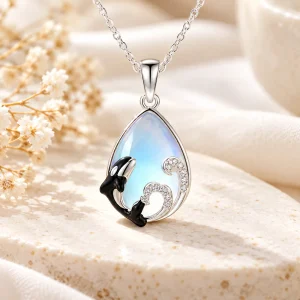
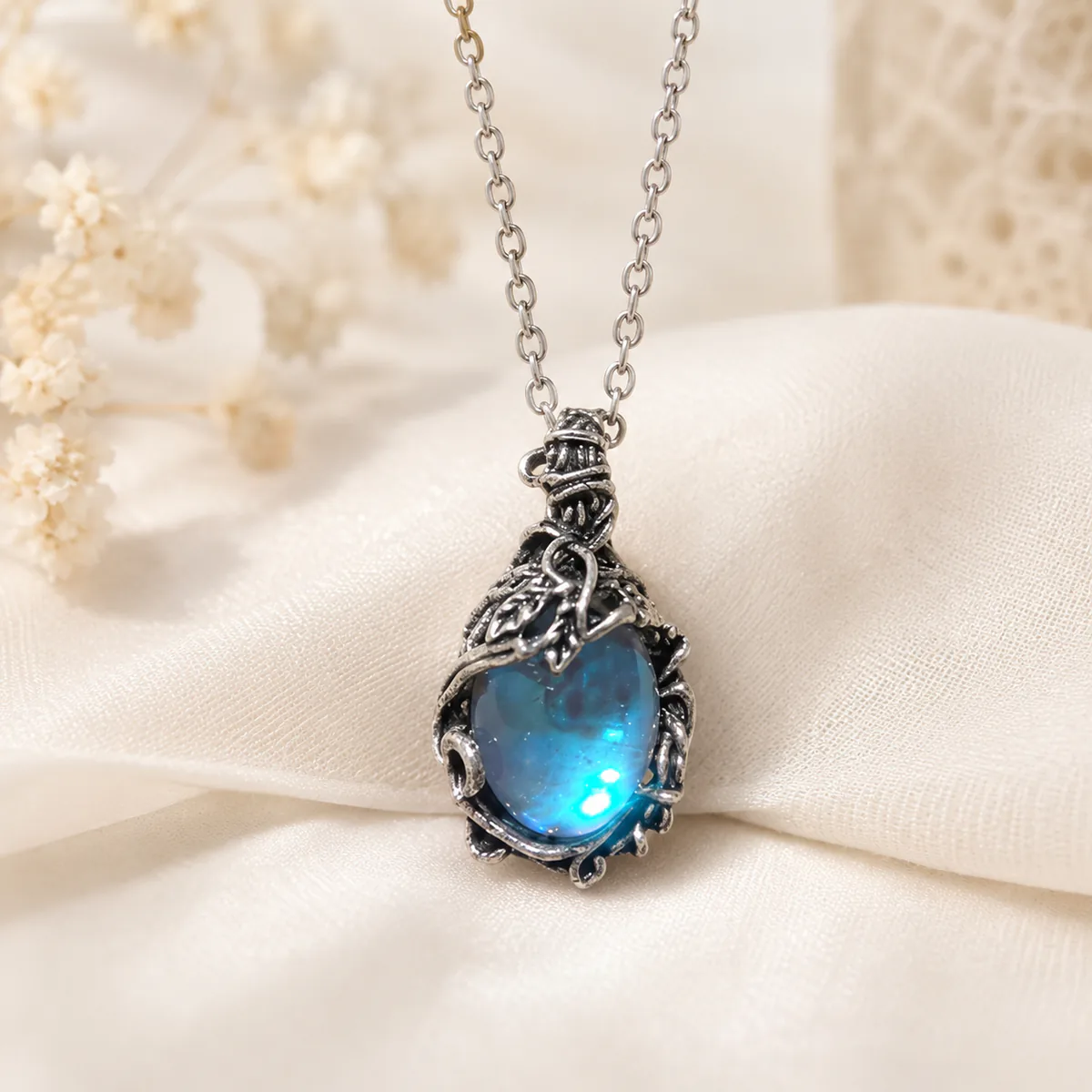
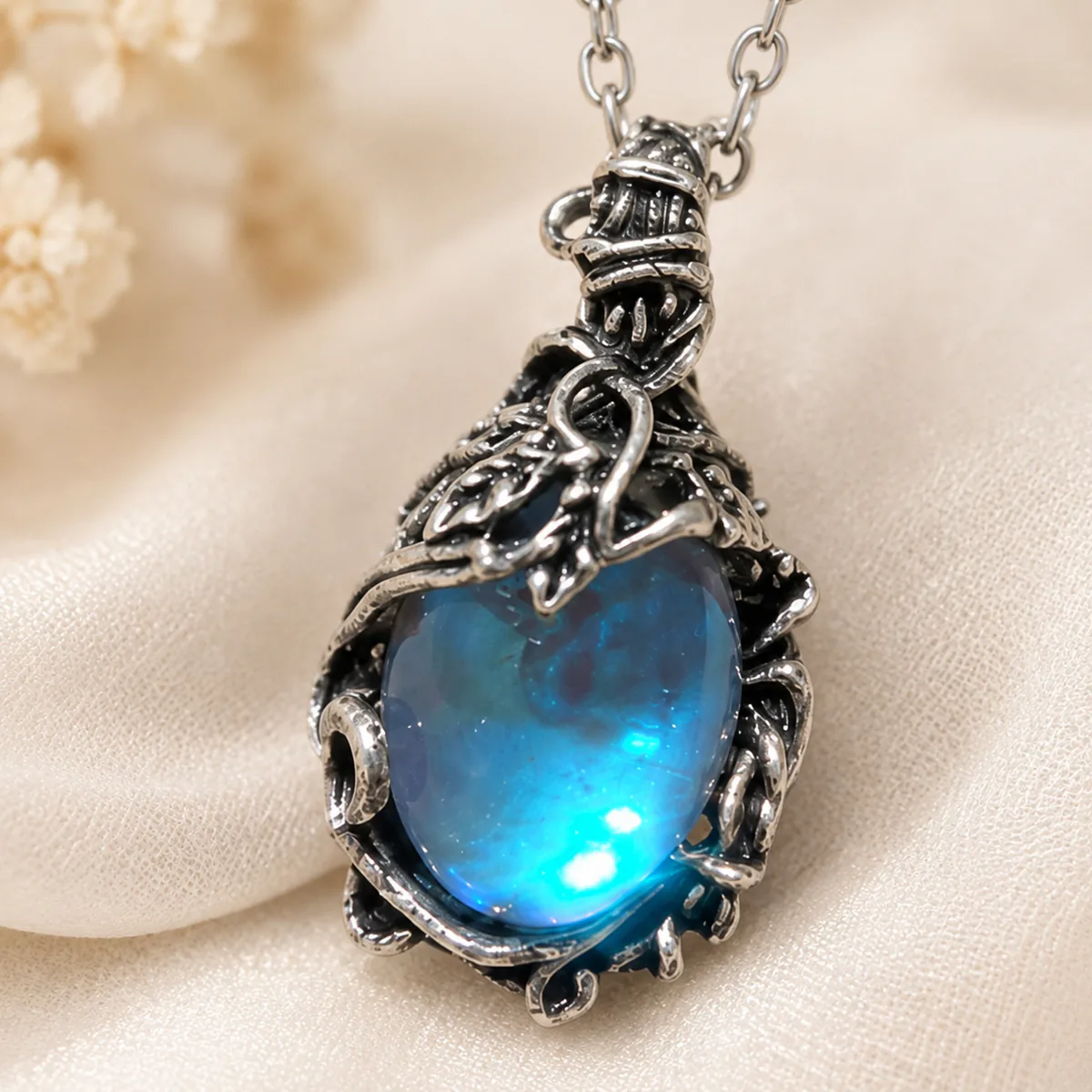
An oval stone of a deep blue, almost turquoise in places, caught in an interlacing of silver leaves and stems with blackened hollows. The mounting winds around it and bites onto its edges: it holds the stone as much as it decorates it.
A saturated blue cannot stand warm lamps
Here is the most useful thing I can write about this necklace, and it is also what explains nearly every disappointment on receiving a blue piece. A colour can only send back what the light brings it. Now a warm bulb, a candle, the lighting of a restaurant or of a living room in the evening give off a great deal of red and orange, and very little blue.
The result is beyond argument: under a warm lamp, this necklace turns grey, muted, almost extinguished. In daylight or under cool lighting it recovers its full saturation at once. It is not the stone that changes, it is what you send at it, and no quality of material escapes that.
Three practical consequences. Unpack it in daylight, or put off your first look until the next morning, otherwise you will judge the stone in the least favourable conditions there are. Wear it preferably by day or in rooms lit in cool white, where it gives its best. And do not be surprised that it looks duller at dinner than at the office: it is predictable, it is measurable, and it has nothing to do with wear.
A mounting that covers the stone
The foliage does not merely surround the cabochon: the leaves climb over its edges and cover it in places. They are what holds it, there is no other fixing system. In other words, what looks like ornament is here the mechanical part of the piece.
The advantage is real and it is twofold. The rim of a cabochon is exactly where it chips: here it is covered on almost its whole circumference, so protected better than by any smooth collar. And if one day a small chip appears under a leaf, you will never see it, where it would leap to the eye on a bare setting. This kind of mounting ages remarkably well for that reason alone.
The trade-off fits in one sentence: you cannot inspect this stone by eye. Its edge is invisible, its borders are under the metal, and a leaf that had lifted still looks like decoration. The check therefore has to be by touch: once a month, lay a fingertip on the stone and push it gently sideways. It must neither move nor click. Then run a fingernail over the leaf tips: none should catch. The stone chips on impact rather than scratching, and on this model it is touch that will warn you, not sight.
The hollows of the metal are deliberately blackened, as on the shop’s other pieces in relief: it is that contrast which makes the foliage legible, and a silver polishing cloth would erase it.
A dark stone hides everything, in both directions
There is a logic shared by the colour of this stone and the drawing of its mounting, and it deserves stating plainly. A dense blue masks what lies inside it: inclusions, veils, small internal irregularities disappear into the depth of the tone, where a pale stone would put them all on show. It is one of the reasons dark stones often look cleaner than pale ones.
The same opacity works the other way: it also masks what is happening. A scratch on the dome, the start of a chip, a deposit of dried cream in a hollow, all of it is noticed far later than on a pale stone. This necklace will not alert you, you will have to look at it on purpose, now and then, in full light and from several angles.
That conclusion holds for the whole piece: between a stone that conceals and a mounting that covers, it is the piece in the catalogue that asks for the most deliberate checking and gives the least of it spontaneously. One minute a month is enough. The shop’s other necklaces are here, and the sizing guide is there.
Crystal healing tradition attaches blue stones to centres different from those of the pale varieties, and I note below one amusing consequence of that reasoning. I will go no further: none of it is demonstrated and no piece of jewellery heals anything. Separately, I have gathered what tradition lends this stone and what each colour changes.
- Deep blue oval cabochon, silver foliage mounting, hollows patinated black.
- Unpack it in daylight: under a warm lamp, a saturated blue looks grey. It is physics, not a fault.
- The leaves hold the stone: the check is done with a finger, not with the eye.
- Delivered in two weeks, with a cotton pouch, a handwritten note and a care card.
The specifications
- Stone
- Blue moonstone, oval cabochon
- Appearance
- Deep blue, more saturated in daylight
- Metal
- 925 sterling silver, hollows patinated black
- Setting
- Foliage closed over the edges of the stone
- Chain
- Oval link
- Gender
- Women
- Brand
- Melissa Moon
Blue is the colour photographs lie about best
I sell jewellery online, so I am going to say the thing that suits me least. On a white or grey stone, a photograph comes fairly close to reality. On a saturated blue it does not: product shots are taken under cool, powerful lighting, which is precisely the light that flatters this colour most, and every screen then renders blues its own way. Two phones side by side will not show you the same stone.
I therefore cannot guarantee you a blue, and I am wary of those who do. What I can do is tell you to judge it in the right conditions and without hurrying: take it outside, look at it at several hours of the day, and use the fourteen-day right of withdrawal, which exists for exactly that. A blue that disappoints you in real life has no reason to stay in a drawer. The rest of the shop is here.
Of all the colours, blue is the one photographs lie about best. Judge it outdoors.
No salt, no ultrasonic tank, no hot water: all three damage the stone for good, and ultrasonics would loosen the leaves that hold it besides. And one rule takes priority here: nothing that polishes, no silver cloth, no paste, no cleaning bath for silverware, on pain of erasing the black patina of the hollows and flattening the foliage. Lukewarm water, a drop of mild soap, a very soft brush passed between the stems, a rinse and thorough drying by dabbing, water lingering under the leaves and leaving pale rings as it dries. Take the necklace off before the shower, the pool and sport. The detail is in cleaning a moonstone piece, and the safe methods in caring for it without harming it.