


Description
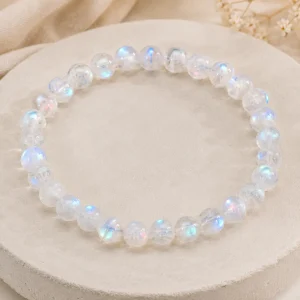
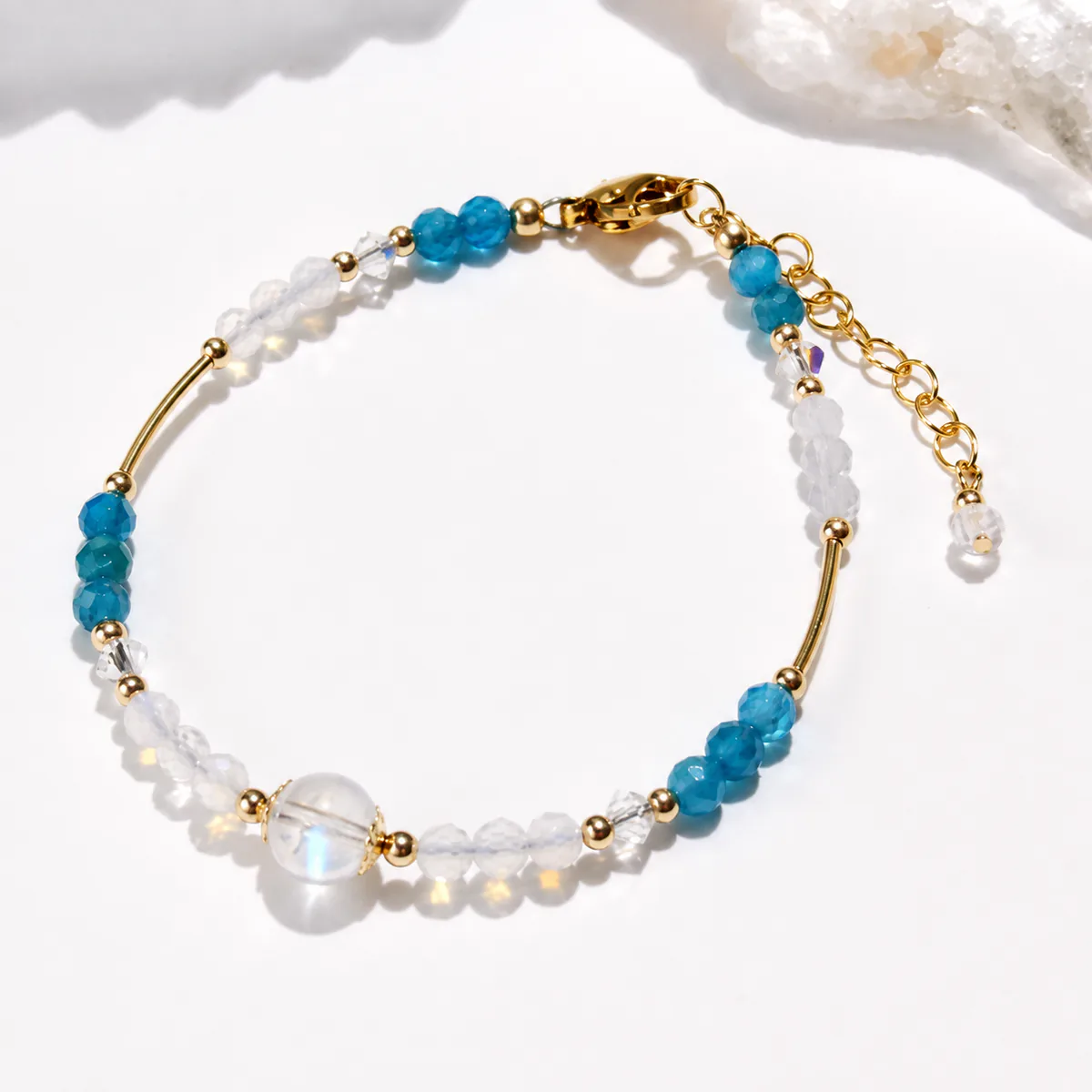
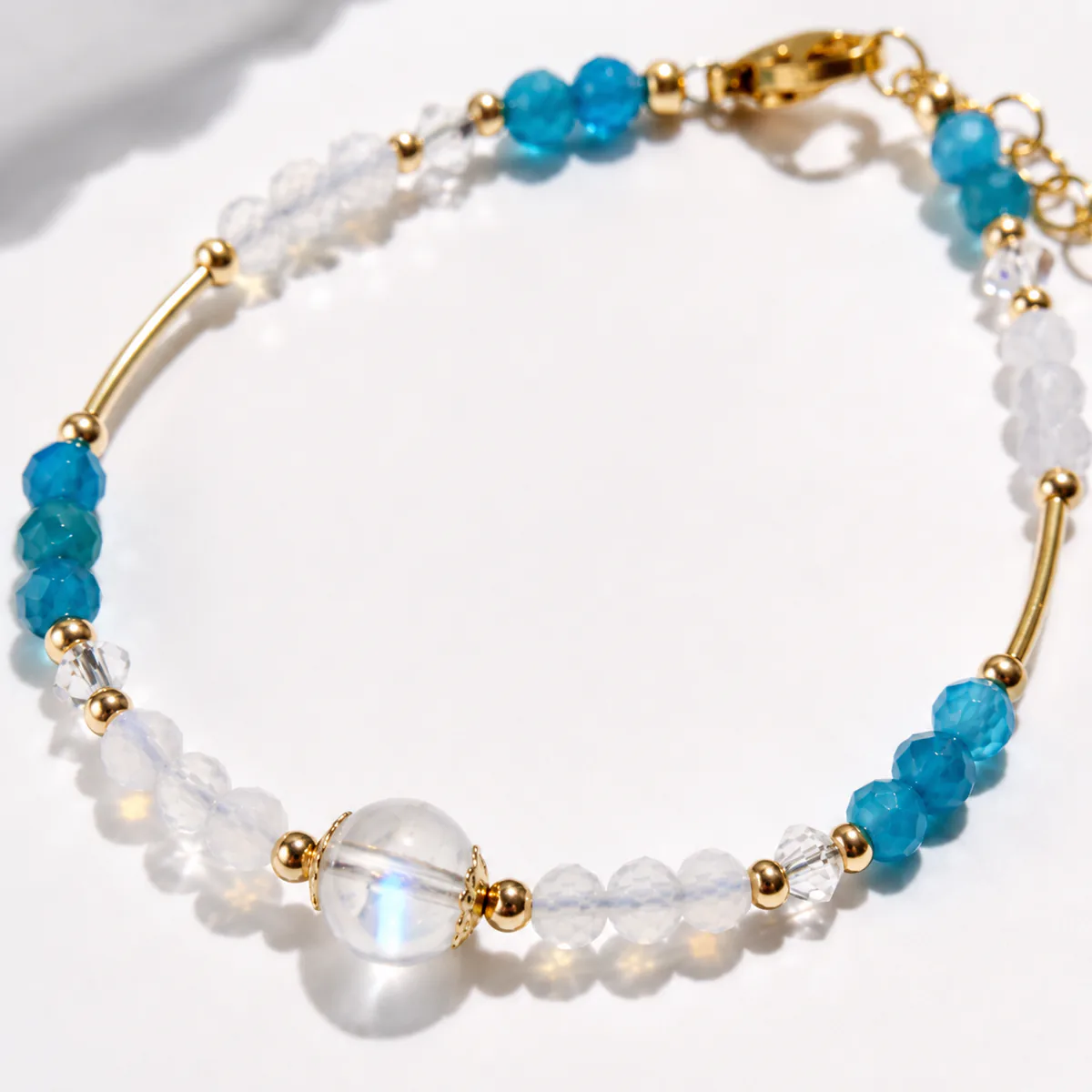
Small faceted white beads, groups of beads in a vivid, almost electric blue, one large clear bead capped with gilt caps, and curved gilt metal tubes giving the whole its rhythm. It is the most contrasted duo in the catalogue: one stone that waits for light, another that does not need any.
For once, the moonstone is the harder one
I write the same warning on every two-stone bracelet: careful, the companion stone is harder and it will mark the moonstone. Here it is exactly the opposite, and for once the figures are unambiguous. Apatite occupies rank 5 on the hardness scale, and that is not an approximation: it is the stone Mohs chose as the reference for that rank when he built his scale. Feldspars sit between 6 and 6.5.
In other words, on this bracelet it is the apatite that will take the marks. The white beads are harder than their blue neighbours, they rub against them at every movement of the wrist, and after a few years the blue facets will be slightly blunted while the white ones will have barely moved. That is not a manufacturing fault, it is mechanics.
The practical consequence is simple and it goes against habits I recommend elsewhere: this bracelet is the least suited of all to stacking. A quartz or amethyst bracelet worn on the same wrist would damage the apatite far faster than it would damage the moonstone. Wear it on its own, or with a fabric bracelet.
A blue that does not need light
The contrast between the two stones is not only a matter of colour, it is first of all a matter of behaviour. The moonstone shows itself only under favourable light: under a ceiling lamp it becomes a white bead again, and its sheen needs a turn of the wrist to appear. The apatite is blue permanently, in the dark as in the sun, because its colour is a body colour and not an optical effect.
That is what makes this bracelet legible in every circumstance. There is always something to see: the vivid blue holds the piece together when the light is poor, and the white beads take over as soon as it is good. Few duos work as well in that respect, and it is the whole reason for this one.
In exchange, apatite asks for two precautions that moonstone does not. It fears heat, which can alter its colour: no sunny windowsill, no car in summer, no hot water. And it fears acids, since it is a phosphate: vinegar, household products, jewellery cleaners and even very acid perspiration dull it over time. Rinse it in clear water after a workout, dry it, and the problem does not arise.
Where a fine bracelet breaks, and why it is always in the same place
Here is what is particular about this model, and it has to do with its construction rather than its stones. The row is punctuated by curved gilt metal tubes, which give the bracelet its line and keep it from collapsing. They are rigid segments inserted into a flexible assembly, and that is where the lifespan of the piece is decided.
A bracelet flexes at every movement. On a row of beads, that flexing is shared among all the beads. Here it cannot happen inside the tubes, which do not bend: it therefore concentrates just where they end, on the two or three centimetres of thread continuing them. That is precisely where a bracelet of this type eventually gives way, and never in the middle of a free section.
Nothing can be done about the principle, but two moves count: never pull on the bracelet to take it off, open the clasp, and check the immediate surroundings of the tubes now and then, where a tired thread shows before it snaps. The clasp is a lobster fitted with an extension chain, which lengthens but never shortens: as on the other models with a chain, choose on the tight side. The sizing guide is here, and the shop’s other bracelets are there.
Both stones stay sensitive to impact, the apatite even more than its neighbour: they chip rather than scratch, and a facet is the worst possible place to take a knock. The quality criteria are set out here. Crystal healing tradition associates these two stones with different centres, and I have put those correspondences below. I will go no further: none of it is demonstrated and no piece of jewellery heals anything. Separately, I have gathered what tradition lends this stone, what each colour changes and what is said about which wrist to choose.
- Faceted white beads and vivid blue apatite beads, on a gilt assembly with curved tubes.
- Apatite is the softer of the two: it is the one that marks, and this bracelet is worn on its own.
- No heat and no acids for the apatite. No hot water, no car in summer.
- Lobster clasp and extension chain. Delivered in two weeks, with a cotton pouch and a care card.
The specifications
- Stones
- White moonstone and blue apatite
- Cut
- Faceted beads, one round central bead
- Metal
- Gilt metal: curved tubes, balls, caps and clasp
- Construction
- Lobster clasp with extension chain
- Hardness
- Moonstone 6 to 6.5; apatite 5
- Gender
- Women
- Brand
- Melissa Moon
What I look at on an apatite
This stone poses a choice few others impose so plainly: in any one parcel, the most intensely blue beads are almost always the cloudiest, and the most limpid are almost always the palest. You cannot have both, or only at a price that has no business on a bead bracelet.
I come down on the side of colour, and the faceted cut helps me: the edges send back enough light for the slight internal veil to go unnoticed, where it would leap to the eye on a round polished bead. It is one of the rare cases where faceting is not a contradiction but a solution. The rest of the shop is here.
Usually I explain which stone will mark the moonstone. On this bracelet, it is the moonstone that marks.
No salt, no ultrasonic tank, no hot water: the three usual prohibitions count double here, apatite being softer and more sensitive than moonstone. Add a fourth, particular to it: no acid product and no jewellery cleaner, which chemically attack a phosphate. Lukewarm water, a drop of mild soap, a soft cloth, careful drying between the facets. The gilt metal, for its part, cannot be polished: no paste, no brush, no abrasive cloth, on pain of taking the gilding off. The detail is in cleaning a moonstone piece, and the safe methods in caring for it without harming it.