


Description
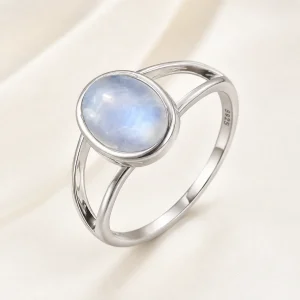
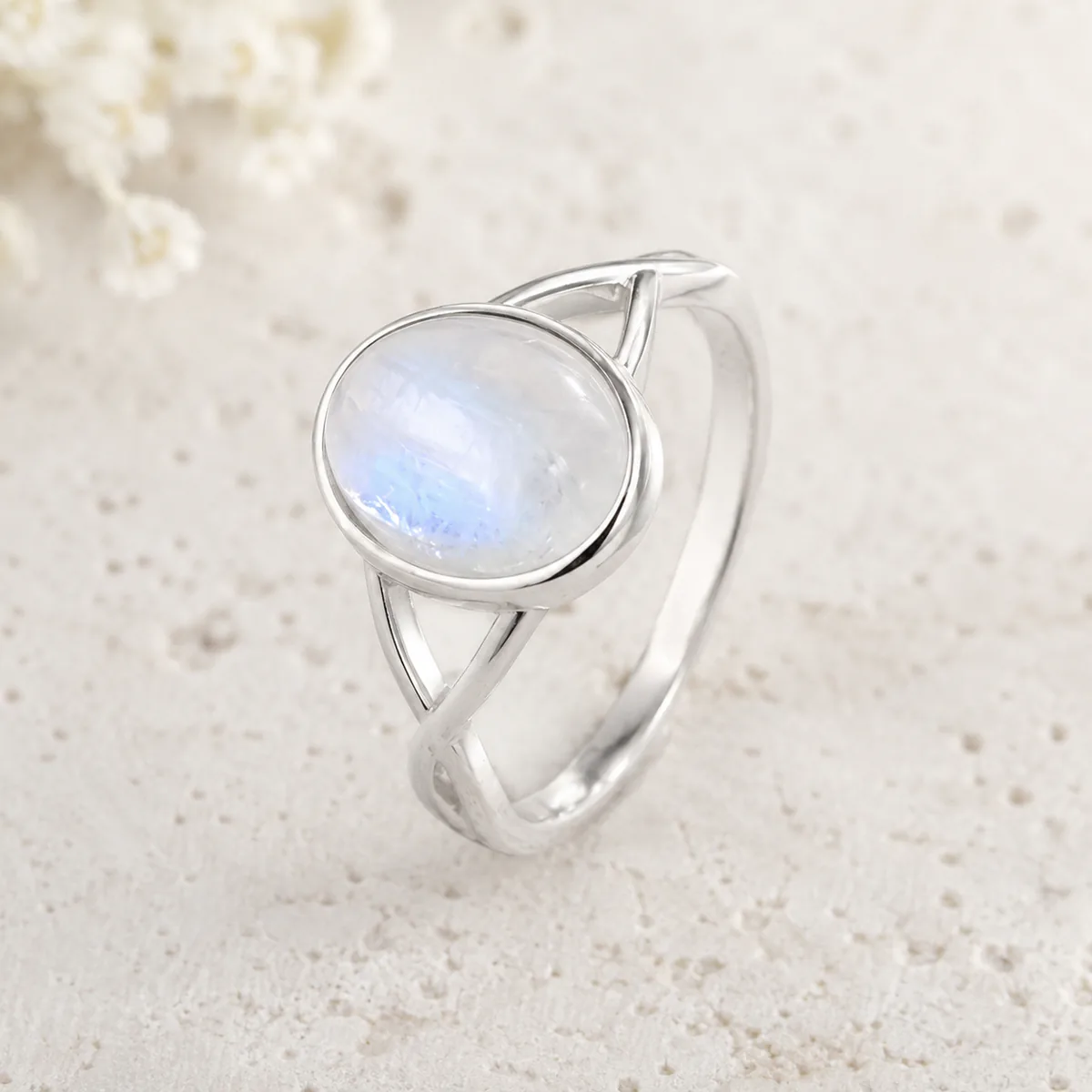
It is the ring you never take off. A silver band so thin you forget it after two days, crossing under the stone instead of running as a plain circle, and a moonstone cabochon sitting on top as if it floated. This is the one you wear for no reason at all, on a Tuesday.
A crossed band, and why it changes everything
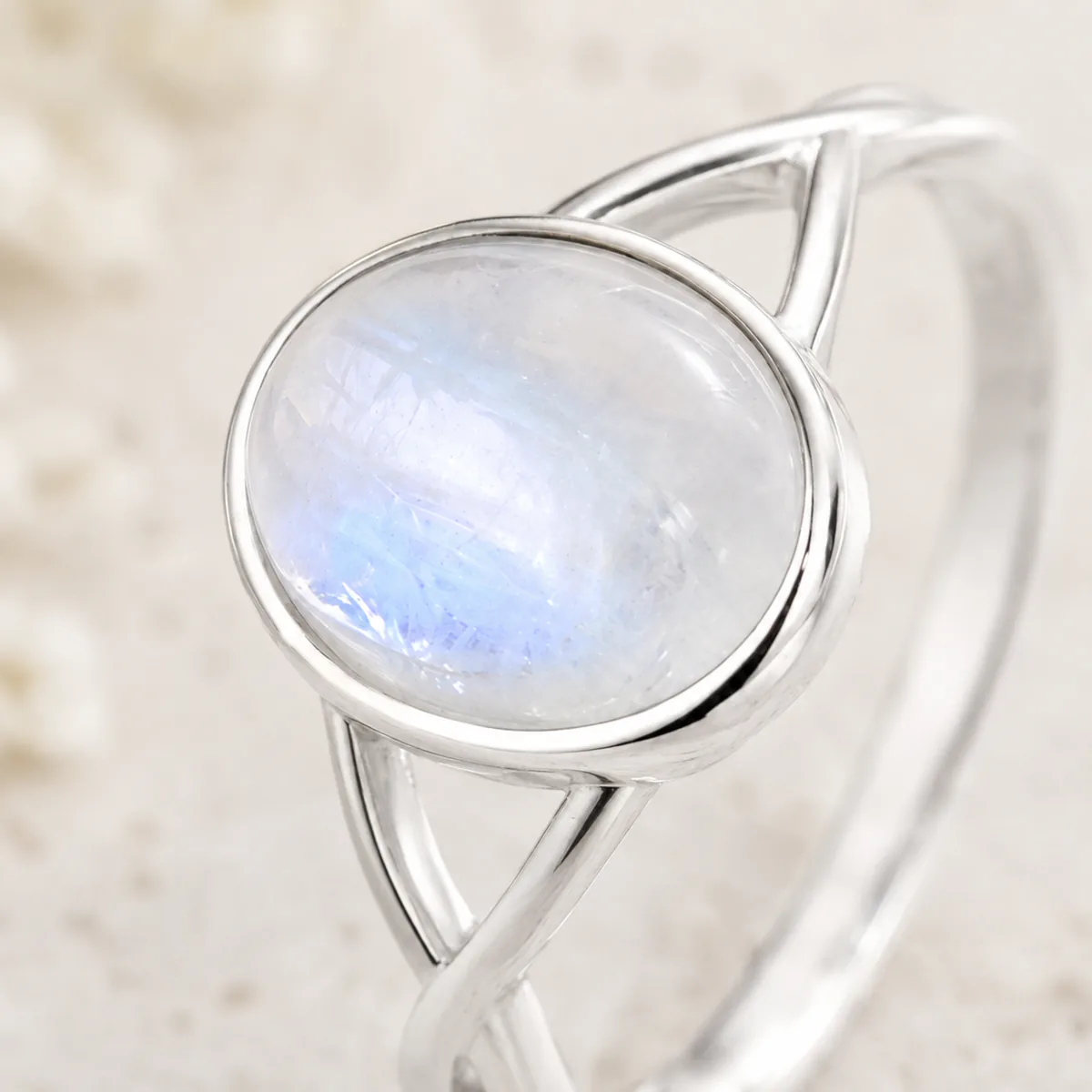
The band does not run in one plain circle. It splits, its two strands cross under the setting and pull apart again to hold the bezel on either side. It is not decoration: a plain band thin enough to disappear would be too soft to carry a stone this size, and the crossing gives back exactly the rigidity it loses in thickness. It is the same principle as a lattice beam, in a much prettier shape.
The cabochon, meanwhile, is left bare in a smooth bezel. The blue veil you see sliding across the dome is called adularescence, and it needs to be left alone. Nothing is engraved, nothing is blackened, nothing is set around it.
It can be worn alone or stacked. One useful detail: with its crossed strands, it stacks better against a flat band than against another shaped ring. If you want more presence, the shop offers a version with a blackened beaded crown and another in gold plate; if you want the same simplicity with a plain band, there is the split version. They are all here.
The limit, and on this ring it matters more than on others
A thin band deforms, and a crossed band cannot be resized. On a plain band, a jeweller cuts, adds or removes metal and closes it back up. Here the crossing point is the load-bearing point of the whole ring: touching it means redrawing it. So take the time to check the size guide before ordering, and if you are torn between two, take the larger. The second point is the stone itself: moonstone has perfect cleavage, it chips on impact without scratching easily, and a thin setting protects it less than a heavy one. This is not a DIY ring, and not a gardening one either.
- Oval moonstone cabochon, clear blue veil, smooth undecorated bezel.
- Sterling silver, thin band with crossed strands under the setting. No glue.
- UK sizes I 1/2 to T 1/2 (48 to 62 mm). Delivered in two weeks with a cotton pouch, a handwritten note and a care card.
- The most understated ring in the catalogue. Put on in the morning without thinking, still there at night.
The specifications
- Stone
- Real moonstone (adularia), oval cabochon cut
- Metal
- 925 sterling silver
- Setting
- Smooth closed bezel, no glue
- Band
- Thin, crossed strands under the setting
- Resizing
- Not adjustable after manufacture
- Sizes
- UK I 1/2 to T 1/2 (48 to 62 mm)
- Gender
- Women
- Brand
- Melissa Moon
Why I keep making thin bands
Because it is what people actually wear. I have sold wide, elaborate rings to happy customers who told me six months later they only wore them on weekends. A ring you do not wear is a failed ring, however much care went into it. Thin is more fragile, it deforms, it needs looking after: I would rather make a piece worn three hundred days a year that needs some care than an indestructible one that sleeps in a box.
The crossing under the setting is not decorative. It is what lets the band go this thin without going oval on your hand after a month. A plain band this delicate would not hold this stone. The rest of the shop is here, including what I have taken out of the catalogue.
I am often asked whether it can stay on for sleep. Yes, and it is actually the best test: after a week, either you no longer feel it, or you have put it away.
No salt, no ultrasonic tank, no hot water: moonstone is a feldspar, and all three damage it for good. Lukewarm water, a soft cloth. On a band this thin, add one more habit: take it off for anything that puts force through your hands, carrying bags, using a screwdriver, gardening. It is not water that deforms a thin ring, it is pressure. The detail is in cleaning a moonstone piece, and the safe methods in caring for it without harming it.