


Description
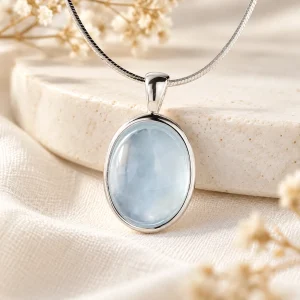
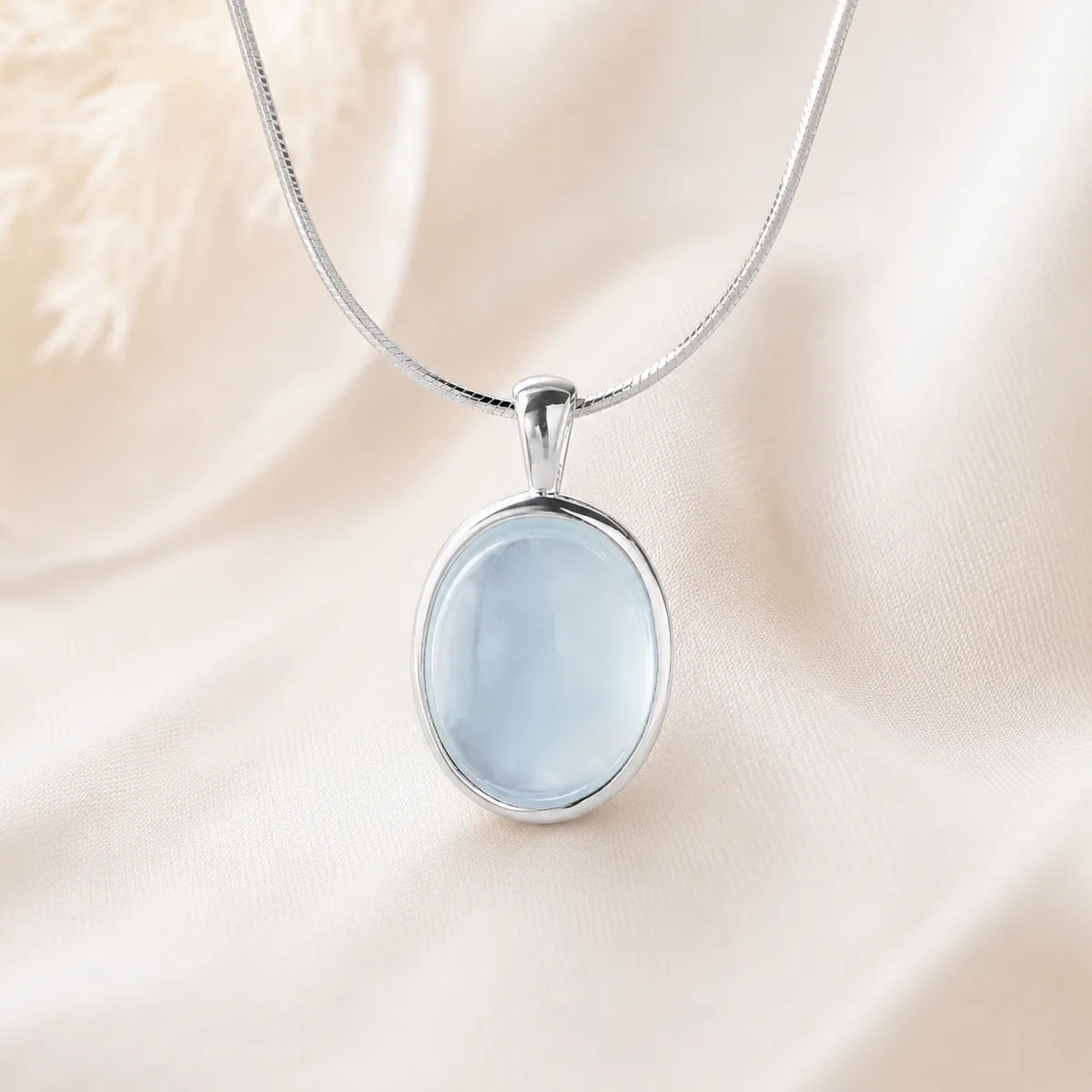
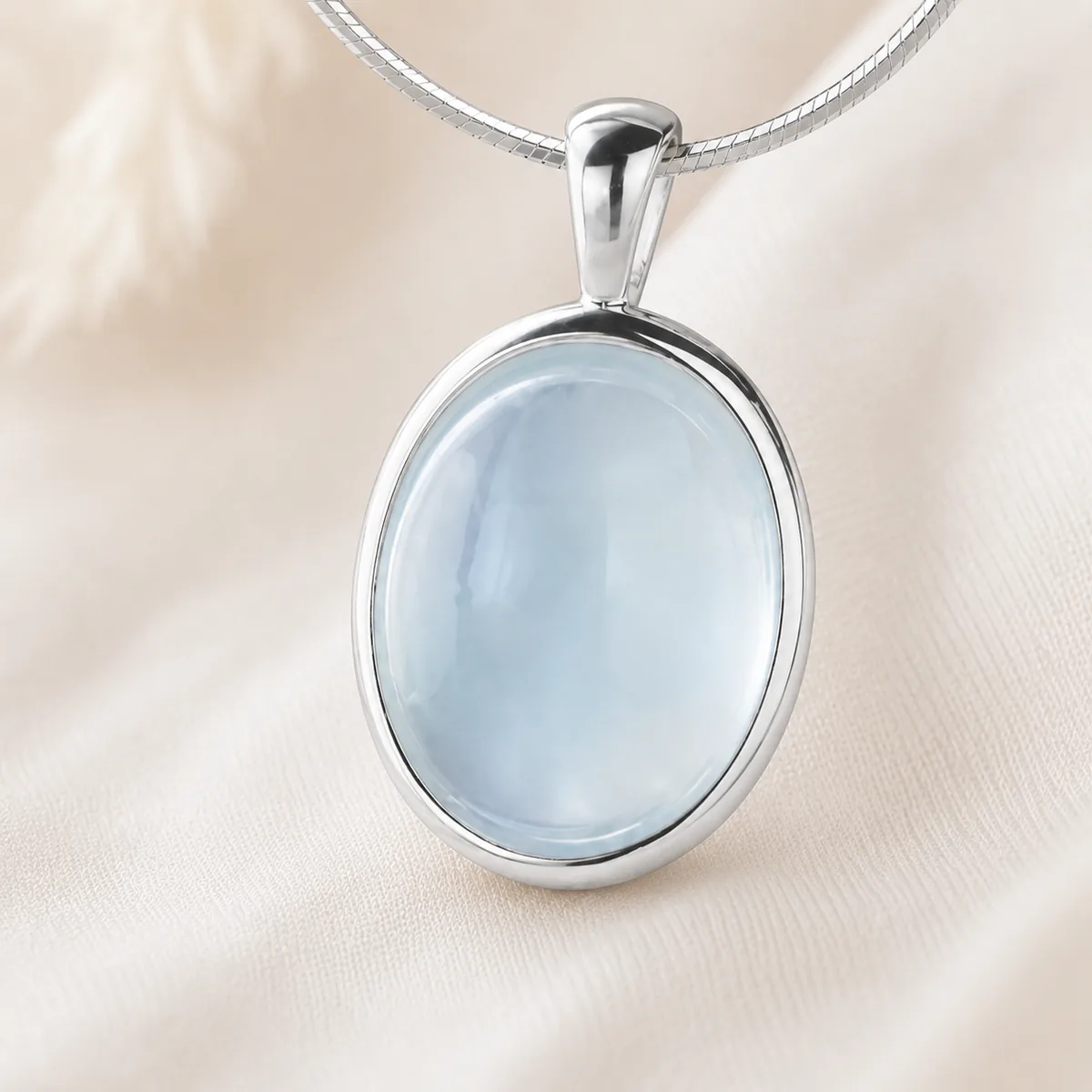
A wide oval cabochon in bluish white, closed inside a plain polished silver ring with no decoration at all, a flat bail, a round smooth chain. Everything here is stripped to essentials, and the subject of this page is not the stone but the metal that holds it.
Why 925 and never 1000
Pure silver exists, it is called fine silver, and it is not used to make jewelry. It is too soft: around 2.5 on the hardness scale, it scratches with a fingernail, deforms under pressure and will not hold a setting for more than a few months. A bail in pure silver would open on its own under the weight of a pendant.
Hence the alloy. The number 925 means 92.5% silver and 7.5% other metals, almost always copper. It is this copper that makes the piece possible: it hardens the whole, allows riveting, setting, polishing and a clean edge. Without it, this necklace would not exist in this form.
And here is the paradox that explains the rest of this page: that same copper is what causes the tarnish. The alloy’s virtue and its flaw are the same metal. You cannot have solid silver that never tarnishes, and any seller who promises that is selling you something else, usually plating. The number 925 is stamped somewhere on the piece, usually on the bail or the clasp tag: it is small, you often need a magnifier, and it checks out in thirty seconds.
Tarnish, and why you should wear this necklace
Here is this piece’s real particularity, and it is a misunderstanding kept alive everywhere. Silver does not rust and does not get damaged by tarnishing. That grey, then brown, then black film is silver sulfide, a surface reaction with the sulfur compounds present in the air. It does not eat into the metal, it sits on top of it, and it comes off.
The consequence is counterintuitive and I rarely see it written: a silver piece worn often tarnishes far less than one left in a drawer. Friction against skin and clothing constantly polishes the surface and carries the sulfide away as it forms. This necklace is therefore not one to save for special occasions: it is exactly the opposite, it wears best worn every day.
If you do need to store it for a long time, air is the enemy: a closed bag with no contact with the ambient air beats a dish left on a dresser. Also watch out for a few neighbors that speed everything up, because they release sulfur: wool, rubber, certain cardboard and paper, eggs, onion. An elastic band left around a silver piece leaves a clear black mark within days.
One last point, often worrying for no reason: if your skin darkens slightly under the piece, or if it tarnishes faster on you than on a friend, that is neither an allergy nor a fake. It is your own chemistry, the acidity of your sweat, a medication or a cream, speeding up the same reaction. The cleaning method is detailed here.
A closed bezel, and why it is the right choice here
The stone is enclosed in a ring of metal folded over its edge, with no visible prongs at all. This is not an aesthetic choice but a technical one, and it comes down to the nature of this particular stone.
A prong setting exists to let light in from underneath and pass through the gem: essential on a transparent, faceted stone, whose entire sparkle comes from what passes through it. On a moonstone, that serves no purpose whatsoever, since its sheen is born from light arriving from above and leaving on the same side. Closing the underside takes nothing away from it, and adds three things: protection all around the rim, exactly where a cabochon chips, no prongs to catch on sweaters or bend up unnoticed, and a hold that will not loosen with the years. The stone chips on impact without scratching easily, which makes this protection genuinely useful day to day.
The chain, meanwhile, is what is known as a snake chain, round and smooth, with no visible links. It has a weakness worth knowing: it cannot be bent sharply. A link chain deforms and straightens back out; a snake chain bent at an angle keeps that crease forever, and that crease becomes a breaking point. Do not roll it up tight at the bottom of a bag, do not pull on it to take the necklace off, and hang it rather than leaving it in a pile. The shop’s other necklaces are here, including the openwork version that presents the same stone another way. The size guide explains how to choose a length.
- Oval closed-bezel cabochon, 925 silver, snake chain.
- 925 means 92.5% silver and 7.5% copper: the copper makes it strong, and it is also what makes it tarnish.
- A silver necklace worn every day tarnishes far less than one left in a drawer.
- Shipped in two weeks with a cotton pouch, a handwritten note and a care card.
The specifications
- Stone
- Moonstone, domed oval cabochon
- Look
- Translucent bluish white, moving sheen
- Metal
- 925 sterling silver, hallmarked
- Setting
- Closed bezel, no prongs
- Chain
- Snake chain, 925 silver
- Gender
- Women
- Brand
- Melissa Moon
Why the shop chose silver
It is not a question of budget, or not only. At this price point, the alternative is not gold, it is gold plate, and I have already written elsewhere what I think of that: plating has a lifespan, it cannot be repolished, and the day it wears through, the piece is finished. Solid silver, on the other hand, can be brought back indefinitely. A tarnished, scratched, blackened necklace can be made like new by any jeweler, and it can be done ten times over.
It is the only argument that matters to me when choosing a piece meant to be worn every day for years. A metal that ages badly but can be nursed back is worth more than a metal that does not age at all until the day it cracks. Silver tarnishing is not a flaw, it is the price of a repairable material. The rest of the shop is here.
Silver tarnishes, and that is its virtue. It is the materials that never change that cannot be brought back.
No salt, no ultrasonic tank, no hot water: moonstone is a feldspar, and all three damage it for good. For the metal, lukewarm water, a drop of mild soap, a soft cloth, a complete drying with attention to the edge of the setting, where water settles between the silver and the stone. When the necklace has properly tarnished, a silver polishing cloth is the right tool, but only on the metal: these cloths are mildly abrasive and have no business on a cabochon. Skip silver-cleaning dips, though, which seep under the stone and stay there. Take the necklace off before the shower, the pool and sport. The detail is in cleaning a moonstone piece, and the safe methods in caring for it without harming it.