Rainbow Moonstone
A clear, almost transparent body, crossed by blue flashes that light up in patches. Rainbow moonstone is the most demonstrative of the family, and the cheapest of the stones that make this effect. It is not an adularia: it is a pale labradorite, and I prefer to write it.
Showing all 3 results
-
-20 %

Rainbow Moonstone Necklace
Original price was: 52,90 €.41,90 €Current price is: 41,90 €. Choose options -
-20 %
Rainbow Moonstone Pendant
Original price was: 42,90 €.33,90 €Current price is: 33,90 €. Add to cart -
-20 %
Rainbow Moonstone Ring
Original price was: 54,90 €.43,90 €Current price is: 43,90 €. Choose options
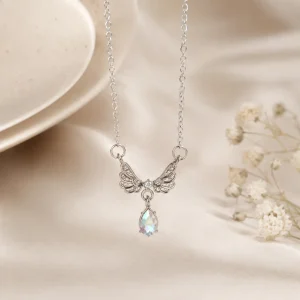
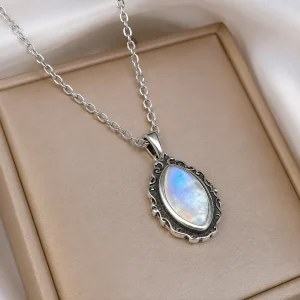
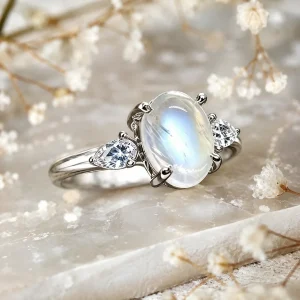
A pale labradorite, and what that changes to the price
Classic moonstone is an orthoclase, adularia. Rainbow moonstone is a labradorite, a plagioclase feldspar: the neighboring branch. The GIA, Mindat and the International Mineralogical Association class them separately.
That is what explains its price. A fine blue adularia trades between 50 and 500 EUR a carat, a pale labradorite between 3 and 25. Rainbow is therefore the most affordable way to have a clear play of light on a pale body. What makes the price sets out the scale.
The optics differ too. Adularia produces an adularescence, a continuous bluish veil. Labradorite produces a labradorescence: patches that light up zone by zone. More demonstrative, less subtle. The full sorting is here.
Why “rainbow” promises more than the stone gives
Better said before the purchase than on delivery. The name leads you to expect a full spectrum; what you will see on a real stone is mostly blue, with golds and sometimes a violet that appear at certain angles, on the finest pieces.
“Rainbow” says it can bring up several colors, not that it shows them all at once. A stone that displays a regular spectrum over its whole surface, under any light, is almost never a labradorite.
There is an honest flip side to that reservation. In a window, a rainbow moonstone is more demonstrative than a fine adularia: its colors leap out, where adularescence asks you to take the time to tilt the stone. If you want a piece that is noticed from two yards away, this is the one.
Coated quartz, the trap of this variety
Every variety has its counterfeit. For white, it is opalite, glass. For rainbow moonstone, it is quartz covered with an iridescent film, and a good part of what sells online under this name is exactly that.
Three signs are enough. The colors are too vivid and too regular, spread evenly instead of concentrating in patches. They do not move as you tilt the stone, because they are on it, not in it. And the film stops dead near the setting, where the layer wears. The five full signs are in the blog, with what the law requires of the seller.
On a real stone, the flash is born of lamellae caught in the crystal: it moves and goes out with the angle. It is the only test that counts, and it needs nothing but a lamp. Then come the spread of the flash and the cleanness of the body, a jeweller’s six criteria.
The setting decides what you will see
This is where rainbow is not handled like its dark sister. Its body is translucent: part of the light passes through before coming back out, so what is behind the stone counts as much as what is in front.
A bezel protects a stone with perfect cleavage, but it also closes off the back. An openwork setting lets daylight through and gives the body more life, at the cost of a more exposed stone. The trade-off is here, and on an everyday ring I lean toward the bezel.
The rest holds for the whole family: 6 to 6.5 on the Mohs scale and perfect cleavage, so it splits more than it scratches. Never salt, never ultrasound, no shower and no pool. And a pale body shows the marks of use that a dark ground hides: cleaning it and cleansing it without risk therefore count for more here.
What tradition lends it
A change of register. What comes before can be measured. What follows belongs to crystal healing, an approach founded on traditions and beliefs, and is written in the conditional.
It would be lent clarity and protection in travel. These attributions come from two distinct places: from the moonstone whose name it carries, and from the labradorite that is its species. None belongs to it in its own right, and saying so seems more useful to me than copying out a list. Its meaning is in the blog.
More concrete: it gives well. The play of colors is seen at once, which makes it a gift that needs no explaining. Who to give it to and when.
These correspondences are not properties. They belong to crystal healing, an approach founded on traditions and beliefs. They are not a medical claim and never replace the advice of a health professional. Read the full disclaimer.
What you will not find here
No coated quartz. It is the reigning counterfeit of this variety, and it is prettier in a photo than the real stone. I do not set it.
No labradorite sold as an adularia. I use the trade name “rainbow moonstone” because that is how it is searched for, but the species is named on every listing and the price is that of a labradorite.
No retouched photo. The colors you see are the ones the stone gives under ordinary light.
No promise. A piece heals nothing and acts on no one. What tradition tells is above, presented as a tradition.
A question before you order? Write to me, I reply within 48 working hours, and you have fourteen days to change your mind. If it is another sheen you are after:
On this variety more than the others, two neighboring stones do not look alike. On request I send a two-angle photo of the exact piece you will receive. The workshop, in a few words.