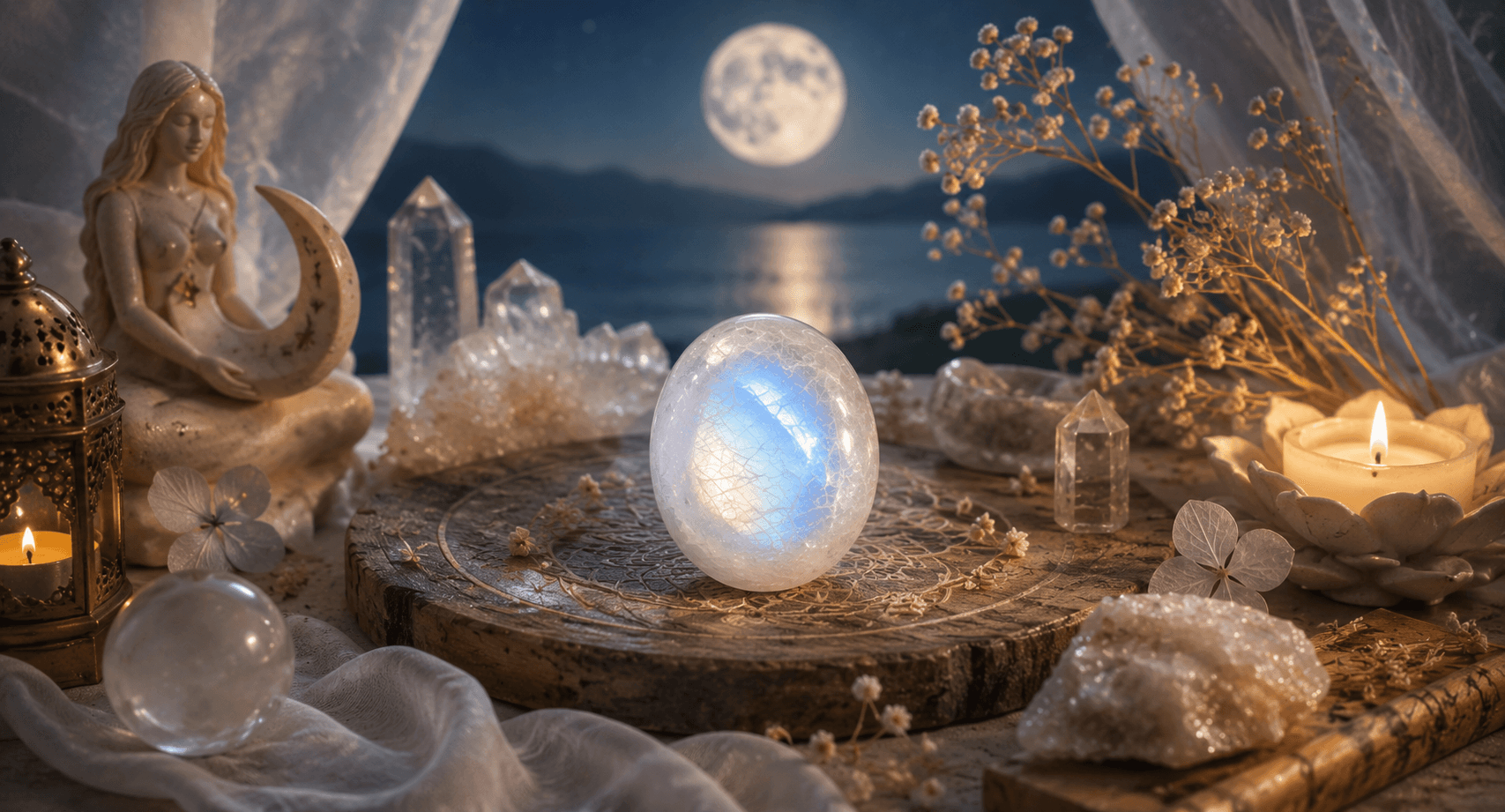
Moonstone Meaning
What moonstone actually means, not what powers it is credited with: its lunar symbolism, the phrase "sacred feminine" and its real age, what it meant in Rome, in India and at Lalique, the meaning attached to each color, and above all the message you send when you give it to someone.
Benefits and meaning are two words most sites cram into the same page. They are not the same question. Benefits are what the stone is said to do, and that is the subject of the benefits of moonstone. Meaning is what it says: its symbol, its history, and the message a gift carries. That is this page.
The short version, if you are in a hurry
- Its symbol comes down to one idea: light given back. The Moon produces no light of its own, it reflects it. Everything else in the symbolism flows from that.
- It means cycle and passage, what changes shape without disappearing. That is the most consistent meaning across cultures.
- The equation Moon equals feminine is not universal. Chandra in India, Tsukuyomi in Japan, Sîn in Mesopotamia, Máni among the Germanic peoples: four male moon gods.
- The phrase "sacred feminine" dates from the 1970s, and its spread in France owes a lot to a 2003 novel.
- It was an Art Nouveau stone around 1900, used by Lalique and Louis Comfort Tiffany, for its milky light. That is a documented fact, not a legend.
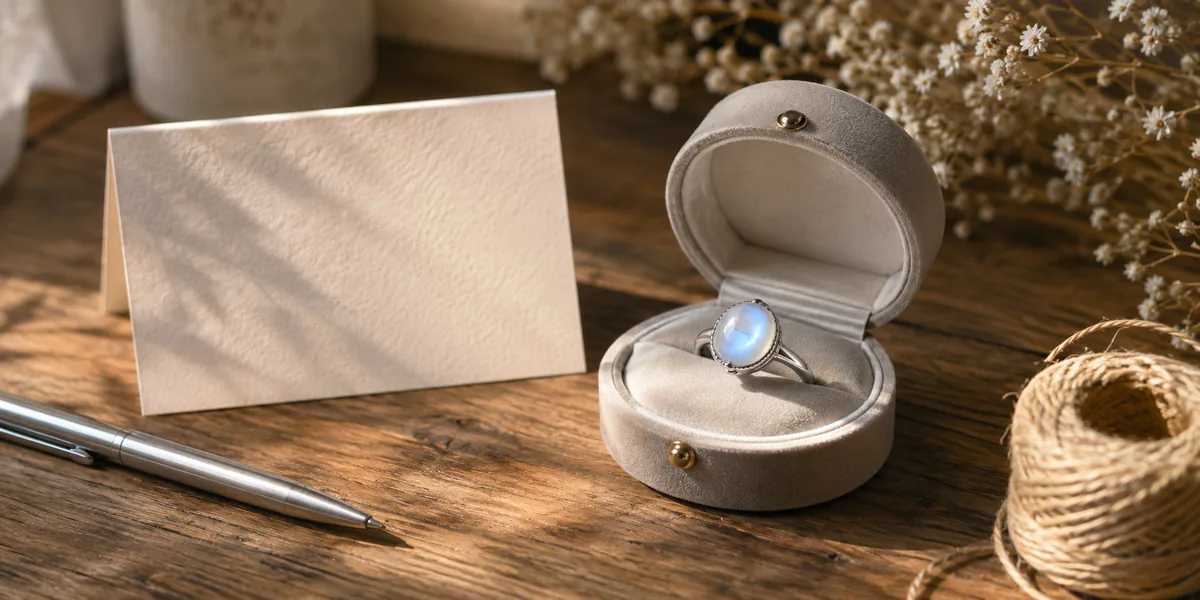
- Given as a gift, it says "something is starting", and that is the truest message you can have it carry.
- The meaning of colors is the most recent layer, and the least stable: sources disagree with each other, except on two of them.
Why a stone's meaning matters, even without power
Might as well settle this right away, because this page would be dishonest without it.
A stone has no demonstrated effect. I have written elsewhere why, with the study that shows it, in the benefits of moonstone. That does not disqualify this page, because meaning is not the same order of thing as effectiveness.
The meaning of an object is a social fact, not a physical property. A wedding ring does not do anything either. It does not protect a couple, it does not make anyone faithful, and yet no one finds it absurd to wear one. What it does, it does entirely through what it means: it makes a commitment visible, and that visibility is real.
A moonstone works exactly the same way. When someone gives you one at a moment your life is changing, the object changes nothing about your situation. It says "I noticed." That is already a lot, and it requires no belief at all.
That is why I take this page seriously while refusing to write that a stone heals anything. The two positions are perfectly compatible: I am talking about meaning, not effect.
Lunar symbolism, the root of everything
Everything starts from the moon itself, and a single characteristic explains almost everything else.
Let us start with the fact, stated plainly, because it is measurable: the Moon produces no light. It reflects the Sun's. What we see of it is borrowed light, sent back.
From that single fact, cultures have drawn a remarkably consistent family of meanings. The Moon was seen as the symbol of what receives rather than what produces, what reveals without blinding, what accompanies the night without erasing it. Where the Sun is associated with assertion and plain evidence, the Moon is associated with nuance, reflection, what you catch out of the corner of your eye. This opposition has structured the stone's symbolism since antiquity.
The second family of meanings comes from the cycle. The Moon is the only object in the sky whose shape visibly changes and comes back. It waxes, wanes, disappears, returns. So it became, everywhere, the symbol of what passes without ending: seasons, ages, new starts, death that is not final. This is the most consistent meaning from one culture to the next, far more than the feminine.
That leaves the third family: the hidden face. The Moon always shows the same side from Earth. Hence the idea of a kept part, a secret, something that exists without showing itself. This is where all the vocabulary of intuition and dreams attached to this stone comes from.
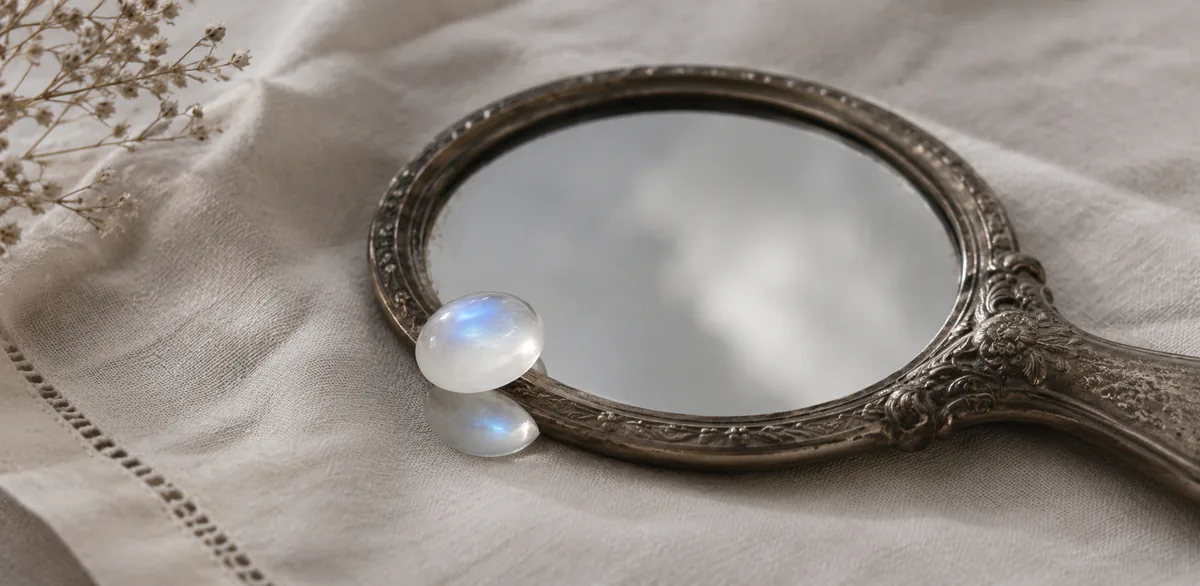
A word on what the stone itself actually does. Its veil is not light it emits: it is ambient light scattering between microscopic lamellae and coming back out bluish. The detail is in the article on adularescence.
I want to note, in a separate paragraph, that the coincidence between these two facts is lovely but remains a coincidence. The stone was not chosen for this: it was named after a visual resemblance, as told in moon rock or moonstone. That the symbol and the mechanism echo each other is a gift of chance, not proof of anything.
The sacred feminine, and the real age of the phrase
This is the phrase that comes up most often in the messages people send me, and the one I have researched the most.
Moonstone is presented almost everywhere as the stone of the sacred feminine. The reasoning goes: the Moon makes the month, the month makes the cycle, the cycle makes the feminine, so the Moon's stone is women's stone. A flawless chain of analogies, and two serious problems.
First problem: the Moon is not feminine everywhere. It is even false across a good half of the world. In India, Chandra is a god, male, and he is precisely the one traditionally linked to this stone. In Japan, Tsukuyomi is a god. In Mesopotamia, Sîn, also called Nanna, is a god, and he governed wisdom and time. In the Germanic world, Máni is a god. The equation Moon equals feminine comes mostly from the Greco-Roman world, with Selene, Artemis, Diana and Luna, and then from its modern revival in the West. The full picture is in the gods and goddesses of the Moon.
This is a detail that is not really a detail. A shop that writes "the Moon has always been feminine" is wrong about three quarters of the planet, and says so with total confidence.
Second problem: the phrase itself is recent. "Sacred feminine" was born in the North American goddess movement of the 1970s and 1980s, around books like When God Was a Woman by Merlin Stone, published in 1976, and The Spiral Dance by Starhawk, in 1979. In France, the phrase stayed niche until the 2000s, when it was massively spread by a bestselling 2003 novel and its film adaptation. These are verifiable facts of cultural history, and they take nothing away from what the phrase can mean for someone today.
What I take from this, and what I tell anyone who writes to me: moonstone can absolutely mean the feminine for you. It is simply not a thousand-year-old tradition, it is a meaning the West gave it about fifty years ago. And nothing obliges anyone to relate to it: the subject has its own article, moonstone for men.
What it has meant, era by era
A stone's meaning is not fixed. This one has changed at least four times, and each layer is still visible in what is said about it today.
Rome, first century. Pliny the Elder describes a stone he calls selenites, said to contain the image of the Moon. At that time, it mainly means the correspondence between sky and earth: a stone carrying the moon in miniature. It is linked to Diana.
India, over the long term. It is Chandra's stone, and the Sanskrit chandrakanta translates as "beloved of the Moon." There it means the marital bond more than the feminine: it is a traditional wedding gift, and in certain traditions it is presented only on a yellow cloth, the sacred color. These stories are gathered in moonstone myths and legends.
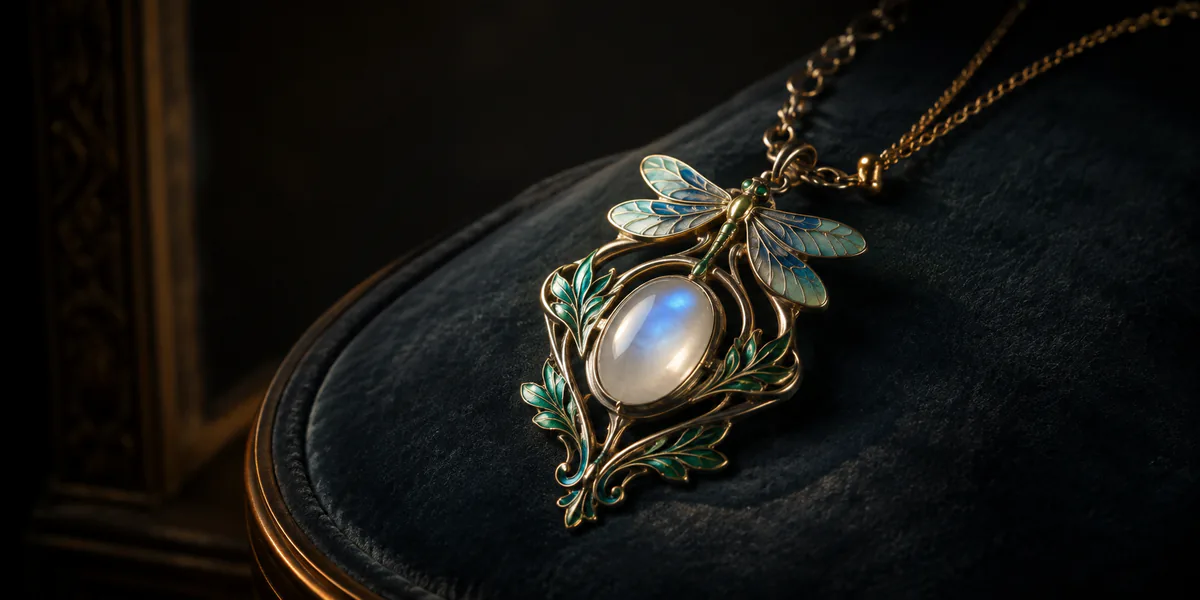
Europe, around 1900. This is the most interesting and most forgotten moment. Art Nouveau adopted moonstone widely, because its milky light suited the era's plant-like lines and translucent enamels. René Lalique set it in his brooches and pendants, Louis Comfort Tiffany paired it with plique-à-jour enamel and opal, the Scandinavian school of Georg Jensen worked it in a more restrained register. At the time it meant a rejection of the prestige jewel: choosing a stone for its emotion rather than its price, which was an almost militant aesthetic stance. This is the subject of moonstone in Art Nouveau.
Today. It has become the stone of beginnings and of the feminine, under the influence of English-language crystal healing manuals and the movement described above. This is the thinnest and loudest layer. It is about forty years old.
A methodological note, so this timeline is legible: the first three layers are documented by texts and objects you can go see in museums. The fourth is documented by books you buy at a shop. That is not the same quality of evidence, and I would rather flag it than smooth it over.
The meaning attached to each color
Here is the part everyone searches for and almost no one treats honestly.
A warning first: the meaning of colors is the most recent and least stable layer of the whole symbolism. It gets manufactured shop by shop, often in a single sentence, and sources contradict each other. The table below reports what is said, and above all, in its last column, whether sources agree. For the mineral nature of each variety, which is an entirely different question, see the colors and varieties of moonstone.
| Color | The meaning attributed to it | Sources agree |
|---|---|---|
| White | Purity, new beginnings, the default stone | Yes |
| Blue | Clarity of mind, honest speech, calm | Yes |
| Rainbow | Protection, transition, opening | Partially |
| Black | Grounding, the kept part, the night | Partially |
| Peach | Softness, self-kindness | No |
| Pink | Tenderness, affection | No |
| Gray | Withdrawal, observation | No |
| Green | Renewal, growth | No |
Read the last column before the others. Only two colors reach any consensus, white and blue, and that is no accident: they are the only two found in ancient authors, because they are the only two that genuinely existed on the market before the massive arrival of Indian varieties.
The four marked "no" have no stable meaning. You will find peach linked to softness on one site and to creativity on the next. That is not a scandal: it is simply a symbolism still in the process of forming, and it should be presented as such rather than as established knowledge. The two "partially" entries raise a different issue, which I get to right after: they are labradorite, and part of what is said about them, protection in particular, comes from labradorite's symbolism rather than moonstone's.
Each variety has its own page: white, rainbow, black, as well as blue, pink and orange and peach.
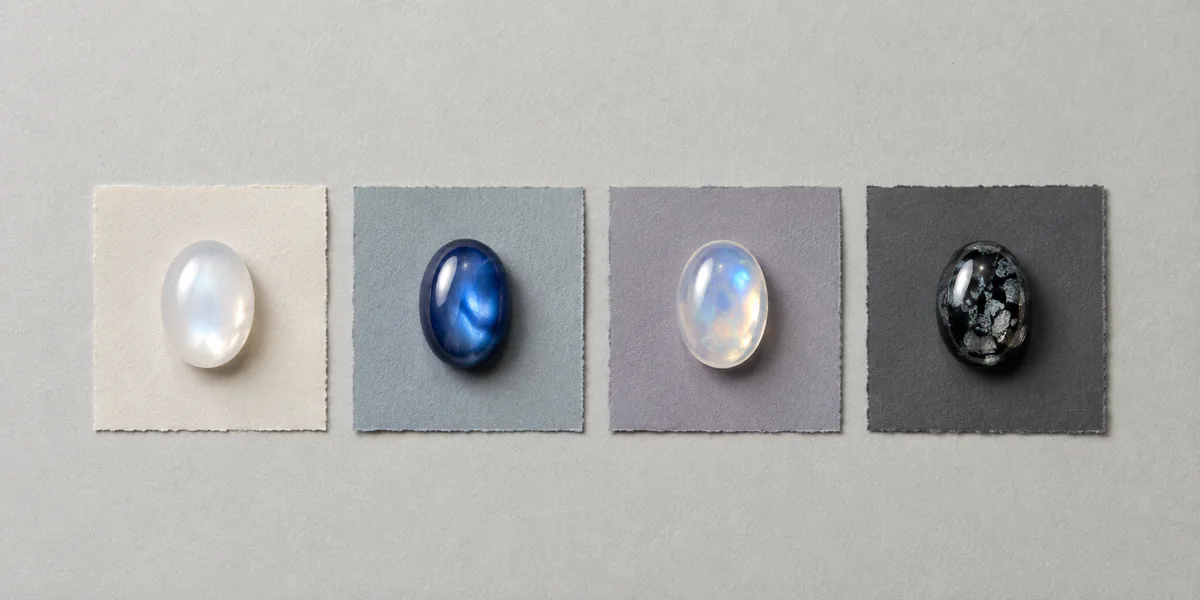
One color, one meaning: white, blue, rainbow, black
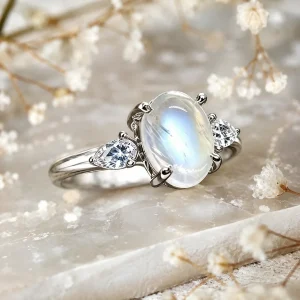
What you are saying when you give it
This is the real question behind most searches for this word, and I cover it last because everything above serves to answer it.
Giving moonstone says "something is starting, and I noticed". Moving house, a new job, a separation, a birth, finishing school, moving abroad: it fits every turning point, including the hard ones. It is the only phrasing I find both accurate and honest, and it has the advantage of promising nothing.
Three more specific uses come up often.
Marriage and couples. This is the oldest meaning, in India, where it is one of the traditional wedding gifts. In the West, it keeps coming back as an engagement ring, which raises a real question of durability more than symbolism: I address it plainly in is a moonstone engagement ring a good idea. You will also see wedding anniversary gemstone lists circulating. Be wary: they do not agree with each other. Moonstone appears sometimes for the third anniversary, sometimes as a variant of the thirteenth, whose usual stone is citrine. These are commercial lists, not a tradition.
June birthdays. This one is clean, dated, and it holds up. Moonstone has officially been the June birthstone since 1912, alongside pearl, with alexandrite added in 1952. It is a trade association decision, which makes it arbitrary but perfectly traceable. The detail is in the June birthstone.
A parting gift. The truest to the stone's long history, since it was first a traveler's talisman. For someone leaving, it is the best-grounded and least overused meaning.

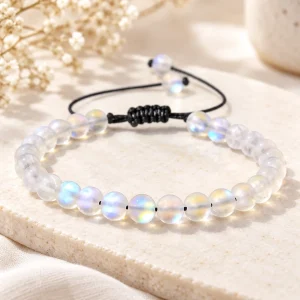
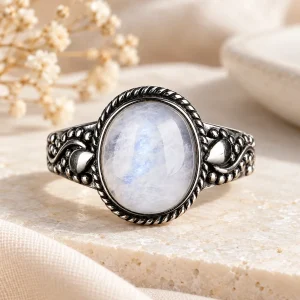
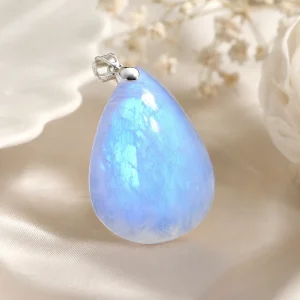
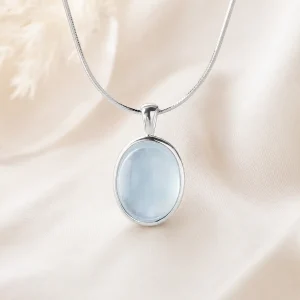
On choosing the piece itself, each type has its own article: the ring, the necklace and pendant, the bracelet. And on choosing the recipient and the occasion, giving moonstone as a gift.
One thing not to do, and I state it plainly: never give this stone as a response to a health problem, nor to someone going through a medical ordeal, with the idea that it might help. However well-intentioned, that gesture turns a piece of jewelry into a promise.
The pieces people buy from me to say something




Three misconceptions about its meaning
Three errors come up everywhere, and all three are easy to set aside.
"It is a woman's stone." The most widespread misconception, and the most recent. It forgets Chandra, Tsukuyomi, Sîn and Máni, and above all it forgets that the stone was first worn by sailors and travelers. The feminine meaning exists, it is legitimate, it is fifty years old, and it does not exhaust the subject.
"Moonstone and selenite are the same thing." The name Selene brings them close, and they have nothing in common. Selenite is a gypsum, soft enough to scratch with a fingernail, and it carries the goddess's name for other reasons entirely. The breakdown is in moonstone or selenite.
"Rainbow and black moonstone mean the same thing as white." They have a different symbolic path, because they are a different thing: they are labradorite, and a good part of what is said about them, protection in particular, comes from labradorite's symbolism rather than adularia's. That is what the "partially" column in the table was flagging. The detail is in moonstone or labradorite.
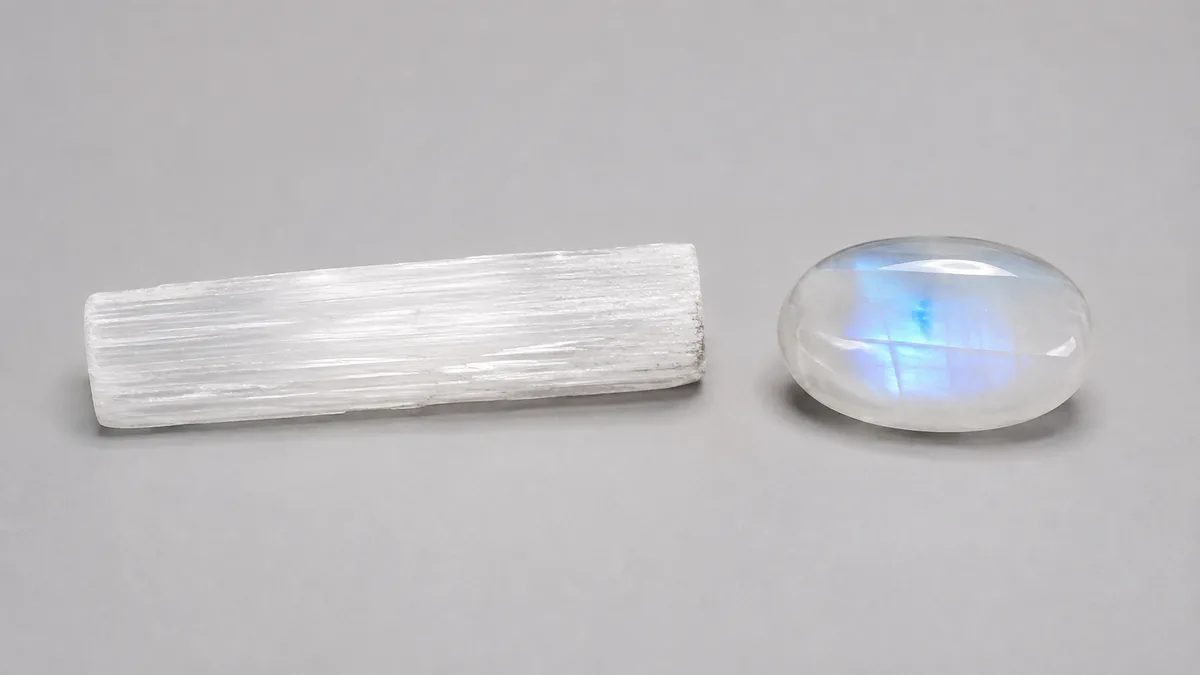
What I answer when I am asked the question
I get asked almost every week what a moonstone "means," often right before someone gives one as a gift. Here is my real answer.
I say first that the meaning is not in the stone. It is in what two people decide to put into it. A stone given to mark a move means that move, and nothing any website has written will weigh more, for the person receiving it, than that.
I say next that history helps, as long as it is accurate. Knowing it was Chandra's stone, that it passed through Art Nouveau, and that it became the stone of new beginnings in the 1990s gives real substance to what you write on the card. What I refuse to do is serve up a false history, with "since time immemorial" tacked in front of an idea from 1985.
And finally I say what I will not say: I will never write that a stone brings luck, protects against anything, or acts on the person wearing it. The rest of what I refuse to do is in the complete guide, and I explain how I work on the workshop page.
These meanings and correspondences belong to tradition and crystal healing, approaches founded on beliefs. They do not constitute a medical claim and never replace the advice of a health professional. Read the full disclaimer.
Frequently asked questions
What does moonstone mean?
It symbolizes light given back rather than produced, cycle and passage, and a kept part. Given as a gift, it says "something is starting." These are cultural meanings, not properties: a stone acts on no one.
What is the difference between meaning and benefits?
Meaning is what the stone stands for: its symbol, its history, the message of a gift. Benefits are what it is said to be capable of doing, and they have their own article. The two are often wrongly conflated.
Is moonstone really a feminine stone?
It is a real meaning, but a recent and regional one. The Moon is masculine in many traditions: Chandra in India, Tsukuyomi in Japan, Sîn in Mesopotamia, Máni among the Germanic peoples. The equation Moon equals feminine comes mostly from the Greco-Roman world and its modern revival.
Where does the phrase "sacred feminine" come from?
From the North American goddess movement of the 1970s and 1980s, around works like When God Was a Woman by Merlin Stone in 1976 and The Spiral Dance by Starhawk in 1979. It spread in France in the 2000s, very largely carried by a bestselling 2003 novel.
What are you saying when you give someone a moonstone?
The truest message is "something is starting, and I noticed." It suits turning points, both happy and difficult ones. Absolutely to avoid: giving it as a response to a health problem.
Does moonstone bring luck?
I will not write that it does. Some traditions credit it with protection while traveling, and I report that as an old belief for which I have found no primary source. A piece of jewelry does not act on events.
Which color should you choose based on meaning?
Only white and blue have a stable meaning from one source to the next, new beginnings for one, clarity for the other. The other colors have no fixed symbolism: choose the one you like, that will be a better criterion.
Why is it found in Art Nouveau jewelry?
Because its milky light suited the era's translucent enamels and plant-like lines, and because the movement championed choosing a stone for its emotion rather than its price. Lalique, Louis Comfort Tiffany and Georg Jensen all used it.
Is it a wedding anniversary stone?
Depending on the list, and the lists contradict each other. It appears at the third anniversary in some, as a variant of the thirteenth in others, whose usual stone is citrine. These are commercial conventions, not an old tradition.
What does black moonstone mean?
It is credited with grounding and a kept part, but watch out: it is labradorite, not adularia, and part of its symbolism comes from that. The point is explained in moonstone or labradorite.
Where to go next
- The counterpart to this page: the benefits, the myths and legends.
- History and the gods: the gods and goddesses of the Moon, moonstone in Art Nouveau, moon rock or moonstone.
- Giving it: to whom and for what occasion, the June birthstone, the engagement ring.
- Meaning by piece: the ring, the necklace, the bracelet, how to wear it.
- The correspondences: the chakras, astrology and Cancer.
- The bigger picture: the complete guide to moonstone.
The jewelry is in the shop. And if you are unsure what to write on the card that goes with a gift, write to me: it is the kind of question I like best.
My sources
For the male lunar deities: reference entries on Chandra, Tsukuyomi, Sîn or Nanna and Máni, and directories of lunar deities showing that cultures with a male moon god often have a female sun deity.
For the phrase "sacred feminine": When God Was a Woman by Merlin Stone, 1976, and The Spiral Dance by Starhawk, 1979, two founding works of the North American goddess movement. For its spread in France, the wave of books and film in the 2000s, widely commented on at the time, including in critical reviews.
For Art Nouveau: jewelry history entries on René Lalique, and documented pieces by Louis Comfort Tiffany for Tiffany & Co. pairing moonstone cabochons, plique-à-jour enamel and opal, around 1910.
For the June birthstone, the standardization of the list by the American jewelers' association in 1912, completed in 1952. For wedding anniversary gemstones, the lists from the GIA and the International Gem Society, which give citrine for the thirteenth year, while other commercial lists place moonstone at the third year or as a variant of the thirteenth: it is that very divergence I am reporting. For Rome, Pliny the Elder, Natural History, around the year 77.
A limitation I own up to: the "sources agree" column in the color table is a judgment call on my part, formed by comparing what the main French- and English-language sites say. It is not a measurement, it is an observation, and I present it as such rather than giving it an authority it does not have.
Last updated: August 19, 2026. If you find a mistake in this article, tell me about it: I correct it and I note it.
✦ À porter, à offrir
Découvrez mes créations