Moon Gods and Goddesses
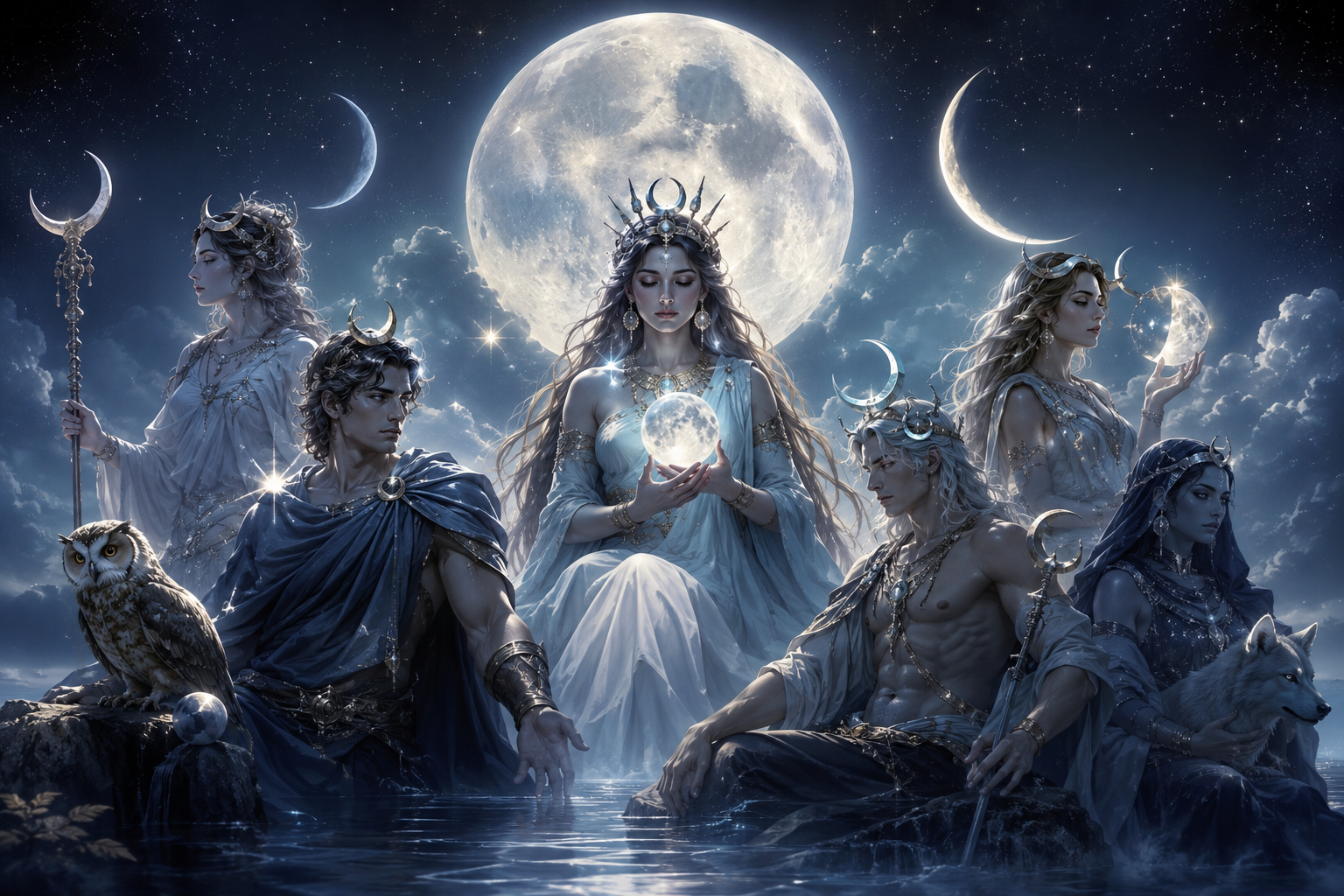
The Moon is not feminine everywhere. It is a god in Mesopotamia, in India, in Japan and among the Norse, and a goddess in Greece, in Rome, in China and among the Inca. The idea that the Moon is feminine by nature is a Greco-Roman inheritance, carried into English by centuries of literature and art. Here is who these deities are, and what moonstone really owes them.
I am not a historian, I set stones. But when you sell a piece of jewelry that carries the Moon's name, you end up reading what gets written on the subject, and noticing that most pages copy the same half-dozen Greek names while leaving out half the world.
The short version, if you are in a hurry
- Roughly half the lunar deities in the world are gods, not goddesses. It is the most counterintuitive fact on the subject.
- The gods: Sin in Mesopotamia, Chandra in India, Tsukuyomi in Japan, Mani among the Norse, Thoth and Khonsu in Egypt.
- The goddesses: Selene and Artemis in Greece, Luna and Diana in Rome, Chang'e in China, Mama Killa among the Inca, Ix Chel among the Maya.
- Among the Norse, everything is inverted: the Moon is a god, the Sun a goddess.
- The "triple goddess" is not ancient. It was formulated by the poet Robert Graves in 1948.
- The link between stone and deity is thin, except in India, where the stone has long carried Chandra's name.
- The word "moonstone" is recent as the name of a gem, far more recent than the deities attached to it.
The idea that the Moon is feminine is a Western one
Let us start with what throws everybody, myself first when I got into it.
In English-speaking culture the equation is automatic: the Moon is soft, changeable, tied to cycles, therefore feminine. The Sun would be its opposite, direct and masculine. That division feels so natural that nobody ever thinks to check it.
It is nevertheless only one particular inheritance, that of the Greco-Roman world, passed on to the whole of Europe by literature and by art. Selene, Artemis, Luna, Diana: four female figures, and that is where our sense of the obvious comes from.
Step outside that perimeter and the obvious collapses. Mesopotamia, India, Japan, Egypt and Scandinavia all have gods of the Moon, male ones, often older than the Greek figures.
This is not a point of pedantry. It is what explains how a stone called moonstone came to be worn by men long before it was filed on the feminine side, as I explain in moonstone for men.
What language does
A good part of our intuition comes not from mythology but from grammar, even for those of us who speak a language that has none.
English has no grammatical gender: the Moon is simply "it". But the languages that shaped our literary tradition do have it. In French la lune is feminine and le soleil masculine, and the same holds in Spanish and Italian. All descend from Latin, where luna was feminine and sol masculine, which fixed the gender of the corresponding deities and passed into English poetry as a Moon called "she".
Switch to German and everything flips: der Mond, the moon, is masculine, and die Sonne, the sun, is feminine. That is no isolated oddity: it is consistent with Germanic and Scandinavian mythology, where the Moon is a god and the Sun a goddess.
In other words, what we take for a truth about the Moon is largely information about the languages our culture borrowed from. A stone knows nothing about the grammatical gender of the word that names it.
The male gods of the Moon
Here are the main ones, and they cover a good part of the Old World.
Sin, or Nanna. The lunar deity of Mesopotamia, honored at Ur and then at Harran. It is one of the oldest attested lunar deities, and it is a god. He is often represented by the crescent, and associated with the measurement of time, since the Mesopotamian calendar was lunar.
Chandra, or Soma. God of the Moon in the Hindu world, present from the Vedic texts onward. He gives his name to a great many things, including, as we will see below, the stone itself.
Tsukuyomi. The lunar deity of Japanese Shinto, male, born at the same time as the solar goddess Amaterasu. Here again we find the inversion: the Sun is a goddess, the Moon a god.
Thoth and Khonsu. Ancient Egypt has two male lunar deities. Thoth, associated with writing, calculation and the calendar; Khonsu, whose name evokes the traveler, the one who crosses the sky.
Mani. The Norse god of the Moon, whom I come to further down because his case is the most striking.
The goddesses of the Moon
They exist, of course, and they are the ones we know best.
Selene. The Moon itself in the Greek world, sister of Helios the Sun. Her figure stayed so central that her name was used for a mineral, selenite, and still lingers in scientific vocabulary.
Artemis, then Diana in Rome. Goddesses of the hunt and of wild places, associated with the Moon later on, through a gradual merging with Selene.
Hecate. A figure of crossroads and passages, associated with the dark Moon and with night in the later tradition.
Chang'e. In the Chinese tradition, the woman who flies up to the Moon and stays there. She is at the heart of the Mid-Autumn Festival, still celebrated today.
Mama Killa. Inca lunar goddess, wife of the Sun Inti, protector of the calendar and of women.
Ix Chel. Among the Maya, a female figure associated with the Moon, with weaving and with childbirth, whom I come back to below because she deserves a qualification.
The main lunar deities
The table that is missing everywhere, and that settles the question at a glance.
| Deity | Culture | Gender |
|---|---|---|
| Sin, or Nanna | Mesopotamia | God |
| Chandra, or Soma | Hindu world | God |
| Tsukuyomi | Japan, Shinto | God |
| Thoth and Khonsu | Ancient Egypt | Gods |
| Mani | Scandinavia | God |
| Selene | Greece | Goddess |
| Luna, Diana | Rome | Goddesses |
| Chang'e | China | Goddess |
| Mama Killa | Inca empire | Goddess |
| Ix Chel | Maya world | Goddess |
Five gods, five goddesses, and I did not sort them to balance the count: that is what the list of the best documented lunar deities gives. The idea of a Moon feminine by nature does not survive this table.
The Norse case, a complete inversion
This is my favorite example, because it does not merely qualify the picture, it turns it upside down.
In Norse mythology, Mani is the Moon and he is a god. Sol is the Sun and she is a goddess. They are brother and sister, and they cross the sky pursued by wolves that will eventually catch them.
Everything our culture associates with the Moon, softness, receptivity, the feminine, is therefore found here on the side of the Sun, and the other way round. This is not a marginal variant: it is the system of an entire cultural sphere, and it matches exactly the German grammatical gender I mentioned above.
Remember this case if you only remember one: on its own it demonstrates that the Moon-and-feminine correspondence is nothing like universal.
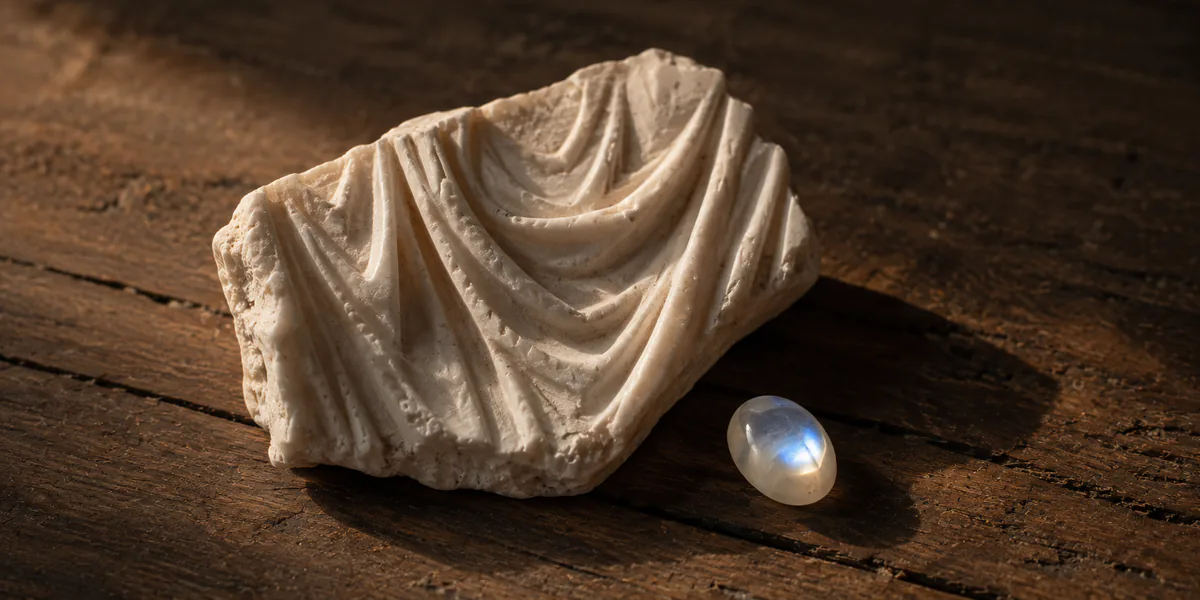
Ix Chel, and what is actually known
Here is a case where I am going to be more careful than most of the pages you will read.
Ix Chel is regularly presented as "the Maya goddess of the Moon", associated with weaving, with medicine and with childbirth. The name is old and attested, and a female deity linked to the Moon does exist in the Maya codices.
The delicate point is identification. Specialists still debate whether Ix Chel and the lunar goddess of the codices are one and the same figure, or whether several distinct deities were merged into one by colonial sources and then by popular writing.
I flag it because it is typical of this subject: the deities of the least documented cultures are the ones people describe with the most confidence, precisely because there are fewer texts to contradict them. When a page describes the character and attributions of a Maya deity in three lines, be wary of the tone.
The "triple goddess", invented in 1948
You will meet the lunar "triple goddess" everywhere: the maiden, the mother and the crone, matching the waxing crescent, the full moon and the waning crescent. It is an elegant scheme and it is presented as immemorial.
It is not. That formulation comes from the poet Robert Graves, in The White Goddess, published in 1948. Graves proposed a poetic synthesis by gathering figures drawn from different cultures, and his book had considerable success in the spiritual movements of the second half of the twentieth century.
Antiquity certainly knew divine triads, and Hecate was sometimes represented with three faces. But the maiden, mother, crone system applied to the lunar phases is a twentieth-century construction.
As always on this site, that is not a disqualification. A recent image is still an image, and it can mean something to whoever uses it. What I refuse is to present it as an ancient inheritance when it is less than eighty years old. The same sorting is done in the myths and legends of moonstone.
Why the phases produced so many stories
A fundamental question: why has the Moon inspired so many deities, everywhere, and more than most other celestial bodies?
Three practical reasons, and none of them is mystical.
It changes. It is the only object in the sky whose shape transforms visibly and regularly. A sun is always the same disc; a moon tells a story in twenty-nine days.
It measures time. The first calendars are lunar, because counting lunations is infinitely simpler than observing a solar year. A lunar deity is therefore often a calendar deity, like Sin or Thoth.
It disappears and comes back. That cycle of disappearance and return has been read everywhere as a model of death and rebirth, which explains the role of lunar deities in stories of passage.
That is why the Moon is the most deified celestial body in the world, and why its deities have such varied attributions from one culture to the next.
What moonstone owes these deities
An honest question, and the answer is thinner than what usually gets written.
The name moonstone, as the name of a gem, is recent on the scale of these mythologies. The gem variety of orthoclase is called adularia, after a Swiss massif, and the trade name comes from the look of the stone: a milky halo that recalls moonlight. It does not come from a cult.
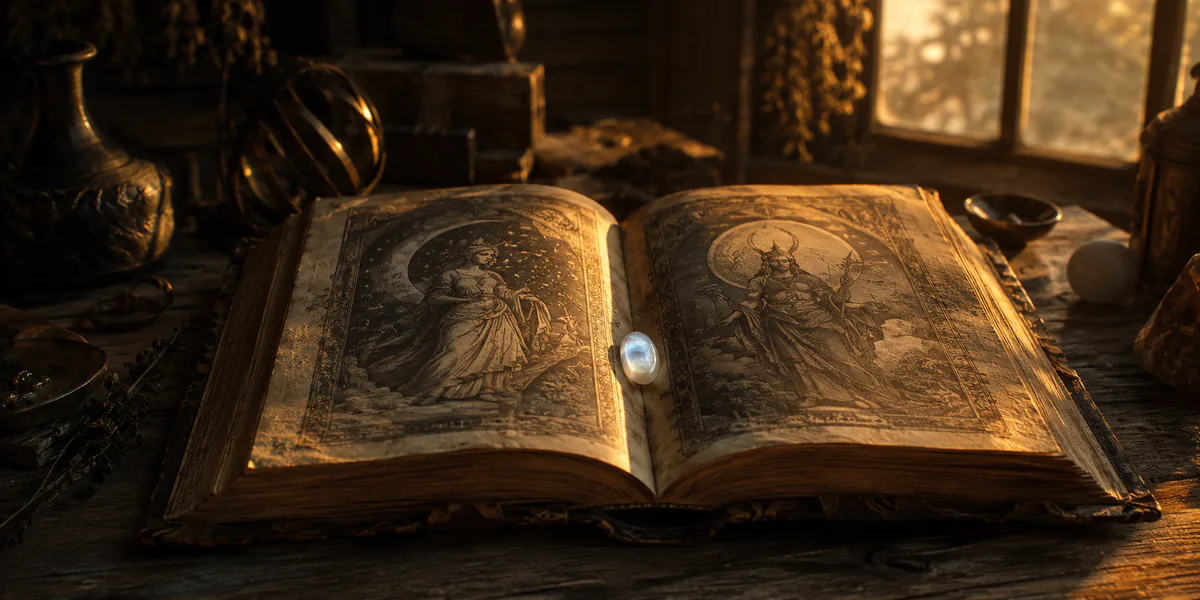
There is one exception, and it is old: Pliny the Elder describes, in the first century, a stone he calls selenitis, white and translucent, whose brightness was said to wax and wane with the Moon. Specialists debate what exactly he meant: gypsum, today called selenite, or a feldspar of the kind we call moonstone. The confusion between those two minerals is therefore nearly two thousand years old, and it is covered in moonstone or selenite.
For the rest, the vast majority of the correspondences you read between a given deity and this particular stone are modern attributions, written in the twentieth century by the crystal healing literature. They are pretty, they are not ancient.
The symbolic correspondences mentioned here belong to traditions and beliefs. They are not a medical claim and never replace the advice of a healthcare professional. Read the full disclaimer.
Cabochons chosen for their sheen, not for their legend
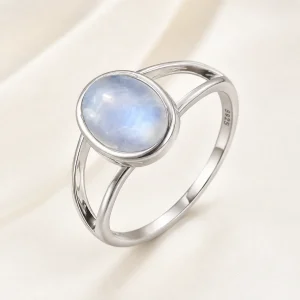
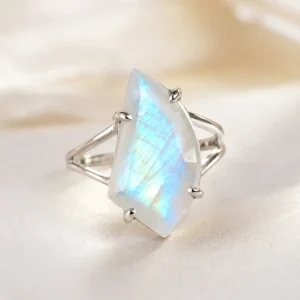
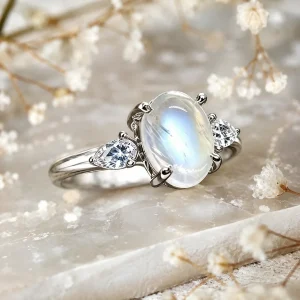
The Indian case, the strongest link
If one real link between a deity and this stone is to be kept, it is this one.
In the Indian world the Moon is Chandra, and the stone bears a name built on his: chandrakanta, literally something like "beloved of the Moon" or "shining like the Moon" depending on the translation. The link is therefore not a correspondence added after the fact, it is in the name itself.
India and Sri Lanka are moreover the regions where this stone has been mined and worked for the longest time, which makes the connection coherent: the cultures that had the stone to hand are the ones that named it after their lunar deity.
A note of caution, because it comes up constantly online: you often read that the stone was reserved for temples, offered at particular ceremonies, or worn by a given caste. Those claims circulate without any verifiable source, and I would rather not repeat them. What is solid is the name and the antiquity of the mining. The rest is in the moonstone deposits.
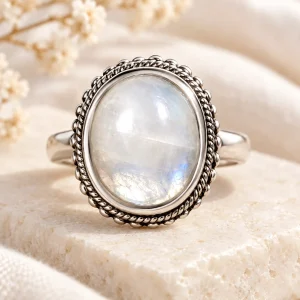
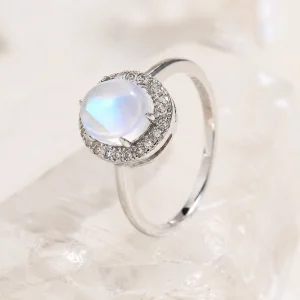
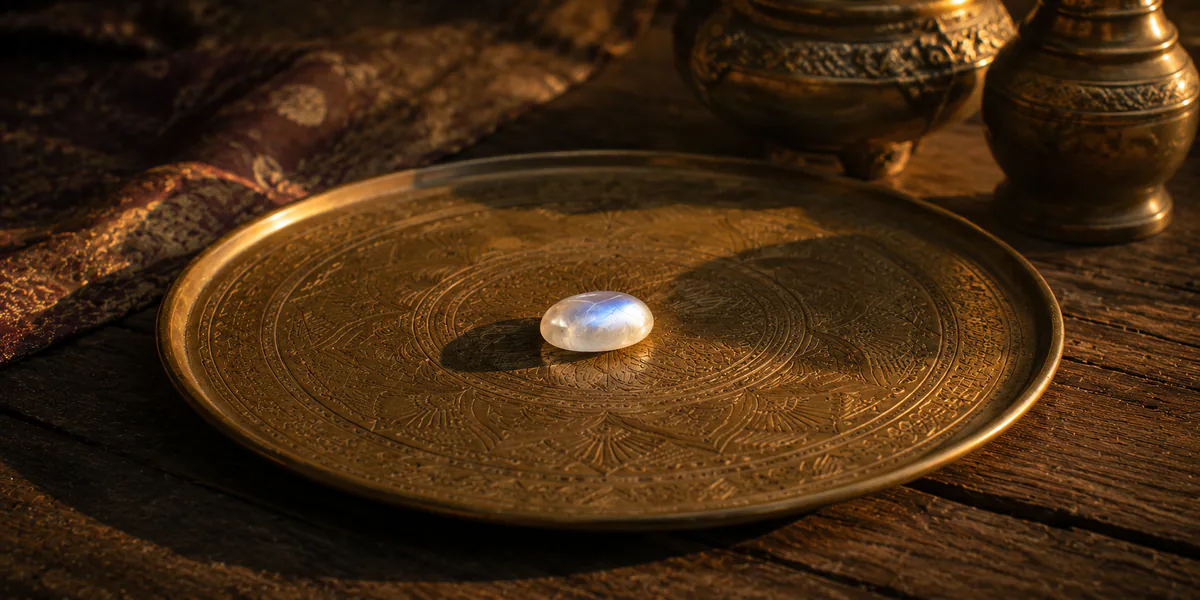
The workshop rings, feldspar and nothing else




Frequently asked questions
Who is the main moon goddess?
In the Greco-Roman world it is Selene, who became Luna in Rome, and with whom Artemis and Diana were associated. But there is no single main lunar deity worldwide: each culture has its own, and roughly half of them are male gods.
Is the Moon feminine in every culture?
No. It is masculine in Mesopotamia with Sin, in India with Chandra, in Japan with Tsukuyomi, in Egypt with Thoth and Khonsu, and in Scandinavia with Mani. The Moon-and-feminine equation is a Greco-Roman inheritance, reinforced in English by centuries of poetry that called her "she".
Who is Chandra?
The god of the Moon in the Hindu world, present from the Vedic texts onward, also called Soma. He is the lunar deity whose link with moonstone is the strongest, since the Sanskrit name of the stone is built on his.
Is the triple goddess an ancient belief?
No. The maiden, mother and crone system applied to the lunar phases was formulated by the poet Robert Graves in The White Goddess, in 1948. Antiquity knew divine triads, but not that reading of the phases.
Was moonstone dedicated to a deity?
Not in any documented way, except in India where the name of the stone is built on that of Chandra. The English name is recent and comes from the look of the gem, a milky halo that recalls moonlight, not from a cult.
Why has the Moon inspired so many deities?
Because it changes shape visibly and regularly, because it served as the basis for the first calendars, and because its cycle of disappearance and return has been read everywhere as a model of death and rebirth.
Who is Mani?
The Norse god of the Moon, brother of Sol, the goddess of the Sun. It is the most striking case on the subject: everything there is inverted compared to our intuition, and it matches the grammatical gender of the words in modern German.
Is Ix Chel really the Maya goddess of the Moon?
The name is attested and a female deity linked to the Moon does exist in the codices, but specialists still debate whether Ix Chel and that figure are one and the same deity. The very confident descriptions you read online often go beyond what the sources allow.
Where to go next
This page covers the deities. For the rest:
- Story and symbol: the myths and legends of moonstone, the meaning of the stone, moonstone and astrology.
- Name confusions: moonstone or selenite, moonstone or opalite, moonstone or labradorite.
- The stone itself: how it forms, the mineral data sheet, the deposits.
- The lunar calendar: when to recharge your stones with the moon.
- The big picture: the complete guide.
What I make is in the shop, with no legend added to the listings. A correction to point out on this page? Write to me, I will read it carefully: this is not my field and I know it.
My sources
The deities cited and their gender follow the standard comparative mythology reference works and the entries of the major reference encyclopedias. These are standard identifications, not discoveries: Sin, Chandra, Tsukuyomi, Thoth, Khonsu and Mani are unanimously described as male, Selene, Luna, Diana, Chang'e and Mama Killa as female.
The dating of the triple goddess rests on a book with a name and a year: The White Goddess by Robert Graves, 1948. The caution about Ix Chel reflects a real debate among specialists of the Maya world, which I flag rather than settle.
The mention of selenitis comes from the Natural History of Pliny the Elder, first century. Its mineral identification is disputed, and I say so rather than picking the one that would suit this page.
I am not a historian. This page gathers verifiable facts and flags what is not verifiable, without claiming anything more.
Last updated: August 19, 2026. If you find an error in this article, let me know: I correct it and I note it.
✦ À porter, à offrir
Découvrez mes créations