Is Moonstone a Piece of the Moon?
No, moonstone does not come from the Moon. It is an earthly feldspar, formed a few kilometers under our feet, and its name comes from its sheen. A real piece of the Moon does exist, though, it is measured in grams, and the irony is that it too is made of feldspar. Here are the two stories, kept properly apart.
It is the question I get asked most often while wrapping a package, and almost always with an apology, as if it were naive. It is not naive at all: the name is misleading, has been for two thousand years, and no one takes the time to explain it. So I do it here, with the numbers, the dates and the sources.
The short version, if you are in a hurry
- Moonstone is earthly. It is a feldspar, orthoclase or plagioclase depending on the variety, formed in magmatic rocks and hydrothermal veins of the earth's crust.
- Its name comes from its sheen, that bluish veil that seems to float beneath the surface and that brought to mind moonlight caught in the stone.
- A real piece of the Moon exists. The six Apollo missions brought back 382 kg of it between 1969 and 1972, and three Soviet probes about 326 g.
- None of these samples are for sale. They are the property of the US government, and selling one to a private individual is illegal.
- The only legal way to own one is a lunar meteorite: debris blasted off the Moon by impacts, fallen back to Earth, collected in deserts. Between 200 and 1,000 euros per gram, sometimes more.
- The Moon is largely made of feldspar too. But not the same kind, and that is exactly why no lunar rock shines like moonstone.
- Moonstone has never seen the Moon, and lunar rock has never had adularescence. The two worlds touch only through their name.
The answer in three sentences
Moonstone is a feldspar, meaning a member of the most common mineral family in the earth's crust. It formed on Earth, in pegmatites and rock fissures, at depths of a few kilometers and over timescales measured in millions of years. It has no connection to the Moon, not in origin, not in composition, not in mechanism.
The misunderstanding does not come from a seller's lie. It comes from a description that became an explanation: people first said the stone resembled a piece of moonlight, and eventually came to hear that it was one. Two thousand years is plenty of time for that kind of drift.
If you want the full technical sheet, density, hardness, crystal system, it is in the properties of moonstone. Here, I deal only with the question of origin.
Why it carries that name
The name is old, and it is coherent, as long as you read it as a comparison rather than a claim.
The oldest written trace is Roman. Pliny the Elder, in his Natural History completed around the year 77, describes a stone he calls selenites, from the Greek selene, the Moon. He writes that it contains the image of the moon, and that this image waxes and wanes with it. That is false, but it is an honest observer's mistake: the veil does indeed change intensity with the light, and someone looking at their stone two weeks apart will indeed see two different things. Nothing guarantees, moreover, that Pliny's selenites is our stone: the ancients classified by appearance, and the word probably covered several minerals, including gypsum. That is the confusion covered in moonstone or selenite.
The scientific name tells the same story a different way. Classic moonstone is an adularia, a variety of orthoclase described in 1781 by the Italian mineralogist Ermenegildo Pini, after the Adula massif in the Swiss Alps. That is where the word adularescence comes from, now used for the optical phenomenon itself. The word no longer evokes the Moon at all: it names a mountain. The mechanism is detailed in the article on adularescence.
Finally, India has its own version, and it is the prettiest one: the stone was said to be made of solidified moonbeams, and the Sanskrit chandrakanta translates as "beloved of the Moon." Here too, it is an image, not a shipping address. These stories are gathered in moonstone myths and legends, and the lunar deities themselves in the gods and goddesses of the Moon.
What tradition attributes to this stone belongs to crystal healing and folklore, approaches founded on beliefs. None of this constitutes a medical claim and never replaces the advice of a health professional. Read the full disclaimer.
Where it actually comes from
Here is the exact address, and it is noticeably less poetic than a moonbeam.
Alkali feldspars form at high temperature as a solid solution: potassium and sodium coexist within the same crystal. As it cools slowly, the two separate, a bit like a vinaigrette settling back out, and the crystal reorganizes into alternating lamellae of orthoclase and albite. This is what is called exsolution.
Everything then hinges on the thickness of these lamellae. When it gets close to the wavelength of visible light, a few hundred nanometers, the light entering the stone scatters between the layers instead of passing straight through. Short wavelengths scatter the most, which is why the veil is blue on the finest stones and milky white on others. The sheen is not sitting on top of the stone: it is manufactured inside it, by its structure.
Two settings produce these conditions. Granitic pegmatites, pockets of residual magma that cool very slowly and give the crystals time to organize. And alpine-type hydrothermal fissures, where lukewarm solutions deposit adularia in rock cracks: this is the setting that gave the stone its name, in the Adula. The geological detail is in how moonstone forms.
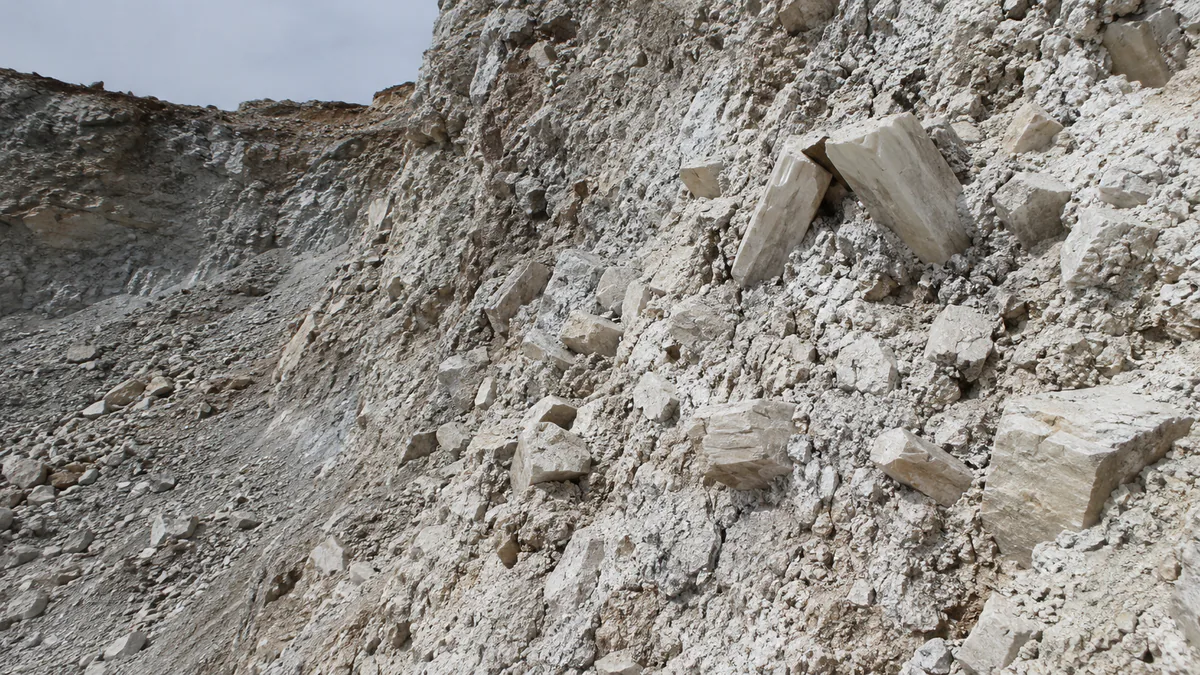
In the field, that translates into three main addresses. Sri Lanka, and especially the Meetiyagoda deposit, for the most sought-after blues. India for most of the rainbow and colored varieties. Madagascar, Tanzania, Myanmar and the United States for the rest. The full map is in the deposits of moonstone, and the story of the Sri Lankan deposit in moonstone from Sri Lanka.
Stones born in Sri Lanka, India and Madagascar
What a real piece of the Moon is
Now for the other story, the one for people typing "moon rock" while actually looking for a lunar stone. It deserves to be told properly, because it is at least as beautiful.
Between 1969 and 1972, six Apollo missions brought back 382 kilograms of rocks, cores, pebbles, sand and dust, spread across roughly 2,200 distinct samples collected at six sites. That is NASA's figure, and it has not moved since.
Three uncrewed Soviet probes did the same thing without a crew, and with quantities on an entirely different scale: Luna 16 brought back 101 g in 1970, Luna 20 55 g in 1972, Luna 24 170.1 g in 1976. About 326 grams total, the weight of an apple.
Then nothing for forty-four years, until China. Chang'e 5 brought back 1,731 g in December 2020, and Chang'e 6 1,935.3 g in June 2024, collected in the Apollo crater, on the far side. It was the first time matter from that side had ever reached Earth.
| Object | Real origin | Buyable |
|---|---|---|
| Moonstone | Earthly feldspar, pegmatites and alpine fissures | Yes |
| Apollo sample | Brought back by crew, 382 kg total | No, illegal |
| Luna or Chang'e sample | Uncrewed probes, a few kilos | No |
| Lunar meteorite | Ejected by an impact, fallen to Earth | Yes, expensive |
| Selenite | Earthly gypsum, no connection | Yes |
| Opalite | Manufactured glass, not a stone at all | Yes, avoid it |
The important point for anyone looking to buy one: these samples are not on the market. The Apollo rocks are property of the US government, they have never been sold, not even to the astronauts who collected them, and possessing one as a private individual amounts to theft of public property. What you see in a museum is on loan, not given away.
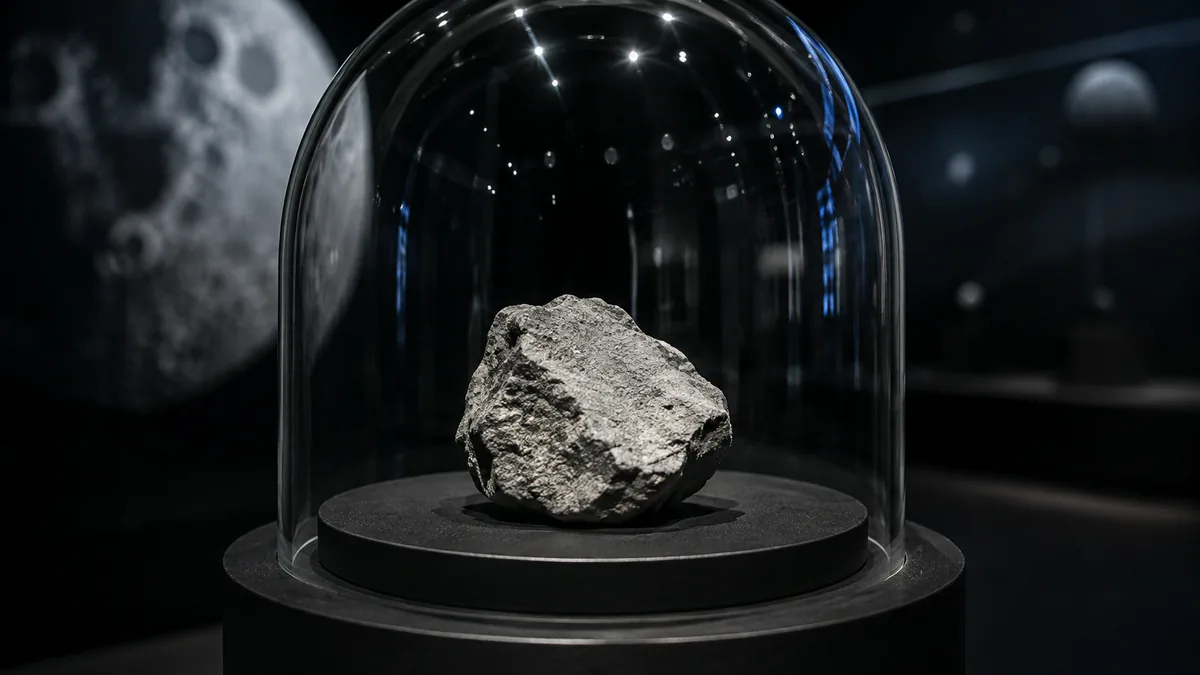
Lunar meteorites, the only legal route
There is, however, a perfectly legal way to have a piece of the Moon at home, and it owes nothing to any space agency.
When an asteroid strikes the Moon, some of the debris is ejected fast enough to escape its gravity. These fragments wander for a few million years, and some eventually cross paths with Earth and fall. Noble gas measurements show that every known lunar meteorite left the Moon less than 20 million years ago, which is very recent on a geological scale.
They are found wherever a dark stone stands out to the eye and does not weather away: Antarctica, the Sahara and the Oman desert. The first one ever recognized is called ALHA 81005, collected in January 1982 in the Allan Hills by an ANSMET program expedition. A stone the size of a walnut, whose analysis showed in 1983 that it came from the lunar highlands. Before it, no one seriously imagined that the Moon was sending us mail.
Since then, the count has exploded. As of December 31, 2024, Washington University in St. Louis, which keeps the reference list, counted 714 recognized lunar stones for about 1,159 kilograms. Many are fragments of the same fall, which brings the number of genuinely distinct meteorites down to less than half that. Even counting conservatively, more lunar matter has arrived on its own than Apollo ever brought back. I find that fact very underrated.
How do we know a stone found in the Sahara comes from the Moon? By comparing its mineralogy, chemistry and isotopes to the Apollo samples, which serve as the standard. And by looking for cosmogenic nuclides, isotopes that only cosmic rays can produce, and only outside Earth's atmosphere. Without the 382 kg from Apollo, none of these identifications would be possible: the two collections depend on each other.
On price, expect on the order of 200 to 300 euros per gram for a common fragment, up to 1,000 euros and well beyond for rare basalts or historic pieces. Serious sellers cut things down into fractions of a gram, which puts a micro-fragment under a display dome at a few dozen euros. And the record piece, NWA 12691, 13.5 kilograms, was offered for private sale at Christie's at around 2.5 million euros.
The one real link: feldspar on both sides
Here is the part I have not seen anywhere else, and it is the one that amuses me the most.
The Moon is largely made of feldspar too. Its light-colored highlands, the ones that trace out the pale zones you see with the naked eye, are made of anorthosite, a rock almost entirely composed of plagioclase. The most famous sample is the Genesis Rock, number 15415, collected by the Apollo 15 crew on August 1, 1971 at the edge of Spur crater: 269 grams, about 98% plagioclase, an age of roughly 4.1 billion years. A piece of the primordial crust, crystallized on the surface of a global magma ocean.
In other words, if you held a piece of the Moon in your hand, you would be holding feldspar. Exactly the same mineral family as your ring.
And yet it would not shine. For two reasons, and they are clear-cut.
It is not the same feldspar. Adularescence arises from the separation of potassium and sodium within an alkali feldspar. Lunar plagioclase is calcium-rich, anorthite: no significant potassium or sodium, so no alternating lamellae, so nothing to scatter.
There is no water. The purest adularias form in hydrothermal fissures, with lukewarm fluids and plenty of time. The Moon is a dry world, with no water circulating in its crust: that setting simply does not exist there.
I should note that I am reasoning here from mineralogy rather than from a study that framed the question in these terms, because no one seems to have bothered to publish "no, lunar rocks are not adularescent." But both conditions are well established, and neither is met up there.
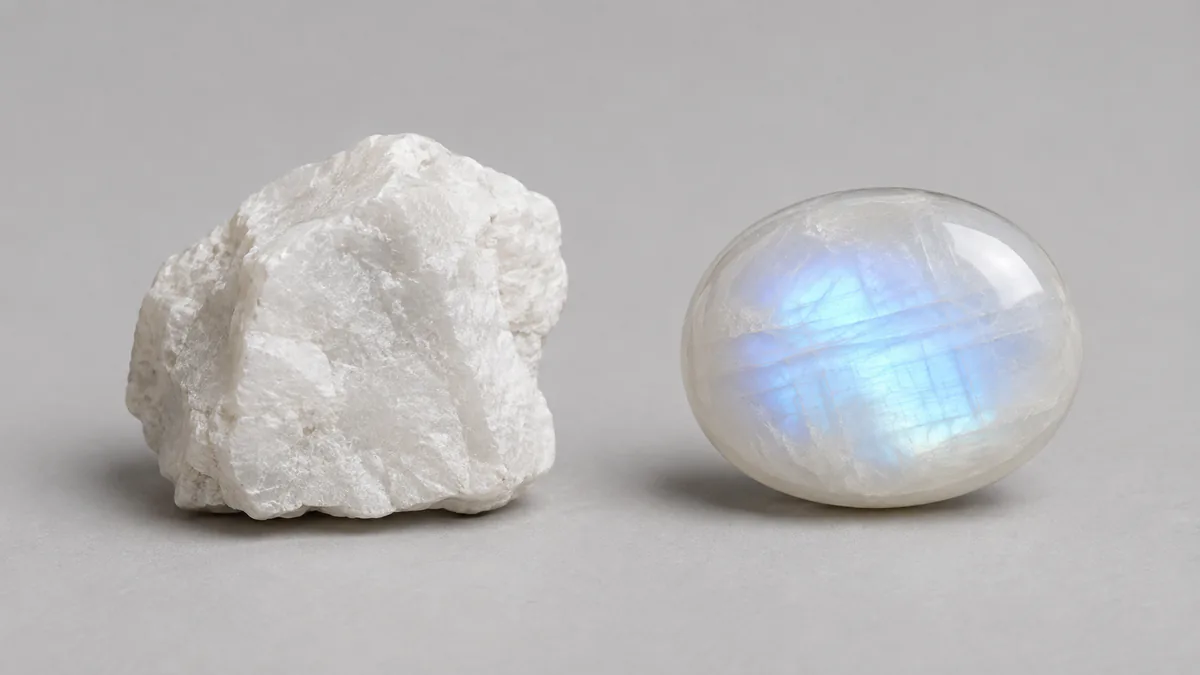
There is one consolation for the Moon: three minerals were discovered up there before being found here. Armalcolite, whose name is built from the syllables of Armstrong, Aldrin and Collins, pyroxferroite and tranquillityite, all three identified in the Apollo 11 samples. The first two were found on Earth in the years that followed. The third held out until 2011, when it finally turned up in rocks from Western Australia. None of these three bears any resemblance whatsoever to moonstone.
Three confusions that sell
The fuzziness around origin is not just a curiosity of vocabulary. It sells, and not always honestly.
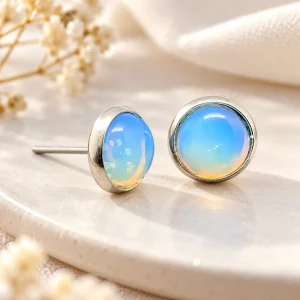
The first is opalite. It is manufactured glass, regularly sold as moonstone and sometimes as something lunar. It has a uniform bluish sheen that does not move when you tilt the piece, whereas real adularescence shifts with the angle. The full breakdown is in moonstone or opalite, and the checks to run in recognizing a genuine moonstone.
The second plays on wording. Pendants sold as "piece of the Moon" sometimes contain a real crumb of lunar meteorite, with a certificate, and sometimes nothing at all. Price is a good indicator: at 200 euros a gram minimum, a twenty-euro lunar pendant does not contain any Moon. If that kind of piece appeals to you, buy it from a meteorite dealer, not a jeweler.
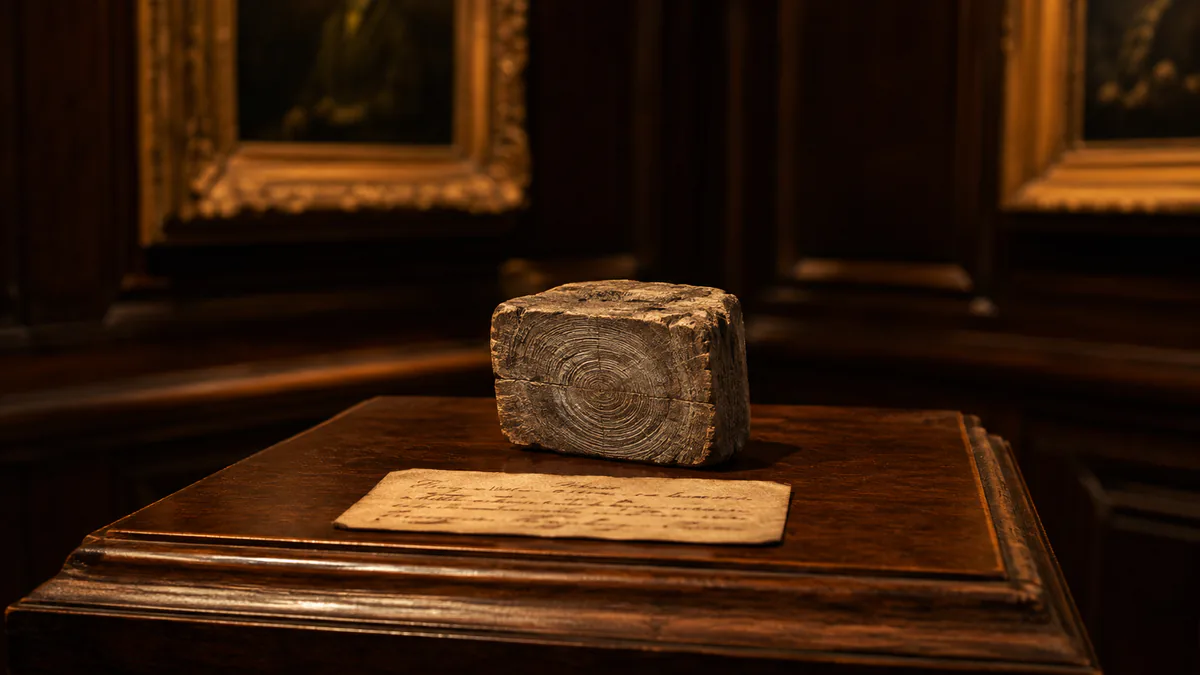
The third is unintentional, and it is delightful. In 1969, after the Apollo 11 flight, a stone the size of a matchbox was presented to Dutch Prime Minister Willem Drees by the US ambassador, during the astronauts' tour. When Drees died in 1991, the object went to the Rijksmuseum in Amsterdam, which insured it for a hundred thousand guilders and displayed it as a lunar rock. In 2009, a doubt led to an analysis: it was petrified wood. The museum kept it, as a curiosity, and rightly so: it is probably the most instructive piece in the collection.
What I sell, and what I do not
Might as well say it plainly, since this whole article revolves around honesty about provenance.
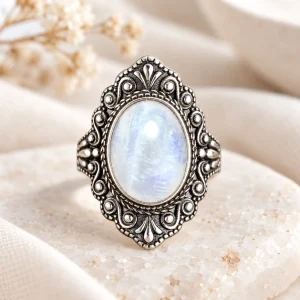
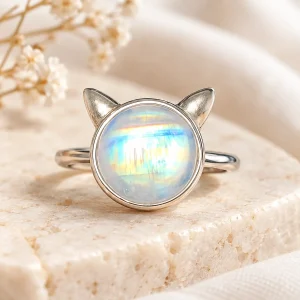
I sell earthly feldspar. Adularia for the whites and blues, labradorite for the rainbows and blacks, a distinction almost no shop bothers to make, which I detail in moonstone or labradorite. These stones come from Sri Lanka, India and Madagascar, through trade channels where lots get mixed together: I know my two suppliers and the regions they work in, and I stop there rather than embroidering a stone-by-stone origin.
I do not sell opalite, ever, under any name. I do not sell any meteorite fragment, lunar or otherwise: it is not my trade, and a serious authentication requires a lab I do not have. And I do not claim my stones fall from the sky, when the real story, slow cooling a few kilometers underground, is already more than enough.
Rings from the workshop, feldspar and nothing else




Frequently asked questions
Does moonstone come from the Moon?
No. It is an earthly feldspar, formed in pegmatites and hydrothermal fissures of the earth's crust. Its name comes from its sheen, which brought to mind moonlight caught in the stone, not from its origin.
Can you buy a real piece of the Moon?
Yes, but only in the form of a lunar meteorite: debris ejected from the Moon by an impact and fallen back to Earth. Expect 200 to 300 euros per gram at minimum. The samples brought back by Apollo, on the other hand, remain property of the US government and are not for sale.
How much lunar matter is there on Earth?
About 382 kg brought back by the six Apollo missions, 326 g by the three Luna probes, 1,731 g by Chang'e 5 and 1,935.3 g by Chang'e 6. Add to that the lunar meteorites, which by themselves weigh more than the entire Apollo collection.
Does the Moon contain moonstone?
It contains huge amounts of feldspar, but not that kind. Its highlands are made of anorthosite, a calcium-plagioclase rock. Adularescence requires an alkali feldspar and very slow cooling in the presence of water: two conditions the Moon does not offer.
Where does the word adularescence come from?
From the Adula massif in the Swiss Alps, where adularia was described in 1781. The scientific term therefore makes no reference to the Moon at all: it names a mountain. The optical mechanism is explained in the article on adularescence.
Can moonstone be a meteorite?
No, and the reverse is not true either. A lunar meteorite is a breccia or a basalt, gray to black, matte, with no play of light. Moonstone is an adularescent gem. No serious jeweler would ever sell one for the other.
Why are lunar meteorites found in deserts?
Because a dark stone stands out to the eye against light-colored ground there, and a dry climate preserves it instead of weathering it away. Antarctica, the Sahara and Oman account for most of the finds.
How do you prove a meteorite really comes from the Moon?
By comparing its mineralogy, chemistry and isotopes to the Apollo samples, which serve as the standard, and by looking for cosmogenic nuclides, which only cosmic rays produce outside the atmosphere.
Does the sheen change with the phases of the Moon?
No. That was already Pliny the Elder's mistake. The sheen depends on the angle of light and the internal structure of the crystal. It varies from one moment to the next because the lighting varies, not because the Moon has moved.
Are there minerals that were discovered on the Moon first?
Three, all identified in the Apollo 11 samples: armalcolite, pyroxferroite and tranquillityite. The first two were found on Earth shortly after, the third only in 2011, in Western Australia.
Where to go next
- The stone itself: the mineral data sheet, adularescence, how it forms.
- Its geographic origins: the deposits, the Sri Lankan deposit, raw or cut.
- Not mixing it up: opalite, selenite, labradorite, recognizing a genuine stone.
- The stories: myths and legends, the gods and goddesses of the Moon, the glossary.
- The bigger picture: the complete guide to moonstone.
And if you want to see what that famous sheen actually looks like, everything is in the shop. If you landed here looking for a real lunar meteorite, I do not sell those, but write to me anyway: I really like those conversations.
My sources
The Apollo figures, 382 kg and about 2,200 samples across six missions, come from NASA's Lunar Sample Curation office at the Johnson Space Center. The masses of the Soviet probes Luna 16, 20 and 24 come from NASA's NSSDCA. Those for Chang'e 5 (1,731 g) and Chang'e 6 (1,935.3 g) are published by CNSA, the Chinese space agency.
The lunar meteorite count, 714 stones and about 1,159 kg as of December 31, 2024, is from Washington University in St. Louis, which keeps the reference list, supplemented by NASA's Lunar Meteorite Compendium. ALHA 81005 was collected in January 1982 by the ANSMET program and identified as lunar in 1983, in a series of articles in Geophysical Research Letters. The Genesis Rock 15415 is documented by the Lunar and Planetary Institute.
For the stone itself: the GIA and Mindat for adularia, orthoclase-albite exsolution and the origin of the word adularescence, with the first description credited to Ermenegildo Pini in 1781. Pliny the Elder, Natural History, around the year 77, for selenites. The petrified wood episode is documented by the Rijksmuseum itself and by the Dutch press in 2009.
One honest clarification, already made above: the absence of adularescence in lunar rocks is not drawn from a publication, it is a deduction from two established facts, the calcium composition of lunar plagioclase and the absence of water. If you know a source that addresses the question head-on, I would like to hear about it.
Last updated: August 19, 2026. If you find a mistake in this article, tell me about it: I correct it and I note it.
✦ À porter, à offrir
Découvrez mes créations