The Moonstone Glossary
Adularescence, adularia, orthoclase, plagioclase, exsolution, cabochon, girdle, bezel setting: here are all the words you meet on a listing or in a conversation at a show, explained in plain language. With, for each one, what it actually designates and what it does not.
A misunderstood vocabulary costs money. Half the bad purchases I see come from one word taken for another: a labradorite bought as an orthoclase, a trade name taken for a species, a quality claim taken for an official grading. This page is here so that it does not happen to you.
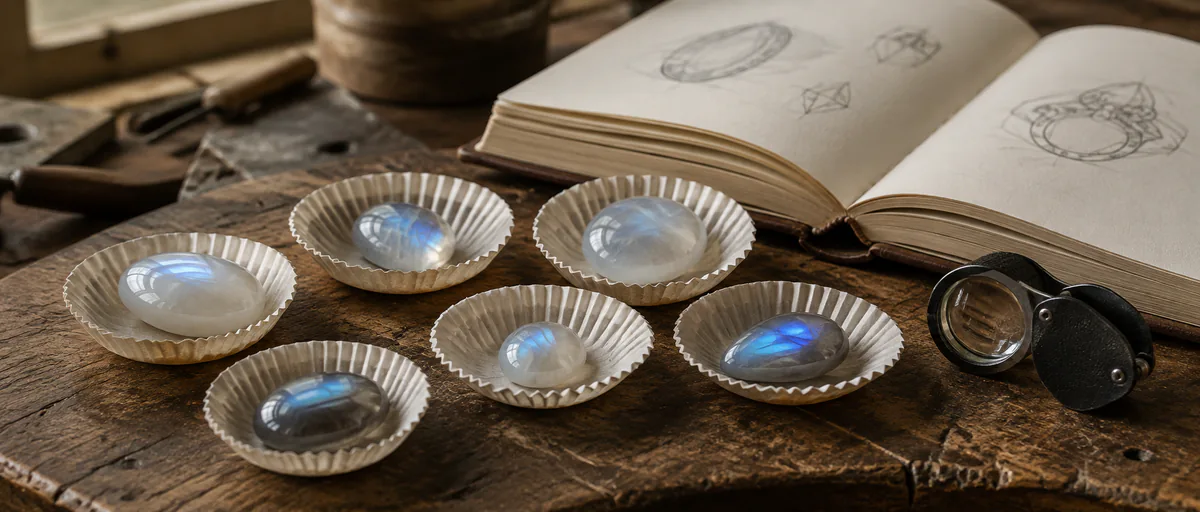
How to read this glossary
- A species name can be checked, a trade name cannot. That distinction structures this whole page.
- Orthoclase is the word that counts: it is the species of true moonstone.
- Adularescence means the moving veil, and nothing else. It is neither a color nor a surface reflection.
- Labradorite is not a defect, it is another species, with another optical phenomenon.
- Cabochon is not a style, it is a necessity: a veil does not show on a faceted stone.
- Cleavage explains the fragility, not the hardness. Those are two distinct properties.
- "AAA" means nothing. No organization issues that grading.
The material: species and family
Feldspar. The large family of minerals moonstone belongs to. They are aluminum silicates combined with potassium, sodium or calcium, and they make up more than half the crust of the earth. So saying that a stone is a feldspar is not enough to identify it.
Alkali feldspar. The branch rich in potassium and sodium. It is the branch of true moonstone.
Orthoclase. The precise species of moonstone in the strict sense. The name comes from the Greek and means roughly "straight fracture", because its two cleavage directions meet at a right angle.
Adularia. The gem and transparent variety of orthoclase, the one that gives the cabochons. The name comes from a Swiss massif, the Adula, in the Saint Gotthard region, and that is where the word adularescence comes from.
Albite. The other feldspar present in a moonstone, in the form of fine lamellae alternating with the orthoclase. That layering is what makes the veil.
Plagioclase. The other branch of the feldspars, sodium and calcium bearing. It includes labradorite and oligoclase among others.
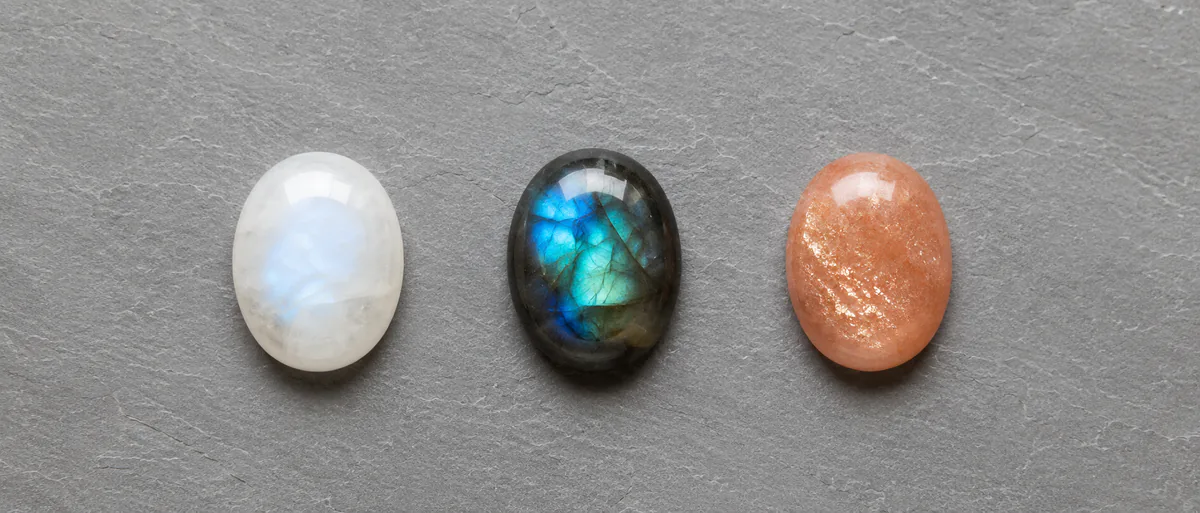
Labradorite. A plagioclase, therefore a species distinct from orthoclase. Its optical phenomenon is not adularescence but labradorescence. It is what gets sold under the names rainbow moonstone and black moonstone. See moonstone or labradorite.
Sunstone. A feldspar with inclusions of metallic platelets, which sparkles instead of veiling. Same family, different effect. See moonstone and sunstone.
The optical phenomena
This is the most useful section of the glossary, because these four words are systematically confused, sellers included.
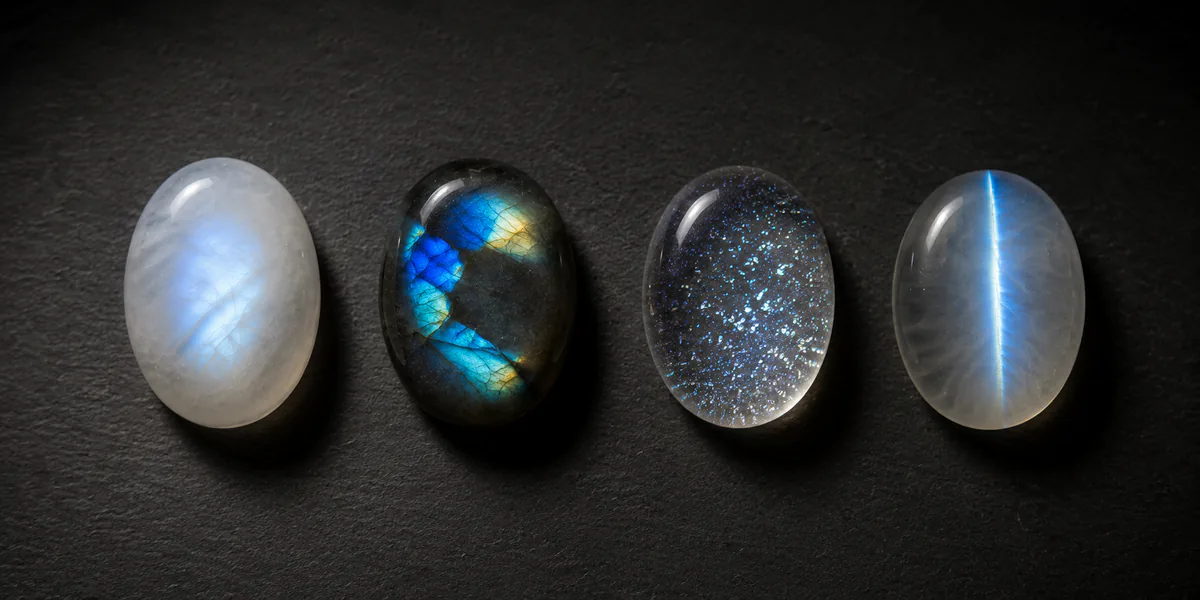
Adularescence. The milky or bluish veil that seems to float below the surface of a moonstone and moves when you tilt it. It is born of the scattering of light by internal lamellae. It is not a color: grind the stone and the powder is white. The mechanism is set out in adularescence.
Labradorescence. The play of vivid color, blue, green, gold, in sharp patches, shown by labradorite. It is not a diffuse veil but colored zones that light up and go out depending on the angle.
Aventurescence. A sparkle in distinct bright points, produced by inclusions of reflective platelets. It is the effect of sunstone.
Chatoyancy. A single band of light running across the surface of a cabochon, as on a cat's eye, produced by parallel fibers. It is what you see on fibrous selenite, and sometimes, more rarely, on a moonstone.
Asterism. A star with four or six rays, same mechanism as chatoyancy but in several directions. Rare on moonstone.
Schiller. A German word used in gemology to designate the internal reflections of feldspars in a general way. It is vaguer than adularescence, and some sellers use it precisely because it commits them to nothing.
Girasol. A trade term for a milky, floating look. It is applied to several different materials and designates no species: treat it as a description, not as an identification.
Formation and geology
Pegmatite. An igneous rock with very large crystals, formed in the last stages of cooling of a granitic body. It is the usual context of gem moonstones.
Exsolution, or unmixing. The separation, in the solid state, of an initially homogeneous crystal into alternating lamellae of two compositions. It is the event that turns an ordinary feldspar into a moonstone. It requires very slow cooling. See how moonstone forms.
Lamella. Each of the alternating layers produced by exsolution. Their thickness decides the color of the veil: very thin, they give blue; thicker, white.
Primary deposit. The original vein, where the stone is still in its host rock.
Secondary deposit, or alluvial deposit. A deposit where the stone has been carried by erosion and water, and lies mixed in with gravels. Most of the moonstone on the market comes from these.
Illam. The local name, in Sri Lanka, for the gem-bearing gravel layer the miners work. See Sri Lankan moonstone.
Centipede inclusion. Fine tension cracks arranged in a herringbone pattern, characteristic of natural moonstone. It is not a defect but a signature: no glass imitation has them.
Cutting and the lapidary work
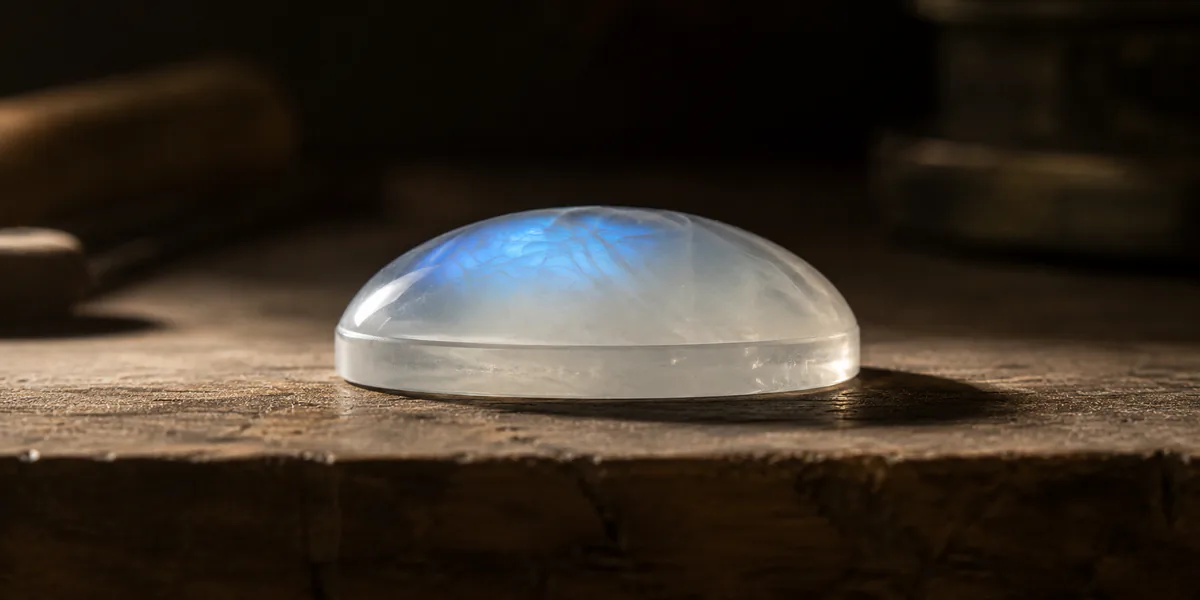
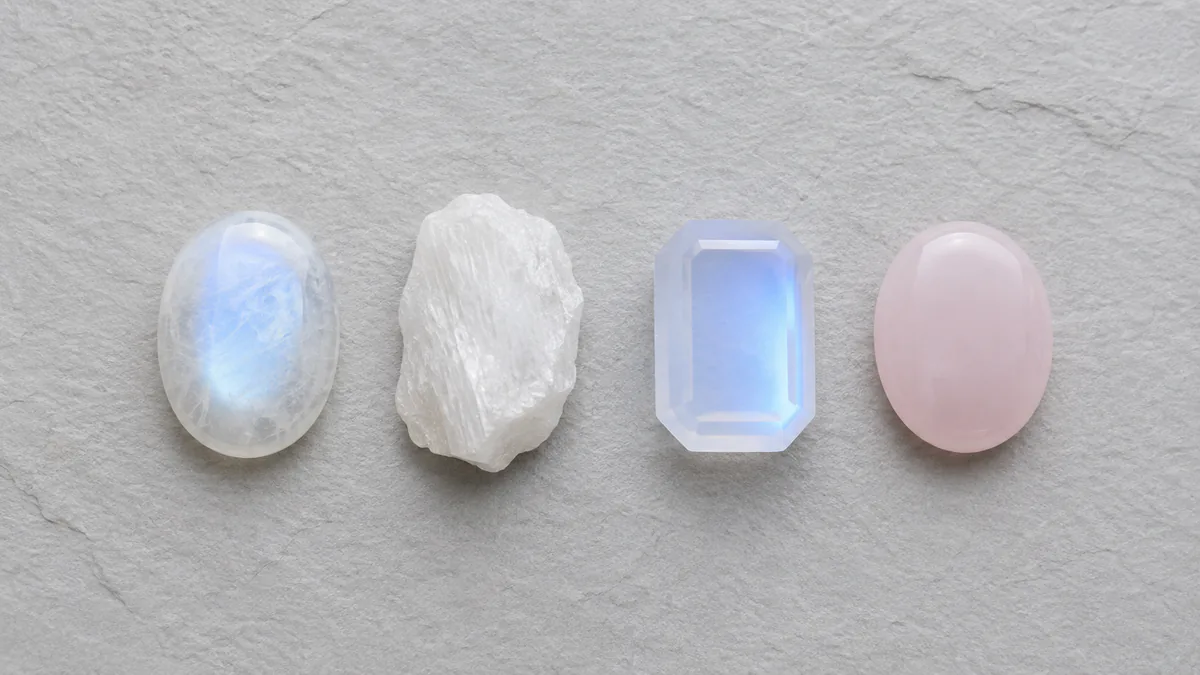
Cabochon. A stone cut as a smooth dome, without facets, with a flat base. On this stone it is not an aesthetic choice: a veil can only show on a curved, polished surface.
Dome. The rounded part of the cabochon. A high dome gives a more generous veil and exposes the stone more; a low dome protects it and softens the effect.
Girdle. The edge that runs around the cabochon, where the dome meets the base. It is the breaking point of a stone with cleavage, and it is exactly what a bezel setting covers. On a faceted stone the same word applies to the same line, and it is the same weak point.
Orientation. The choice of the cutting axis. On a moonstone the flat base has to lie parallel to the plane of the lamellae, otherwise the veil slides off the edge instead of floating in the center. That is lost yield, and it is part of the price.
Calibrated size. A standard dimension, given in millimeters, such as 8 x 6, 10 x 8 or 12 x 10. A stone in a standard size can be replaced identically if it breaks.
Freeform. A stone cut to suit the rough piece, with no standardized dimension. It makes the most of the material but becomes irreplaceable once it is in a piece of jewelry.
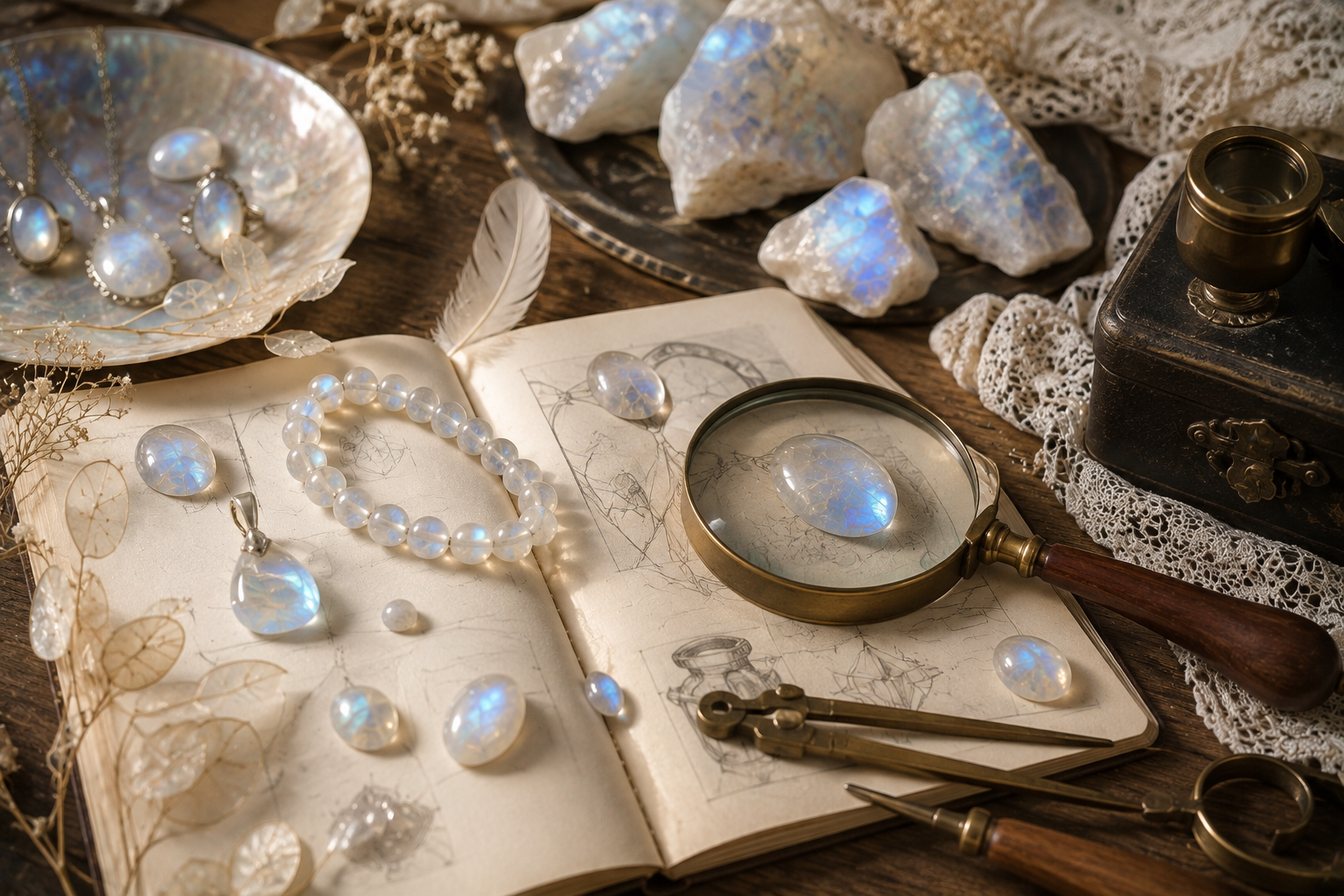
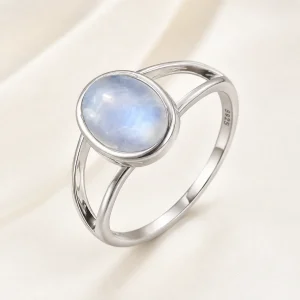
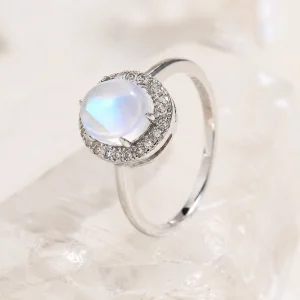
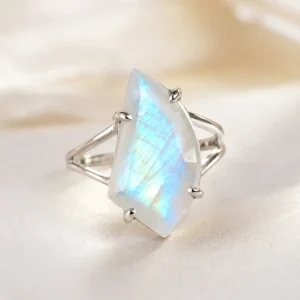
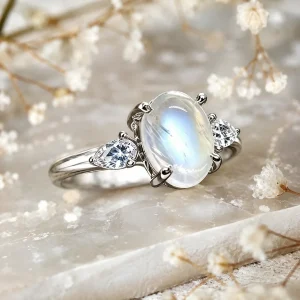
Cabochons oriented on the lamellae, in standard sizes
The setting and the piece
Bezel setting, or simply bezel. A setting where a continuous ribbon of metal surrounds the girdle of the stone. It is the only one that covers the breaking point, and it is the one to prefer on this stone. See bezel or prong setting.
Prongs. Small metal claws that grip the stone at a few points. They leave the flank bare, apply pressure at single points and catch on clothing.
Setting seat. The metal housing that receives the stone. A plain seat is one that is neither engraved nor decorated.
Closed back. A setting whose underside is solid. It stops the stone from flexing and blocks soapy water and dust from getting under the cabochon.
Bail. The loop that joins a pendant to its chain. Soldered, it lasts for years; merely closed up, it opens out little by little and the pendant eventually falls. See moonstone necklace and pendant.
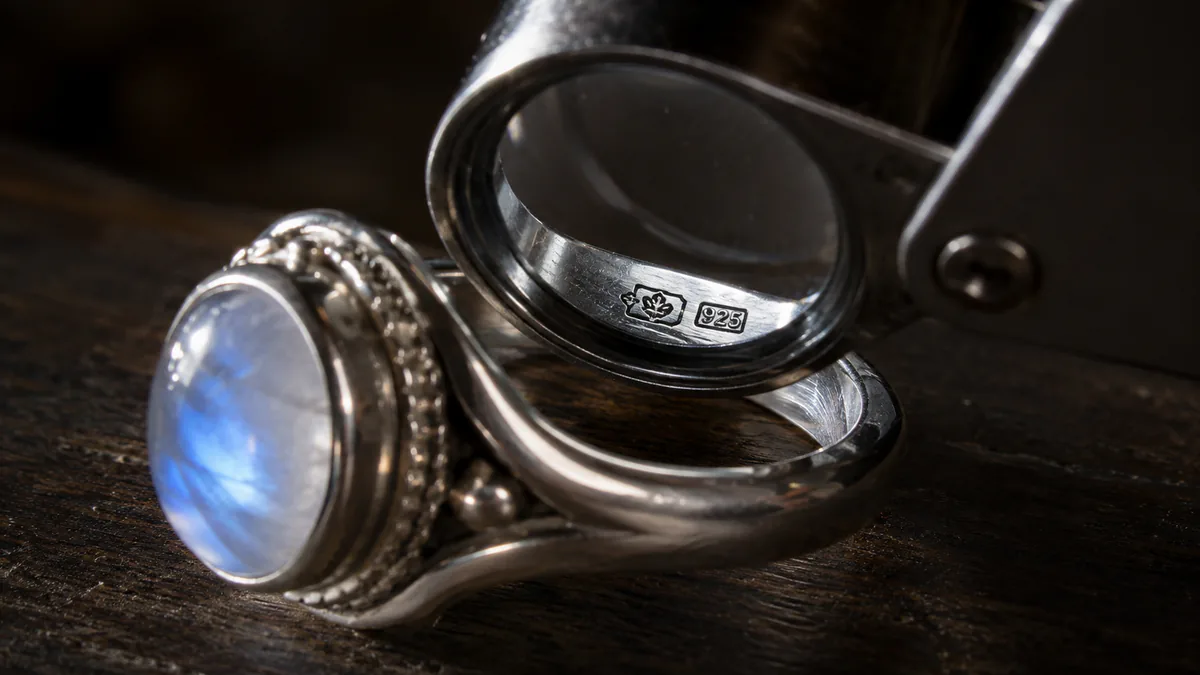
Hallmark. A mark struck into the metal, which commits the maker on the composition of the alloy. Silver 925 or gold. The words "silver plated" are not a hallmark and commit nobody.
Measurements and units
Mohs scale. A hardness scale, from 1 to 10, ranking minerals by their resistance to scratching. Moonstone sits at 6 or 6.5. Careful: this scale is ordinal, not linear, and a gap of half a point can change a great deal.
Hardness. Resistance to scratching. Nothing else.
Toughness. Resistance to breaking. These are two distinct properties, and moonstone is decently hard while having mediocre toughness.
Cleavage. The tendency of a crystal to separate cleanly along internal planes. Moonstone has two directions of it, at a right angle. That is what makes it liable to break, and it has nothing to do with its hardness. See is moonstone fragile.
Density. The ratio of mass to volume. About 2.56 for moonstone, which makes it a little heavier in the hand than a selenite of the same size.
Carat. A unit of mass for gems, worth 0.2 gram. Not to be confused with the karat of gold, which measures a purity.
Trade names
These are not species. They are accepted by the trade, they are not dishonest in themselves, and you need to know what they cover.
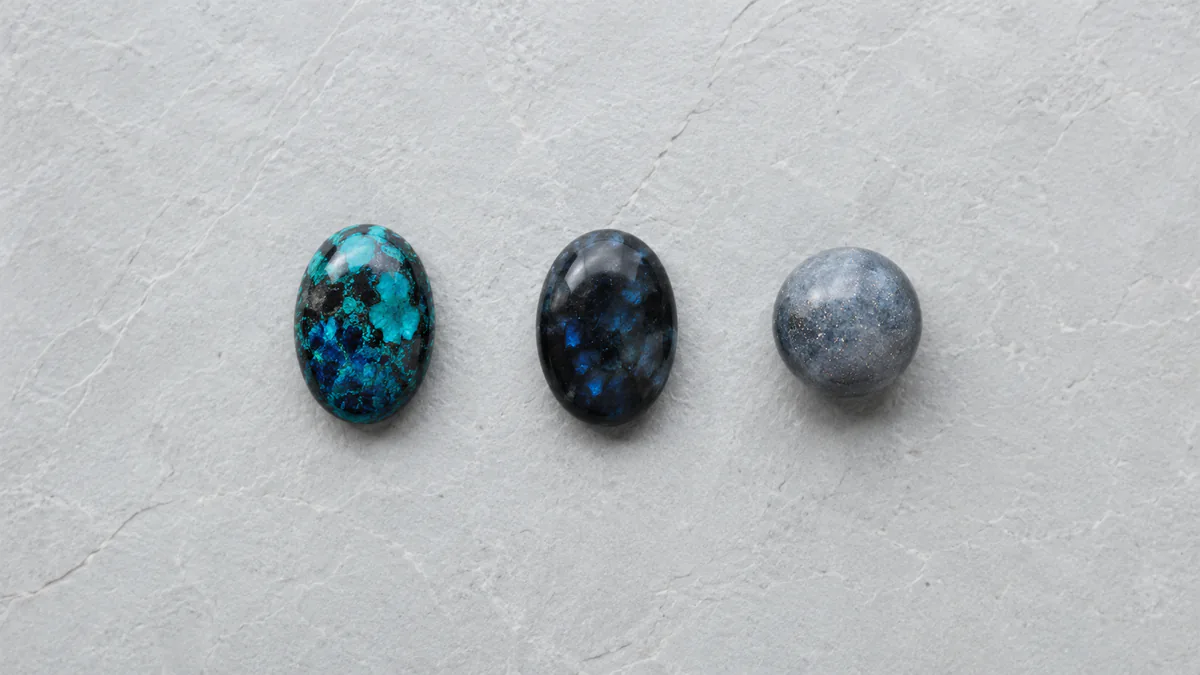
"Rainbow moonstone". A labradorite, therefore a plagioclase. Its play of color is labradorescence, not adularescence.
"Black moonstone". Most often a labradorite with a dark body, frequently from Madagascar.
"Norwegian moonstone", "blue pearl granite". Larvikite, an igneous rock from the Larvik region. It is not even a gem, but a rock made of unmixed feldspars. Fine material, different category.
"Spectrolite". A labradorite from one precise deposit, at Ylämaa in south-eastern Finland. A Madagascan labradorite is not a spectrolite.
"AAA quality", "AAAA", "gem quality". No organization issues these gradings for this stone. Every seller invents their own scale, and they are not comparable with one another.
"Genuine", "natural". Shop-window words. What tells you something is the species name, not the adjective. See where to buy moonstone jewelry.
False friends
Materials that get taken for moonstone, or the other way round.
Opalite. An opal glass, manufactured. It imitates the halo but its glow does not travel when you tilt the stone, and the beads of one bracelet are rigorously identical. It is the most expensive trap on the subject. See moonstone or opalite.
Selenite. A variety of gypsum, hardness 2, which scratches with a fingernail and is damaged by water. Its name also comes from Selene, the Greek Moon, hence two thousand years of confusion. See moonstone or selenite.
Opal. An amorphous hydrated material whose colored fires come from an entirely different mechanism. See moonstone or opal.
Rose quartz. Sometimes sold as pink moonstone. A uniform milky pink, with no adularescence at all.
Dyed quartzite. Sold as colored beads under moonstone names. The tilt test exposes it immediately.
Care
Ultrasonic cleaner. A vibrating cleaning tank. Forbidden on this stone: the vibrations propagate existing fractures along the cleavage planes.
Microfracture. An internal crack too fine to be seen with the naked eye. Salt, chlorine and solvents settle into it, which explains most of the care prohibitions.
Cleansing, recharging. Crystal healing practices consisting of "discharging" and then "reactivating" a stone. They are beliefs circulated since the 1970s; no effect of that kind is demonstrated. Physical cleaning, on the other hand, has a perfectly visible effect. See cleansing and recharging your moonstone.
Last on, first off. The wearing rule: the piece goes on after the cream, the perfume and the hairspray, and comes off before the washing up and the sport.
The crystal healing practices mentioned in this glossary are reported as traditions and beliefs. They are not a medical claim and never replace the advice of a health professional. Read the full disclaimer.
The twenty words to remember
If you keep only one block from this page, take this one and read it again before a purchase.
| Word | What it designates | Checkable? |
|---|---|---|
| Feldspar | The family, very broad | Yes, but not enough |
| Orthoclase | The species of true moonstone | Yes |
| Adularia | Its gem variety | Yes |
| Plagioclase | The other branch of the feldspars | Yes |
| Labradorite | A distinct species | Yes |
| Adularescence | The moving veil | Yes, by tilting |
| Labradorescence | The play of color in patches | Yes, by eye |
| Aventurescence | The sparkle in points | Yes, by eye |
| Chatoyancy | The single band of light | Yes, by eye |
| Exsolution | The unmixing into lamellae | No, it is an explanation |
| Pegmatite | The rock of origin | No, on a cut stone |
| Cabochon | The smooth dome cut | Yes |
| Girdle | The edge of the cabochon | Yes |
| Calibrated size | A standard dimension | Yes, with calipers |
| Bezel setting | The setting that surrounds the stone | Yes |
| Bail | The loop of a pendant | Yes, with a loupe |
| Hallmark | The metal composition mark | Yes |
| Mohs | The hardness scale | Yes, by comparison |
| Cleavage | The tendency to split cleanly | No, except by accident |
| "AAA" | Nothing at all | No |
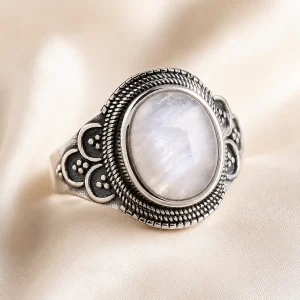
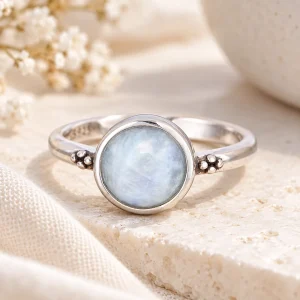
The workshop rings, species named on every listing




The most frequent vocabulary mistakes
Five confusions that come back constantly, professionals included.
Confusing hardness and fragility. A stone can be hard and liable to break. Moonstone is at 6.5, which is decent, and it splits on an impact because of its cleavage. The two words are not talking about the same thing.
Calling any reflection adularescence. A labradorite has no adularescence, it has labradorescence. Nor does a sunstone.
Taking a trade name for a species. "Rainbow", "black", "spectrolite" and "Norwegian moonstone" are not mineral species.
Believing that a certificate is a certificate. A document with no laboratory name and no number is only a label printed by the seller.
Using "stone" and "gem" as synonyms. Larvikite is a rock, not a gem, and the distinction changes everything about the price.
Frequently asked questions
What is the difference between orthoclase and adularia?
Orthoclase is the mineral species, a potassium alkali feldspar. Adularia is its gem and transparent variety, the one that gives the cabochons. All adularia is orthoclase, the reverse is not true.
Adularescence or labradorescence?
Adularescence is a milky or bluish veil, diffuse, that seems to float below the surface and slides when you tilt the stone. Labradorescence is a play of vivid color in sharp patches, which light up and go out. Two mechanisms, two species.
What does "AAA quality" mean?
Nothing checkable. No organization issues that grading for moonstone: every seller invents their own scale, and they are not comparable. Judge the veil, its cleanness, its position on the dome and the transparency of the body.
Why is this stone always cut as a cabochon?
Because a veil can only show on a curved, polished surface. Facets break the phenomenon up and put it out. So the cabochon is not an aesthetic stance but an optical necessity.
What is the girdle of a cabochon?
The edge that runs around it, where the dome meets the flat base. It is where the cleavage starts, so it is the exact place a bezel setting has to cover. On a faceted stone the word designates the same line.
What is a centipede inclusion?
Fine tension cracks arranged in a herringbone pattern, visible with a loupe, recalling the outline of a centipede. They are born of the internal stresses of formation. They are not a defect but a signature of authenticity: no glass imitation has them.
Hardness and toughness, what is the difference?
Hardness measures resistance to scratching, toughness resistance to breaking. Moonstone is decently hard, at 6 or 6.5 on the Mohs scale, and its toughness is mediocre because of its cleavage. That is why it splits without being easy to scratch.
Is larvikite a moonstone?
No, and it is not even a gem: it is an igneous rock from the Larvik region in Norway, whose reflections come from feldspars unmixed within the mass. It is sold as beads under the names black moonstone or Norwegian moonstone.
Where to go next
This glossary is a crossroads. Each family of words has its page:
- The material and the formation: the mineral file, how it forms, adularescence, the deposits.
- The neighboring species: moonstone or labradorite, moonstone and sunstone, moonstone or selenite, moonstone or opal, moonstone or opalite.
- Judging and buying: judging the quality, recognizing a real stone, is it treated, the price, where to buy it.
- The piece of jewelry: bezel or prong setting, how to wear it, is it fragile.
- The whole picture: the complete guide, starting out with this stone.
On the listings in the shop, the species is named for every piece, and trade names are put in quotation marks. A word you have met elsewhere and cannot find here? Write to me and I will add it.
My sources
The mineralogical definitions, the species names, the optical phenomena, the hardnesses and the densities follow the public files of the GIA, of Mindat and of the International Gem Society, together with the standard descriptive mineralogy of the feldspars.
Trade names are flagged as such and put in quotation marks. They are used by the trade without being recognized species names, and this page translates them systematically.
The vocabulary of cutting and setting, cabochon, girdle, calibrated size, bezel setting, bail, hallmark, comes from workshop practice and from the usages of the jewelry trade.
The crystal healing terms are reported as beliefs, without ascribing any effect to them.
Last updated: 19 August 2026. If you find an error in this article, let me know: I correct it and I note it.
✦ À porter, à offrir
Découvrez mes créations