White Moonstone
A translucent, almost colorless body, crossed by a blue veil that seems to float below the surface. White moonstone is the one that gave its name to all the others, and the only one of the three varieties I sell that is a true adularia.
Showing the single result
-
-20 %

White Moonstone Bracelet
Original price was: 34,90 €.27,90 €Current price is: 27,90 €. Choose options
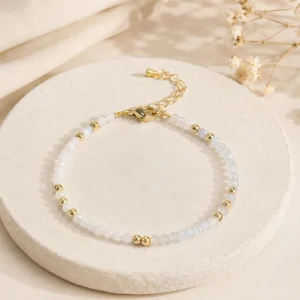
This one is a true moonstone
I spend my time writing that rainbow and black are labradorites. Let me put it the other way round here: white moonstone is an orthoclase, the potassium feldspar gemmologists call adularia. It is the original species, the one the name belongs to.
Its light has a name of its own. We speak of adularescence, a continuous bluish veil that sweeps the stone, and not labradorescence, those patches that light up zone by zone in the other two. The veil is born of alternating microscopic lamellae in the crystal. The phenomenon is explained here.
It is therefore more discreet: you have to move it for it to give itself. It is the choice between a stone that is noticed and a stone that is discovered.
Why one is worth fifteen euros and another two hundred
It is the variety where the price gap is widest, and it comes neither from the setting nor from the size of the stone. It comes from the veil, judged on three points.
Its color first: the clearer the blue, the higher the stone climbs. A milky white veil is the bottom of the scale; a deep blue is already a blue one, and another budget. Its position next: the veil should be centred on the dome and cover the stone, not take refuge on an edge. The clarity of the body last, because a cloudy body kills the light before it comes back out.
That is also why a fine white costs more than a rainbow: the latter is a labradorite, between 3 and 25 EUR a carat. A jeweller’s six criteria and what makes the price set out the full scale.
Peristerite, the trap nobody names
Every variety has its counterfeit. Opalite, opalescent glass, is the crudest: its shine is stuck to the surface and does not move when you tilt the stone. It is spotted in three seconds.
The real problem of this variety is elsewhere, and it is more honest. Peristerite is a sodium plagioclase, close to albite, which produces a soft, continuous bluish sheen, very close to that of an adularia. It is not glass, it is a stone: it passes the visual tests, and a good part of what sells as cheap moonstone is exactly that, especially the large, very regular white cabochons at round prices.
It is the most frequent source of error among sellers who do not cheat: they bought in good faith. I do not claim to tell it apart by eye on a supplier photo, and that is precisely why I look at the stones before setting them. The full case is treated here, and the six tests hold for the rest.
The engagement ring, and what I will tell you first
It is the variety bought from me to give, and often to get engaged. Better to lay the problem out than to cash in: a white moonstone is 6 to 6.5 on the Mohs scale with perfect cleavage, so it splits clean under a knock. Worn every day on the hand for forty years, it will eventually go.
I do not say no, I state the conditions: a bezel rather than prongs, and a ring you take off for sport, housework and gardening. I have written what to weigh up before saying yes, without trying to sell you the one in the catalogue.
On care, the rule holds for the whole family: never salt, never ultrasound, whose vibrations find the cleavage planes, and no shower and no pool. Cleaning and cleansing without risk set out the gestures.
What tradition lends it
A change of register. What comes before can be measured. What follows belongs to crystal healing, an approach founded on traditions and beliefs, and is written in the conditional.
Here, at least, the attributions are not borrowed: this is the stone tradition points to when it speaks of moonstone. It would be lent the feminine, cycles, intuition and beginnings. The benefits and the meaning are treated in the blog, with the dates and sources of each attribution.
One fact, on the other hand, and verifiable: moonstone is June’s birthstone, alongside the pearl. It is the white one this list points to, and the choice between the two really arises at the moment of giving.
These correspondences are not properties. They belong to crystal healing, an approach founded on traditions and beliefs. They are not a medical claim and never replace the advice of a health professional. Read the full disclaimer.
What you will not find here
No white labradorite sold under this name. It is the first refusal of the house, and the one that targets this page: a pale labradorite is not a white moonstone, even if it looks like one for a third of the price.
No opalite. It is glass, sold everywhere under the name moonstone. It is not a stone, and I do not set it, not even at entry level.
No unstated peristerite. If a piece carried one, it would be written on its listing, as the species is on all the others.
No promise. A piece heals nothing and acts on no one. What tradition tells is above, presented as a tradition.
A question before you order? Write to me, I reply within 48 working hours, and you have fourteen days to change your mind. If it is another sheen, or another setting:
On an adularia, the veil is only seen in motion, and no photo renders it quite fully. I send two under different angles, on request. The workshop, in a few words.