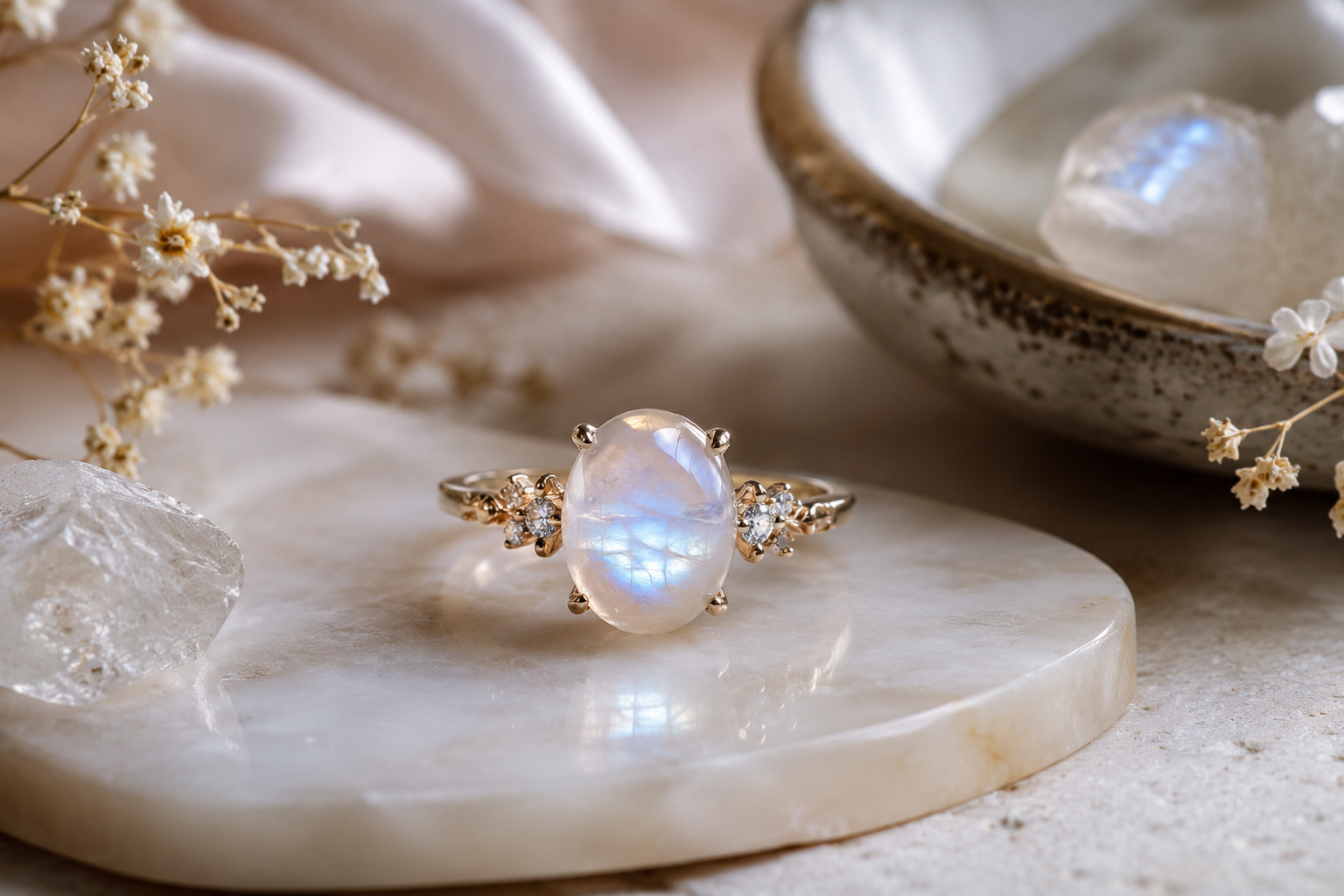
Is Moonstone Good for an Engagement Ring?
Yes for some hands, no for others, and the answer doesn't come down to taste: it comes down to what the person does with their days. A moonstone engagement ring is a real alternative to a diamond, but it's a perfectly cleavable stone set on the one piece of jewelry that never comes off. Here's how to decide.
I sell a moonstone engagement ring, so you can read what follows with a healthy dose of skepticism. That's exactly why I'd rather write the counterarguments before the arguments: if you walk away with a sapphire, you'll have made the right call, and if you walk away with a moonstone, you'll know exactly what you're signing up for.
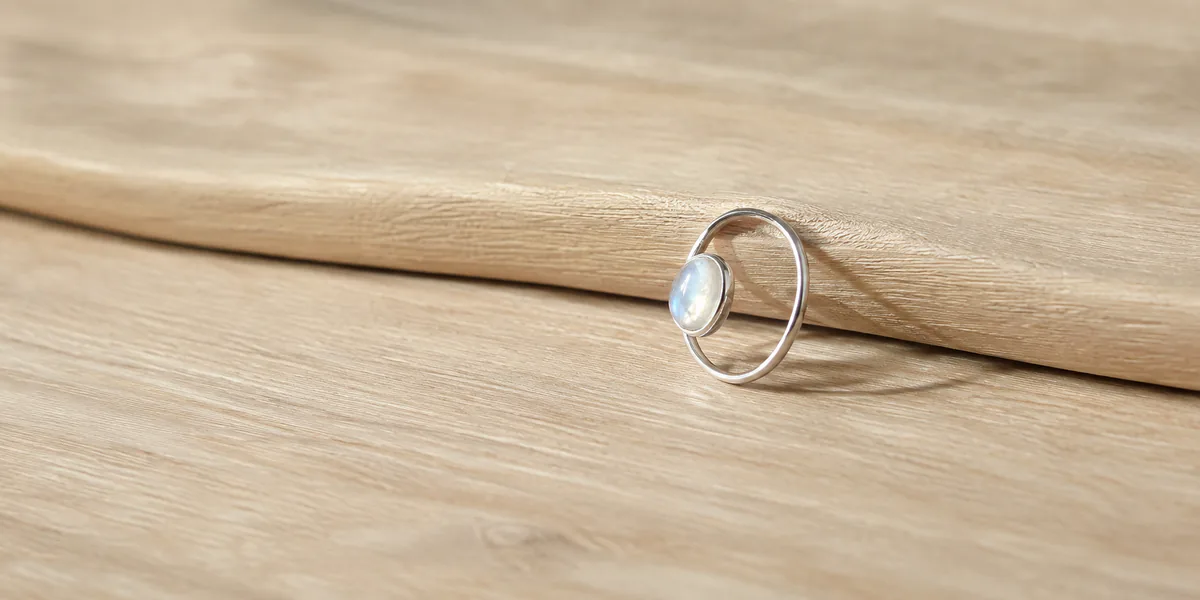
The short answer
- Yes if the person works a desk job, takes off their jewelry without thinking about it, and likes the idea of a stone that isn't everyone else's.
- No if they work with their hands, or if they never take their rings off. This isn't a question of care, it's a question of physics.
- The number that decides it: 6 to 6.5 on the Mohs scale, with perfect cleavage. Gemology recommends 7 and up for a ring worn every day.
- A bezel setting is mandatory, with a low dome and a closed back. Prongs on a moonstone engagement ring are a mistake.
- The wedding band worn next to it is an underrated danger, especially if it's set with stones.
- The most common compromise: moonstone for the proposal, a harder stone for everyday wear.
- Insist on a standard size. A free-form stone can't be replaced with an identical match.
Why the idea is appealing
It's appealing for good reasons, and I'm not going to pretend otherwise.
It steps outside the solitaire. A lot of people don't see themselves in the classic engagement ring, or in what it represents. A milky cabochon crossed by a blue sheen says something else, softer and less coded.
It's unique in the strictest sense. No two cabochons ever have the same sheen, or the same position of the reflection on the dome. That's not a sales pitch, it's a property of the mineral: adularescence depends on each stone's internal structure.
It's alive. The reflection shifts as the hand moves. An engagement ring gets looked at a lot in the first few months, and this one changes all day long.
It costs noticeably less at an equivalent size, which frees up budget for the setting, for a genuinely beautiful cabochon, or elsewhere.
All of that is true. The problem lies elsewhere.
The problem, in one number
Moonstone sits at 6 to 6.5 on the Mohs scale, and the GIA rates its toughness as poor. Those are two different properties: hardness measures resistance to scratching, toughness measures resistance to breaking.
Two consequences, and they need to be taken separately.
On scratching. Household dust contains quartz, hardness 7. Anything under 7 eventually dulls from contact with ordinary dust. And the Mohs scale isn't linear: the gap between 6.5 and 7 isn't a trivial half-point, it's the threshold set by ambient dust. That's the reason gemologists recommend 7 and up for a ring worn daily.
On this stone, scratching isn't just cosmetic either. The sheen reads through the polished surface: a dulled dome doesn't just lose its shine, it loses its adularescence. The ring keeps its shape and loses the exact thing it was chosen for.
On breaking. Perfect cleavage is the real issue. The stone splits cleanly, along internal planes, instead of chipping randomly. And the plane of least resistance sits just under the dome's polished surface, because the lapidary orients the cabochon's base along the sheen plane. An impact on top therefore lands perpendicular to the fracture plane. The detail is in is moonstone fragile.
What an engagement ring actually goes through
This is where the issue actually plays out, and not in the spec sheet.
An engagement ring isn't jewelry like any other. It's the one piece worn continuously, often for years without being removed, including for sleeping, showering, and washing dishes. People don't take it off because they're afraid of losing it, and because it carries a value that isn't the object's own.
Make a list of what a hand goes through in an ordinary day: doorknobs, a steering wheel, a bag strap, the edge of a sink, a keyboard, jean pockets, a subway pole, carrying a child. A perfectly cleavable stone doesn't need an accident to split. It needs time and repetition.
I put it this way at the workshop: it's not the stone that's the problem, it's the contract. An engagement ring implicitly promises to never leave the hand, and this stone asks for exactly the opposite.
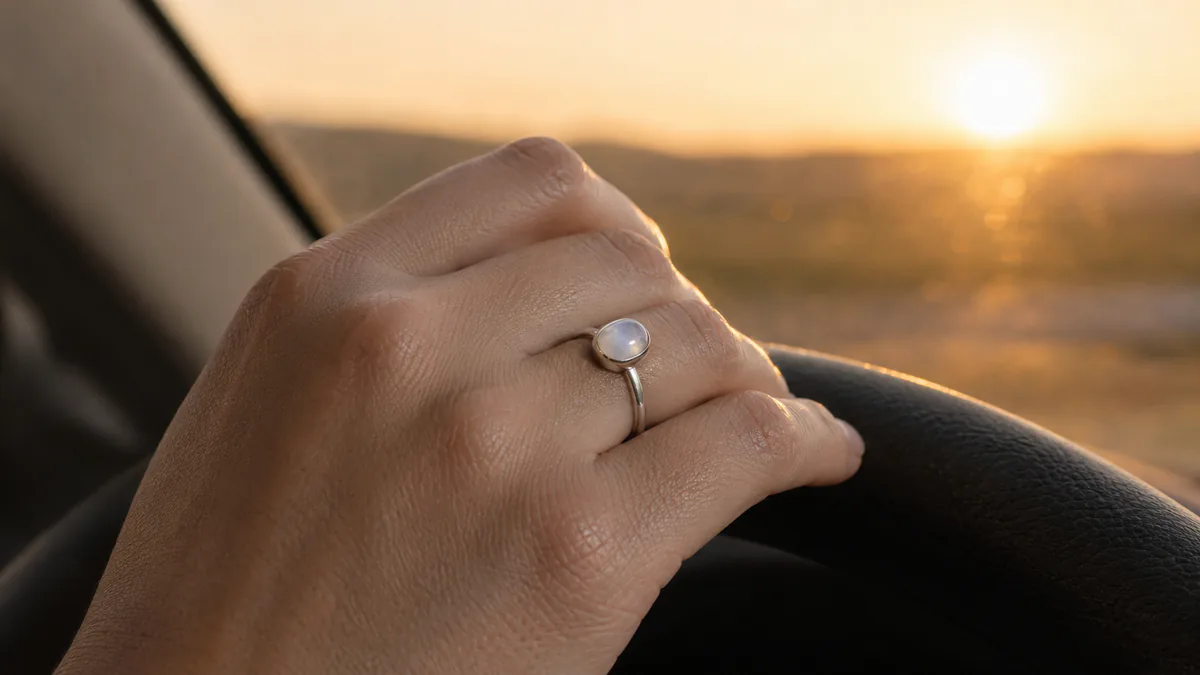
My verdict, profile by profile
Rather than a general opinion, here's the chart I actually use when I'm asked this question at the workshop.
| Profile | Verdict | Why |
|---|---|---|
| Desk job, takes jewelry off | Yes | Rare impacts, already in the habit of removing it |
| Likes gemstones, accepts the upkeep | Yes | Knows the subject and anticipates the habits |
| Never takes rings off | No | The ring's contract contradicts the stone's |
| Manual trade, caregiving, cooking, gardening | No | Daily impacts on the cabochon's girdle |
| Contact sport or weightlifting | No | The bar crushes the metal against the stone |
| Wants a ring they never have to think about | No | Choose 8 or 9 on Mohs, not 6.5 |
Three "no"s out of six. That's not a knock against the stone, it's a reminder that an engagement ring is an extreme use case, and few gems actually hold up to it.
The setting that changes everything
If you decide to go ahead, five points make all the difference between a ring that lasts ten years and one that breaks in ten months.
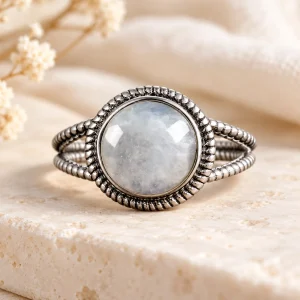
- Bezel setting, no exceptions. A continuous band of metal covers the cabochon's girdle, exactly the edge where cleavage starts. Prongs leave that flank bare, apply pinpoint pressure, and snag on clothing.
- Low dome. A high dome gives a prettier sheen and sticks out further past the plane of the hand. On a ring worn continuously, protection comes first.
- Closed back. It keeps the stone from flexing and blocks soapy water and abrasive dust from getting under the cabochon.
- Standard size. 8x6, 10x8, 12x10 millimeters. The day the stone breaks, it can be replaced with an identical match without redoing the setting. A free-form stone dooms the whole piece.
- Set, never glued. Glue gives way to solvents, hand sanitizer, and heat long before the stone does.
A sixth point, less well known: ask whether the ring can be resized, and how. Resizing is done with a torch, and heat near a cleavable cabochon is a real risk. On my settings, the stone is unset before the operation and reset afterward. An open band avoids the question entirely. Settings are compared in bezel setting or prongs.
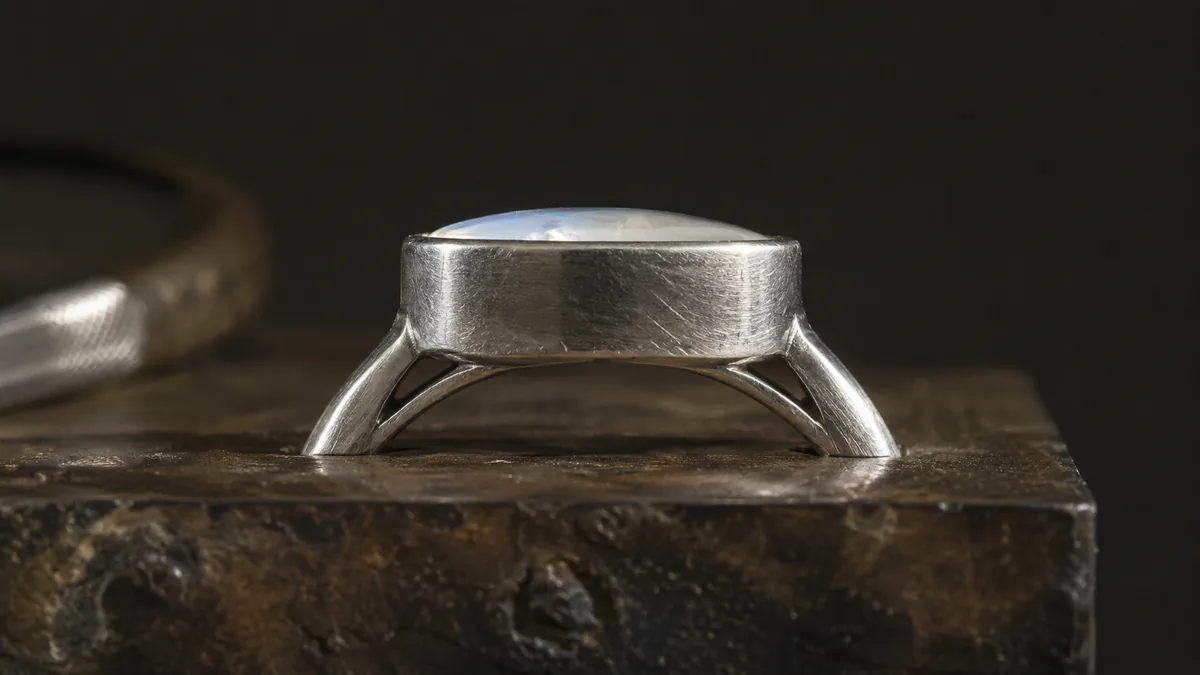
The workshop's bezel-set cabochon settings
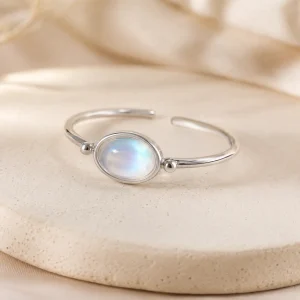
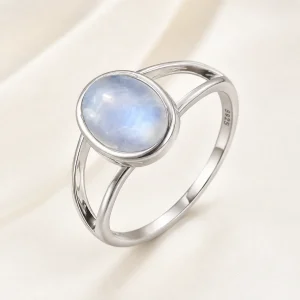
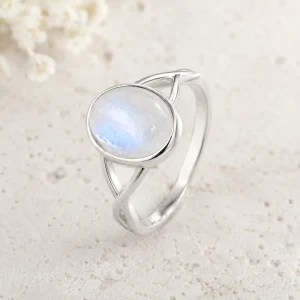
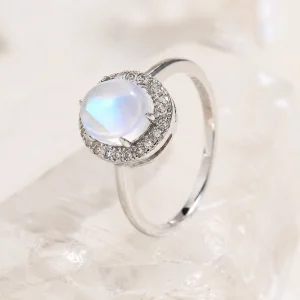
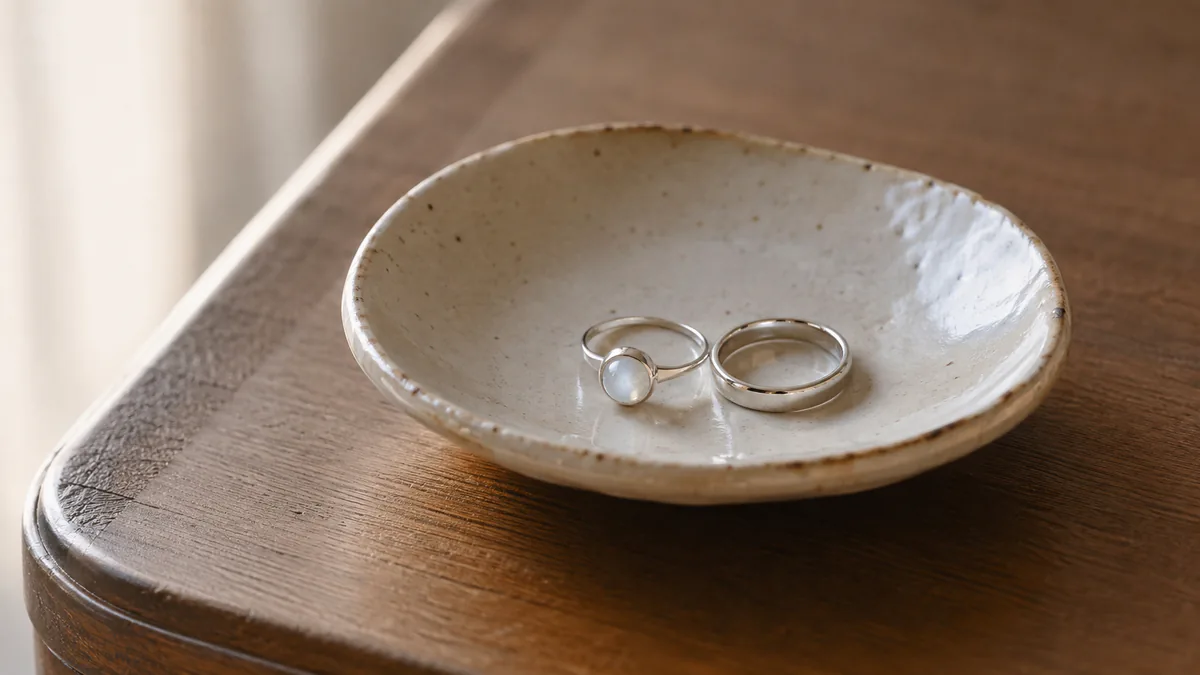
The problem of the wedding band worn next to it
Here's the point almost nobody sees coming, and it damages a lot of soft stones after the wedding.
A wedding band worn on the same finger rubs against the engagement ring constantly, with every flex of the hand. Two very different cases.
A plain gold or silver band won't scratch the stone: those metals sit around 2.5 to 3 on the Mohs scale, well below feldspar. The risk is mechanical, not abrasive: repeated contact happens against the bezel and, if the two rings aren't at the same height, against the cabochon's girdle.
A band set with stones is a whole different matter. Diamonds at 10 on Mohs, or zircons or sapphires, rubbing against a 6.5 cabochon: the moonstone loses, every time, and fast. A tungsten carbide or ceramic band, around 8 or 9, poses the same problem.
Three solutions, in order of preference. Have a wedding band shaped to fit the bezel made, so the two pieces sit flush without working against each other. Wear the wedding band on the other hand, which works perfectly well. Or choose a plain, wide band, without stones, sitting at the same height as the bezel.
The solution I suggest most often
It's not in any catalog, and it solves the whole problem.
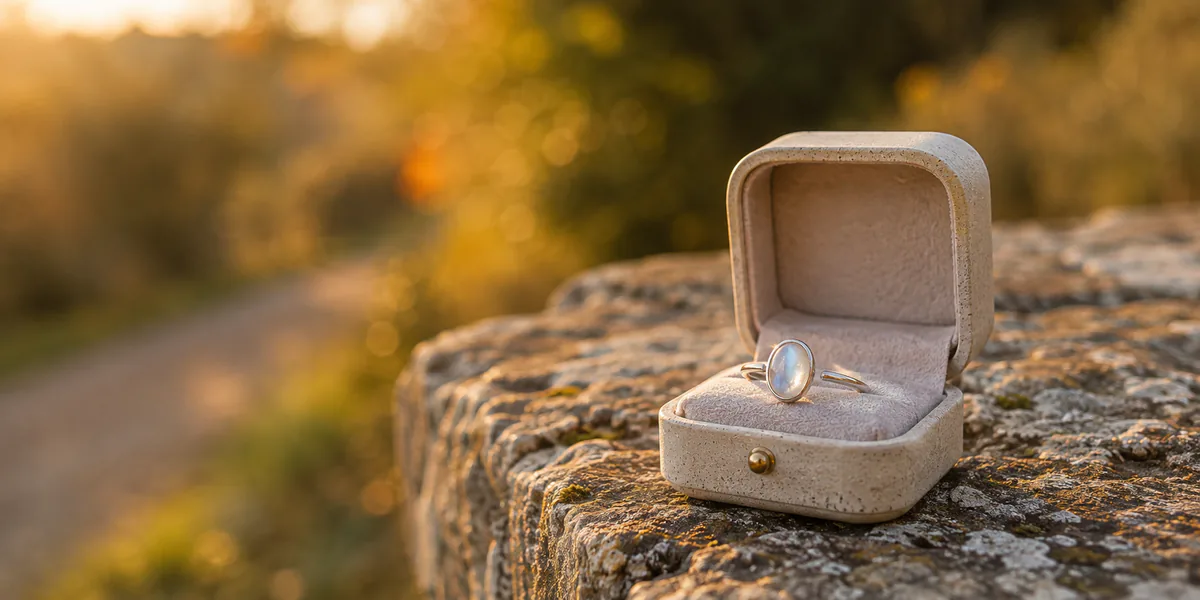
Use moonstone for the proposal, not necessarily for the thirty years that follow. The proposal ring is a moment object: it gets photographed, worn for a few weeks, shown off. Afterward, the couple picks the ring they'll wear every day together, with the right size and the right stone.
Three advantages. You don't need to know the ring size at the moment of the proposal, especially if the band is open. The person receiving it gets a say in the ring they'll actually wear. And moonstone keeps a role that suits it: the piece for the gesture, not the piece for daily wear.
The engagement ring I make is built exactly for this scenario: oval cabochon in a bezel setting, open band, one size fits all. It requires no measurement beforehand, which is precisely the problem faced by someone planning a proposal in secret. The topic of gift-giving is covered in giving moonstone as a gift.
The alternatives, if you pass
If the profile doesn't fit, better to know beforehand than after. Here's what I suggest, while staying in the spirit of an alternative to a diamond.
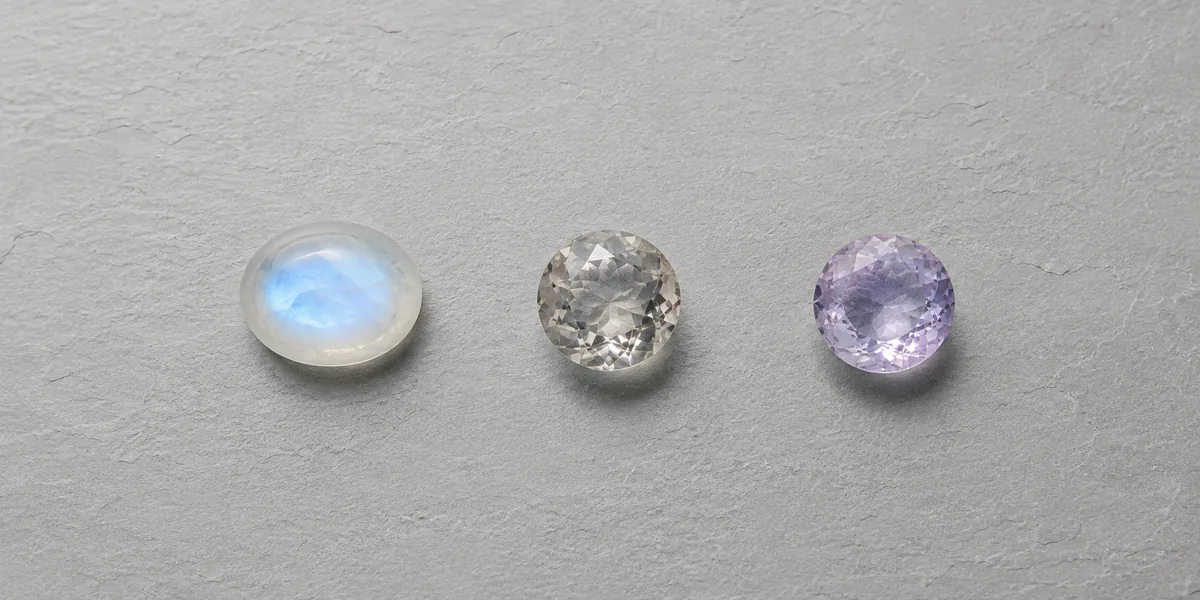
Sapphire, hardness 9, with no exploitable cleavage. It's the toughest engagement-ring stone after diamond, and it comes in gray, pale blue, and colorless, not just the deep blue people expect.
Spinel, hardness 8, very tough, available in grays and lavender-blues that echo the mood of moonstone without its fragility.
Labradorite is not a sturdy alternative, contrary to what you'll read: same 6 to 6.5 hardness, same cleavage. The dark background changes the look, not the mechanics. See moonstone or labradorite.
Opal even less so: softer, sensitive to dehydration, it's a worse choice than moonstone for this use.
If the attachment is really about the blue sheen and nothing else, then there's no substitute: adularescence is unique to feldspars, and feldspars all sit at 6 to 6.5 with cleavage. That's a trade-off, not a problem to solve.
Caring for a ring that's almost never removed
Let's say you go for it. Here are the habits that make the difference over ten years.
When to take it off. Doing dishes, cleaning, gardening, sports, DIY projects, the pool, and the sea. The shower too, because of thermal shock and soap building up under the cabochon.
Cleaning. Lukewarm water, mild soap, a very soft brush, dry with a cloth. Never ultrasonic, never a steam cleaner: ultrasonics propagate fractures along cleavage planes. If a jeweler offers you a courtesy ultrasonic clean, decline and explain why.
The yearly check. Have the bezel inspected once a year. A bezel setting doesn't loosen the way prongs do, but an impact can slightly open the edge, and it's repairable as long as the stone stays intact.
The full detail is in how to clean moonstone jewelry, and how to wear it in how to wear moonstone.
What it changes about the budget
A moonstone, even a very beautiful one, costs a fraction of a comparably sized diamond. That changes two things about the math.
Replacement becomes realistic. With a standard size, a broken stone can be replaced without redoing the setting, for an amount nowhere near the price of the ring. That's what makes the gamble worthwhile, and it's why I push so hard on the standard size.
The budget shifts toward the setting. A well-executed bezel, a properly fitted closed back, hallmarked metal: that's where to put the money on this kind of ring, because the setting is what protects the stone.
What sets a moonstone's price, the clarity of the sheen, its color, and its position on the dome, is covered in moonstone prices and judging quality.
The workshop's rings, in a bezel setting for the most part




What tradition says about it
I'm putting this at the end of the article on purpose, because it's not what should decide.
Tradition links moonstone to softness, intuition, and new beginnings, and some see it as a symbol that fits well with a commitment. Others, on the contrary, tie it to cycles and therefore to change, which would make an odd message for an engagement. As often happens, the sources say one thing and its opposite, which is enough to suggest the belief is recent rather than handed down.
The symbol that holds up without any belief attached is simpler: it's a stone whose reflection shifts with angle and light, and that never looks quite the same way twice. What each person makes of that is theirs. The question of meaning is covered in the meaning of moonstone.
These correspondences fall under crystal healing, an approach based on traditions and beliefs. They are not a medical claim and never replace the advice of a healthcare professional. Read the full disclaimer.
Frequently asked questions
Is a moonstone engagement ring a good idea?
Yes if the person works a desk job and takes their jewelry off naturally. No if they work with their hands or never take it off. The stone is 6 to 6.5 on Mohs with perfect cleavage, while an engagement ring is the most-worn piece of jewelry there is.
Will moonstone break?
Not necessarily, but it's exposed. It doesn't shatter in one go: it chips at the girdle or loses a flat flake on the surface, after months of small repeated impacts. A low-dome bezel setting sharply reduces this risk without eliminating it.
Which setting should I choose?
Bezel setting, low dome, closed back, standard size, set rather than glued. Prongs should be avoided: they leave the flank of the stone exposed, apply pinpoint pressure, and catch on clothing.
Can you wear a wedding band next to it?
A plain gold or silver band, yes, preferably at the same height as the bezel. A band set with diamonds or zircons, no: those stones are much harder and will wear down the cabochon. Wearing the wedding band on the other hand is a perfectly acceptable solution.
Which stone should I choose if I pass on moonstone?
Sapphire, hardness 9 with no exploitable cleavage, available in gray or pale blue too. Or spinel, hardness 8, in grays and lavenders close to the mood you're after. Labradorite isn't an alternative: same 6 to 6.5 hardness and same cleavage.
Can the ring be resized?
Yes, but the stone has to be unset before the operation: resizing is done with a torch, and heat near a cleavable cabochon is a real risk. An open band avoids the question entirely, which is useful for a proposal planned in secret.
How do I clean it?
Lukewarm water, mild soap, a very soft brush, dry with a cloth. Never ultrasonic or steam, even at a jeweler's: ultrasonics propagate existing fractures along cleavage planes.
What do I do if the stone breaks?
If the size is standard, it can be replaced with an identical match without redoing the setting, for a cost nowhere near that of the ring itself. That's exactly why a free-form stone should be refused on this type of piece.
Where to go from here
This page settles one specific question. For the rest:
- The mechanics: is it fragile, bezel setting or prongs, cleaning it, wearing it every day.
- Choosing the stone: judging quality, the price, colors and varieties, where to buy it.
- The gesture: giving moonstone as a gift, the ring and its meaning.
- The full picture: the complete guide.
The rings I make are in the ring collection, in a bezel setting for the most part. If you're planning a proposal and you're on the fence, write to me: I'll tell you honestly whether your situation is a good fit.
My sources
Hardness, toughness, and cleavage follow the public sheets from the GIA, Mindat, and the International Gem Society, along with the comparative hardness of sapphire, spinel, and precious metals. The recommendation of a hardness of 7 and up for a ring worn daily is a common gemological rule of thumb, not a formal standard.
The profile chart, the setting advice, the wedding-band question, and the proposal-ring compromise come from my workshop and from pieces brought to me for repair. These are professional observations, and I'd rather say so than dress them up as a study.
Last updated: August 19, 2026. If you spot an error in this article, let me know: I'll fix it and note it.
✦ À porter, à offrir
Découvrez mes créations