


Description
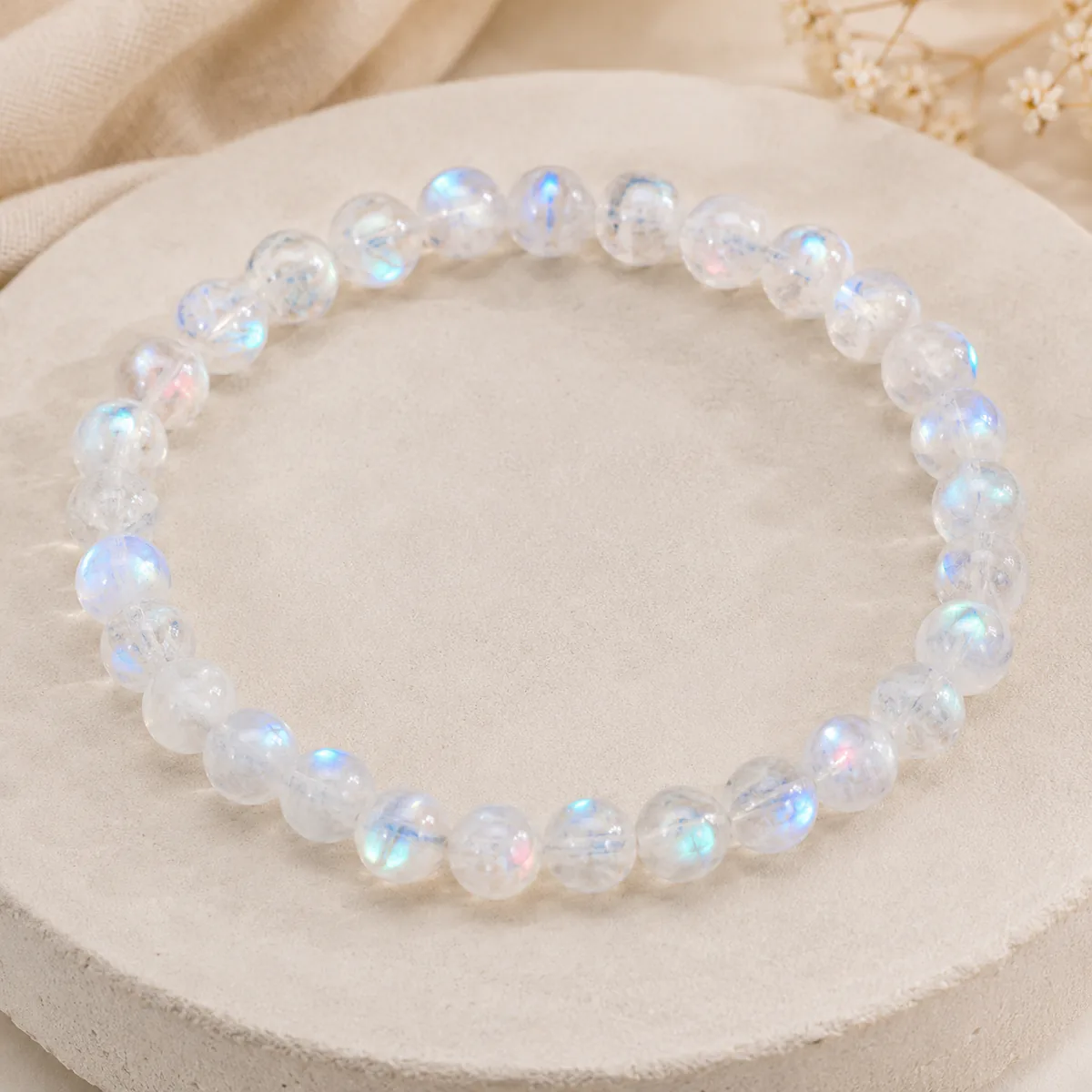
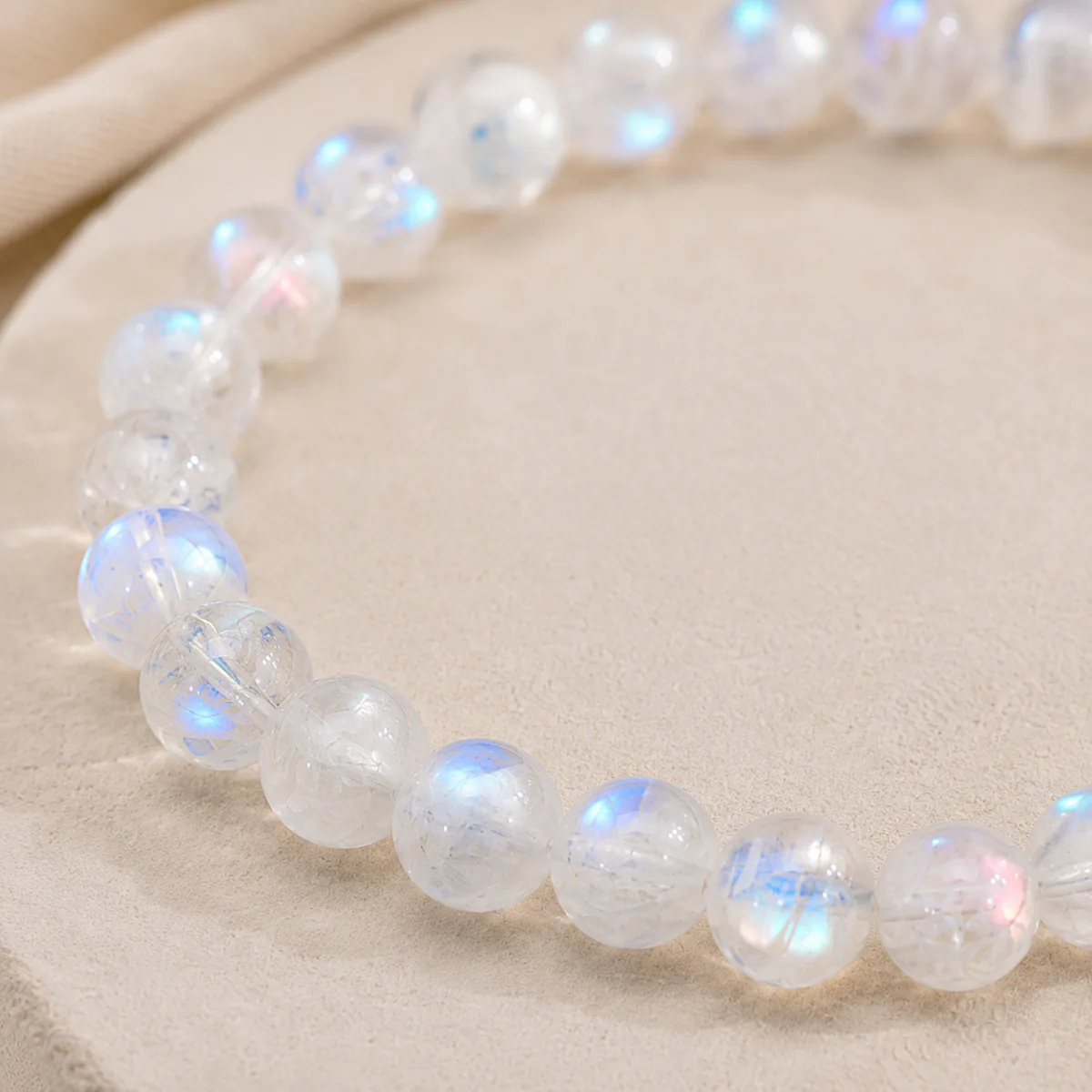
Round beads, almost transparent, crossed by blue, pink and green flashes depending on the angle. It is the most spectacular bracelet in the catalog, and the only one whose beads are clear enough to let you see inside the stone.
Those lines inside are not cracks
It is the first thing people notice when this bracelet arrives, and the first worry. Looking closely at a bead, you make out planes, veils, sometimes fine sharp lines that look like fissures. On every other bead in the shop you see nothing of the sort, not because there is nothing there, but because the material is too milky to let the eye through. Here the stone is transparent, so it shows its inside.
The interesting part is that those planes are exactly what makes the flash. This stone is made of stacked internal layers, born of the mineral cooling very slowly, and it is by bouncing between those layers that light comes back out colored. The lines you see and the flashes you love are the same phenomenon seen two ways. A perfectly limpid bead, with no visible plane at all, would be a bead with no rainbow.
That said, those same planes are also the surfaces along which the stone parts when it takes a knock. That is cleavage, it is perfect in feldspars, and it explains why moonstone chips without scratching. On this model you therefore have the rare advantage of seeing where the stone would give way: the internal lines show you the map of its weak points.
The light has to come from behind you
Here is what is particular about this model, and it explains the disappointment of a good many buyers of iridescent stones. This flash is a reflection, not a transparency. The light therefore has to arrive from the same side as your eye, which is to say from behind you or above you. Hold the bracelet up against a window to examine it backlit and it becomes a plain row of colorless beads: you have put the effect out by looking at it.
The right move is the opposite: turn toward daylight, hold your wrist out in front of you, and roll the bracelet slowly. The colors will appear bead by bead, never all together, because they only light up on the beads whose internal orientation faces the light. A bracelet entirely lit at once exists only in photographs, where the lighting is placed on purpose. What you will wear is a handful of live beads relaying one another as you move, and it is prettier than it sounds written down.
Two or three beads will always look duller than the others at any given moment. They are not of lesser quality, they are badly oriented at that moment. Turn the bracelet a quarter turn and it will be their neighbors going out. The real quality criteria are set out here.
It is not the same stone as the rest of the catalog
I say it on every rainbow piece and I say it again here: this variety is not adularia, moonstone in the strict sense, but a pale labradorite. The whole trade sells it as rainbow moonstone, I do the same so that you can find it, but you deserve to know what you are wearing. The difference is explained in detail here, and everything the shop offers in rainbow is there.
For a bracelet, that kinship has a pleasant practical consequence. Both stones belong to the same family and therefore have roughly the same hardness: you can stack this bracelet with the other moonstone models without either marking the other. That is not the case with a quartz or amethyst bracelet, markedly harder, which will leave its trace on yours.
The stretch cord remains a wearing part: one to three years before restringing, longer if you put the bracelet on by rolling it over the hand rather than stretching it to full width. The shop’s other bracelets are here.
Crystal healing tradition treats this variety apart from classic moonstones, on account of its flash and not of its composition. I have put those correspondences below. I will go no further: none of it is demonstrated and no piece of jewelry heals anything. Separately, I have gathered what tradition lends this stone, what each color changes and what is said about which wrist to choose.
- Clear round beads with blue, pink and green flashes. A white labradorite, not an adularia.
- The planes visible inside are not cracks, they are what makes the flash.
- Look at it with the light behind you. Backlit, the effect disappears.
- Stretch cord, no clasp. Delivered in two weeks, with a cotton pouch and a care card.
The specifications
- Stone
- Rainbow moonstone, a pale labradorite
- Appearance
- Clear beads, blue, pink and green flashes depending on the angle
- Construction
- Stretch cord, no clasp and no spacers
- Number of beads
- Varies with wrist size
- Wrist size
- 14 to 20 cm
- Gender
- Women and men
- Brand
- Melissa Moon
Why I do not remove the beads with visible planes
It would be the easiest sorting to do, and the most tempting: set aside every bead where a line can be made out inside, keep only the limpid ones, and sell a bracelet nobody would find suspicious. The trouble is that those beads are also the deadest ones. In a parcel, the finest colors are almost always in the most inhabited stones.
What I do set aside are the beads where a plane runs out to the surface, because there it is no longer an internal structure but the start of a chip, and one day it will open. The difference shows under a fingernail: if the nail catches, the bead leaves the batch. If the line stops beneath a smooth surface, it stays. The rest of the shop is here.
It is the only piece in the shop that shows how it works. Everywhere else, the stone keeps its secret.
No salt, no ultrasonic tank, no hot water: moonstone is a feldspar, and all three damage it for good. The ultrasonic tank is to be banned here in particular, since its whole principle is to make matter vibrate along its planes of weakness, and those planes are visible to the naked eye on your beads. Lukewarm water, a soft cloth, careful drying. On beads this clear, the greasy film from fingers shows at once and puts the colors out: a wipe with a dry cloth is enough to light them again, and it is often all that is missing from a bracelet people believe has gone dull. The detail is in cleaning a moonstone piece, and the safe methods in caring for it without harming it.