

Description
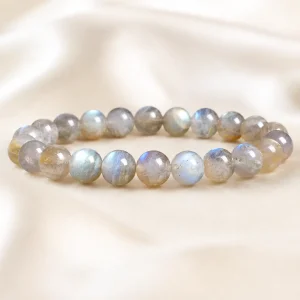
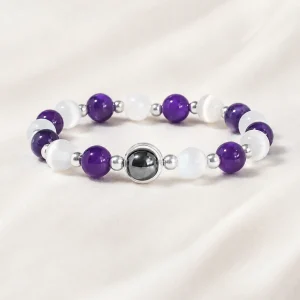
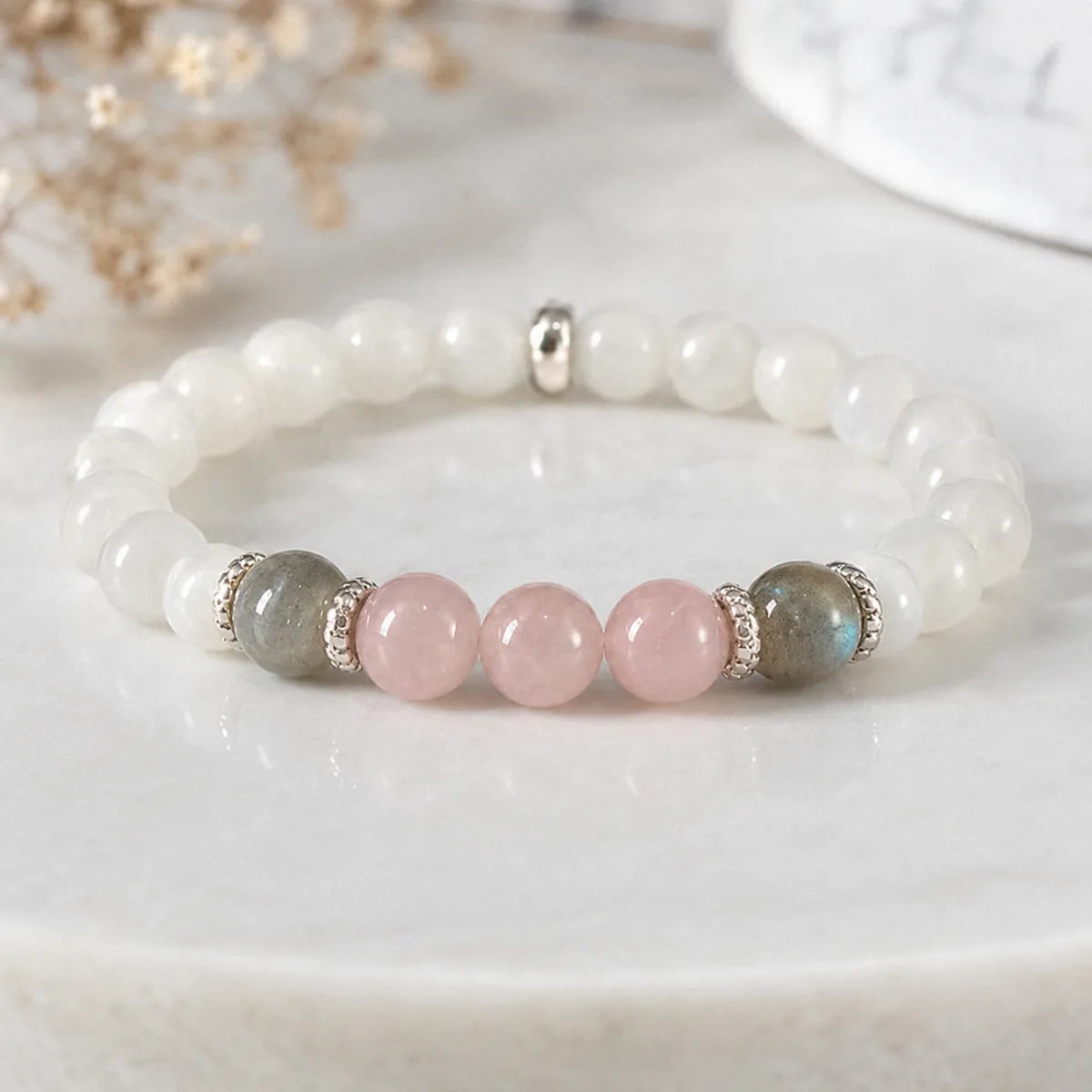
The most requested duo in the catalog, strung in 8 millimeter beads on a stretch cord. Mostly white beads, three pink ones at the center, and on either side two gray beads crossed by a sharp blue flash, separated by carved silver spacers. It is actually a trio, and the third stone deserves to be named.
What is really on this cord
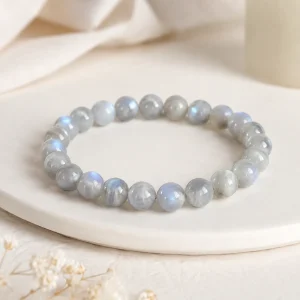
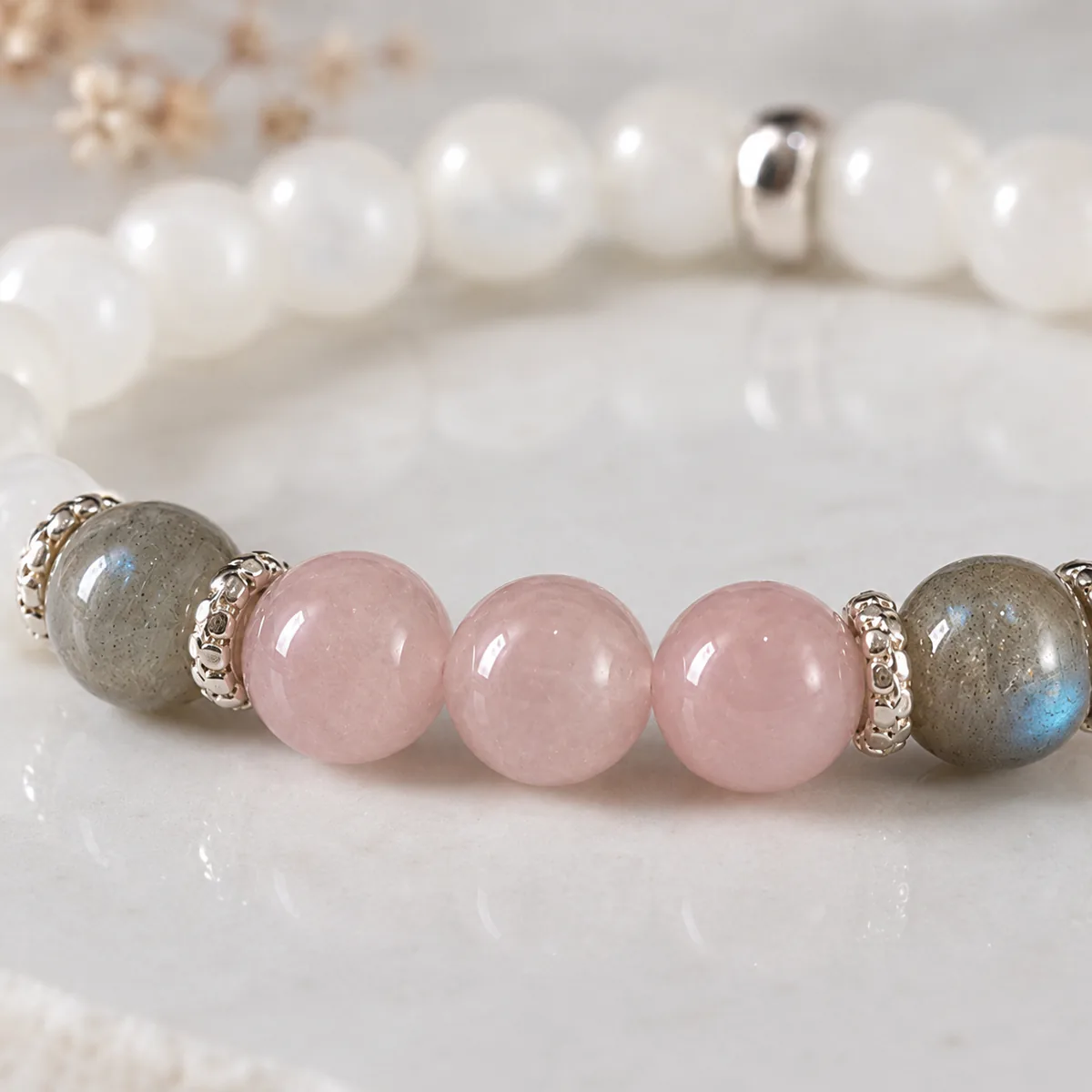
The composition reads from the outside in. Most of the bracelet is moonstone beads, milky white, whose glow shifts as the wrist turns. At the center, three rose quartz beads, pale pink and translucent, providing the bracelet’s only real color. Between the two, on the left and right, one gray-green bead whose surface throws back a distinct blue flash.
That gray bead is not there by chance, and it is not a darker white moonstone. It is labradorite, meaning a plagioclase, the exact same species as the variety the trade calls moonstone rainbow. In other words, this bracelet carries two moonstones, an adularia and a labradorite, without its name saying so. They actually look quite different: one veils, the other flashes. The difference between the two is explained on the Moonstone or Labradorite listing.
The four carved silver spacers are not purely decorative either, and I come back to that below, because it is the technical point of this bracelet.
Two hardnesses on the same cord
It is the question worth asking of any multi-stone bracelet, and almost nobody writes it down. Rose quartz is harder than moonstone. On the Mohs scale, quartz sits at 7, feldspars around 6 to 6.5. That is not a huge gap, but it is enough: on a flexible cord where beads roll and rub against each other all day, it is the pink that marks the white, never the other way around.
Hence the value of the silver spacers, placed exactly at the junctions between materials. They do more than punctuate the design: they keep beads of different hardness from touching directly. A multi-stone bracelet strung without separators always ends up showing micro-marks at the contact points, and on a milky stone they show. It is the kind of detail that separates a thought-out assembly from a merely assembled one.
I have gathered elsewhere the pairings that work and, more importantly, the ones to avoid, where the question of hardness comes up every time. The shop’s other bracelets are here.
What to know before ordering
The white beads do not all look alike, and that is normal: a moonstone’s sheen depends on the orientation of its internal layers, which nobody chooses when drilling a bead. A perfectly uniform batch would not be real stone. Rose quartz beads, by contrast, vary less, because their color is spread through the whole mass rather than being an optical effect.
The stretch cord is a wearing part: expect one to three years before a jeweler needs to restring it, and put the bracelet on by rolling it over your hand rather than stretching it to full width, since that is what decides its lifespan. Finally, moonstone has perfect cleavage: it chips on impact without scratching easily, and it is the beads underneath that hit table edges first.
Tradition ties moonstone to cycles and intuition, and rose quartz to gentleness toward oneself: it is that combination, not any particular property, that explains why the duo is the most requested. I will not go further: none of this is proven and no piece of jewelry heals anything. Beyond that, I have gathered what tradition attributes to this stone and what is said about which wrist to wear it on.
- 8 mm beads: white moonstone, three rose quartz at the center, two labradorites.
- Four carved silver spacers, placed at the junctions between materials.
- Quartz is harder than moonstone: the spacers keep them from touching.
- Stretch cord, no clasp. Delivered in two weeks with a cotton pouch and a care card.
The specifications
- Stones
- White moonstone, rose quartz, labradorite
- Bead diameter
- 8 mm
- Spacers
- Four carved silver-toned metal rondelles
- Construction
- Stretch cord, no clasp
- Hardness
- Quartz around 7, feldspars around 6 to 6.5
- Wrist size
- 14 to 20 cm
- Gender
- Women
- Brand
- Melissa Moon
Why I name the third stone
The product is called moonstone and rose quartz because that is the name people search for, and I am not going to rename it moonstone, rose quartz and labradorite so nobody finds it. But the labradorite is there, it shows, and a customer who notices it and wonders what it is deserves an answer rather than silence. It costs me nothing to write it, and it avoids exactly the kind of question that, left unanswered, turns into doubt about everything else.
As for stringing, I neither drill nor polish these beads, nobody does that per unit. What I check when opening a lot is whether the white beads average a decent sheen, and whether the spacers sit properly at the junctions rather than scattered at random. The second point is the one most often skipped. The rest of the shop is here.
A three-stone assembly is judged where the stones touch. The rest is just design.
No salt, no ultrasonic tank, no hot water: moonstone is a feldspar, and all three damage it for good. Rose quartz holds up better, but you treat a bracelet according to its most fragile stone, not its toughest. Lukewarm water, a soft cloth, drying thoroughly between the beads and around the spacers. Take it off before the shower: soap does not attack the stones but it wears the cord and dulls the metal of the spacers. The detail is in cleaning a moonstone piece, and the safe methods in caring for it without harming it.