


Description
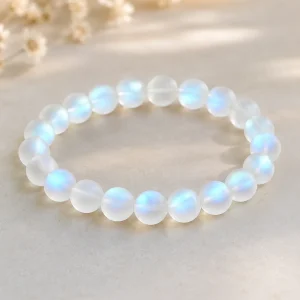
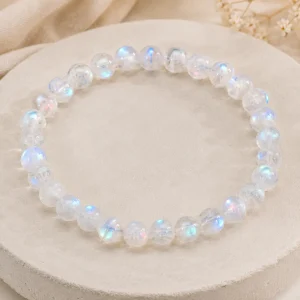
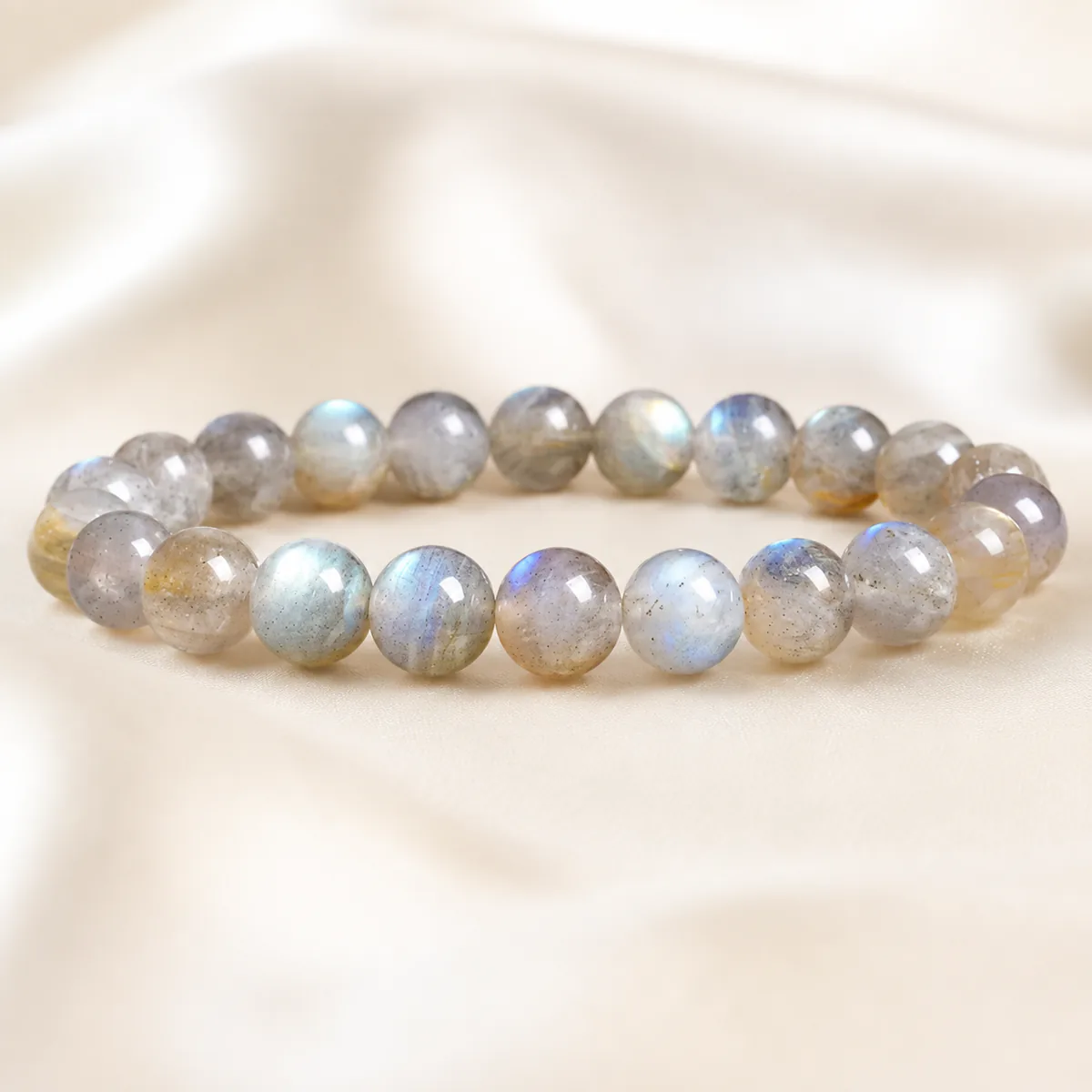
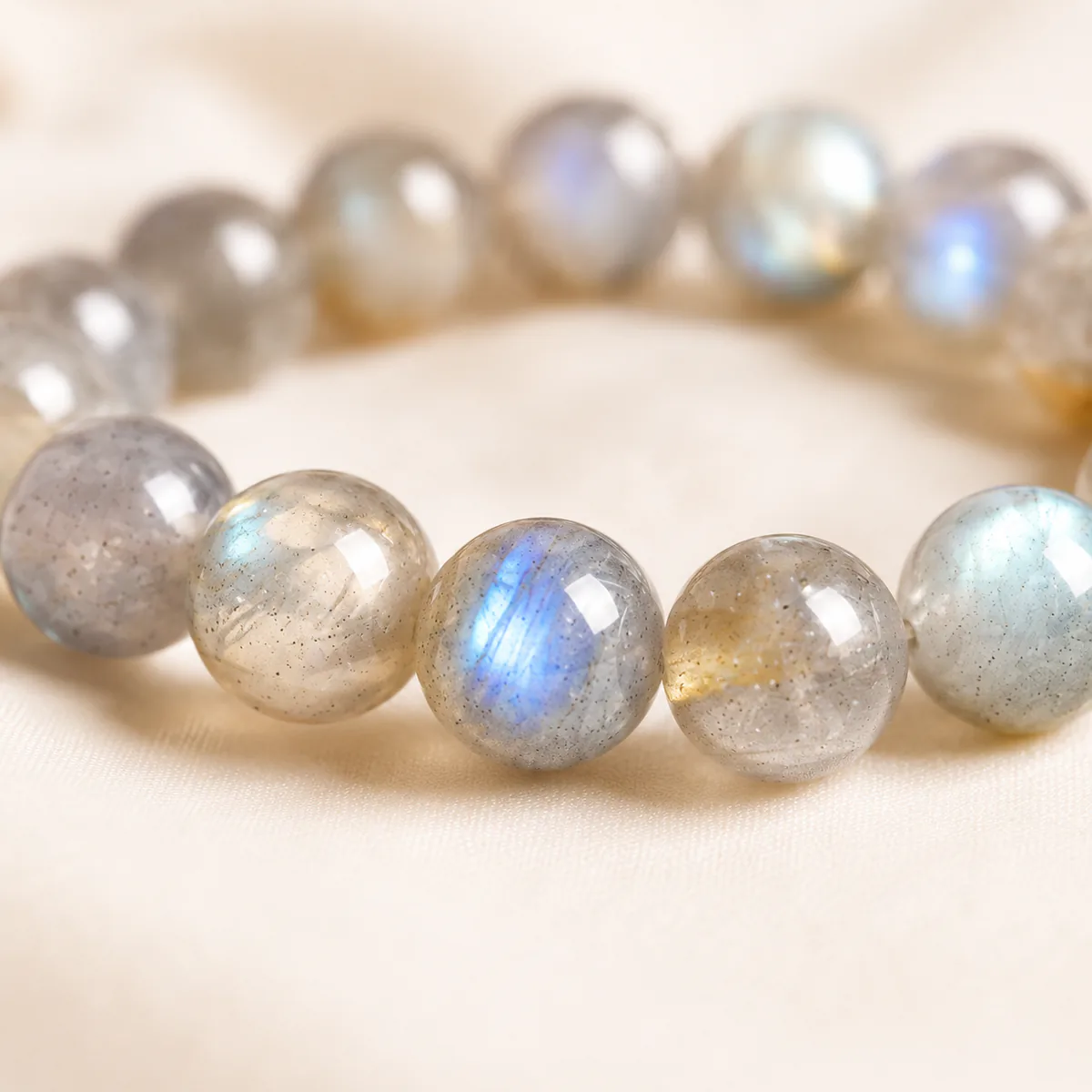
This is the most coherent pairing in the catalog, and the one where you will have the hardest time telling which bead is which. Gray, golden beige, and blue flashes that light up intermittently as the wrist turns. Two stones so close that the trade often sells one under the other’s name.
Two cousins, and that is not a figure of speech
White moonstone is an orthoclase. Labradorite is a plagioclase. They are two branches of the same family, the feldspars, which alone make up half of the earth’s crust. They share the same layered structure, and in both cases it is that structure that produces an internal play of light rather than a surface shine.
The difference is in the manner. On adularia, the light comes back out as a diffuse, milky veil floating above the stone: that is adularescence. On labradorite, it bounces off far more contrasted internal planes and returns in sharp sheets, blue, sometimes golden or green, that appear and vanish depending on the angle. One veils, the other flashes.
The kinship runs so deep that the trade ended up confusing the names. What is sold everywhere as “rainbow moonstone” is white labradorite, and nobody says so. Strictly speaking, this bracelet therefore pairs two moonstones in the commercial sense, and two feldspars in the mineralogical sense. I have set out what really separates them here.
You may not be able to tell them apart
Better said before the purchase than on opening the parcel. On the shop’s other pairings, the second stone is obvious: rose quartz is pink, carnelian is orange, there is no mistaking them. Here, both materials sit in the same range of milky gray, and their difference lies in the nature of the reflection, not in the color.
The trick is simple once you know it: tilt the bracelet slowly in front of a window. The beads that light up a sharp, clean blue that appears then cuts out abruptly are the labradorites. The ones whose glow stays soft and drifts slowly without ever bursting are the moonstones. Under artificial light the exercise does not work, and all you will see is a gray bracelet.
The only pairing where neither stone damages the other
This is the technical advantage of the combination, and it is real. On the catalog’s other multi-stone bracelets, one stone is always harder than moonstone and eventually marks it: rose quartz at 7, amethyst at 7, carnelian at 7, against 6 to 6.5 for a feldspar.
Here, both stones are feldspars: same hardness, same behavior, same fragility. Neither scratches the other, however long they spend rolling side by side on the wrist, and that is why this bracelet needs no metal spacers at all. It is the only pairing in the catalog in that position.
The flip side follows logically: they also share the same weakness. Both have perfect cleavage, they chip on impact without scratching easily, and it is the beads underneath that knock against table edges. I have gathered elsewhere the pairings that work and the ones to avoid. The other bracelets are here.
The elastic cord is a wear part, one to three years before restringing, and it wears mostly if you stretch it to full width to put it on rather than rolling it over the hand.
- Moonstone and labradorite beads, two feldspars from the same family.
- One veils, the other flashes. Tilt the bracelet in daylight to tell them apart.
- Same hardness: neither stone marks the other. The only pairing in the catalog like that.
- Elastic cord, no spacer and no clasp. Shipped in two weeks with a cotton pouch.
The specifications
- Stones
- Moonstone and labradorite
- Mineral families
- Two feldspars: orthoclase and plagioclase
- Hardness
- 6 to 6.5 for both
- Construction
- Elastic cord, no clasp, no spacer
- Wrist sizes
- 14 to 20 cm
- Gender
- Women and men
- Brand
- Melissa Moon
A pairing that is almost a tautology
It is only honest to admit it: pairing a moonstone with a labradorite means pairing a stone with its cousin, and with the very one the trade sells under its name when it is white. This is not the most contrasted pairing in the catalog, far from it. It is, on the other hand, the most harmonious, because both stones behave the same, age the same, and resemble each other enough never to compete for attention.
On a batch of labradorite, what I look at is not the average of the flashes but their variety. A batch where every bead flashes the same blue is dull on the wrist; a batch with blue, gold and gray gives a bracelet that changes with every movement. It is the only model where I look for irregularity rather than put up with it. The rest of the shop is here.
Two stones from the same family do not make a contrast. They make a chord, and that is harder to get right.
No salt, no ultrasonic tank, no hot water: both stones are feldspars, and all three damage them the same way. This is the only bracelet in the catalog where the care is identical for every bead, with no need to align on the most fragile one. Lukewarm water, a soft cloth, careful drying between the beads. Take it off before the shower: soap does not attack the stones but it wears the elastic. The detail is in cleaning a moonstone piece, and the safe methods in caring for it without harming it.