


Description
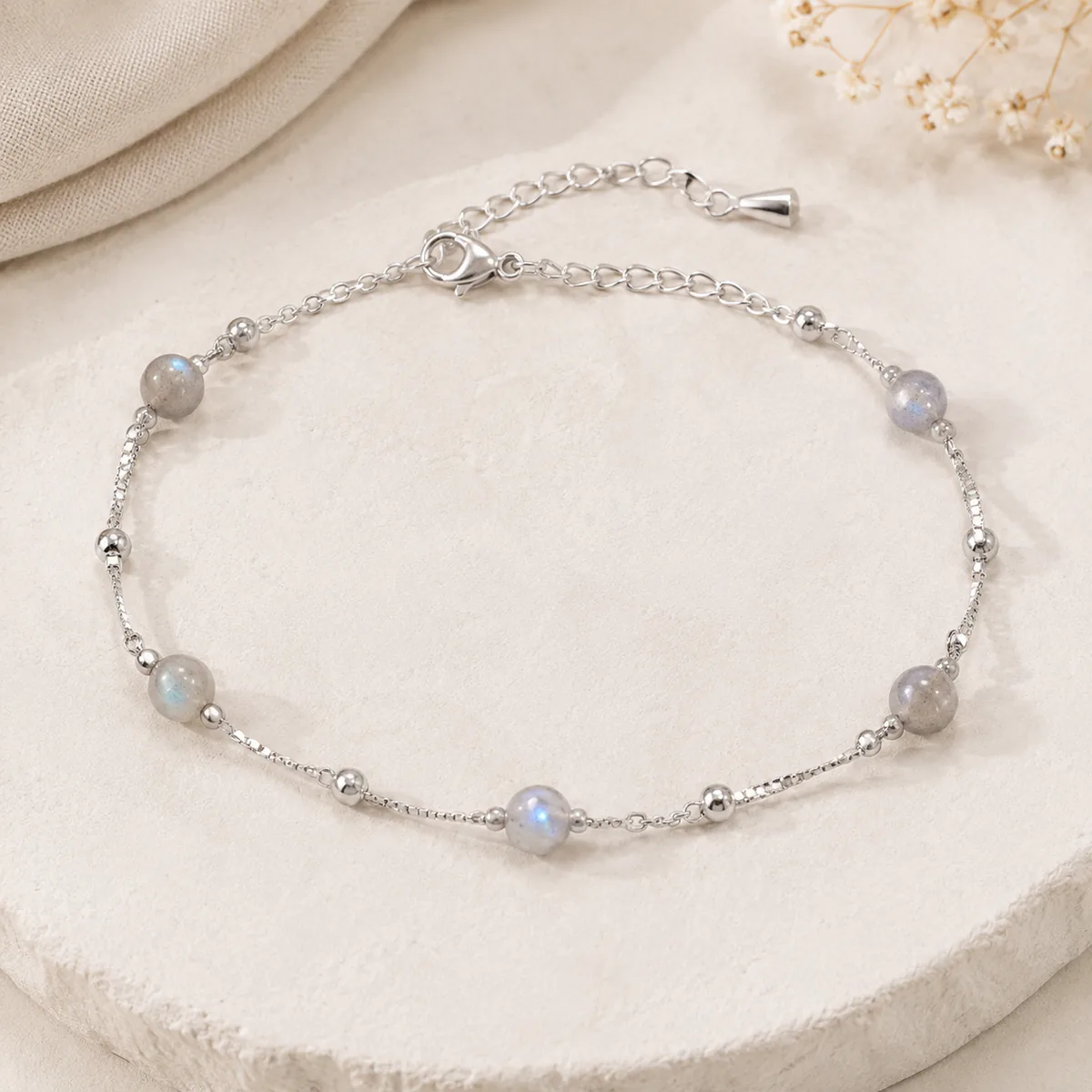
Two strands of fine silver chain, sown with small round moonstones and silver balls, with an adjustable length. It is the only foot piece in the catalog, and the only one designed to be seen while walking.
An ankle is not a wrist
People often buy an anklet the way they would buy a bracelet, looking only at whether it is pretty. Yet the two places have nothing in common. The ankle is the part of the body that gets knocked most: door frames, table legs, pedals, the edge of the bed, and above all the other ankle, which brushes it at every step. A bracelet lives at arm height, sheltered; an anklet lives at obstacle height.
That is the reason for this model’s design. The stones are spaced along the chain instead of being packed against one another: they rarely touch, and the chain absorbs the movement between them. On a strand of packed beads, every step rubs the stones two by two; here it is the links that work, and silver takes that far better than feldspar, which chips on impact without scratching.
The double strand has its trade-off, worth knowing before buying: two fine chains always end up twisting around each other, especially under trousers or a sock. It untangles in ten seconds with a fingernail, it breaks nothing, but it is worth remembering when you roll up the hem of a jean.
Sand is harder than moonstone
Here is this model’s particularity, and I have seen it written on no anklet page anywhere. An anklet is worn in summer, and therefore at the beach. Now the sand of most beaches is essentially quartz, which is harder than moonstone. On the hardness scale, quartz is at 7, feldspars between 6 and 6.5. In other words, the sand scratches your stones, and not the other way round.
That is not a reason to leave the piece at home, it is a reason to take it off before walking in dry sand and before lying down on it, which are the two moments when it takes the most. Wet sand at the water’s edge is less aggressive, because the grains slide instead of rubbing.
The sea poses another problem, and it concerns the metal. Salt water and pool water attack 925 silver, not the silver itself but the copper in the alloy, which gives that dull darkening on the way back from a holiday. If the piece has had a swim, rinse it in fresh water that same evening and dry it: that is the gesture that changes everything, and it takes thirty seconds. The question of water and moonstone is dealt with in detail here.
An ankle is measured in the evening
The chain is adjustable, which settles most cases, but two things deserve saying. First, an ankle swells over the course of the day, and more so in hot weather, on a plane or after a long walk. As this piece is precisely a summer piece, take your measurement in the evening and in warm weather rather than on waking in winter, otherwise the adjustment will be too short on the days you most want to wear it.
Second, an anklet is worn looser than a wrist bracelet: it must be able to turn and slide a centimeter or two above the bone, without ever gripping. Too tight, it marks the skin and rubs on the bone; too long, it slips down onto the foot. The sizing guide is here, and the shop’s other bracelets are there.
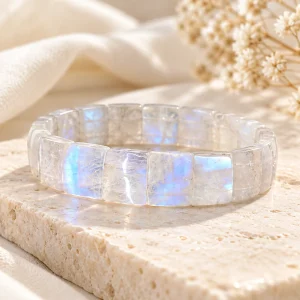
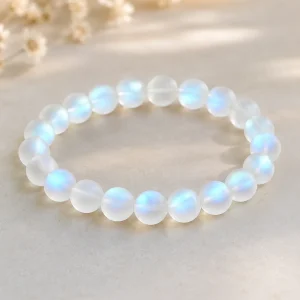
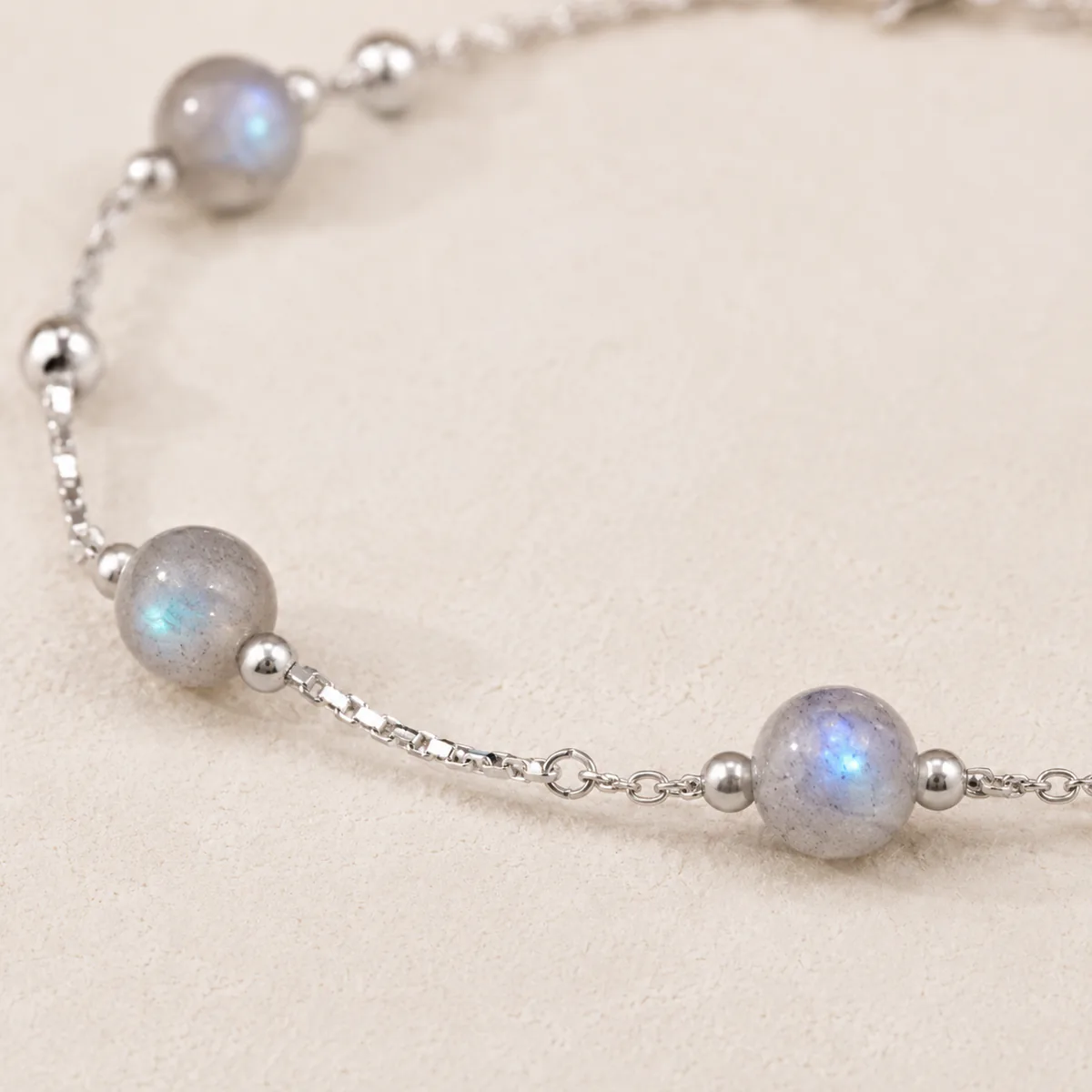
The stones are of the classic white variety, the one whose bluish sheen rises from within as the light moves. On beads of this diameter, the veil shows above all in full sun, which suits a summer piece: the phenomenon is explained here and the whole white variety is gathered there.
Crystal healing tradition lends moonstone correspondences tied to cycles and intuition, but it has little to say about a piece worn on the foot. I have put what it does say apart, further down. I will go no further: none of it is demonstrated and no piece of jewelry heals anything. Separately, I have gathered what tradition lends this stone and what each color changes.
- Double strand of fine 925 sterling silver chain, spaced stones and silver balls.
- Sand scratches moonstone. To be taken off before walking or lying down in dry sand.
- After the sea or the pool, rinse in fresh water that same evening and dry.
- Adjustable length. Delivered in two weeks with a cotton pouch, a handwritten note and a care card.
The specifications
- Stone
- White moonstone, spaced round beads
- Look
- Translucent white, moving bluish sheen
- Metal
- 925 sterling silver, chain and balls
- Assembly
- Double strand of fine chain, adjustable length
- Worn on
- Ankle
- Gender
- Women
- Brand
- Melissa Moon
The only piece you do not hear fall
A ring that slips, you feel it go. A bracelet that opens, you see it hang. An anklet, no: it falls into the grass or the sand without a sound and without touching anything, and you notice the next day. It is the only piece I advise checking with a finger as you leave a place, the way you check your keys.
It is also why I insist on a properly closed jump ring rather than a spectacular clasp. On a fine chain it is never the clasp that gives, it is the small open ring linking it to the rest, pushed apart by a snag in a hem. Nobody ever looks at it, and yet it is what decides whether the piece comes back from the beach. The rest of the shop is here.
An anklet is not lost, it is forgotten. It is not the same thing, but the result is identical.
No salt, no ultrasonic tank, no hot water: moonstone is a feldspar, and all three damage it for good. On this model, add the rule of sand, which is quartz and which scratches: you never rinse a sandy piece by rubbing it, you first run it under a trickle of lukewarm water to carry the grains away, then dry it with a soft cloth. Silver that has tarnished comes back with a silver cloth, carefully avoiding the stones. The detail is in cleaning a moonstone piece, and the safe methods in caring for it without harming it.