


Description
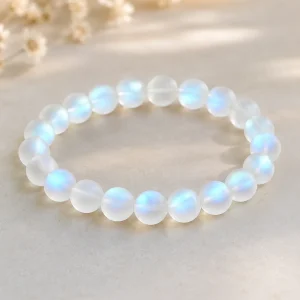
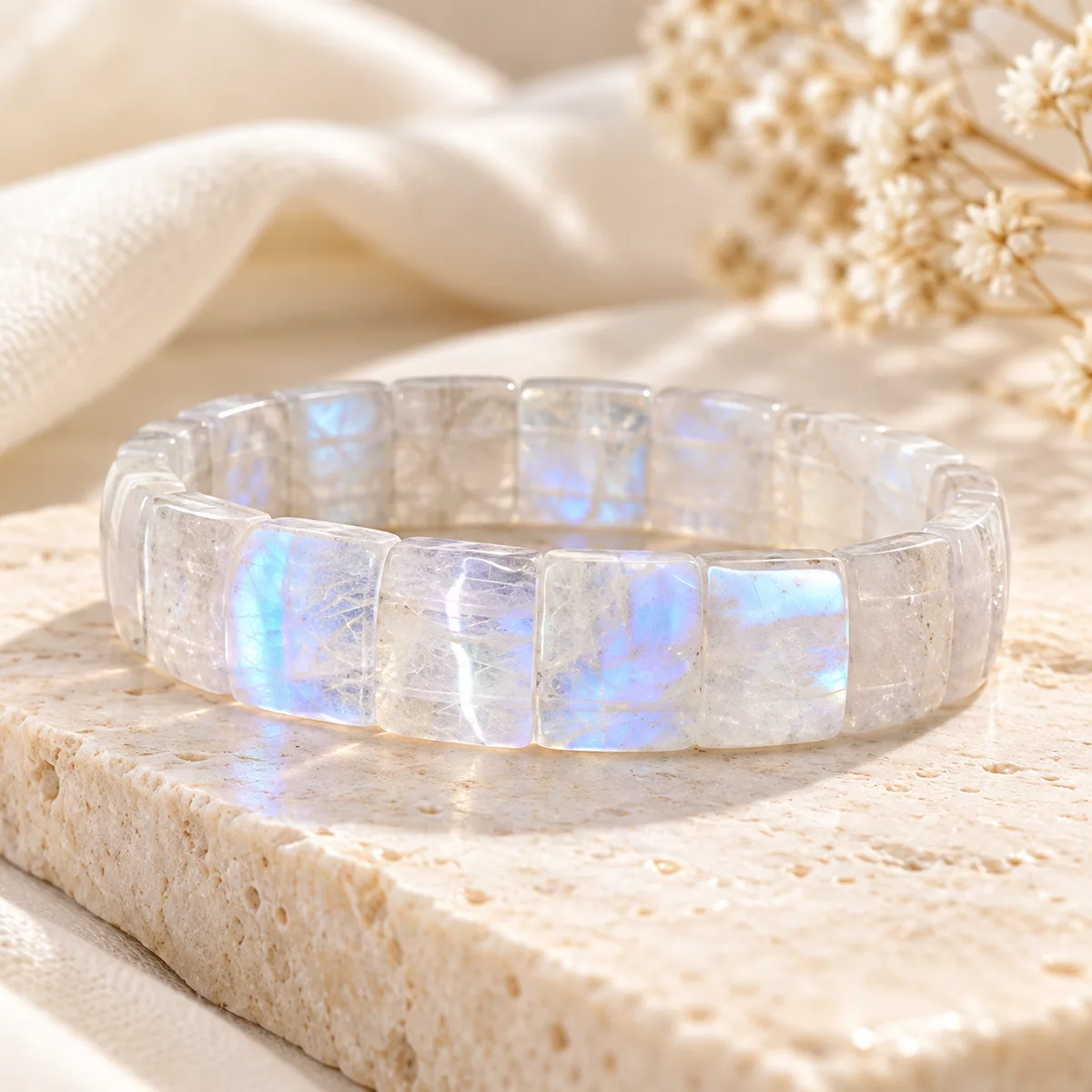
A bracelet made of stone alone: flat tablets of iridescent moonstone, threaded on an elastic cord, with no clasp and no metal. It slips on like an elastic and it hardly ever comes off again.
Tablets rather than round beads
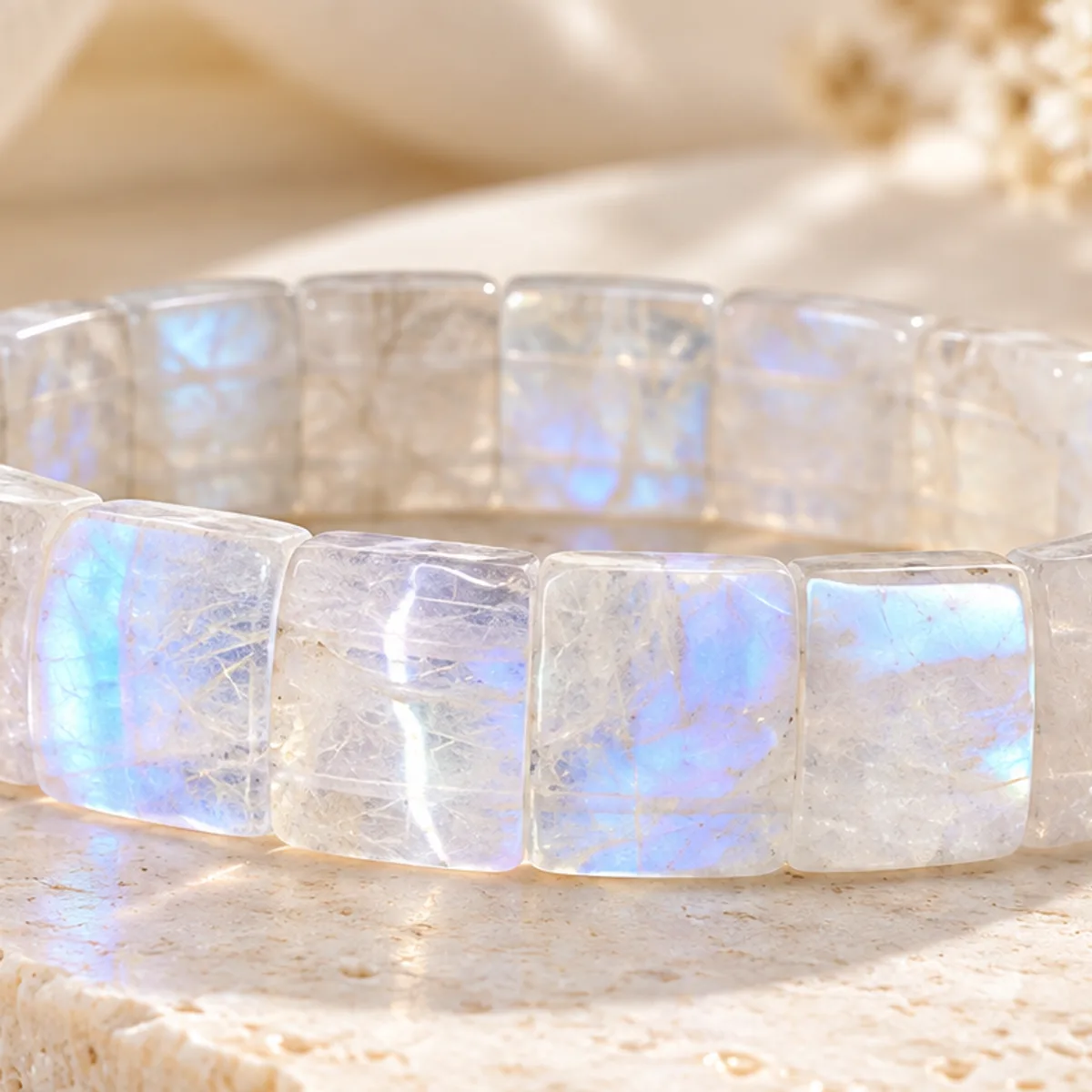
The shape changes everything. A round bead is polished over its whole surface, and its veil turns with it: it appears as small mobile patches, pretty but messy when there are thirty of them. A tablet is flat on both faces, and the veil spreads across the whole visible surface. On the wrist you therefore see thirty small fields of light that come on together as the arm turns, then go out together. The effect is far cleaner.
The tablets are iridescent, which is to say chosen from among the stones with the frankest veil. On a piece made entirely of stone, that is the only criterion that counts: there is no metal to make up for a dull stone. They are matched by tint, not by size: a slight irregularity of dimension makes a bracelet live, an irregularity of colour makes it look mismatched.
There is no clasp, no metal and no solder. The bracelet goes on by spreading it with both hands, and it holds by the elasticity of the cord. It is the simplest construction there is, and it has a real advantage: no mechanical part can give way. Its drawback is just as real, and it concerns the cord itself, which I come to below.
Moonstone chips on impact: on a bracelet with no setting the tablets are directly exposed, and this is the model I advise against most plainly for manual work. The veil is the same phenomenon as on the cabochons, explained in adularescence. The other bracelets are here.
- Tablets of real moonstone, iridescent, matched by tint rather than by size.
- Elastic cord, no metal, no clasp: nothing mechanical can fail.
- Flat faces: the whole row lights up together instead of flickering bead by bead.
- The stone is unprotected, so this is the piece to take off for manual work.
- Shipped in two weeks.
The specifications
- Stone
- Real moonstone (adularia), flat tablets, iridescent
- Origin
- India
- Metal
- None: no metal, no clasp, no solder
- Setting
- Drilled tablets threaded on an elastic cord
- Shape
- Single row, tablets matched by tint
- Finish
- Polished stone, faces flat on both sides
- Sizes
- Elastic, fits most wrists
- Gender
- Women
- Brand
- Melissa Moon
The cord will need replacing, and that is fine
Elastic cord is the weak point of every bracelet built this way, mine included. It stretches slowly, then one day it goes, usually while being pulled over a hand. Expect two to four years depending on how often you wear it, sooner if it meets soap and hand cream regularly. Anyone can restring it, the cord costs almost nothing, and I will do it for the price of postage if you send it back.
What I will not do is pretend that a stronger cord exists. The ones sold as unbreakable are simply thicker, which means a larger hole through each tablet, which means a weaker stone. Given the choice between a cord you replace every few years and stone that splits, I choose the cord every time, and I would rather tell you now than have you discover it in a supermarket aisle with thirty tablets on the floor.
The cord is the part that fails. That is deliberate: it is cheaper to replace than the stones.
No salt, no ultrasonic tank, no hot water: moonstone is a feldspar, and all three damage it for good. On this one, water is a second problem because it soaks into the cord and ages it, so take it off before washing your hands rather than after. Store it flat rather than hanging, which keeps the elastic from being stretched all week. Cleaning a moonstone piece and caring for it without harming it cover the rest.