


Description
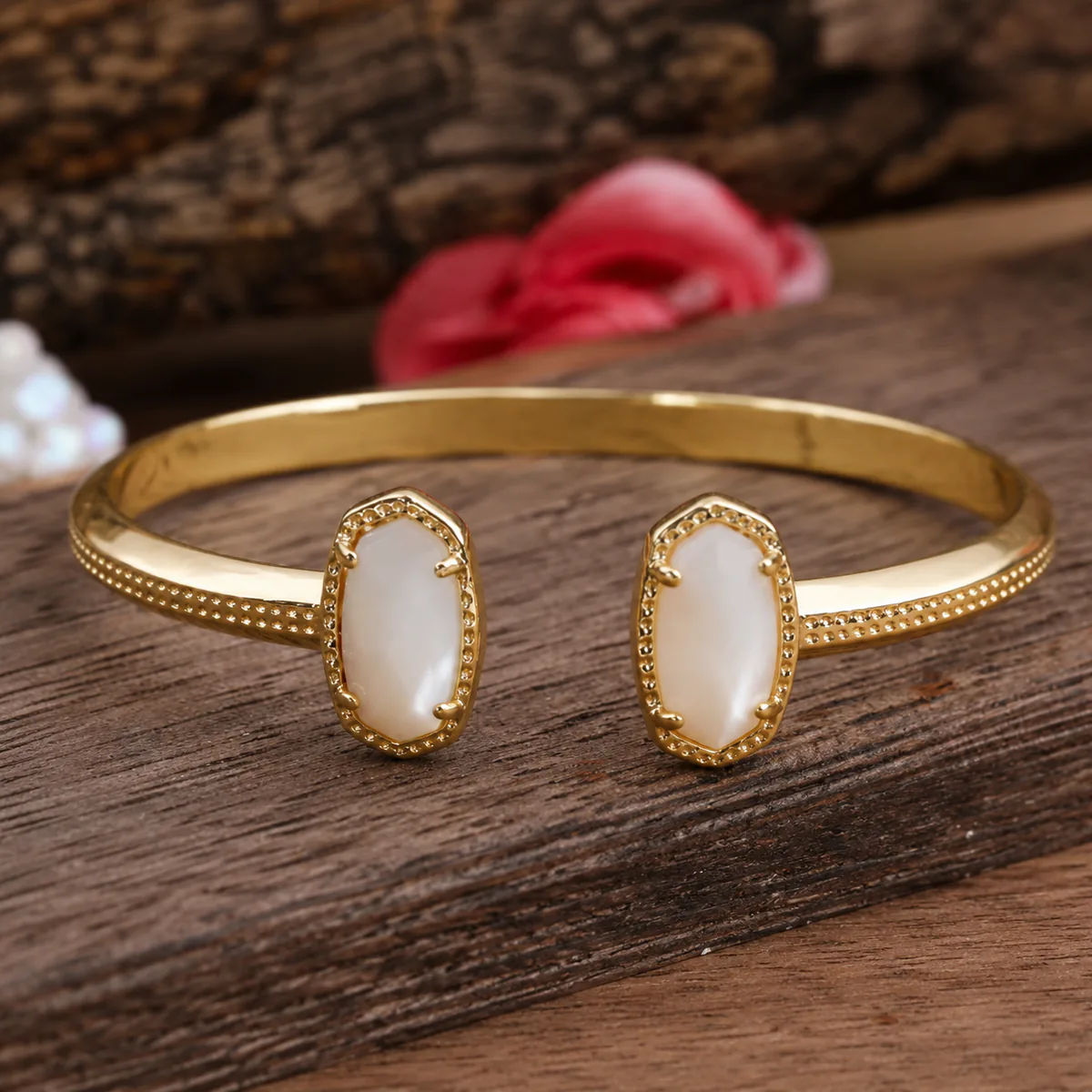
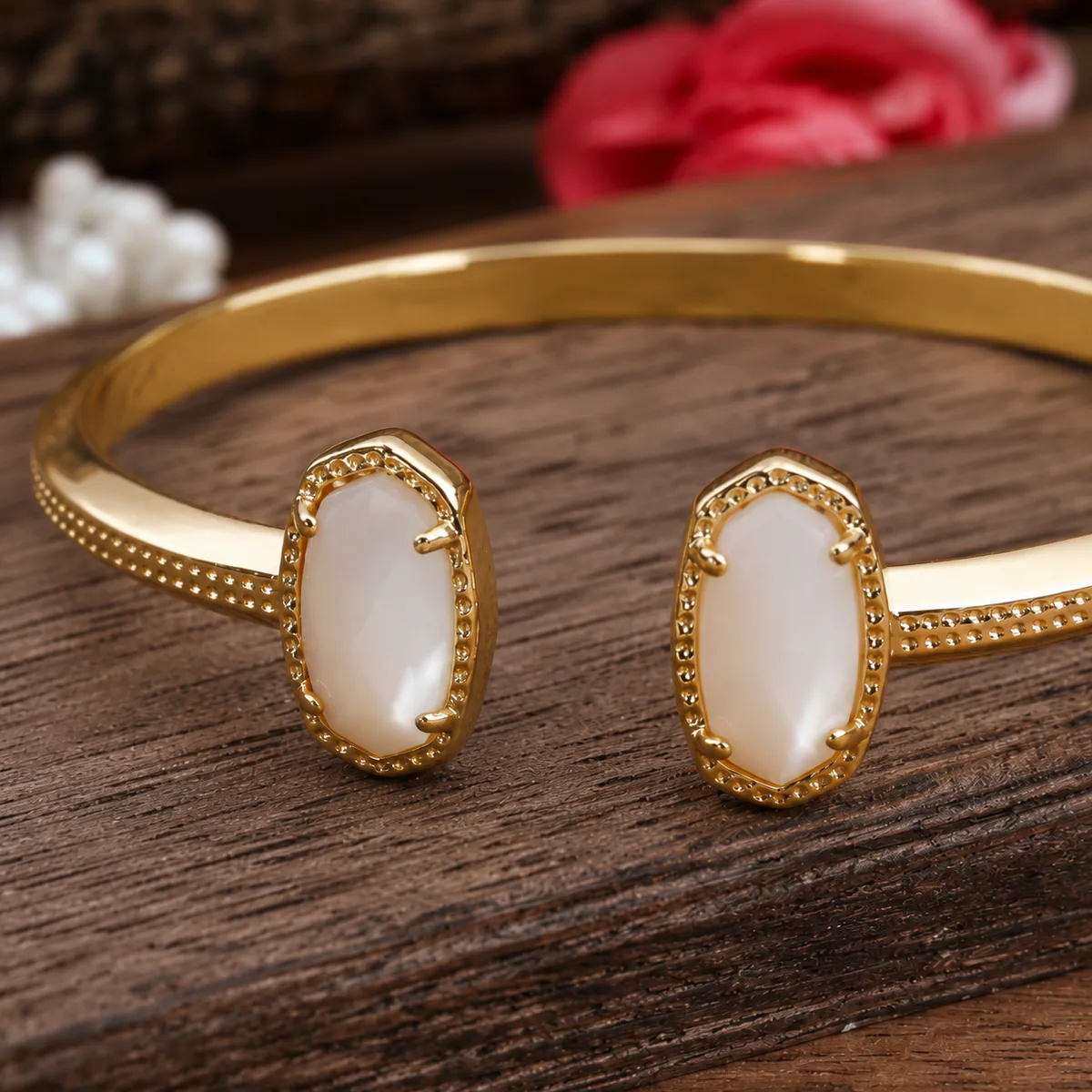
An open bangle in gilt metal, each of its two ends carrying a milky white cabochon held by four prongs on a beaded surround. It is the only gilt bracelet in the catalog, and the only one whose stones sit at the tips rather than at the top of the arc.
Two stones placed exactly where the knocks land
The drawing is that of an open bangle, but the opening is not hidden at the back: it is put forward, and the two stones are what mark it, facing each other, a centimeter apart. That is what gives this bracelet its look, and it is also what decides how it will age.
The two ends of an open bangle are the most exposed points of the piece. They are the ones that arrive first against a door frame, a table edge or a car door, because they stand clear of the arc instead of following its curve. On the shop’s silver bangle the stones are lined up on top and the arc partly shields them; here they are in the front line. So wear the opening under the wrist rather than on top: both cabochons are better sheltered there, and they catch less on sleeves.
For the rest, it is worn like any open bangle: you present it side on, slide it in from the side of the wrist, pivot it into place, and never spring it open to pass it over the hand. The sizing guide shows how to measure a wrist for a rigid bracelet, which is not the same measurement as for a flexible one.
A gilt piece cannot be repolished
Here is what is particular about this model, and it is the one thing I would like you to remember. A solid metal piece can always be brought back: scratched, tarnished, dulled, it is repolished and it goes for another ten years. A gilt piece cannot: polishing it amounts to removing the very layer that gives it its color. The polishing cloth, the jeweler’s paste, the brush and the silver rubber are therefore to be banned here, when they are exactly the moves recommended everywhere else.
On a rigid bracelet, wear concentrates in two precise places, and it is better to know them. The first is the inner face, the one resting on the wrist: it rubs constantly against skin, and perspiration speeds things up. That is where the color will lighten first, in a place you never look at. The second is the middle of the arc, at the back, where the metal bends when you adjust the bracelet: the gilt layer follows the deformation badly and cracks there before anywhere else.
Hence the rule, which luckily overlaps with the one for the metal itself: you adjust a bangle once, on arrival, gently, with both hands, and then you leave it alone. After that, three habits extend the gilding far more than any product: taking it off before the shower, the pool and sport, putting it on last after cream and perfume, and storing it on its own rather than loose with other pieces that would scratch it. The shop’s other bracelets are here.
Four prongs, and the move to make once a month
Each cabochon is held by four small prongs folded over its edge, inside a beaded surround. That beading is decorative: it visually refines the mounting and masks the join, but it holds nothing at all. Everything rests on the prongs.
It is a far safer method of fixing than gluing, and it has one decisive advantage: a prong that lifts is tightened again by a jeweller, whereas a stone that has come unglued never sits back quite as well. You still have to notice it. The move takes three seconds once a month: lay a fingertip on each stone and press lightly at an angle. If it moves by a hair, or if the bracelet has started catching the loops of your jumpers, a prong has shifted.
The cabochons themselves stay sensitive to impact like every stone in the catalog: they chip rather than scratch, and on a pale stone a fresh chip is spotted by its shine. The quality criteria are set out here, and the whole white variety is gathered there.
Crystal healing tradition lends moonstone correspondences tied to cycles and intuition, and gold solar associations. I have put them apart below. I will go no further: none of it is demonstrated and no piece of jewelry heals anything. Separately, I have gathered what tradition lends this stone, what each color changes and what is said about which wrist to choose.
- Open gilt bangle, two white cabochons prong set on a beaded surround.
- It cannot be repolished: no polishing cloth, no jeweler’s paste, no brush. They take the gilding off.
- Adjust it once, on arrival. The gilding cracks at the point where it bends.
- Delivered in two weeks, with a cotton pouch, a handwritten note and a care card.
The specifications
- Stone
- White moonstone, two elongated cabochons
- Appearance
- Milky white, pale sheen depending on the angle
- Metal
- Gilt metal, beaded surround
- Setting
- Four prongs per stone
- Construction
- Rigid open bangle, adjustable once
- Gender
- Women
- Brand
- Melissa Moon
Why this model does not exist in silver
I am often asked, and the answer is not a commercial one. This design, with its two stones facing each other and its beading, belongs to a family of pieces meant to be worn hard and changed often. Making it in solid silver would amount to selling at three times the price an object whose shape was never conceived to last thirty years. The shop’s silver bangle answers the other need, that of the piece you never take off.
So I would rather put things the right way round: a gilt piece has a lifespan, it depends on your skin, your work and your habits, and it is counted in years rather than decades. That is not a hidden fault, it is what you are buying. Choose between the two bangles according to the use you expect of them, not according to the label. The rest of the shop is here.
A gilt piece has a date. That is not a fault, it is a contract, and it is better read beforehand.
No salt, no ultrasonic tank, no hot water: all three damage the stone as much as the gilding, and ultrasonics loosen the prongs besides. Add the rule specific to gilt: no jewelry product, no paste, no brush, no abrasive cloth, all of which take the layer of gold off along with the dirt. A soft dry cloth is enough in nine cases out of ten. If the bracelet really needs cleaning, lukewarm water, a drop of mild soap, a short rinse and immediate drying, without letting water sit under the stones. The detail is in cleaning a moonstone piece, and the safe methods in caring for it without harming it.