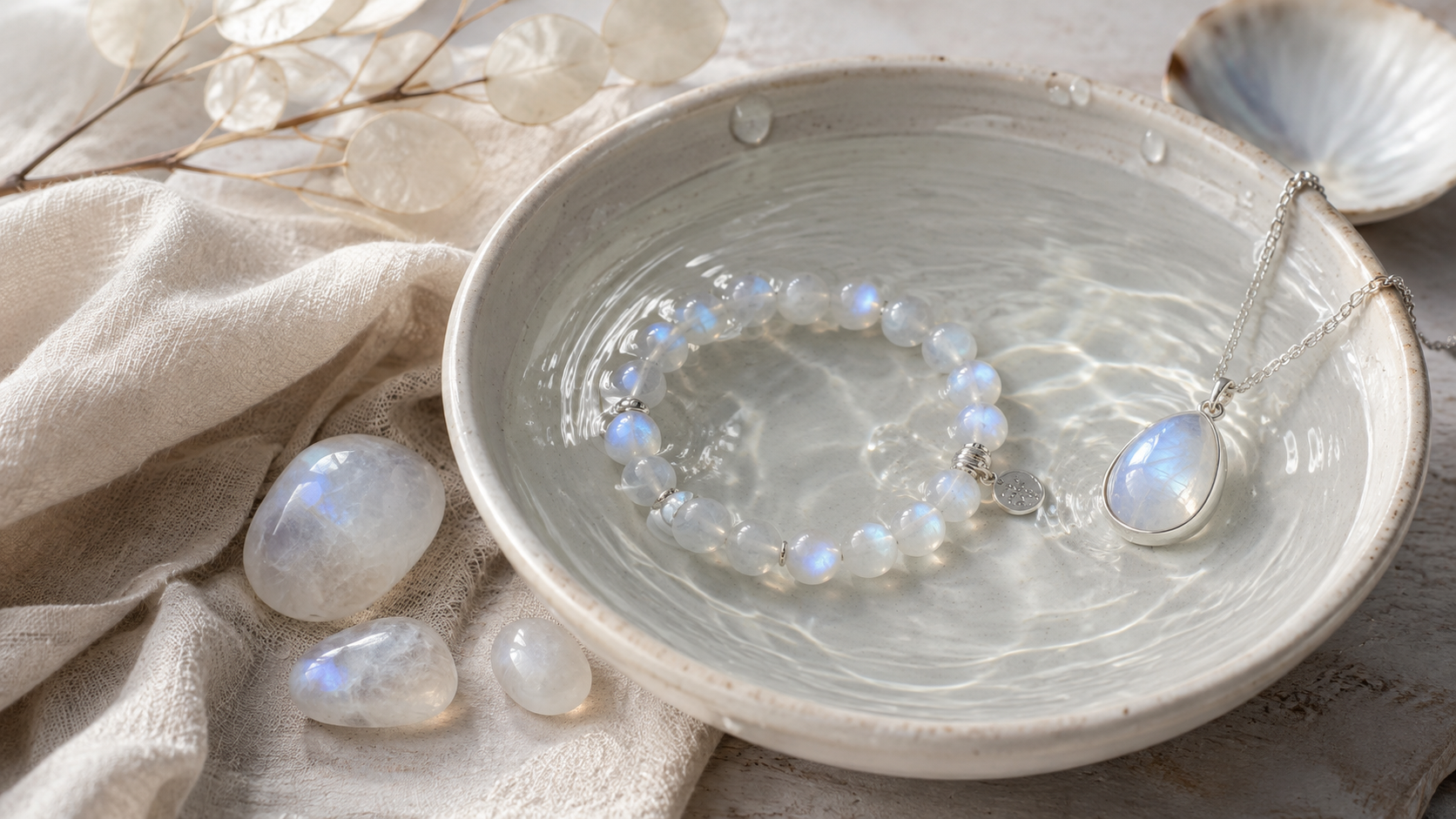
Can Moonstone Go in Water?
Yes for a warm rinse, no for everything else. And the reason is almost never the one people read: the stone isn't afraid of water, it's neither soluble nor porous. What's at risk is the setting, the glue, the cord and the soap. Here is the detail, case by case, from the shower to the pool.
This is the single most common question on the whole site, and the one with the most nonsense written about it, including that the stone would "lose its energy in water" or that it would "dissolve." Both are false, and the real reasons to be careful are more interesting.
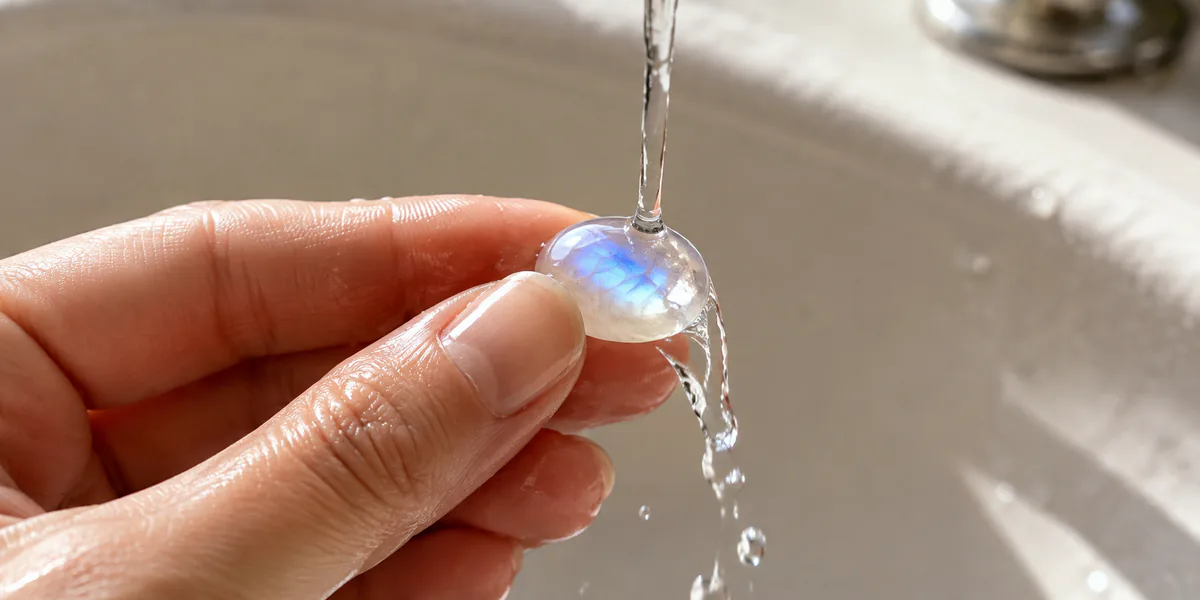
The essentials, if you're in a hurry
- The stone itself isn't afraid of water. A feldspar is neither soluble nor porous. A warm rinse does absolutely nothing to it.
- What's at risk is everything else: the glue in some settings, elastic cord, silver that tarnishes, water trapped behind a closed bezel.
- The shower is not recommended, less because of the water than because of soap and shampoo, which leave a film on the polish.
- The pool is off-limits. Chlorine attacks alloys and discolors some plated settings.
- The sea too. That's salt, so accelerated corrosion, plus sand that scratches and fingers that shrink in cold water.
- Never hot water. A sharp temperature swing is what a feldspar with cleavage tolerates the worst.
- Hard water leaves a haze on the polish and inside the setting. It's the most common cause of a sheen that looks dull.
The three-line answer
For those who won't read the rest.
Yes for a quick rinse in warm water, with or without a drop of mild soap. That's even the cleaning method the GIA recommends, and it's detailed in how to clean moonstone jewelry.
No for prolonged soaking, for the shower, the bath, the pool, the sea, dishwashing and hot water.
And above all, the reason isn't the one you read elsewhere. It isn't a matter of energy, and it isn't a matter of dissolving. It's a matter of metal, glue, cord and soap.
What the stone itself can handle
Let's start by ruling out the false reasons, stated as fact, because they're mineralogical facts.
Moonstone isn't soluble. It's a feldspar, an aluminum potassium silicate. Unlike selenite, which is gypsum, or halite, which is salt, it doesn't dissolve in water. A moonstone left in a glass of water for a month comes out unchanged.
It isn't porous. Unlike turquoise or lapis lazuli, it doesn't absorb liquids and doesn't stain from the inside.
It contains no significant copper or iron. Unlike malachite or pyrite, it doesn't rust and doesn't release anything into water.
In other words: on the three criteria that make a stone incompatible with water, detailed in the seven methods, moonstone passes all three. It's a good student. The problem lies elsewhere.
What actually is at risk: everything else
Here are the four real weak points, in the order they tend to fail.
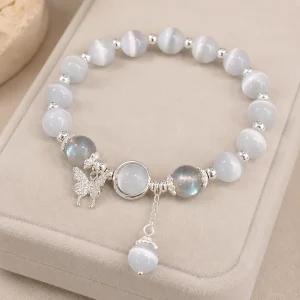
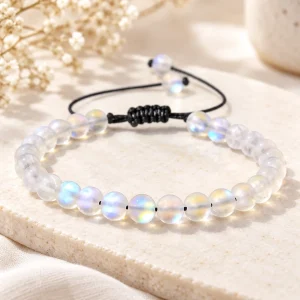
Elastic cord. A beaded bracelet is strung on an elastic that is a wear part, one to three years depending on how often it's worn. Water and soap wear it out faster, and water trapped between the beads takes days to leave. It's by far the most vulnerable piece in the catalog.
Glue. Some settings, particularly cabochons glued into a cup rather than set with prongs, hold with a glue that doesn't like repeated soaking. A stone that starts wobbling in its setting after a season of pool visits is not a coincidence.
Silver. Sterling silver is alloyed with roughly 7.5% copper, and copper tarnishes on prolonged contact with moisture. A piece put away damp comes out gray a week later.
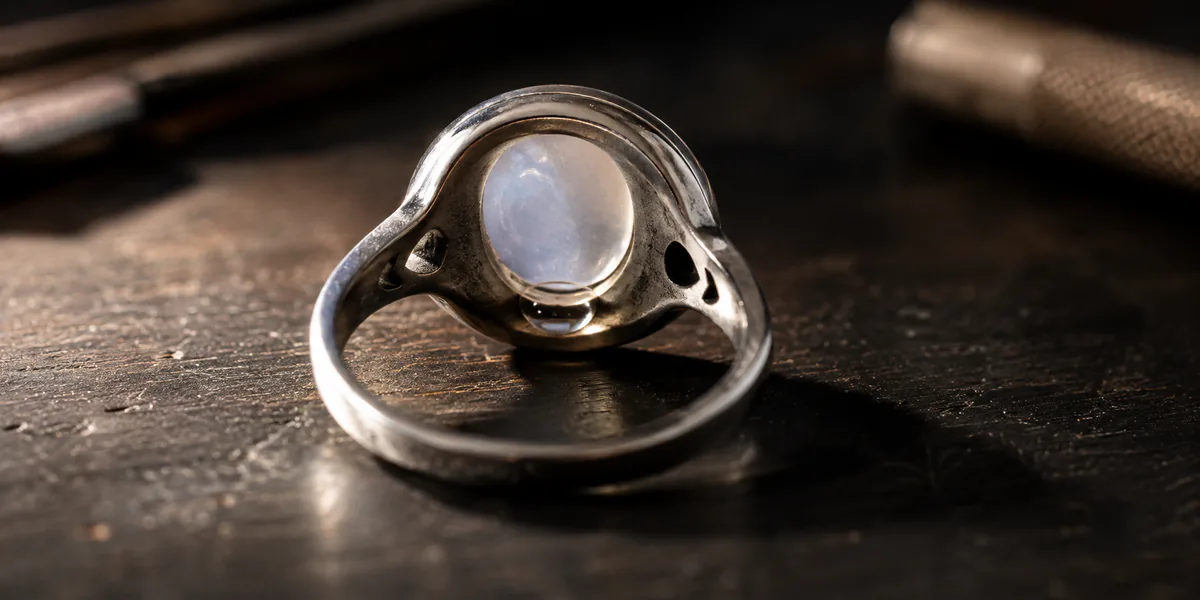
The dead space behind a closed bezel. This is the point nobody mentions. A closed bezel seals the stone inside a metal cup, and there's always a little space left behind it. Water that gets in there doesn't leave on its own: it sits there, works against the metal, and eventually leaves a mark visible from above, at the edge of the stone.
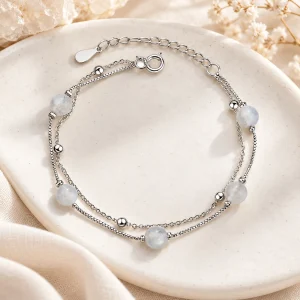
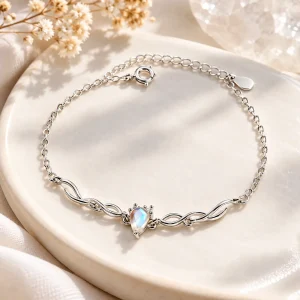
The bracelets on elastic cord, the most vulnerable piece in the catalog
The shower
The question I get asked the most, because it's the everyday one.
Answer: no, take it off. But not for the reason people imagine.
Shower water does nothing to the stone. What causes trouble is everything you use in there: soap, body wash, shampoo, conditioner, oil. These products leave a film on the polish, and they build up in the setting where rinsing doesn't reach them. It's the number-one cause of a sheen that looks dull.
Two secondary reasons, real ones too. Temperature: a hot shower is not warm water. And the fall: a shower floor is hard and wet, a soapy ring slips, and a stone with cleavage doesn't recover from a foot onto tile.
If you wear a ring all the time and taking it off every day feels impossible, the reasonable compromise is to clean it more often, once a month, knowing the film will come back.
The pool, and chlorine
This one has no nuance: no, never.
Chlorine and chlorinated compounds used in pools attack alloys. On silver, they speed up tarnishing. On gold plate, it's worse still: plating is a thin layer, and repeated exposure makes it wear off in patches, usually starting on the edges first. The damage is permanent; you can't re-plate a set ring without removing the stone.
On rhodium-plated white gold settings, chlorine also attacks the solder joints over time, and a fatigued joint means prongs that loosen.
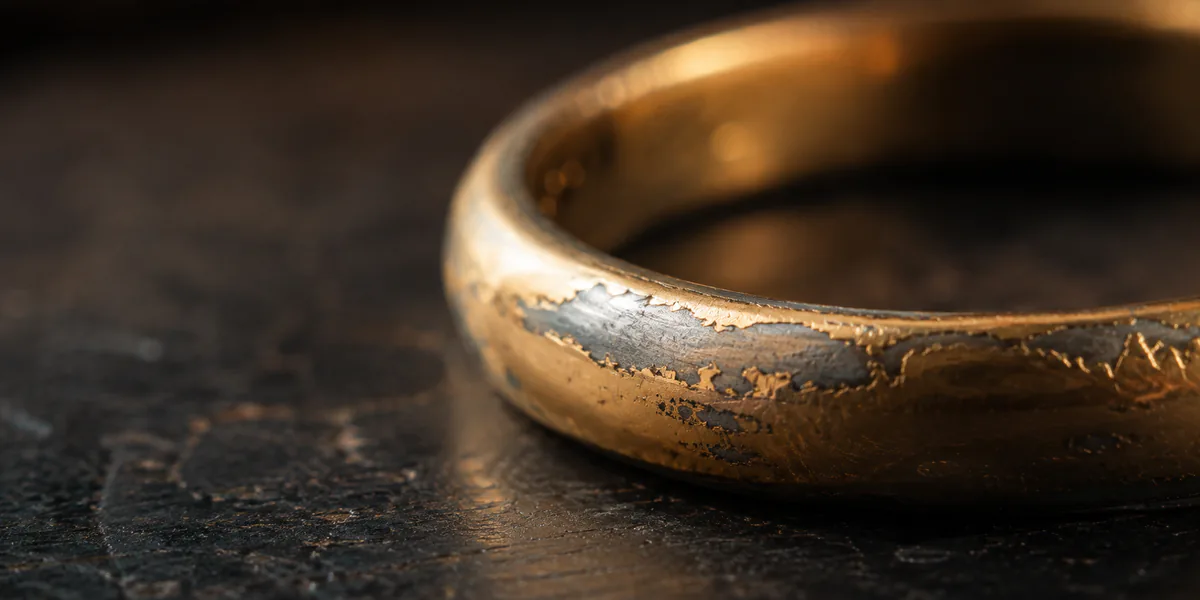
The stone itself is unaffected. Once again, it's the setting that decides, and a pool is a chemically aggressive environment for almost every jewelry metal.
The sea
No, for three combined reasons.
Salt. Seawater is an electrolyte: it speeds up corrosion of alloys, especially silver, and weakens solder joints. Salt crystals then lodge in the setting as it dries and keep working while dry. It's the same mechanism as salt cleansing baths, detailed in cleansing and charging your moonstone.
Sand. Beach sand is mostly quartz, at 7 on the Mohs scale. Moonstone sits at 6 to 6.5. Sand scratches it, literally, and it gets everywhere.
Shrinking fingers. In cold water, fingers contract, and a well-fitted ring becomes a ring that slips off. It's the leading cause of losing jewelry on vacation, ahead of any chemical concern.
If you're heading to the beach with a moonstone piece, the right move is to leave it in the room, not in a beach bag.
Hot water and thermal shock
A technical point, and it's the one that actually breaks stones.
A feldspar handles sudden temperature swings poorly. The material expands, and it does so unevenly if it has cleavage planes and internal micro-fractures. A stone that goes from cold to hot in a few seconds can develop an invisible crack that opens up. That's exactly why the GIA rules out steam cleaners.
In practice, this covers: dishwater, the hot setting on a tap, running cold water over it right after your hand has been in the sun, and a hair dryer to speed up drying.
Warm means warm: the temperature of a baby's bath, not a cup of tea. If the water feels hot to your hand, it's too hot for the stone.
Hard water, the problem no one blames on water
Here is the part I've never seen written anywhere, and it explains half the messages I get about a sheen "that's gone."
Water hardness varies enormously from one place to another. Very soft in some regions, very hard in others. It's measured in grains or degrees of hardness, and past a certain threshold, the water is considered hard.
What that changes. As it dries, hard water leaves a microscopic whitish deposit on every surface. On tile, it's visible and wipes off. On the polished dome of a cabochon, it forms a matte haze that dulls the sheen, and it builds up with every rinse. In the corners of a setting, it slowly scales up.
The result is misleading: the stone looks dull, and people assume it's damaged, when it's simply scaled over. And the more you rinse it to make it shine, the more you add.
The fix comes down to one move: dry it immediately after rinsing, with a microfiber cloth, without letting the water evaporate on its own. It's the evaporation that deposits the mineral scale, not the water itself. If your water is very hard, a final rinse with distilled water, the kind sold for irons, settles the question for good.
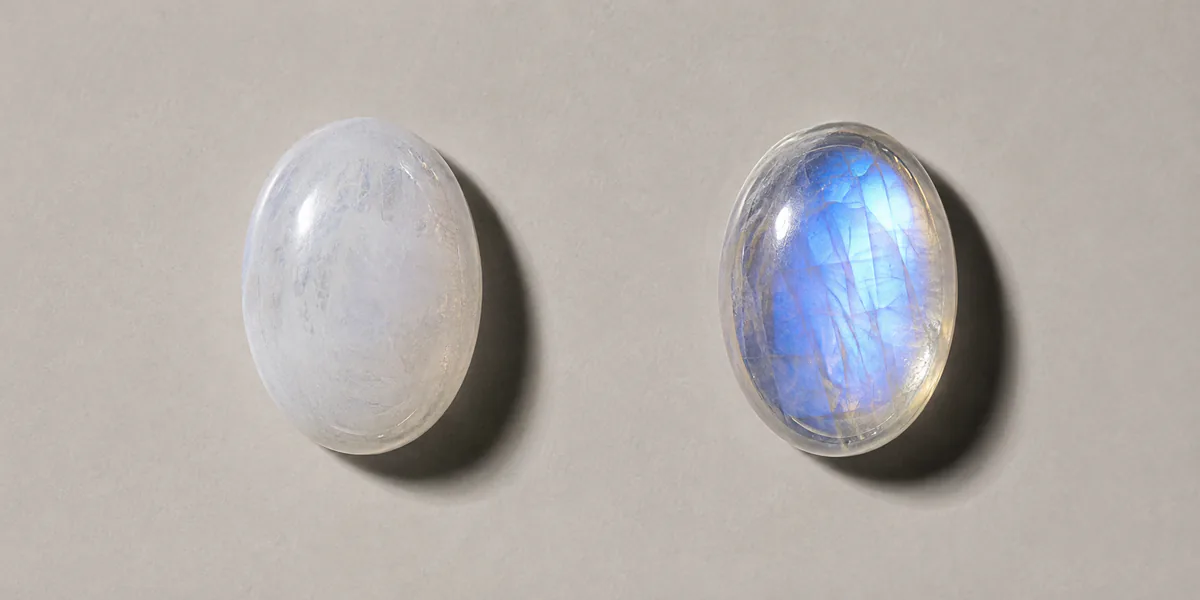
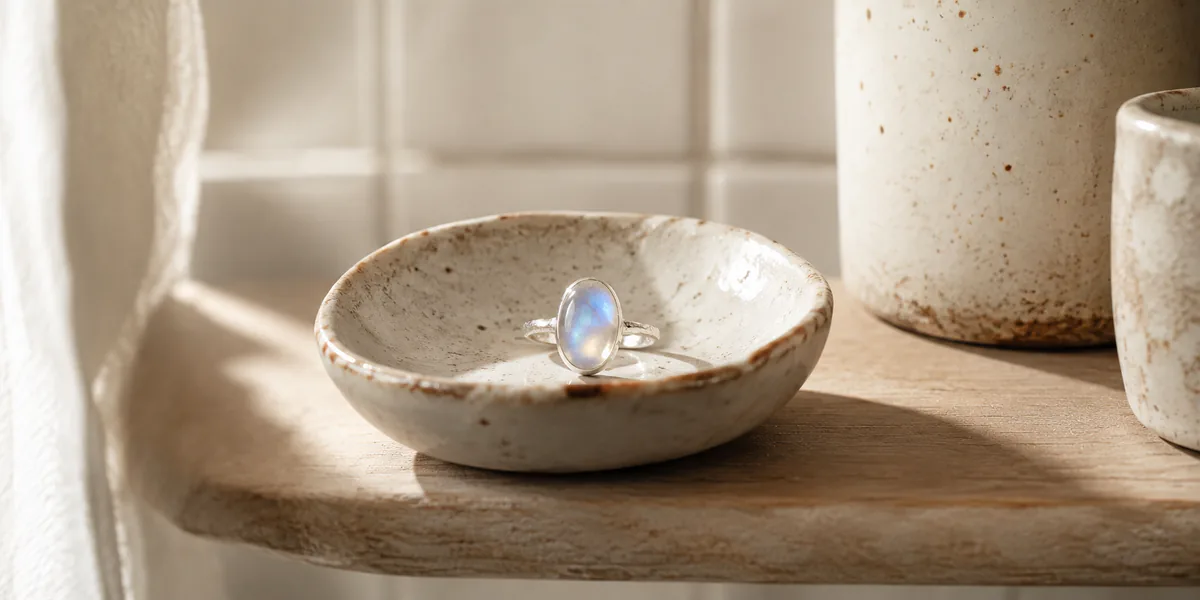
The workshop's rings, the ones you take off before the shower




Rainwater, spring water, moonwater
These three belong to cleansing rituals, so I'm shifting registers to say so clearly.
Contemporary crystal healing sometimes calls for a particular kind of water: spring water, collected rainwater, or water exposed to the Moon. These are symbolic prescriptions, drawn from books written decades ago, and I report them in the conditional.
What I can say, materially, comes down to three notes.
Rainwater is soft, so it leaves less mineral scale than hard tap water. That's a real, if unintentional, benefit of this ritual. It can, however, be acidic in urban areas.
Bottled spring water isn't necessarily soft, some brands are heavily mineralized. Check the label if you're curious.
A bowl of water left outside all night raises exactly the problem described in the moon calendar: the stone spends hours submerged, which is the prolonged soaking I've discouraged since the start of this page. If you're set on this ritual, expose the bowl alone and rinse the stone in the morning.
The notions of cleansing and charging belong to crystal healing, an approach based on traditions and beliefs. They do not constitute a medical claim and never replace the advice of a healthcare professional. Read the full disclaimer.
Recap: yes, no, it depends
The whole article in one table, to keep on hand.
| Situation | What's at risk | Verdict |
|---|---|---|
| Warm rinse, 30 seconds | Nothing, if dried afterward | Yes |
| Washing your hands | Soap, over time | Tolerable |
| Overnight soak | Glue, cord, silver, closed bezel | No |
| Shower | Soap, shampoo, falls | No |
| Bath | Same, plus duration | No |
| Pool | Chlorine attacks alloys | Never |
| Sea | Salt, sand, shrinking fingers | Never |
| Dishwashing | Hot water and detergent | Never |
| Hot water | Thermal shock on cleavage | Never |
| Very hard water | Mineral haze on drying | Dry fast |
Only one line says a plain "yes," and it's the cleaning move. That fits: water is a maintenance tool, not a living environment for a set piece of jewelry.
Frequently asked questions
Can moonstone go in water?
Yes for a warm rinse of a few seconds, no for soaking. The stone itself is unaffected: a feldspar is neither soluble nor porous. It's the glue, the elastic cord, the silver and water trapped behind a closed bezel that cause trouble.
Does moonstone dissolve in water?
No, not at all. It's a silicate, insoluble. The confusion likely comes from selenite, which is gypsum and genuinely dissolves, and whose name also evokes the Moon.
Can you shower with moonstone jewelry?
It's not recommended, but not because of the water: soap and shampoo leave a film on the polish and build up in the setting. Add the water temperature and the risk of a fall onto a hard, wet floor.
What about the pool?
Never. Chlorine attacks alloys, speeds up silver tarnishing, and wears off the plating on gold-plated pieces, starting on the edges. The damage is permanent.
What about the sea?
Never either, for three reasons: salt corrodes settings and lodges in the setting, beach sand is quartz at 7 on the Mohs scale and scratches a stone at 6.5, and fingers shrink in cold water.
Why not hot water?
Because a sharp temperature swing makes a feldspar expand unevenly along its cleavage planes, and can open an invisible crack. It's the same reason the GIA rules out steam cleaners.
My stone's sheen has looked dull since I started rinsing it, why?
Very likely mineral scale. Hard water leaves a whitish deposit as it evaporates that dulls the polish, and it builds up with every rinse. Dry it immediately with a microfiber cloth instead of letting it air-dry.
Can you leave a stone in a bowl of water overnight?
It's a common cleansing ritual, and it's exactly the prolonged soaking I discourage. If you're set on it, expose the bowl alone and rinse the stone in the morning: the symbolic result is the same, and the setting is spared.
Should you dry it right away?
Yes, and it's the single most important move on this page. It's evaporation that deposits mineral scale, and it's residual moisture that tarnishes silver. Microfiber cloth, then an hour in open air before putting it away.
What about washing your hands with your ring on?
Tolerable day to day, no one takes their ring off ten times a day. Just know that soap builds up under the stone, and make up for it with a monthly cleaning.
Where to go from here
- Care: cleaning jewelry, piece by piece, cleansing and charging your moonstone, the seven methods, every stone, the moon calendar.
- Why it's sensitive: is it fragile, the mineral profile.
- Wearing it: how to wear it, which wrist, closed bezel or prongs.
- The full picture: the complete moonstone guide.
The jewelry is in the shop. If your stone has looked dull for a while, send me a photo: nine times out of ten it's mineral scale or a soap film, and it takes four minutes to fix.
My sources
For the stone: the Moonstone Care and Cleaning sheet from the GIA, which recommends warm soapy water and rules out ultrasonic and steam cleaners without reservation, and places the stone between 6 and 6.5 on the Mohs scale with low toughness and two cleavage directions. For the insolubility and lack of porosity in feldspars, Mindat.
For comparison with stones that genuinely fear water, soluble selenite, oxidizing pyrite, porous turquoise, the table in the seven methods article, built on the same sources.
For silver: the 925 alloy contains roughly 7.5% copper, whose oxidation is the classic mechanism behind tarnishing. For sand, the predominantly quartz composition of beach sand is standard geology, and quartz sits at 7 on the Mohs scale.
For water hardness: it's measured in grains or degrees of hardness and varies widely by region and water source, with a common threshold for "hard" water sitting around 10.5 grains per gallon (roughly 180 mg/L as calcium carbonate).
One limitation I'll flag: the observation about the mineral haze comes from the workshop and from photos customers send me, not from a publication. The mechanism itself is the same as any evaporation-based mineral buildup.
Last updated: August 19, 2026. If you spot an error in this article, let me know: I'll fix it and note it.
✦ À porter, à offrir
Découvrez mes créations