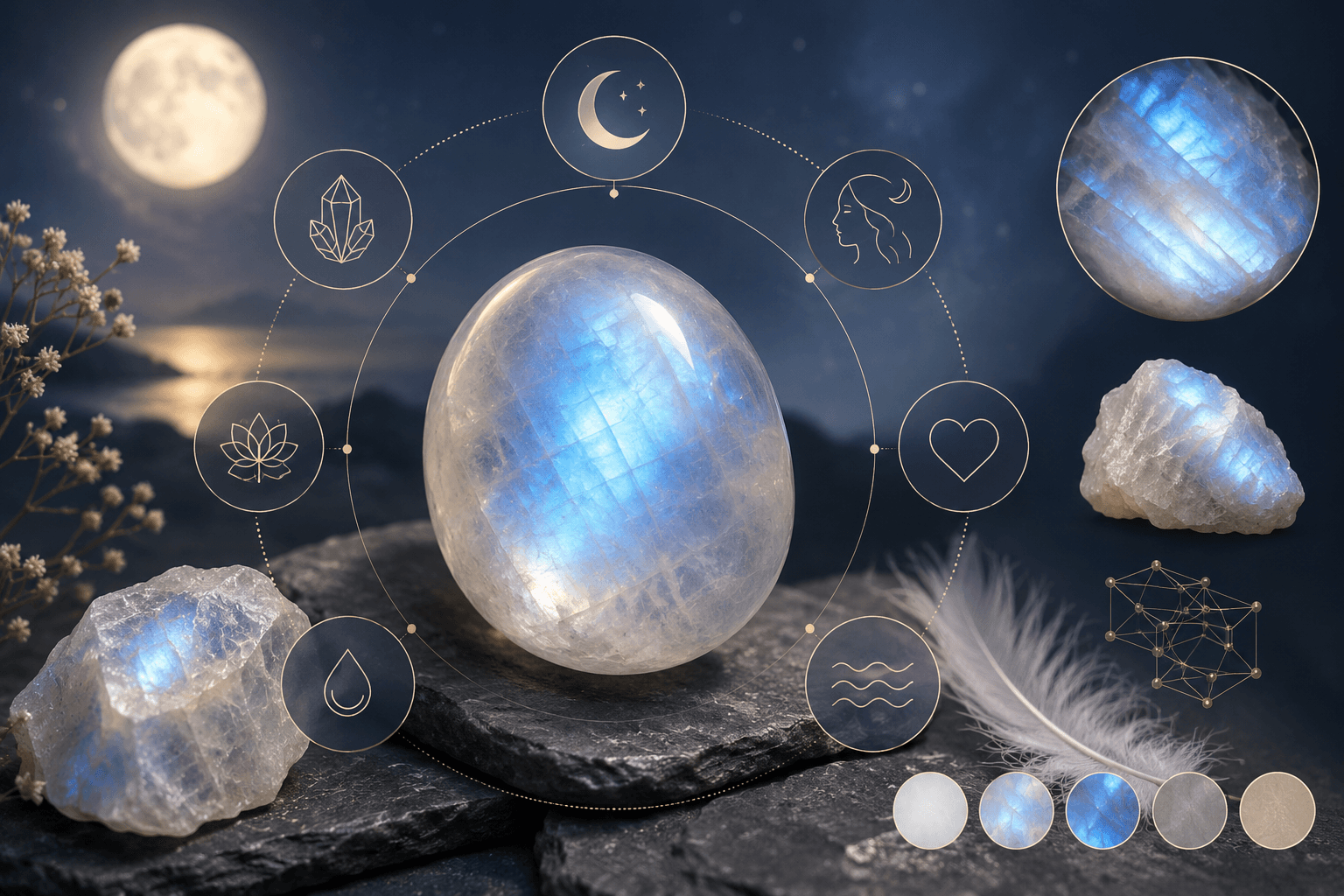
Moonstone Properties: The Mineral Data Sheet
Hardness 6 to 6.5 on the Mohs scale, density around 2.57, refractive index between 1.518 and 1.526, monoclinic system, and above all perfect cleavage. Here is the complete data sheet for moonstone, and what each of these numbers actually changes when you wear the piece.
A word before starting, because the word "properties" is ambiguous in English too. This page covers the physical and optical properties of the mineral: the ones you measure, that show up on a certificate, and that decide how a stone is cut, set and how it breaks. If you are after what tradition attributes to it, intuition, cycles, emotional balance, that is all in the benefits of moonstone. I never mix the two registers.
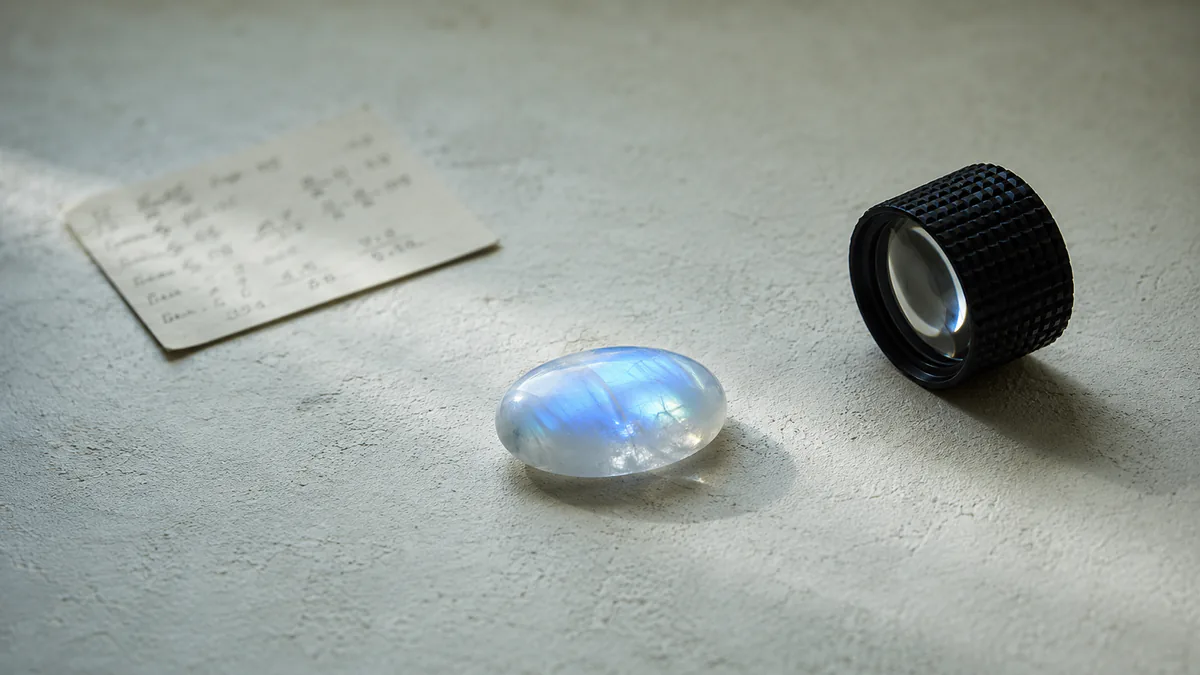
The short version, if you are in a hurry
- The family. Feldspars, the most common mineral group in the earth crust. About 60% of its volume.
- The species. Most often an orthoclase, an alkali feldspar. But some stones sold under this name are plagioclases, another branch of the family.
- The formula. KAlSi₃O₈ for orthoclase, in alternating lamellae with albite NaAlSi₃O₈.
- Hardness. 6 to 6.5 on the Mohs scale. Decent, no more.
- The number that actually matters. Perfect cleavage in one direction, good in a second, the two nearly 90 degrees apart. This is what governs everything else.
- Density. Between 2.55 and 2.63, most often around 2.57.
- Refractive index. 1.518 to 1.526, with a low birefringence, on the order of 0.005 to 0.008.
- Crystal system. Monoclinic for orthoclase, triclinic for plagioclases.
The data sheet, in one table
The values below are those of the public reference data sheets. They vary slightly from one source to another, because moonstone is not a single mineral but a mixture in variable proportions. I give ranges rather than single figures, which would give a false impression of precision.
| Property | Value |
|---|---|
| Group | Feldspars, tectosilicate subgroup |
| Most common species | Orthoclase, adularia variety |
| Formula | KAlSi₃O₈ with albite exsolution NaAlSi₃O₈ |
| Crystal system | Monoclinic |
| Hardness (Mohs) | 6 to 6.5 |
| Density | 2.55 to 2.63 |
| Refractive index | 1.518 to 1.526 |
| Birefringence | 0.005 to 0.008 |
| Optical character | Biaxial negative |
| Cleavage | Perfect in one direction, good in a second, angle close to 90° |
| Fracture | Conchoidal to uneven |
| Luster | Vitreous, pearly on cleavage planes |
| Transparency | Transparent to translucent |
| Streak | White |
| Common twinning | Carlsbad, Baveno, Manebach |
A feldspar, but which one
This is the point almost no data sheet covers, and yet it is the one that explains three quarters of the confusion in the trade.
Feldspars split into two branches. On one side the alkali feldspars, rich in potassium. On the other the plagioclases, which form a continuous series from sodium to calcium. Both branches give stones with a sheen, and both are sold under the name moonstone. Yet they share neither the same composition, nor the same crystal system, nor the same optical phenomenon.
The alkali feldspars, orthoclase among them
Orthoclase is the most common potassium feldspar, formula KAlSi₃O₈. Its crystal system is monoclinic. It is the one that gives classic moonstone, colorless or white, with the blue sheen.
The mechanism works like this: as the crystal cools, it does not stay homogeneous. Potassium and sodium separate into alternating microscopic lamellae, orthoclase on one side, albite on the other. This unmixing is called exsolution, and it is what produces the sheen. The mechanism is detailed in the article devoted to adularescence, a subject on its own.
The plagioclases, labradorite among them
Plagioclases crystallize in the triclinic system, not monoclinic. Their density rises slightly, from 2.62 to 2.76 depending on calcium content, and their refractive index with it, up to about 1.57 for the calcium-rich members.
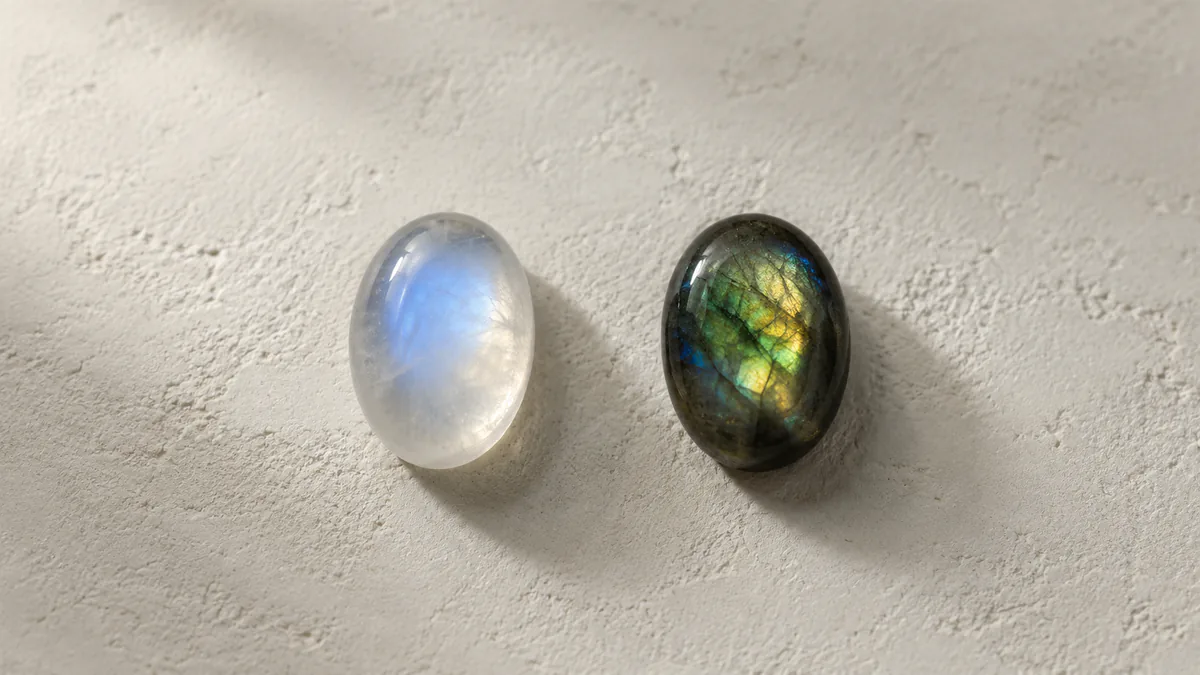
Labradorite belongs to this branch. And it is labradorite that gets sold under the names rainbow moonstone and black moonstone. These are not adularia. Their play of color is labradorescence, a neighboring but distinct phenomenon, giving broader, more colorful flashes where adularescence gives a diffuse blue veil.
Peristerite, for its part, is a sodium plagioclase that produces a bluish sheen very close to that of adularia. It is the hardest confusion to settle by eye, and often the one that makes a well-meaning seller say they are selling moonstone.
The full distinction, with the tests that settle it, is in moonstone or labradorite.
What this changes for the buyer
Three concrete things.
- The price. A fine colorless adularia with a centered blue sheen sells for several tens of euros per carat. A rainbow labradorite of comparable size costs a fraction of that.
- Care. Both branches have marked cleavage, but plagioclases often add twin planes that multiply the points of weakness.
- Honesty on the product page. Selling labradorite under the name moonstone is a tolerated trade usage. Letting the buyer believe they are buying adularia is not. Here, the product page names the species.
Adularia, the variety that gave the stone its name
Adularia is a low-temperature orthoclase, formed in hydrothermal veins rather than in a slowly cooling magma. It takes its name from the Adula massif, in the Swiss Alps, where it was first described.
A useful particularity to know: unlike microcline, the other common potassium feldspar, adularia does not show a grid twinning pattern. Under a polarizer, microcline shows a characteristic checkerboard. Adularia does not. It is one of the criteria that settles the question in a lab, without breaking anything.
It is also from this name that the word adularescence comes. The phenomenon was named after the variety in which it was observed, not the other way around.
Perfect cleavage, the property that governs everything
If there were only one line of this data sheet to remember, it would be this one.
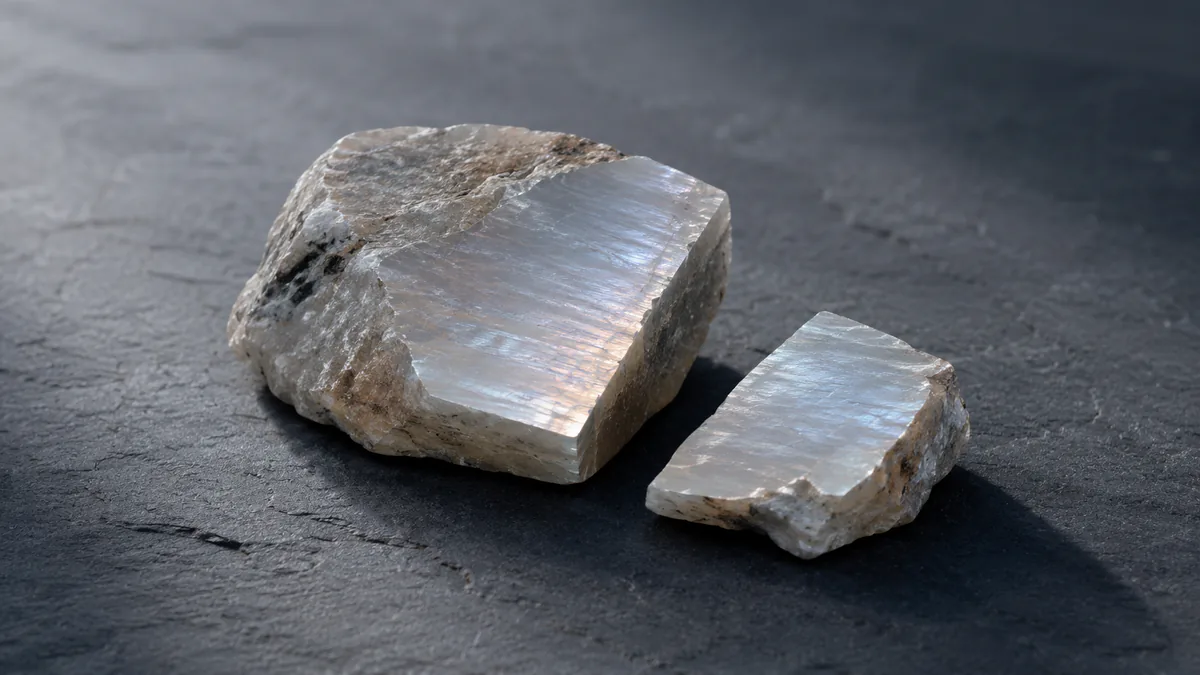
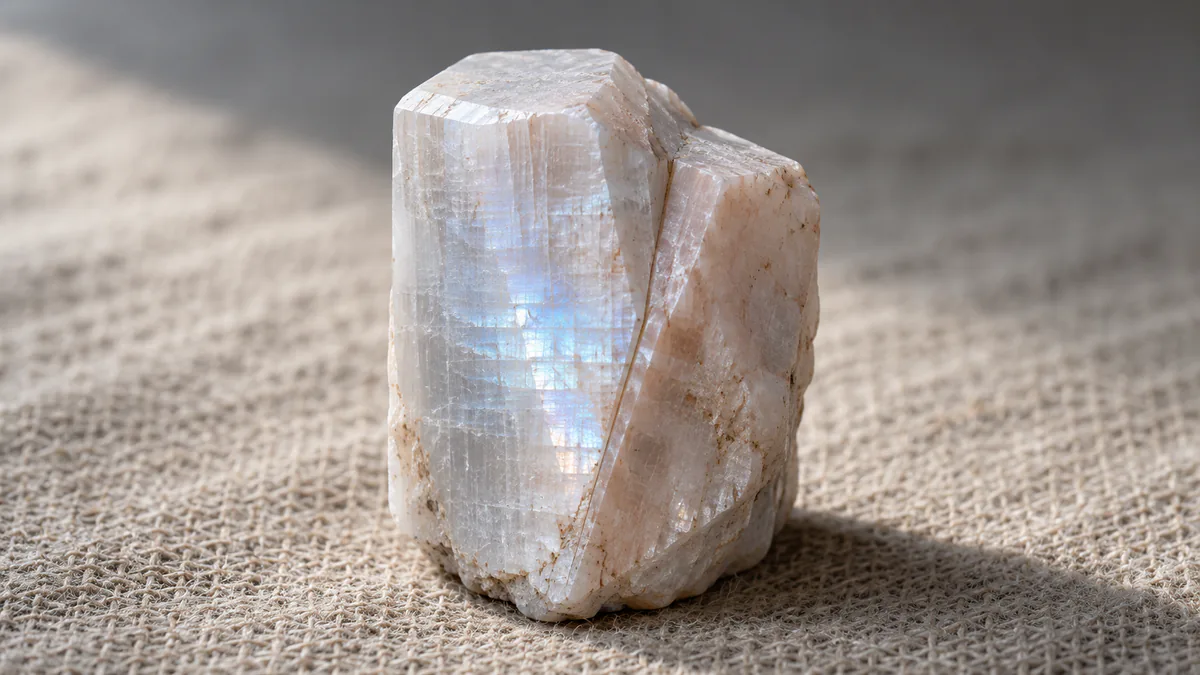
Cleavage is the tendency of a crystal to split along planes defined by its atomic structure. Moonstone has perfect cleavage in one direction and good in a second, the two forming an angle close to 90 degrees. The word "perfect" is not a compliment: in mineralogy, it describes a clean, sharp breaking plane that gives way at the first well-aimed impact.
In other words, moonstone does not wear out, it opens up. A hard stone can be brittle, and that is exactly its case. Mica scratches with a fingernail and nobody is surprised; moonstone resists steel and splits against the corner of a table. Hardness and toughness are two independent properties, which the trade confuses constantly.
What this means when you wear it
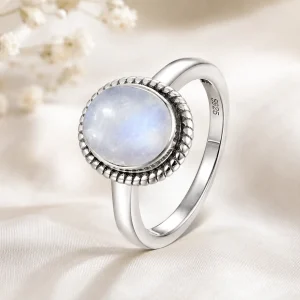
The hand is the part of the body that bumps into things most. A moonstone ring is therefore not a band you never take off: it is a ring you remove for washing up, sport, gardening and moving house.
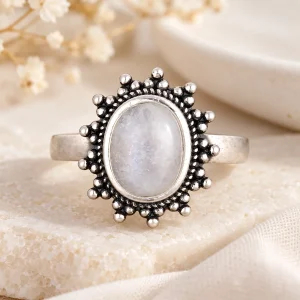
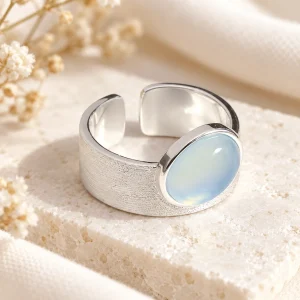
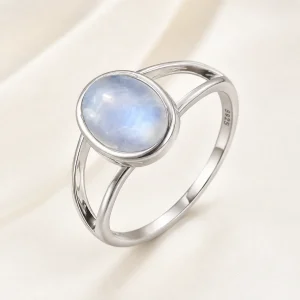
That is also why I set most of my pieces in a bezel, that continuous rim of metal which surrounds the stone and takes lateral impacts in its place. Prongs expose the cabochon more. The trade off is detailed in bezel or prong setting, and the question of fragility in is moonstone fragile.
What this means when you clean it
Never ultrasonic cleaning. The vibrations find the cleavage planes and the stone opens. It is the fastest way to destroy a cabochon, and many jewelers offer it out of habit, because it works very well on a diamond.
Never a steam cleaner, for the same reason, plus the thermal shock on top.
Lukewarm water and a soft cloth are enough. The detail by type of piece is in how to clean moonstone jewelry.
Rings set in a bezel




Hardness, and why 6.5 does not mean tough
The Mohs scale measures one thing only: resistance to scratching. It runs from talc, at 1, to diamond, at 10. It is neither linear nor proportional: the gap between 9 and 10 is far larger than that between 1 and 2.
At 6 or 6.5, moonstone sits just above window glass, around 5.5, and just below quartz, at 7. This position has a practical consequence that few people measure: household dust contains quartz, in the form of fine silica particles. Wiping a moonstone with a dusty cloth therefore scratches it slowly, one pass at a time. That is what explains old cabochons with a dull dome, with no visible impact.
Two habits follow from this. Rinse before wiping, to carry away the particles instead of dragging them across. And store the piece separately, not loose with harder stones that would scratch it.
Density, refractive index and birefringence
These three values are of no use while wearing the piece. They serve to identify the stone, and that is exactly what makes them useful at the point of buying.
Density sits between 2.55 and 2.63, most often around 2.57. That is a low figure for a gem: at equal volume, moonstone weighs noticeably less than a sapphire, whose density approaches 4. A stone sold as moonstone that feels too heavy in the hand deserves a second look.
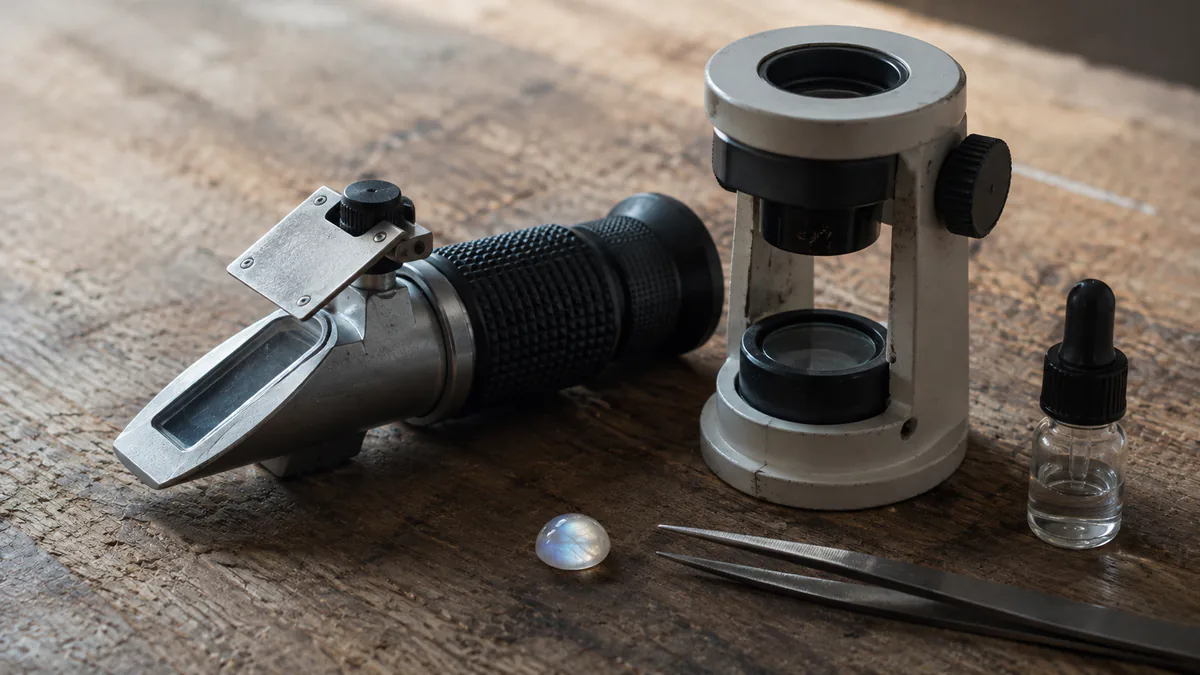
Refractive index runs from 1.518 to 1.526. It is the most discriminating measurement, and it takes seconds with a refractometer, without harming the stone. Common glass, opalite included, most often sits between 1.47 and 1.53 depending on its composition: the ranges overlap, so the index alone does not always settle it. Combined with density and optical behavior, it does.
Birefringence, at 0.005 to 0.008, is low but genuinely present. It is what firmly places moonstone among crystalline minerals: glass is isotropic, it has no birefringence at all. This single point rules out opalite beyond argument, provided you have the instrument.
The stone is biaxial negative, which is consistent with a monoclinic system and lets you tell it apart from uniaxial gems such as quartz.
Crystal system and twinning
Orthoclase crystallizes in the monoclinic system: three axes of different lengths, two of which meet at a right angle and the third obliquely. Plagioclases, for their part, are triclinic, with no right angle at all. This difference in symmetry is what separates the two branches at the most fundamental level.
Feldspars twin a great deal, meaning two crystals grow interpenetrating according to a precise geometric law. Three laws carry the names of the places where they were described:
- Carlsbad, the most frequent on orthoclase, two individuals rotated 180 degrees relative to each other.
- Baveno, after a quarry on Lake Maggiore.
- Manebach, described in Thuringia.
These twins matter for two reasons. They create additional planes of weakness, on top of the cleavage. And their presence or absence helps identify the species: adularia does not show the grid twinning of microcline, which remains one of the surest criteria in a laboratory.
Luster, transparency, fracture
Luster is vitreous on polished faces, and turns pearly on cleavage planes. This nuance is a useful field clue: a broken surface that shines like mother of pearl gives away a cleavage, so a feldspar.
Transparency runs from transparent to translucent. It is a major quality criterion, transparency driving the price up, but it is a matter of commercial judgment more than of the mineral data sheet. The six buying criteria are in judging the quality of a moonstone.
Fracture, when it does not follow a cleavage plane, is conchoidal to uneven. Conchoidal means shell-shaped, with concentric ripples, like broken glass.
Streak, obtained by rubbing the stone on an unglazed porcelain plate, is white. This test is destructive on a small scale: it is never done on a cut stone, only on a rough sample.
What these numbers let you do
Here is how these values chain together, from the most accessible to the most technical.
With no instrument at all. Look at whether the sheen moves when you tilt the stone. It is the most effective test and it costs nothing. Glass returns a fixed brightness. The full method is in how to recognize genuine moonstone.
With a jeweler loupe. Look for fine internal ladder-like fissures, called centipede inclusions, and the absence of round bubbles. No mineral forms spherical bubbles: their presence signs glass.
With a refractometer. An index outside the 1.518 to 1.526 range rules out adularia. A higher index, around 1.56, points toward a plagioclase.
With a polariscope. An isotropic stone, staying dark as you rotate it, is not a feldspar. It is glass.
These last two instruments cost about as much as an entry-level piece of jewelry. For a single purchase, it is more sensible to ask for an invoice that names the species, from a seller willing to write it down.
Stones chosen one by one
What this data sheet does not tell you
A mineral data sheet describes a material, not a particular stone. Three things escape it entirely.
The quality of the sheen. Two cabochons cut from the same block, with exactly the same indices and the same density, can be worth ten times less than one another depending on how the cut was oriented. No line in the table captures that.
The mechanism behind the sheen. Adularescence deserves its own article, and it has one: where the light of moonstone comes from.
Treatments. The data sheet describes a natural mineral. A dyed, impregnated or doubled stone keeps indices close to genuine and fools the measurement. The subject is covered in treated moonstone.
Frequently asked questions
What is the exact hardness of moonstone?
6 to 6.5 on the Mohs scale. It scratches window glass, which sits around 5.5, but it is scratched by quartz, at 7. Since household dust contains quartz, a dusty cloth eventually dulls the dome: rinse before wiping.
Is moonstone an orthoclase or a plagioclase?
Both exist in the trade. Classic moonstone, colorless with a blue sheen, is an orthoclase, an alkali monoclinic feldspar. Rainbow and black moonstone are labradorites, so triclinic plagioclases. These are not the same species, and the prices are not comparable.
What is the density of moonstone?
Between 2.55 and 2.63, most often around 2.57. That is low for a gem: at equal volume, it weighs noticeably less than a sapphire, whose density approaches 4.
What does "perfect cleavage" mean?
That the crystal splits along a clean, sharp plane defined by its atomic structure, instead of breaking at random. It is not a compliment: it is what makes the stone vulnerable to impact despite decent hardness. Hardness measures resistance to scratching, not to breaking.
Can you clean moonstone in an ultrasonic cleaner?
No, never. The vibrations find the cleavage planes and the stone opens. Many jewelers offer it out of habit because the method suits diamond. Lukewarm water and a soft cloth are enough.
What is the refractive index of moonstone?
1.518 to 1.526, with a low birefringence of 0.005 to 0.008, and a biaxial negative character. A noticeably higher index points toward a plagioclase, a total absence of birefringence signs glass.
Is moonstone radioactive or toxic?
No. It is a silicate of aluminum, potassium and sodium, with no radioactive element and no heavy metal. It poses no risk on contact with skin. The one useful precaution concerns cutting dust, which should not be inhaled, as with any silica.
Are moonstone and selenite the same thing?
No, and the confusion comes from the name: selenite derives from Selene, the Greek goddess of the Moon. Selenite is a gypsum, hardness 2, soft enough to scratch with a fingernail and to slowly dissolve in water. Nothing to do with a feldspar at 6.5. The subject is developed in moonstone or selenite.
Where to go next
This data sheet is the technical backbone of the journal. Depending on what you are looking for:
- Understanding the sheen: adularescence, how moonstone forms.
- Not mixing it up: with labradorite, with selenite, with sunstone.
- Buying: recognizing a genuine stone, judging quality, the price.
- The bigger picture: the complete guide to moonstone.
And if you want to see what these properties look like once the stone is set, everything is in the shop. A question about a particular stone? Write to me, I answer myself within 48 working hours.
My sources
The values in this table follow the public data sheets of the GIA, Mindat and the International Gem Society. Ranges rather than single figures are deliberate: moonstone is not a homogeneous mineral but a mixture in variable proportions, and sources diverge slightly depending on the samples measured. The observations on wear and cleaning behavior come from my own workshop.
Last updated: August 18, 2026. If you find a mistake in this article, tell me about it: I correct it and I note it.
✦ À porter, à offrir
Découvrez mes créations