


Description
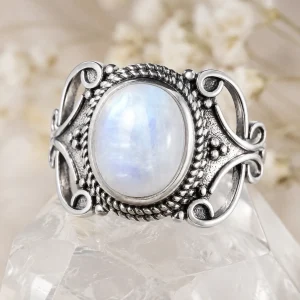
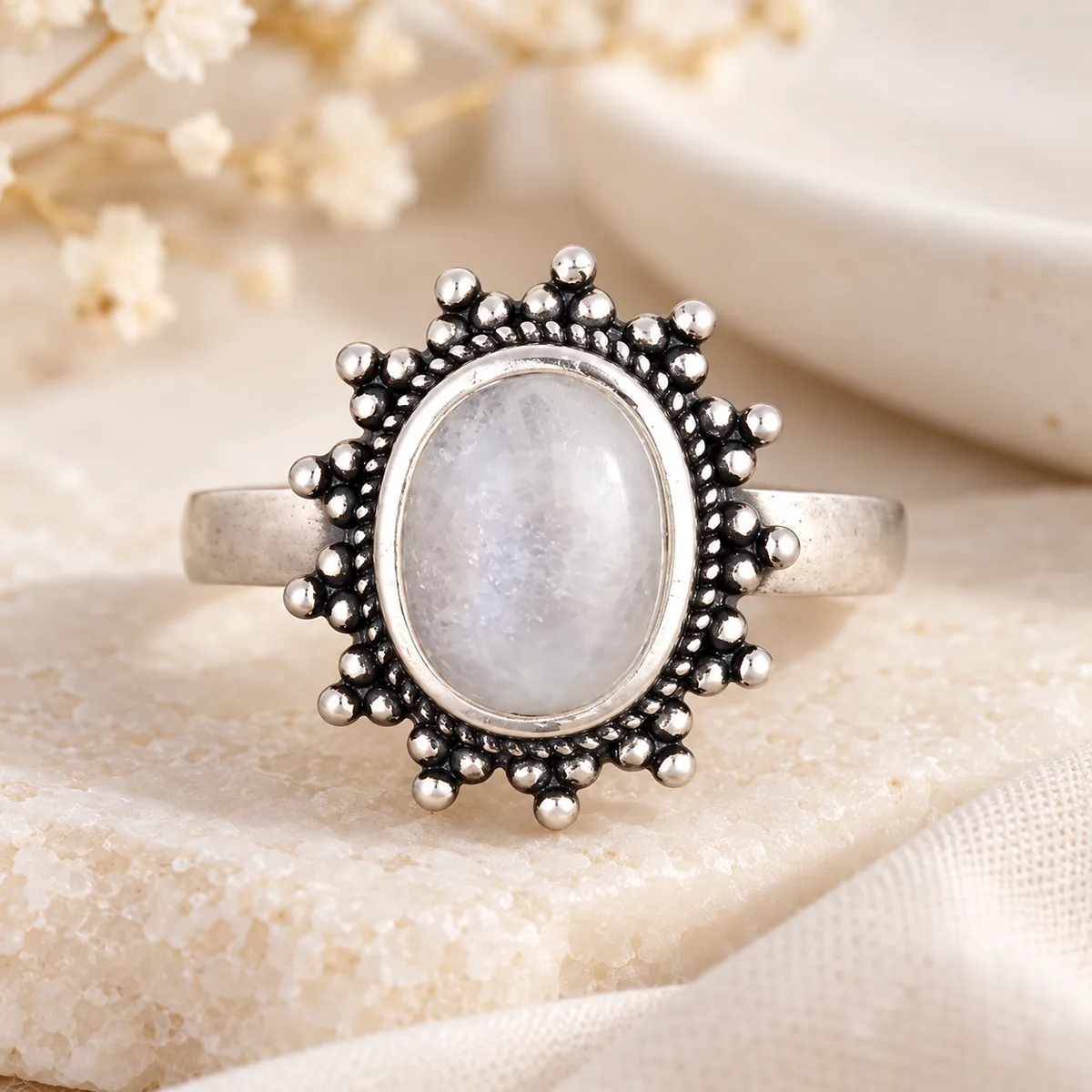
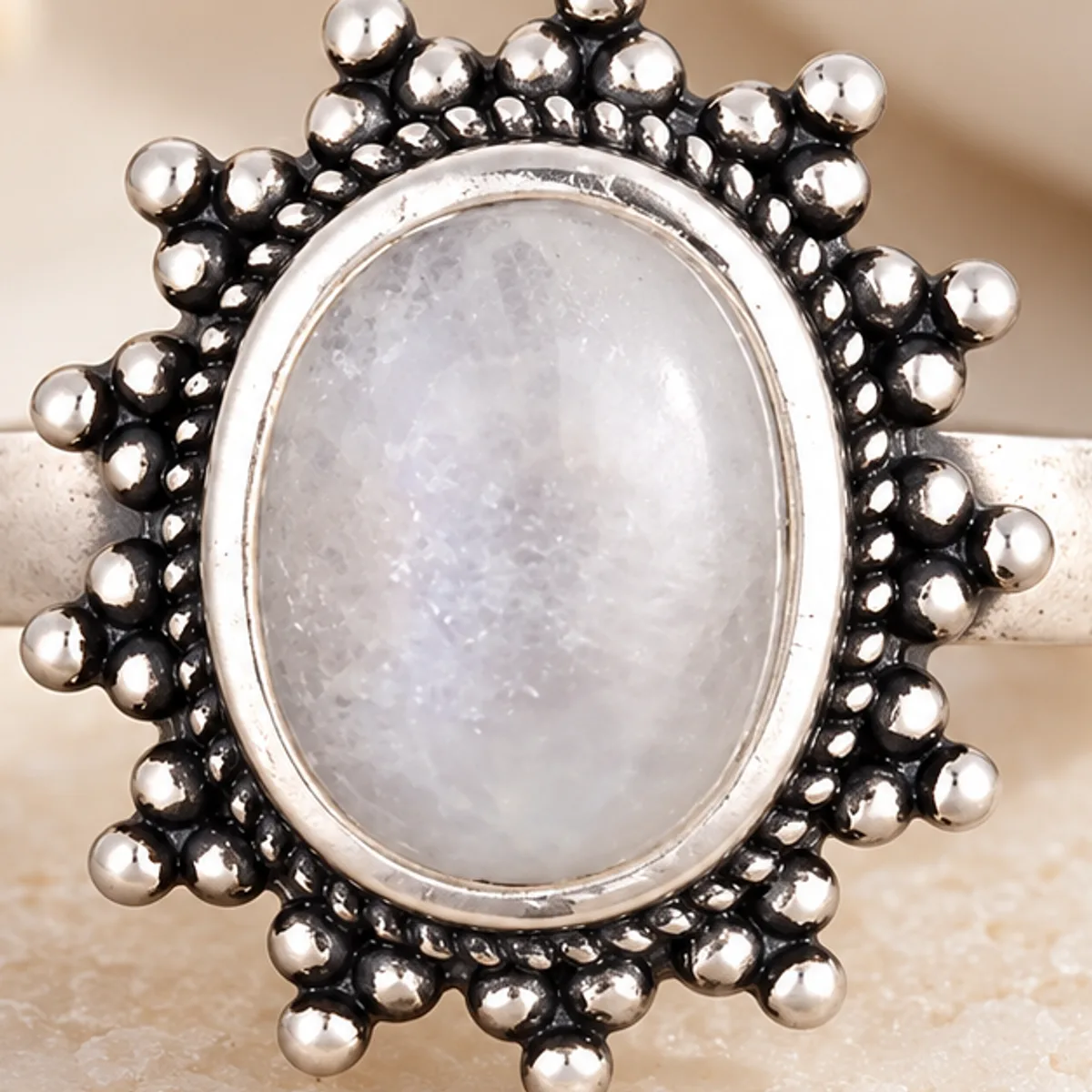
An oval cabochon inside a surround of short rays, each one ending in a bead, carried on a band that is flat rather than domed.
Rays that stop
The surround is made of short rays, radiating out from the bezel and stopping after a few millimeters, each capped with a small bead. Stopping is the point. Rays that run to the edge of the ring turn the whole head into a disc and the stone disappears into it. Rays that stop short leave a border of plain metal between them and the outline, so the eye reads the stone, then the rays, then the edge, in that order. The bead at the end of each ray is what makes the stopping look deliberate rather than unfinished.
The band is flat. Elsewhere in this collection I say plainly that a domed band is more comfortable, because a flat one has two edges that press on the neighbouring fingers, and I am not going to contradict myself here. This band is flat because the design needs a flat plane to sit against: a domed band under a flat radiating head makes the join look like two different rings stuck together. The choice is aesthetic and it has a real cost in comfort.
What I do about that cost is the part worth knowing. The two edges of the band are chamfered, a narrow bevel filed along each one, which removes the sharp corner without turning the band into a dome. It is not as comfortable as a fully rounded profile and it is a great deal better than a raw flat edge. If you already know that flat bands bother you, choose a domed model instead and I would rather tell you that than sell you this one.
The stone sits in a closed bezel at the center of the rays, and the blue veil is the soft thing at the middle of a hard geometry. The other rings are here, and the size guide takes two minutes.
- Oval moonstone cabochon, closed bezel at the center of the rays.
- 925 sterling silver hallmarked S925, short rays each ending in a set bead.
- Flat band with chamfered edges: an aesthetic choice, with the comfort cost stated.
- US sizes 4 1/2 to 10, that is 48 to 62 mm. Shipped in two weeks.
The specifications
- Stone
- Real moonstone (adularia), oval cabochon
- Origin
- India
- Metal
- 925 sterling silver, S925 hallmark
- Setting
- Closed bezel, no glue
- Shape
- Flat band, edges chamfered
- Decoration
- Radiating rays, a bead at the end of each
- Finish
- Oxidized silver, crests rubbed back with a cloth
- Sizes
- US 4 1/2 to 10 (48 to 62 mm)
- Gender
- Women
- Brand
- Melissa Moon
When the design wins and when comfort wins
Most of the time comfort wins, and when it does nobody notices, because a comfortable ring is invisible. Occasionally a design only works one way, and then I have a choice: change the design, or keep it and be honest about what it costs. On this one I kept it, because a radiating head genuinely does need a flat plane, and I chamfered the edges to recover most of what a flat band loses.
What I will not do is pretend the cost is not there. The trade is full of pieces sold as comfortable that simply are not, and the buyer finds out in week two and blames themselves. A flat band with chamfered edges is comfortable enough for most hands and noticeably less so than a domed one. If you wear rings on adjacent fingers, that difference matters; if you wear one ring on one hand, you will never notice it.
I would rather lose a sale to my own description than have a ring come back after a month with a polite note.
No salt, no ultrasonic tank, no hot water: moonstone is a feldspar, and all three damage it for good. The gaps between the rays catch cream, so rinse under lukewarm water and use a dry soft brush once a month. Avoid silver dips, they lift the oxidation from between the rays and the surround reads as a flat disc. The detail is in cleaning a moonstone piece, and the safe methods in caring for it without harming it. The bezel protects the stone, though a moonstone chips on a real knock.