


Description
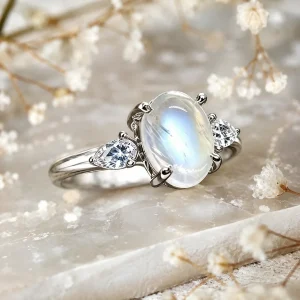
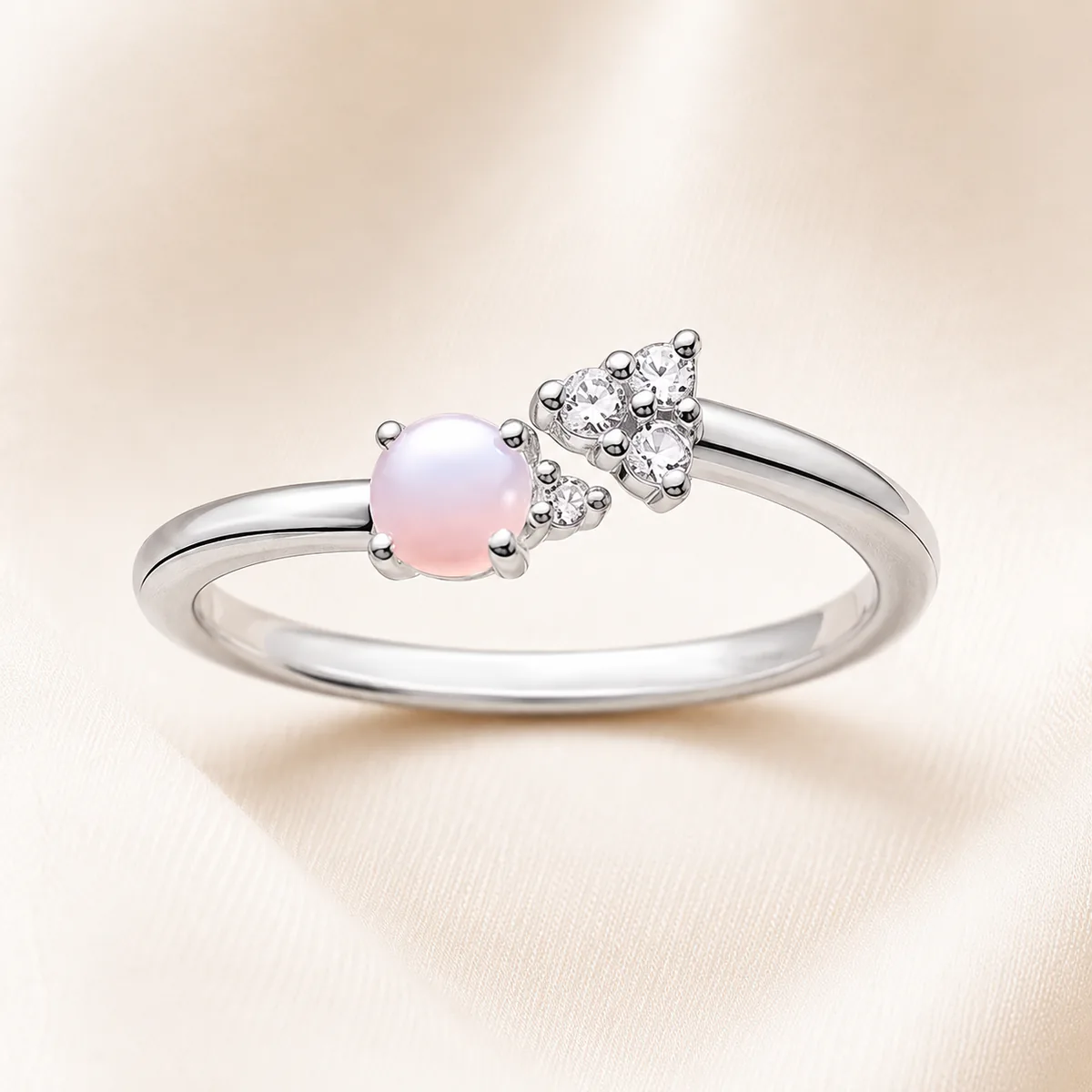
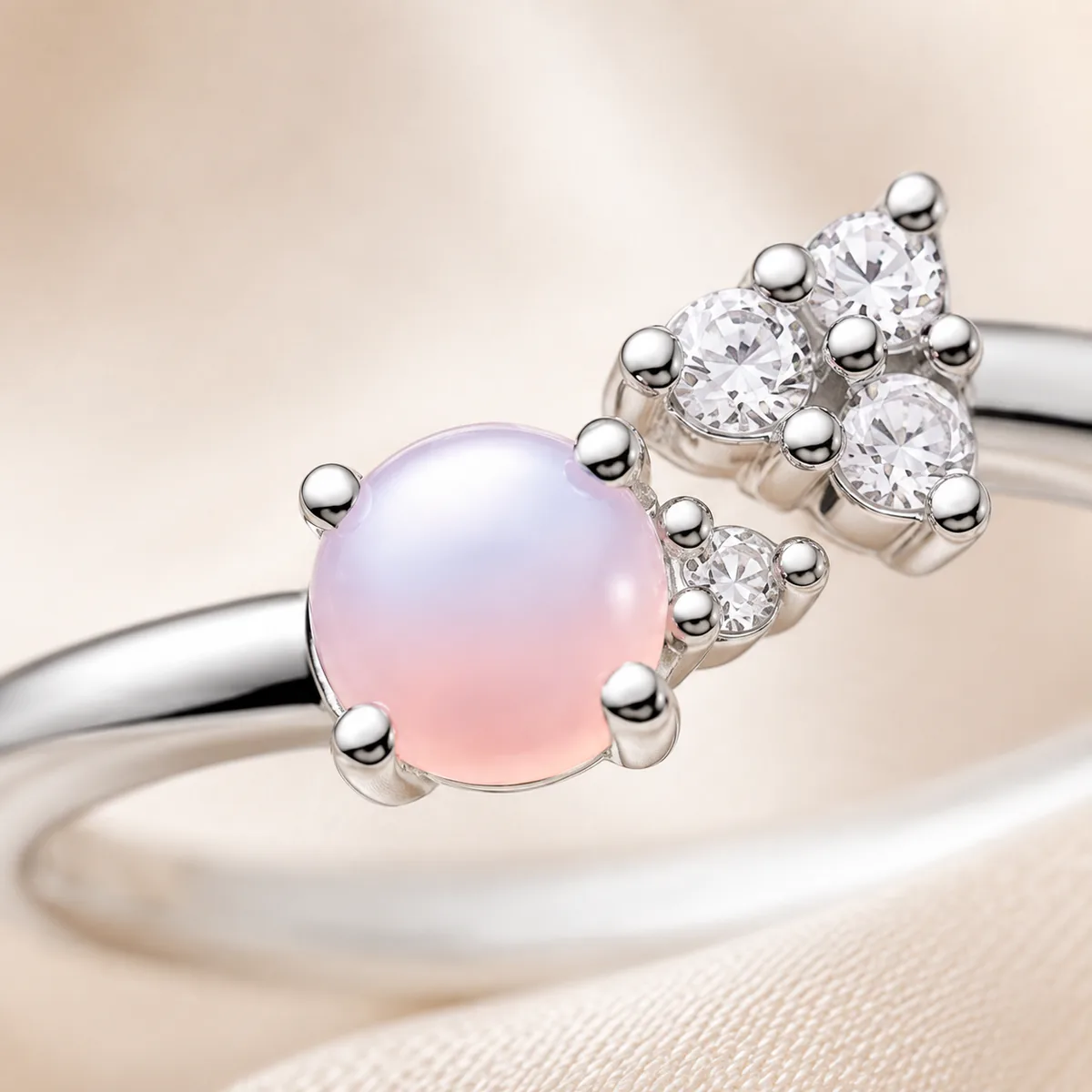
It is the smallest ring in the catalog, and the only one that is not centered. A round pale pink cabochon, a soft glow inside it, and right beside it a little group of clear stones set askew, as if it had been allowed to slip. All of it on a smooth band, with nothing else. It is the one you wear when you do not want a ring to be noticed, only the hand.
A pink that does not shout
The tone runs from peach to rose depending on the light, and it is rarer than white. In feldspars this color comes from traces of iron caught in the crystal as it formed; it is neither a dye nor a treatment, it is an original impurity, and it is what makes the price of the variety. The glow rising from the cabochon is softer than the frank blue of pale stones, less spectacular, and far closer to the color of skin. What each color changes is set out here.
The mounting’s whole idea is the offset. The cabochon is not at the center: it sits to one side, and the little group of four clear stones leans against it at an angle, like a constellation. Nothing answers anything else symmetrically, and that is what gives this ring the air of a piece found rather than a piece designed. The band stays smooth and fine, without one ornament: on a composition already off balance, adding anything at all would have made a mess. The shop’s other rings are here.
An off-center ring has to fit exactly
Now the only thing that really counts when buying, and it holds for every asymmetrical ring. An off-center ring has to be taken true to size. On a smooth fine band, nothing stops a ring from turning through the day, and a centered ring that turns goes unnoticed. This one does not: the motif ends up under the finger and you wear a bare band without knowing it. So take your exact size rather than the larger one, which is the opposite of the advice I give on wide rings. The sizing guide sets out the measurement, and take it at the end of the day, when fingers are at their widest.
Two more honest points. A pink this pale disappears on some skins, especially light warm complexions: the stone melts into them instead of standing out. It is not a fault, it is a choice to make knowingly. And moonstone has perfect cleavage, it chips on impact without scratching for all that, and here it is held by fine prongs: run a fingernail over them once a year.
What tradition says, kept apart
Crystal healing tradition associates pink stones with gentleness and calming, and generally files them on the side of the heart rather than the emotions, which is not exactly the box the other varieties go in. I have put those correspondences apart below. I will go no further: none of it is demonstrated and no piece of jewelry heals anything. Separately, I have gathered what tradition lends this stone.
- Pink moonstone, a peach to rose tone owed to traces of iron. Rarer than the white.
- 925 sterling silver, smooth fine band. Off-center round cabochon and a group of four clear stones set at an angle.
- An asymmetrical ring: take your exact size, or the motif turns under the finger.
- Sizes 4½ to 10. Delivered in two weeks, with a cotton pouch, a handwritten note and a care card.
The specifications
- Stone
- Pink moonstone, round cabochon cut
- Accent stones
- Four small clear stones in prong settings
- Metal
- 925 sterling silver
- Setting
- Prong set, off-center composition, no glue
- Band
- Fine and smooth
- Sizes
- 4½ to 10, to be taken true
- Gender
- Women
- Brand
- Melissa Moon
Imbalance is harder than symmetry
People believe the opposite, because a centered composition looks as though it demands precision. In truth a symmetrical ring almost draws itself: you lay down the axis and the rest follows. An offset composition has no landmark at all, and there is only a handful of positions where the whole stands up instead of looking badly assembled. On this one, the constellation of four stones almost touches the cabochon without touching it, and it is that half millimeter that makes the difference between a design and an accident.
The longest part on this model remains the matching. A small pink cabochon is hard to pair: two stones from the same delivery can turn one toward peach and the other toward gray, and on a stone this size the shade decides everything. It is the only model in the catalog where I set stones aside for their color rather than for their sheen. The rest of the shop is here.
A symmetrical ring gets noticed. An off-center ring gets looked at twice, because at first you think it has turned.
No salt, no ultrasonic tank, no hot water: moonstone is a feldspar, and all three damage it for good. Lukewarm water, a soft cloth. On a pale, light-colored stone, hand creams are the most discreet enemy: they leave a film that puts the glow out without your noticing, and you end up believing the stone has dulled. Put cream and perfume on before slipping the ring on, never after. The detail is in cleaning a moonstone piece, and the safe methods in caring for it without harming it.