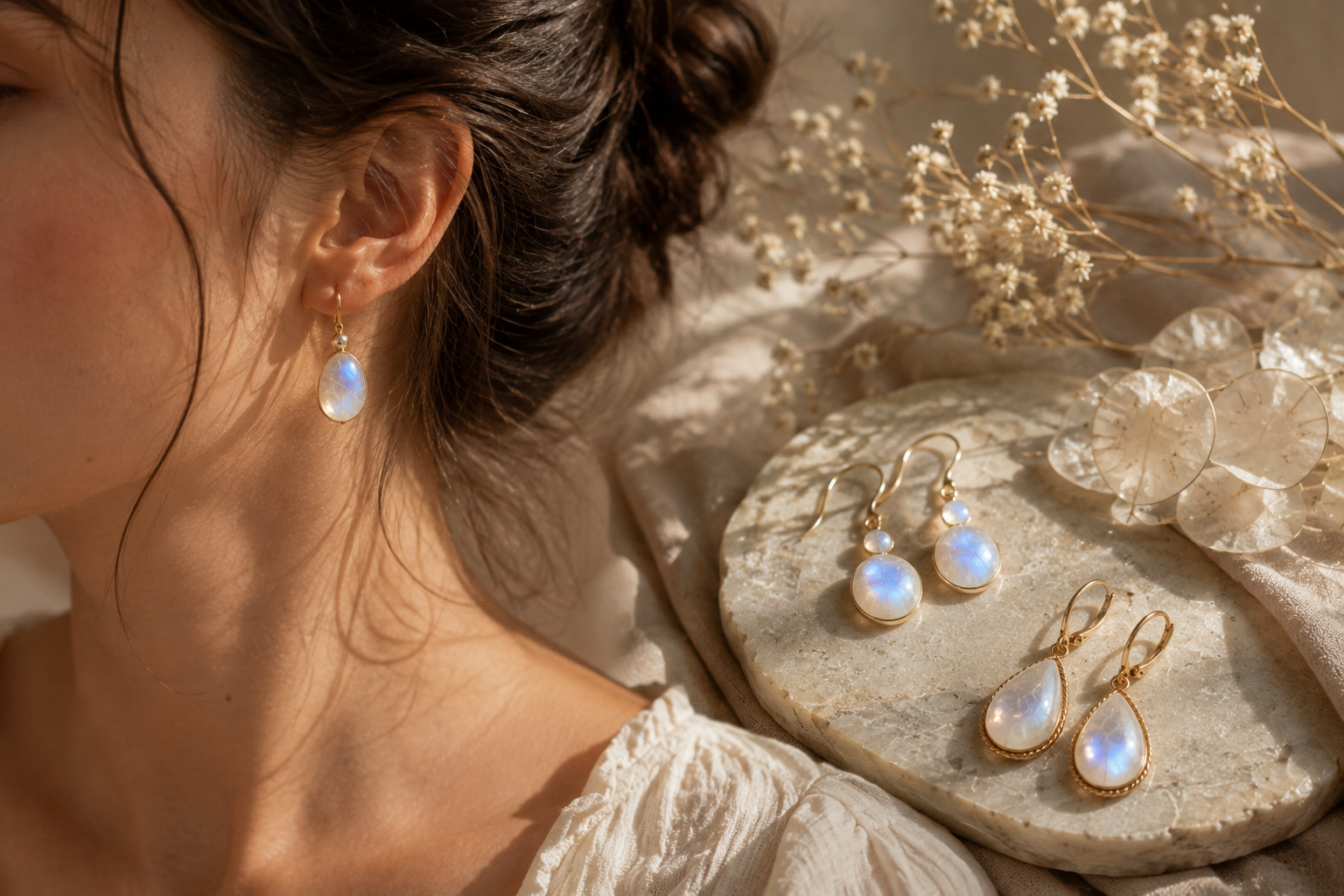
How to Wear Moonstone Earrings
This is the best place on the body for this stone, and almost nobody says so. First because an earring hits nothing, which settles the fragility problem. Second because a hanging stone moves constantly, and that is exactly what the sheen needs in order to be seen.
The rest of this article is practical: which format for which face, what length, which setting really protects the stone, and which back will stop you losing one. For the other pieces, there is how to wear moonstone.
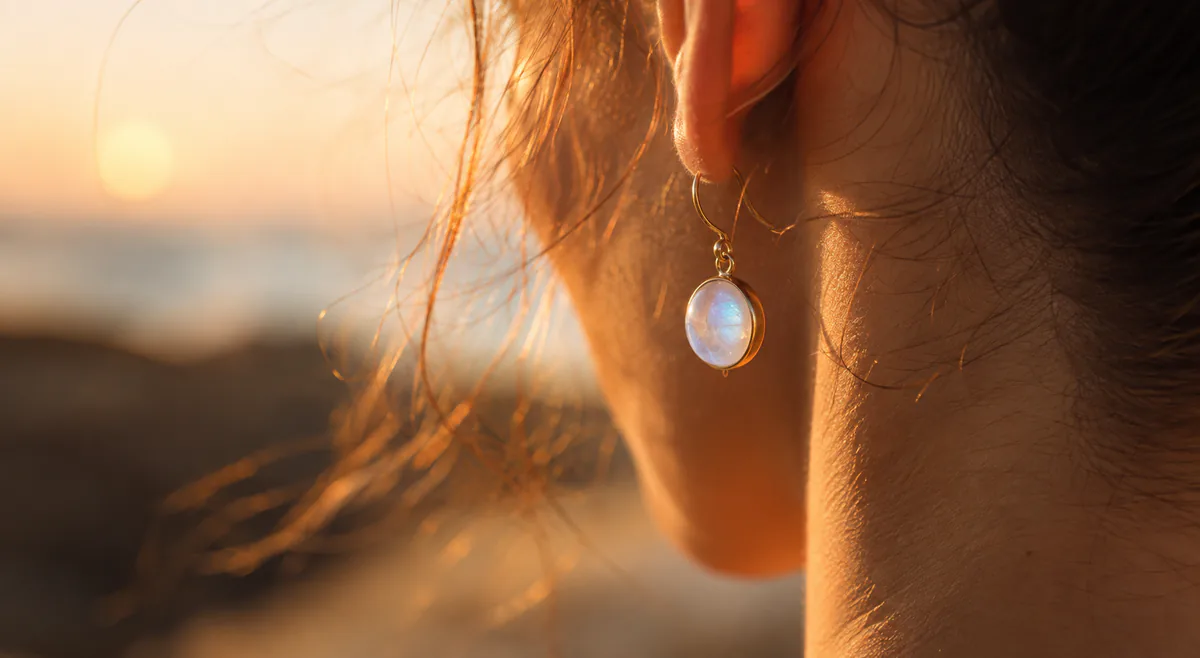
The short version, if you are in a hurry
- It is the safest format for a moonstone: an earring knocks into nothing, unlike a ring.
- The drop is the best choice, because the stone never stops moving and its sheen only shows in movement.
- The stud is the everyday format: discreet, nothing to catch on, and it does not tangle in your hair.
- A bezel setting protects a cleavable stone far better than prongs, and it avoids glue.
- The jump ring must be soldered, otherwise it opens and you lose the earring.
- Leverbacks and screw backs hold, butterfly backs give way over time.
- Silver suits it better than yellow gold, except for peach and orange stones, which take rose gold.
The safest way to wear this stone
Let us start with the mechanical argument, because it governs everything else.
Moonstone sits around 6 on the Mohs scale and has perfect cleavage in two directions, which means a well-placed knock splits it cleanly rather than chipping it. The detail is in is moonstone fragile.
Now, a ring takes knocks all day long. Door handle, keyboard, steering wheel, car door, worktop, bag: that is dozens of micro-impacts a day, and it is why a ring worn constantly is the most exposed format there is.
An earring touches nothing. It hangs in the air. Over the course of a day it meets only hair, a collar, a scarf and a phone against the ear. In other words, it escapes almost entirely the one real danger that threatens this stone.
What remains as a risk comes down to two moments, and both are avoidable: the drop while putting them on or taking them off, and the night spent lying on them. Both are covered below.
The argument nobody makes: movement
This one belongs to this stone alone, and it should decide your purchase.
The sheen of a moonstone is not a color sitting in the material: it is a reflection that only appears at a certain angle between the light source, the stone and your eye. The mechanism is explained in adularescence. In practice, a moonstone that does not move is dark half the time.
That is the quiet tragedy of the pendant, incidentally: a cabochon lying flat on the sternum, lit from above, shows its sheen only at certain moments and often looks gray. You have to lean, to turn, for it to light up.
A drop earring never stops. It swings with every step, every turn of the head, every word spoken. The stone therefore sweeps continuously through the whole range of angles, and the sheen lights, fades, lights again. It is a living piece of jewelry, and for this stone in particular it is the only format that uses it fully.
Direct consequence: if you are to own one single piece of moonstone jewelry, and you want the stone to be seen, buy drops. A stud is wiser and more practical, but it shows less.
Studs, leverbacks, drops: what each format does
Three families, three uses, and they do not replace one another.
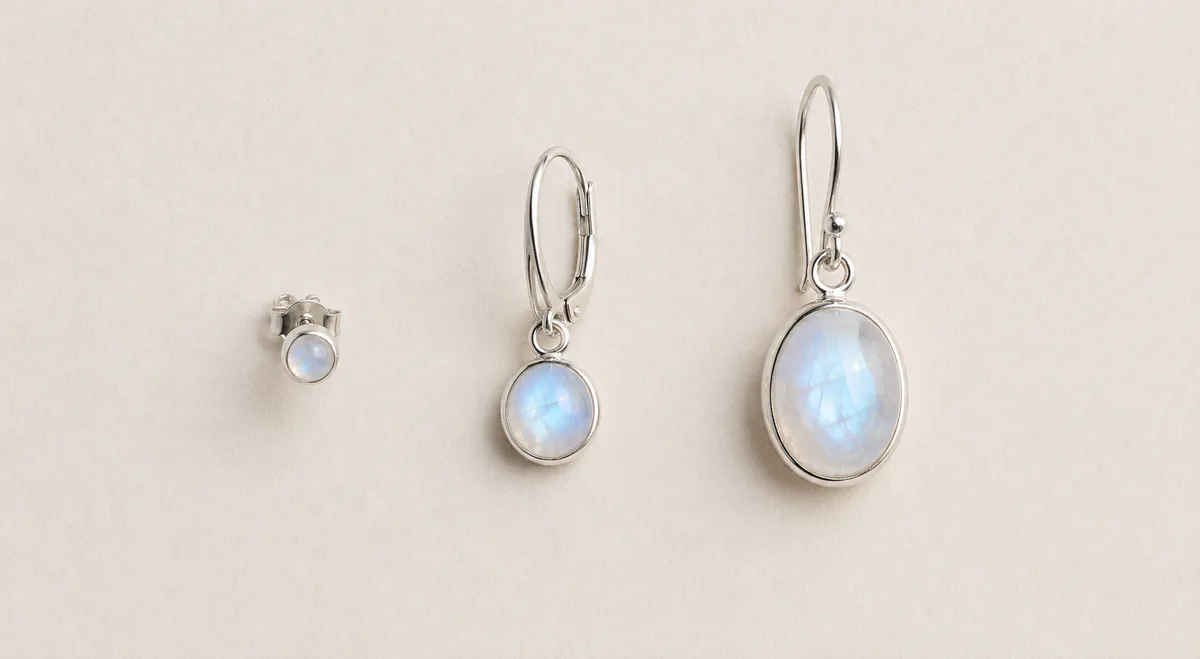
The stud. The stone sits flat against the earlobe, held by a post that goes through it. This is the everyday format: nothing sticks out, nothing catches in a sweater or a scarf, and you forget it is there. Common sizes run from 4 to 8 millimeters, and beyond that a stud starts tipping forward under its own weight. It is also the only format you can wear under a helmet or a turtleneck without thinking about it.
The leverback and the hoop. A leverback is a fitting that closes back on itself, often with a small stone hanging at the front; a hoop is a ring. Both hold better than a stud and take a little length without being cumbersome. It is the compromise for someone who wants movement but works with their hands or often wears a coat.
The drop. The stone hangs at a variable distance from the earlobe, and this is where the sheen gives its best. The price to pay: it catches in long hair and in collars, and you feel it after a few hours if it is heavy.
Length, and what it does to a face
Here are the usual rules. I give them because they are useful, and I say straight away that they are style conventions and not truths: they are visual tendencies, not laws.
The reference point to know is the jawline. An earring that stops exactly on it underlines it and hardens it. An earring clearly above or clearly below softens it. If your jaw is strong and that bothers you, avoid the length that falls right on it.
Round face. Vertical lengths lengthen: fine drops, teardrops, lines rather than circles. Large round hoops tend to widen.
Long or elongated oval face. The reverse: studs, buttons and wide shapes balance it, and very long drops accentuate the vertical.
Square face. Round shapes and teardrops soften the angles better than angular geometric shapes.
Heart-shaped face, narrow chin. Shapes that widen toward the bottom rebalance the lower face.
And the only rule that really counts: try them in front of a mirror, stepping back two meters. At twenty centimeters you judge the earring; at two meters you judge the face, and that is the distance at which people see you. Plenty of earrings that are superb up close do not work from a distance, and the reverse is true as well.
The setting that protects the stone
A technical point, and the one where the worst pieces on the market are found.
A bezel rather than prongs. A bezel is a ribbon of metal that goes around the stone and folds over its edge. It protects the girdle, which is precisely where a cleavable feldspar takes a knock best. Prongs, on the other hand, leave the girdle bare between each claw, and a prong that catches in a sweater pulls on the stone. The full reasoning is in bezel or prongs.
Glue, to be avoided. On cheap earrings the cabochon is often simply glued into a cup, with no rim folded over. It holds for a while, then the glue yellows, dries and gives way, usually out in the street. The test: run a fingernail around the edge of the stone. If you feel a lip of metal folded onto the stone, it is set. If the stone is simply sitting in a cup with a visible bead of glue, that is not a piece of jewelry, it is a consumable.
The height of the cabochon. On a stud, a very domed cabochon stands proud of the earlobe and becomes the most exposed point of the piece. A flatter cabochon lasts better, and that is what I choose for this format.
The same stones, bezel set by hand
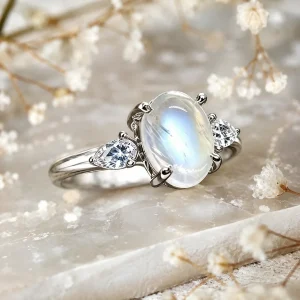
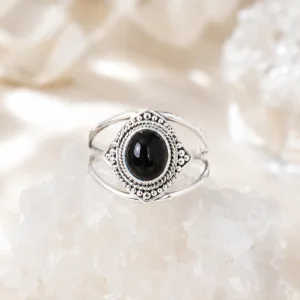
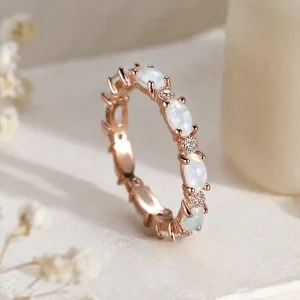
The jump ring, the part nobody ever looks at
On a drop earring the piece almost always breaks in the same place, and it is neither the stone nor the back.
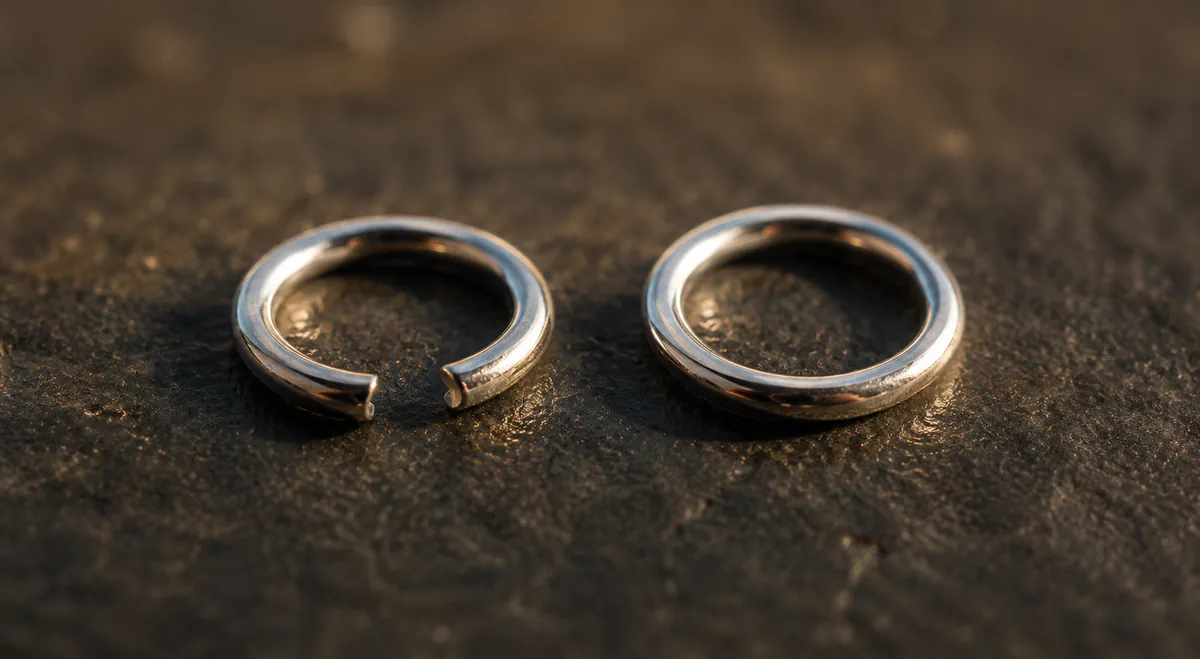
Between the hook and the stone there is a small metal ring. On quick manufacturing it is an open jump ring: a simple coiled wire whose two ends touch without being joined. One tug in a sweater is enough to open it by a few tenths of a millimeter, and the stone is gone.
What you want is a soldered ring, whose join has been closed with a flame, or a bail closed in one piece. You can see the difference with the naked eye: on an open ring you can make out the split. On a soldered ring the line is continuous.
If you already own earrings with open jump rings, do not throw them out: a jeweler solders them in a few minutes for a trifling sum. It is probably the most worthwhile repair in the whole trade.
The back, and why one earring in two goes missing
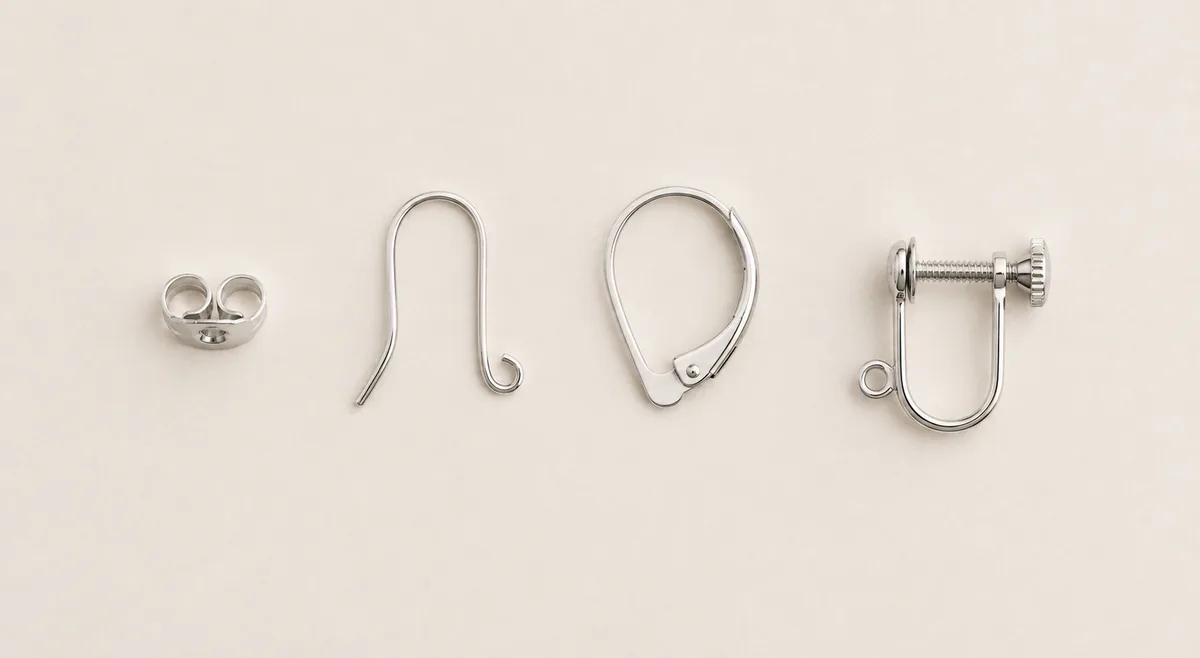
Four systems, and they are nothing like equal.
The butterfly back. The little winged back, by far the most widespread. Its flaw is structural: it holds by the pressure of two metal blades that lose their spring from being pushed apart and pressed together again. After a year or two, it slips. It is the leading cause of a lost earring, far ahead of breakage.
The fish hook. Handy, pretty, and it holds nothing at all: pulling a sweater over your head is enough. Keep it for occasions when you will not be changing clothes, or add a small silicone stopper costing a few cents.
The leverback. The fitting closes back on itself with a lever. It is the best ratio of security to comfort for a drop earring, and it is what I recommend by default as soon as there is a stone you do not want to lose.
The screw back. The back screws onto a threaded post. It is the safest there is, and the slowest to put on. For a stone you care about, or for someone who moves around a lot, it is worth the twenty seconds.
The free move that changes everything, if you are keeping butterfly backs: add clear silicone stoppers behind them. They cannot be seen and they rescue a tired back.
Silver or gold, the question settled
It is not purely a matter of taste: there is an optical reason.
Silver wins because its gray-white and the blue-white of the sheen belong to the same family of tones. Metal and stone answer each other, and the sheen looks brighter against a neutral ground. That is exactly the reasoning of the jewelers of 1900, told in moonstone in Art Nouveau.
Yellow gold does a disservice to a white or blue stone: by warm contrast, the cool sheen leans toward gray and the stone looks dull. It is not fatal on a small stud, but on a drop that puts the stone on show, it is visible.
White gold works like silver, with the advantage of not tarnishing. It is the logical choice for anyone who does not want to maintain anything.
Rose gold is the pleasant surprise, but not with just any stone: it is superb with the warm varieties, peach and orange, which I cover in peach and orange moonstone. With a clear white, it clashes.
One practical point about the earlobe: the post that goes through the ear stays for hours in contact with pierced skin. Nickel is the most common contact allergen, and its release from objects in prolonged contact with skin is regulated in Europe for precisely that reason. If your earlobe itches or weeps, suspect the post before you suspect the stone: sterling silver, gold and titanium are generally well tolerated.
Hair up, hair down
A criterion everyone forgets at the moment of buying, and one that decides the result.
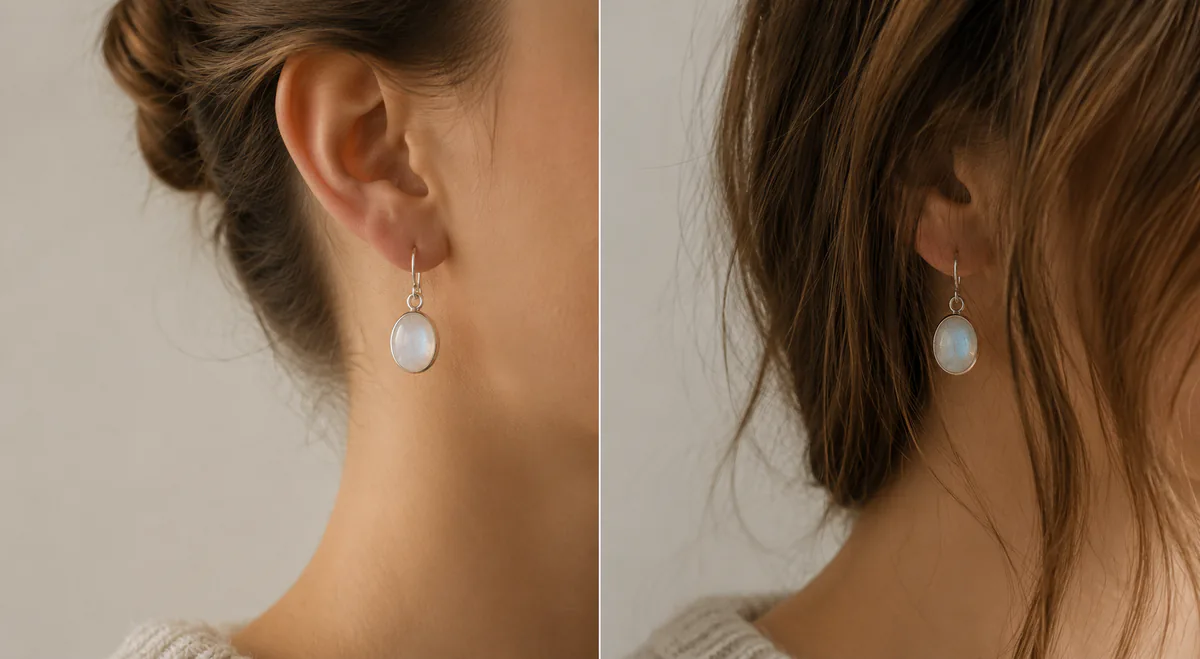
Hair up. The earrings become the main piece on the upper body: they are seen in full, from the front and in profile. A small, fine piece is then plenty, and a large piece can quickly become a great deal.
Hair down and long. Half the earring disappears, and all you catch is a movement at the edge of the face. If you wear your hair down all the time, buy longer or wider than seems reasonable in the shop mirror, otherwise the earring will never be seen.
And the catching. Long hair plus an open hook is the combination that loses the most earrings: the hook catches in a strand and comes out of the earlobe without your feeling a thing. With long hair, leverback or screw back, genuinely.
Weight, and what it does to the earlobe
An unglamorous subject, and yet the one that decides whether the earrings get worn or put away.
An earlobe is soft tissue with a hole through it. A heavy piece worn daily for years lengthens that hole downward, slowly and painlessly. It is reversible while it is slight, much less so afterward.
The honest test, and it calls for no figures: put them on and wait an hour. If you can still feel them at that point, they are too heavy for daily wear. An everyday piece has to vanish from your awareness within minutes.
The good news is that moonstone is moderately dense and that a cabochon of reasonable size weighs almost nothing. The weight of an earring generally comes from the metal, not the stone: a heavy setting with a small cabochon will weigh more than a fine setting with a large stone.
The rule I apply: light for the daytime, heavy for evenings. A pair of substantial drops worn ten times a year will never do any harm.
With which other pieces
There is a rule specific to this stone, and it is counterintuitive.
One moonstone at a time, or two at most. The sheen is a subtle effect that asks for attention: two or three moonstone pieces on the same person compete with one another, and the eye, not knowing where to go, stops seeing any of the three. It is the opposite of a strongly colored stone, which can be multiplied.
The combination that works best: moonstone earrings, and everything else neutral. A fine chain with no pendant, a plain band, a quiet watch. The earrings become the only point of light on the face, and that is where you want the eye.
If you already wear a moonstone ring every day, keep to very discreet studs, or switch to another material for the ears. Two large milky cabochons is one too many.
Mixing metals is no problem if it is deliberate, but keep the same metal between the two ears and the face: silver at the ears and gold at the neck creates a break in the middle of the bust that most people perceive without knowing why. Stone pairings are in which stone to pair with moonstone, and the false friends in what is better avoided.
| Format | Suits | Weak point | Verdict |
|---|---|---|---|
| Stud | Every day, work, sport | Shows the sheen poorly | The safe format |
| Leverback | Everyday wear with movement | Limited length | The compromise |
| Hoop | Hair up | Widens a round face | Depends on the face |
| Short drop | Day and evening | Catches a little | The best choice |
| Long drop | Evening, hair up | Weight, catching | In moderation |
| Bare hook | Nothing in particular | Does not hold | To be avoided |
The three habits that damage them
Three, and they account for nearly all the damage I see come back.
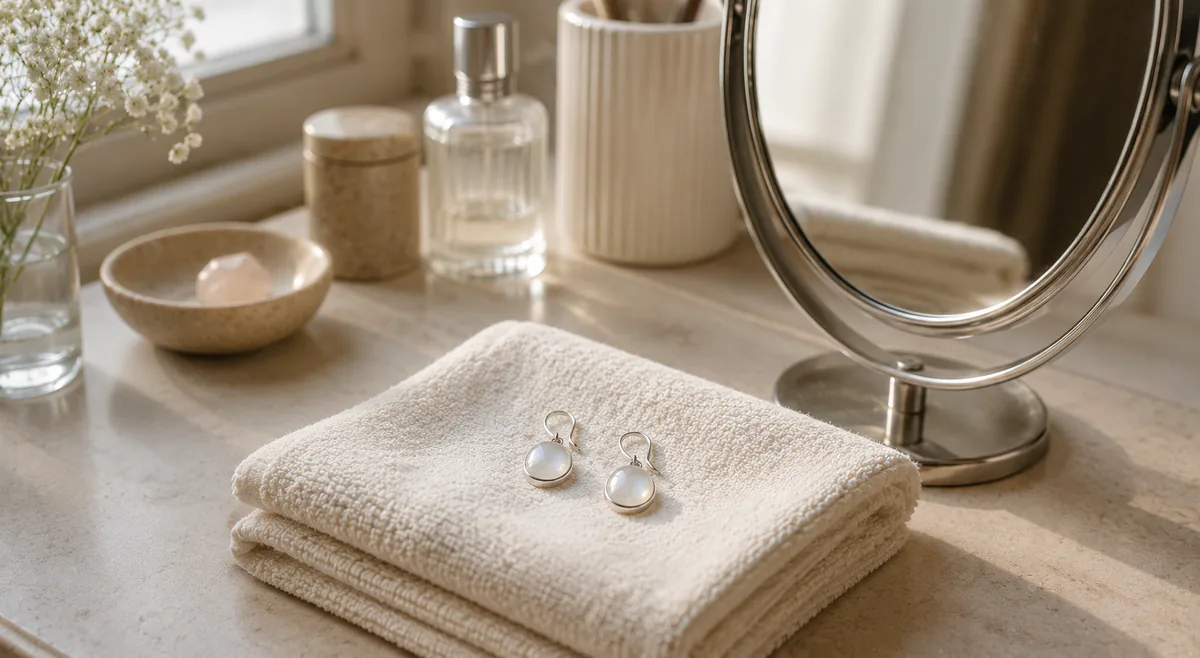
Putting them on standing over a sink. The great classic: the earring slips from your fingers, falls onto the ceramic or vanishes down the drain. A fall of one meter onto something hard is enough to split a cabochon along its cleavage plane. Do it sitting down, over a folded towel, and plug the drain before you start. It sounds excessive until the first time.
Spraying something after putting them on. Hairspray, perfume, hair mist: all of it settles as a film on the stone and on the metal, dulls the sheen and builds up in the setting. Jewelry goes on last, after the hair and the perfume, and comes off first in the evening, before the cleanser. The full principle is explained in how to wear moonstone, and the cleaning in how to clean a moonstone piece.
Sleeping in them. The pillow presses the earring against the skull all night, which bends posts, opens jump rings and wedges the stone at an angle it does not like. Not counting the earlobe. That is the subject of sleeping with moonstone, and the answer there is the same: not with earrings.
What you do not have to worry about, on the other hand: water. Moonstone takes lukewarm water and mild soap perfectly well, and rinsing a pair of earrings carries no risk, contrary to what you read. See can you put moonstone in water. What you must avoid is doing it over an open drain.
The stones I am setting at the moment




Frequently asked questions
How do you wear moonstone earrings?
By favoring drops if you want the sheen to show, because a hanging stone moves constantly and lights up. The stud remains the everyday format: more discreet, nothing to catch on, but it shows the stone less.
Why do earrings suit this stone so well?
For two reasons: they knock into nothing, which protects a cleavable stone that fears impacts, and they move constantly, which is exactly what adularescence needs in order to appear.
Studs or drops?
Studs for every day, work and sport: nothing sticks out and nothing catches. Drops to show the stone, because movement lights the sheen. If you are only to have one pair, the short drop is the best compromise.
What length for which face shape?
Vertical lengths lengthen a round face, wide shapes balance a long face, round shapes soften a square face. The useful reference is the jawline, which an earring stopping right on it tends to harden.
Which setting protects the stone best?
The bezel, a ribbon of metal folded over the edge of the stone, which protects the girdle and leaves nothing to catch. Avoid cabochons simply glued into a cup: the glue yellows and lets go.
Why do people lose an earring so often?
Because of the butterfly back, whose two blades lose their spring over time and end up slipping. Leverbacks and screw backs hold far better. A silicone stopper rescues a tired back for a few cents.
What is a soldered jump ring?
A small ring whose join has been closed with a flame, instead of a simple coiled wire whose ends merely touch. It is the breaking point of drop earrings: an open ring opens under a tug and the stone is gone.
Silver or gold for a moonstone?
Silver or white gold, whose gray-white belongs to the same family of tones as the sheen. Yellow gold makes a white or blue stone look duller. Rose gold is superb, but only with the peach and orange varieties.
Can you sleep in them?
Better not. The pillow presses the earring all night, which bends posts, opens jump rings and wedges the stone at a bad angle, quite apart from the earlobe.
Can they get wet?
Yes, without any problem: moonstone takes lukewarm water and mild soap. The only precaution is not to do it over an open drain, because the real risk is not the water but the fall.
Where to go next
- Wearing the other pieces: how to wear moonstone, which wrist for the bracelet, the necklace, the ring.
- The piece and its setting: bezel or prongs, judging quality, is it treated.
- Caring for them: cleaning a piece, the stone and water, is it fragile, sleeping with it.
- Choosing the stone: the colors, the blue, peach and orange, adularescence.
- The whole picture: the complete guide to moonstone.
The jewelry is in the shop, and the earrings collection grows as I find the stones. If you are after a particular pair, a format or a length I do not have online, write to me: I make to order, and that is often how the finest stones find an owner.
My sources
For hardness and cleavage, the pages of the GIA and Mindat on feldspars, developed in the properties of moonstone. For the mechanism of the sheen and its dependence on angle, the same sources, detailed in adularescence.
For nickel, the European regulation that governs its release from objects in prolonged contact with the skin, and in particular from posts intended for pierced ears. I cite it in principle, without going into the thresholds, which only concern manufacturers.
What comes from my experience and not from a source. The advice on length according to face shape consists of style conventions, widely shared in the trade but with no measurable basis: I give them as starting points, not as rules. Likewise the one-hour test for judging weight is my method, not a standard, and I deliberately give no weight in grams because tolerance varies enormously from one person to another.
And some transparency about stock: my earring range is narrower than my ring range, quite simply because I set stones as I find them. What you read here holds for any pair, not only for mine.
Last updated: August 20, 2026. A question, an error? Write to me, I will correct it.
✦ À porter, à offrir
Découvrez mes créations