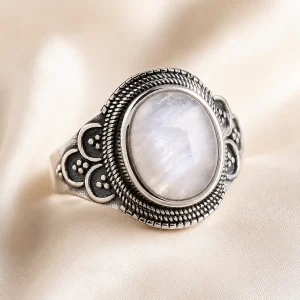
Can You Sleep With Moonstone?
Yes for a bare stone set near you, no for a piece of jewelry. Night is when most rings get broken without anyone noticing, and when most stones go missing. Here's what tradition says, what I see in my workshop, and what I do myself.
This question comes up often, and it deserves better than an enthusiastic yes. I'm answering it here on two levels I never mix: what crystal healing credits the stone with, in the conditional, and what its mineral structure requires, in the indicative.

The essentials, if you're in a hurry
- A bare stone near you: no problem at all. On the nightstand, in a small dish, it risks nothing and neither do you.
- A piece of jewelry worn overnight: a bad idea. The stone's perfect cleavage doesn't take kindly to rubbing against a headboard or twisting in the sheets.
- Under the pillow is the traditional practice, linked to dreams and calm. That's tradition, not a measured effect.
- The most concrete risk is losing it, in the sheets, under the bed, or in the washing machine with the duvet cover.
- One night means eight hours of sweat on a stone full of microfractures. Not dramatic, but it shows over time.
- Never in a child's bed, for choking-hazard reasons before any other consideration.
The short answer, in two parts
The question "can you sleep with moonstone" actually hides two questions, and they don't have the same answer.
Sleeping with the stone near you? Yes, without reservation. Set on the nightstand, in a small dish, or even under the pillow if you'd like. It risks nothing, neither do you, and that's the practice tradition describes.
Sleeping with the jewelry on your finger or wrist? No, and that's advice I give systematically. Not out of superstition: because I see cracked rings come back to me, and eight times out of ten, the person has no idea when it happened. Night is a blind spot.
Everything that follows explains why, and offers solutions for anyone who wants to keep the stone close without damaging it.
What happens to a piece of jewelry overnight
People picture the night as a moment of rest for a piece of jewelry. It's the opposite.
Repeated rubbing. A hand that slides under the pillow, that scrapes against a headboard, that rubs against a bedpost: that's dozens of contacts per night, against surfaces harder than the stone. At 6 to 6.5 on the Mohs scale, moonstone is softer than varnished wood loaded with silica dust.
Twisting in the sheets. A ring that catches on fabric and gets pulled by reflex takes a sideways strain, exactly the kind that makes cleavage give way. It's the most common scenario behind cracked rings.
Fingers that swell. Hands change volume overnight. A ring that fits during the day can tighten by early morning, which increases pressure on the setting and, eventually, on the stone.
The full mechanism is covered in is moonstone fragile, and everyday precautions in how to wear moonstone.
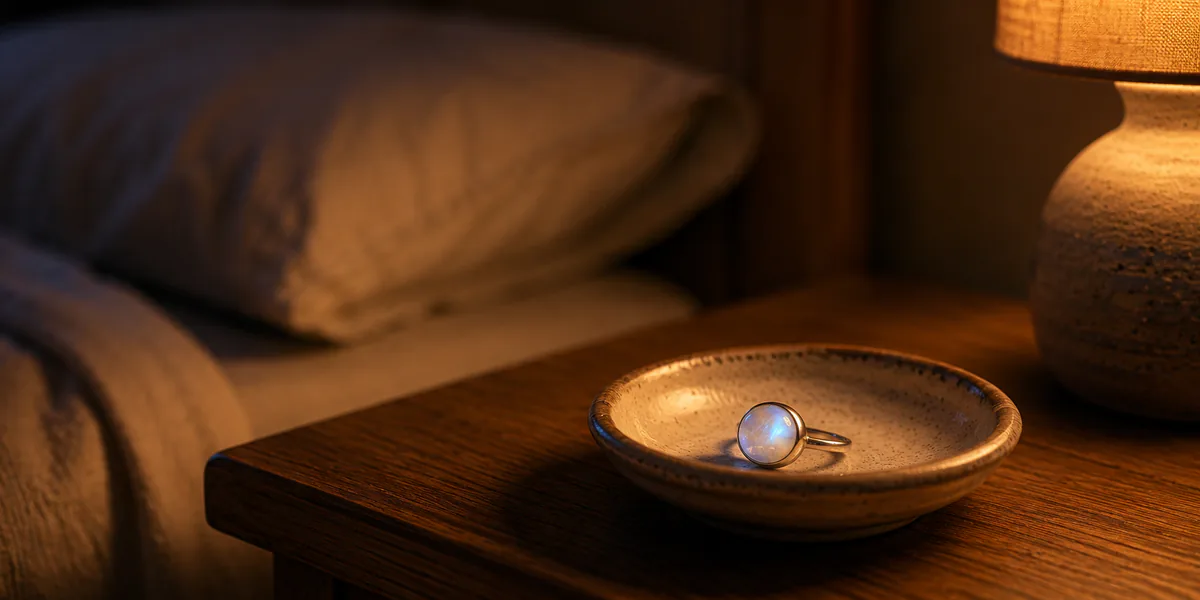
Rings set in closed bezels




Under the pillow: what tradition says
What follows shifts register. Everything above is measurable. What follows belongs to crystal healing, a wellness approach rooted in tradition and belief. So I write it in the conditional.
The most common practice is to slip the stone under the pillow or under the mattress, near the head. Tradition credits it with three things: calming you before sleep, softening restless nights, and encouraging dreams you'll remember.
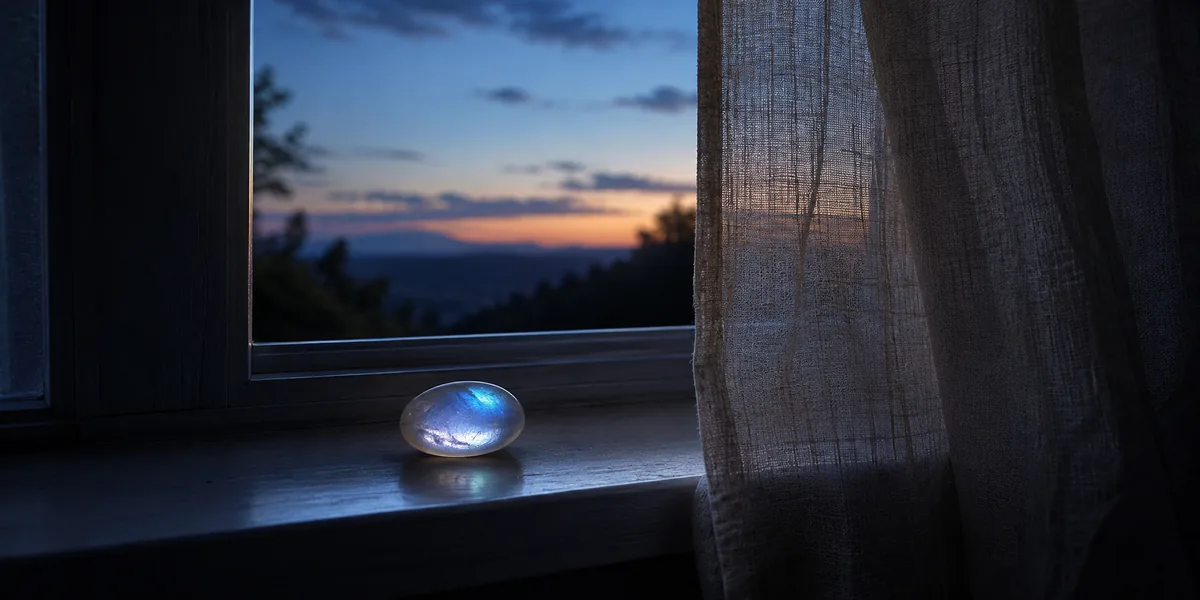
One variant places the stone on the nightstand instead of under the pillow, ideally where moonlight can reach it. That's the variant I prefer, for very down-to-earth reasons explained further down.
Another places it on the solar plexus or lower belly during a quiet moment before bed, then removes it. On chakra correspondences, see moonstone and the chakras.
These correspondences belong to crystal healing, an approach rooted in tradition and belief. They do not constitute a medical claim, do not treat any sleep disorder, and never replace the advice of a healthcare professional. Read the full disclaimer.
If your nights are genuinely difficult, see a doctor, not a stone. I say this all the more willingly since I'm the one selling these stones.
On the wrist: the worst of both worlds
A bracelet worn overnight piles up the drawbacks without delivering what tradition attributes to a stone that's simply set nearby.
The clasp. That's the part that gives way, and it almost always gives way at night, because that's when it takes the most involuntary tugging. A bracelet that opens in bed ends up in the sheets, then on the floor.
Beads under pressure. A beaded bracelet trapped between the wrist and the mattress takes continuous pressure for hours. On drilled beads, already weakened at their center, that's the surest way to crack one.
Marks. As a side note, a bracelet leaves an imprint on the wrist overnight, which doesn't damage anything but is startling to wake up to.
On choosing a wrist during the day, see which wrist to wear a moonstone bracelet on.
The studio's bracelets




The real risk nobody talks about
It's neither breakage nor wear. It's losing it, and by far that's what happens most often.
The pattern is always the same. The stone slipped under the pillow migrates overnight. By morning, it's somewhere in the bed. You make the bed without seeing it. It falls behind, against the baseboard, or under the box spring. Three weeks later, you're searching for it.
The costly variant: it leaves with the duvet cover in the washing machine. There, two things happen, and neither is good. The drum knocks it against metal for an hour, which perfect cleavage does not forgive. And sixty-degree hot water adds thermal shock on top.
That's the main reason I recommend the nightstand rather than the pillow. A dish, always the same one, always in the same spot. You don't lose what you put away.

Dreams that get too vivid, the flip side
Here's a point shops tend to leave out, even though it comes up often in the feedback I get.
Tradition links moonstone to intuition, imagination and dreams. What's presented as a benefit can backfire: several people have written to me that their nights became too crowded, with dreams that were numerous and exhausting, and that they ended up removing the stone from the bedroom.
I have no way of knowing what's going on there, and I'm not claiming to settle it. What I can say is that this feedback exists, and it's consistent with what tradition itself claims. If your nights get restless after placing a stone near your bed, the reasonable response is simple: remove it and see.
The full attributions are in the properties of moonstone, and usage precautions in the contraindications.
What I do myself
Since people ask, here's my own practice, without claiming it's better than anyone else's.
I take off all my jewelry at night, no exceptions, and I set it in a ceramic dish on my nightstand. It's more a workshop reflex than a conviction: when you spend your days repairing cracked stones, you eventually start putting your own away.
That said, I do keep a bare cabochon on that nightstand, one I set aside from a batch because its sheen drifted off to one edge. It's worth nothing commercially and I'm fond of it. Does it change my nights? I have no idea, and I'm not going to tell you otherwise just to sell a stone.
What I do notice, though, is that the act of taking off jewelry at night and setting it in the same spot every time becomes part of going to bed. It marks the end of the day. That part is verifiable, and it has nothing mineral about it.
Never in a child's bed
A bare stone in a child's bed is a no, and for a reason that has nothing to do with crystal healing.
A cabochon is the size of an object a young child can put in their mouth and swallow. That's a choking hazard, and it settles the question on its own. No tradition, however old, justifies taking that risk.
For an older child, if you still like the idea, a stone placed on a shelf out of the bed's reach fills the same symbolic role without the danger.
The same reasoning applies to pets: a cat that finds a cabochon on a nightstand will knock it off, and sometimes worse.
If you sleep with it anyway
You're free to, and I'd rather give good advice to someone who's going to do it their own way regardless than just leave them with a flat no.
- A bare stone rather than jewelry. No clasp, no setting, no drilling: nothing to break.
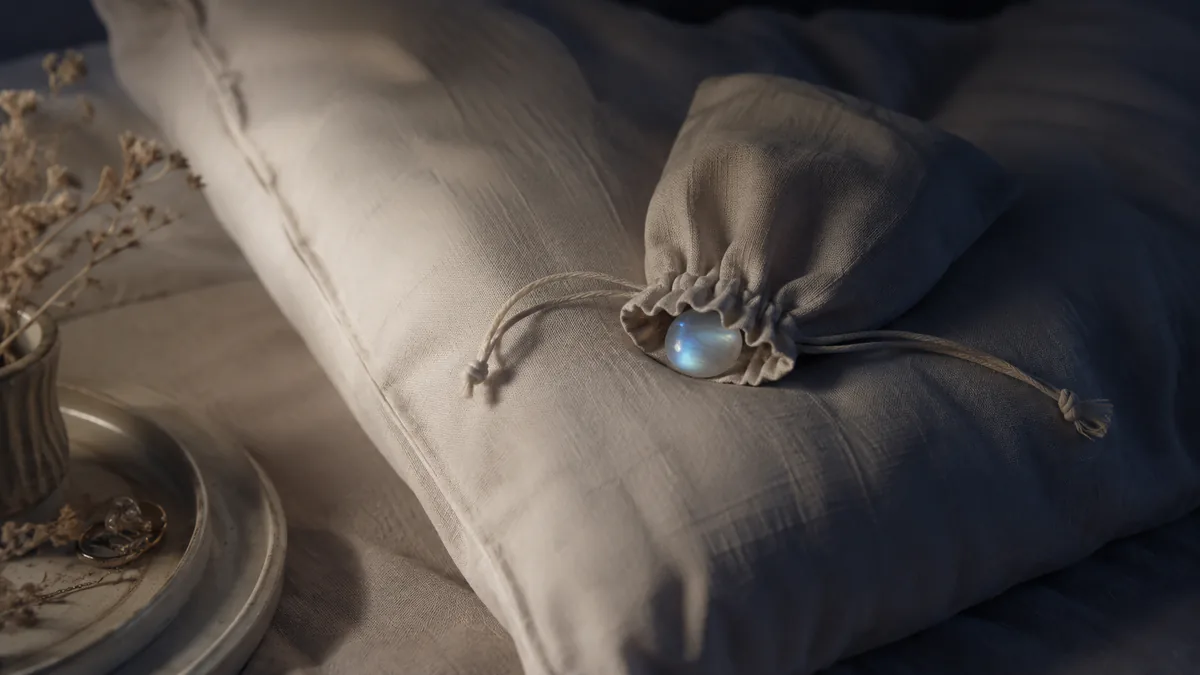
- In a small fabric pouch, closed. It won't get lost in the sheets and won't end up in the wash.
- Under the pillow rather than loose in the bed, for the same reason.
- Rinse it in the morning with lukewarm water, and dry it. One night means several hours of sweat on a stone with microfractures.
- Never salt on it, before or after. It's the most common cleansing method, and it's exactly the one that damages it.
Routine care is detailed in how to clean a piece of moonstone jewelry, and cleansing methods in cleansing and recharging your moonstone.
Frequently asked questions
Can you sleep with a moonstone ring on?
Better to avoid it. Night piles up rubbing against the headboard, twisting in the sheets and swollen fingers. It's the time when the most cracked rings come back, and almost nobody knows when it happened.
Should you put it under the pillow or on the nightstand?
Tradition describes both. I recommend the nightstand, in a small dish, for a very concrete reason: under the pillow, the stone migrates overnight, gets lost in the sheets, and sometimes ends up in the washing machine with the duvet cover.
Does moonstone help you sleep?
That's what tradition credits it with, in terms of calm and dreams. It isn't a measured effect, and it doesn't treat any sleep disorder. If your nights are genuinely difficult, see a doctor.
Can it cause unpleasant dreams?
Several people have written to me that their nights became too crowded after placing a stone near the bed. I have no way of knowing what's going on there, but that feedback exists. If it happens to you, remove it from the bedroom and observe.
Should you clean it after a night?
A rinse with lukewarm water and a soft cloth is enough, especially if it's been in contact with skin. One night represents several hours of sweat on a stone with microfractures. Never salt, hot water, or ultrasonic cleaners.
Can you put one in a child's bed?
No. A cabochon is the size of an object a young child can swallow: that's a choking hazard, and it settles the question on its own. For an older child, a stone placed on a shelf out of reach fills the same role without the danger.
Is a bracelet less risky than a ring?
Not really. The clasp mostly gives way at night, and a beaded bracelet trapped between the wrist and mattress takes continuous pressure for hours. On drilled beads, already weakened at their center, that's the surest way to crack one.
Where to go next
- Protecting the stone: how to wear it every day, is it fragile, cleaning it.
- What tradition credits it with: the properties, the chakras, the contraindications.
- Care: cleansing and recharging, the lunar calendar.
- The full picture: the complete guide.
Everything I set is in the shop, along with a nightstand dish I don't sell but do recommend. A question about a stone you already keep close? Write to me, I answer personally within 48 business hours.
My sources
Hardness and cleavage data follow the public fact sheets from the GIA, Mindat and the International Gem Society. The practices described, stone under the pillow or on the nightstand, are reported as crystal healing traditions, with no scientific validation. Observations on cracked rings and lost stones come from my own workshop and the messages I receive.
Last updated: August 19, 2026. If you find an error in this article, let me know: I'll correct it and note it.
✦ À porter, à offrir
Découvrez mes créations