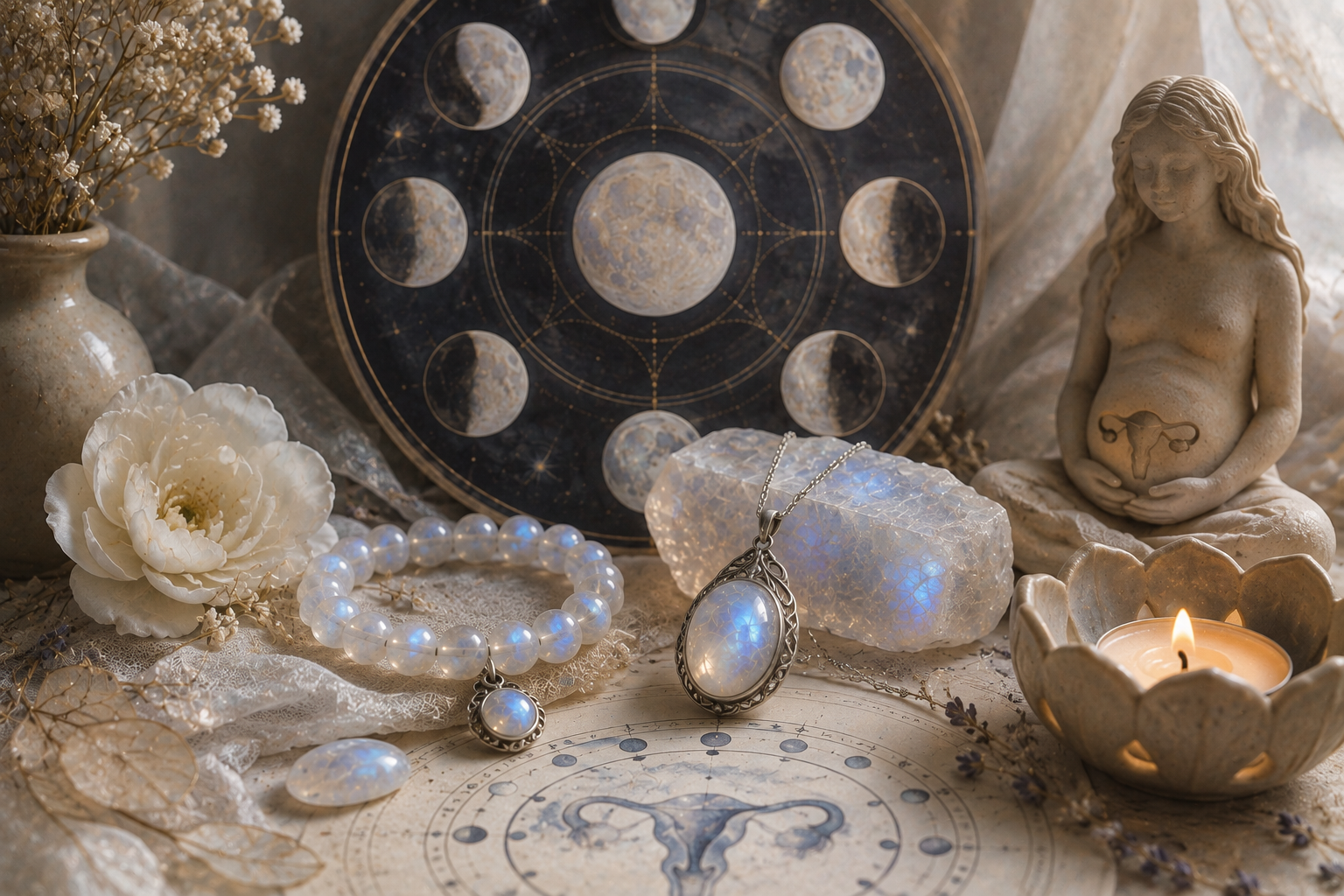
Moonstone, Periods and the Menstrual Cycle
It is the most firmly established association in all of crystal lore, and it rests on three things: a coincidence of durations, an etymology, and books from the 1980s. Here is where it really comes from, what tradition ascribes to it, what no stone does, and when you should see a doctor rather than wear a piece of jewelry.
I sell jewelry, not care. This page exists because the search is a huge one and because what you find on it promises a great deal, often to women who are suffering. I would rather answer honestly, even if that disappoints.
The short version, if you are in a hurry
- No stone acts on a menstrual cycle. No effect of that kind has been demonstrated, for moonstone or for any other.
- The association comes from three things: a coincidence of durations, the etymology of the word "menstruation", and the name of the stone.
- It was written down late, in the literature of the 1980s and 1990s, not in an ancient tradition.
- The studies have found no robust synchronization between the lunar cycle and the menstrual cycle.
- Three words should be banned from a seller: regulate, relieve, cure. They are medical claims.
- Periods that stop you living are not normal. They call for a consultation, not a piece of jewelry.
- An object can accompany you, mark a moment, give pleasure. That is already something, and that is all.
The short answer
Since it is what you came for, I give it before anything else.
No, moonstone has no demonstrated effect on periods, on their regularity, on how heavy they are or on the pain. No study establishes one. No health authority recognizes crystal healing as a treatment.
This is neither a personal opinion nor a token of caution: it is the state of what is known, and it holds for every mineral, not only for the one I sell.
What I can offer you instead is to understand why this association exists, why it is so strong, and why it is so recent. That is more useful than a list of virtues, and it is the subject of this page.
Everything reported here about crystal healing belongs to traditions and beliefs. None of it is a medical claim, and none of it replaces the advice of a health professional. Periods that are painful, very heavy, absent or suddenly different justify a consultation, without waiting. Read the full disclaimer.
The coincidence of durations
Here is the first source, and it is the most striking one.
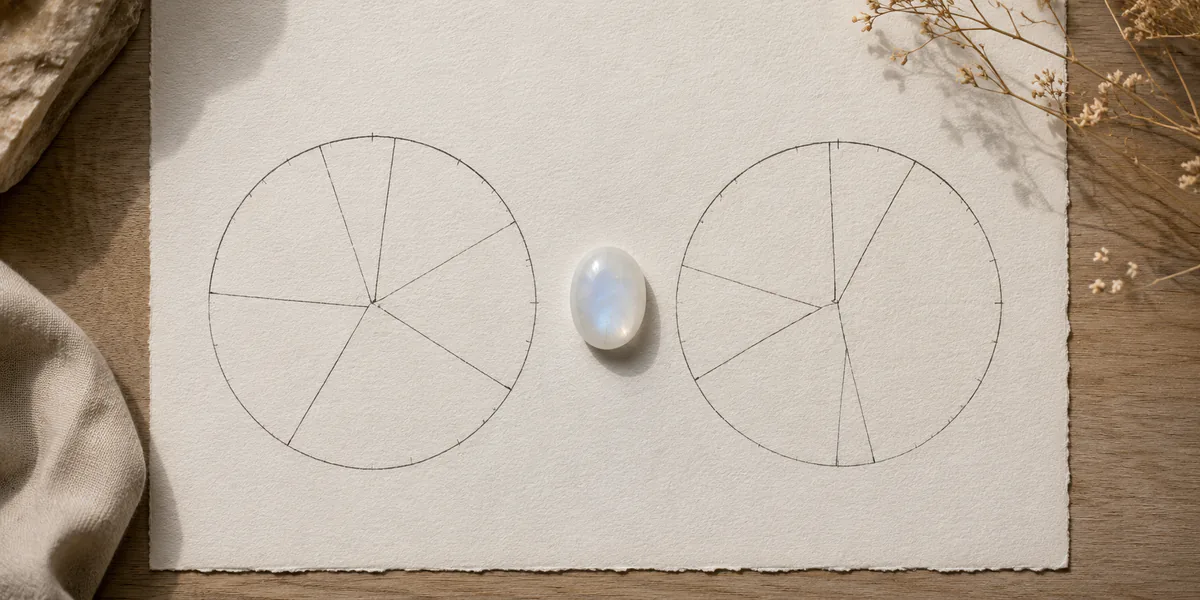
A complete lunar cycle lasts about 29 and a half days. A menstrual cycle lasts on average around 28 days. The two numbers are close enough for the comparison to have suggested itself to just about every culture that has watched the sky.
Two clarifications that change what that coincidence is worth.
The average hides a great deal of variation. A normal menstrual cycle commonly runs from 21 to 35 days, and it varies from one month to the next in the same person. The 28 day average is a textbook convenience, not a biological norm.
Closeness is not causation. Two durations that are near one another prove nothing about a link between them. Plenty of biological rhythms run to roughly a month with no connection to the Moon at all.
That said, the coincidence really has shaped human thinking on the subject, and it explains the strength of the association far more than any mineral property does.
What the words say
Second source, and this one is purely linguistic.
Menstruation comes from the Latin mensis, the month, itself related to a root found in the words for the Moon and for measurement. The word month and the word moon share that kinship across several language families.
In other words, the vocabulary itself links the cycle and the Moon, independently of any observation. When a language hands you the same words for two things, the connection looks obvious before you even ask whether it is true.
Add that the stone is called moonstone, and the chain closes on its own: the Moon is linked to the cycle by the words, the stone is linked to the Moon by its name, so the stone would be linked to the cycle. That is a transitivity of vocabulary, not a chain of causes.
The name of the stone, incidentally, is a good deal more recent than people think: it comes from its appearance, a milky halo suggesting moonlight, and not from any ritual use. The subject is covered in the gods and goddesses of the Moon.
What the studies looked for
The question has been taken seriously and studied, which is good news: we are not reduced to opinions.
Researchers have looked, repeatedly and over decades, for a synchronization between the phases of the Moon and menstrual cycles. The early work, on small numbers, gave contradictory results. The more recent analyses, drawing on very large sets of cycle tracking data, find no robust synchronization at the scale of populations.
What to take from that, put cautiously: no solid link is established between the phases of the Moon and the course of the menstrual cycle. And even if such a link did exist, it would still say nothing about the effect of a pebble worn on the wrist, which is an entirely different question.
It is that second point that everyone systematically forgets. Even granting the astronomical premise, nothing would follow from it for a piece of jewelry.
When the association was written down
Third source, and this is the dating that every page on the subject is missing.
The explicit association between this stone and the female cycle is not found in an ancient tradition handed down. It settles in the literature of the late twentieth century crystal movement, notably in Katrina Raphaell in 1985 and in Melody in 1995, two works widely copied since.
What is old is the link between the Moon and the cycle, present in the words and in observation. What is recent is the transfer of that link onto one particular mineral, with detailed attributions.
Forty years is not nothing, and a forty year old convention is still a convention. But it is not "since the dawn of time", and that is the phrase this site refuses. The same work is done in the myths and legends of moonstone.
What tradition ascribes to it
I report, in the conditional, and without subscribing to it.
In the crystal healing sources, moonstone is said to be linked to the cycle in three ways. It would accompany the mood changes of the premenstrual period. It would soothe a diffuse tension. And, in the boldest formulations, it would regularize an irregular cycle.
The same sources generally advise wearing it in contact with the skin, as a bracelet or a pendant, and sometimes pairing it with other stones described as feminine.
Two remarks. The first is that these attributions vary from one author to another, including on central points, which is the usual sign of a recent body of writing. The second is that the third formulation, the one about regulating, is no longer a harmless belief: it is a statement of a medical kind, and I am coming to that.
The three words I refuse to use
Here, I think, is the most useful part of this page, and it will serve you elsewhere than with me.
Regulate. To say that a stone regulates a cycle is to ascribe a physiological action to it. An irregular cycle can have many causes, some of which call for a diagnosis. A promise of regulation turns you away from an examination.
Relieve. Pain is a symptom, and a symptom gets treated. To say that a mineral relieves it is to set it in competition with proper care, often with people who have been suffering for a long time.
Cure. That one is the rarest, because it is the most visibly forbidden, but it still turns up in disguised forms: "helps with", "supports the treatment of", "rebalances".
My rule is simple: if a wording implies an effect on the body, it does not appear on this site, neither on a listing nor in an article. A seller who uses those words tells you a great deal, not about the stone, but about themselves.
What an object can honestly do
It would be easy to stop at the refusal. That would be incomplete, and a little cowardly.
A piece of jewelry does nothing to a cycle. It can, on the other hand, do three real things, and none of them requires believing in anything.
Mark a moment. Plenty of people use objects to signal something to themselves: a beginning, an end, a decision. That is not magic, it is an ordinary use of objects, and it asks no particular property of the material.
Recall an intention. A bracelet is the only piece of jewelry you see on yourself all day long. Whatever you have attached to it comes back into your field of vision a hundred times a day.
Give pleasure. That is not nothing and it does not need dressing up.
I stop there deliberately. Going further would be to start promising again with more careful words, and that is exactly what I hold against the others.
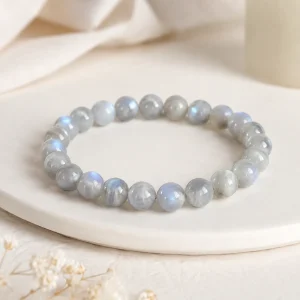
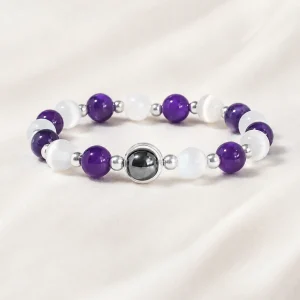
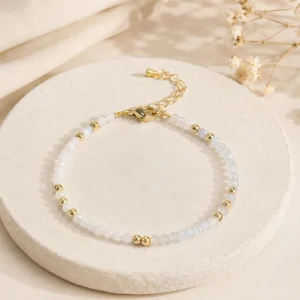
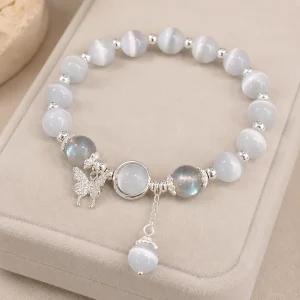
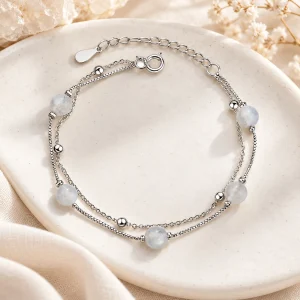
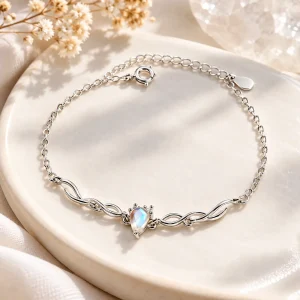
The workshop bracelets, chosen for the stone and nothing else
When to see someone, and not wait
This section is the reason this page exists, and I would rather it were read before the rest if you were only going to read one.
See a health professional if your periods are painful enough to stop you working, studying or sleeping, if they are very heavy, if they disappear for no known reason, or if they change markedly from what you were used to.
One thing deserves to be said plainly, because it concerns a great many people: period pain that puts you out of action is not normal, and it is not a fate to be endured. Conditions such as endometriosis are still diagnosed several years late on average, in part because menstrual pain has long been treated as ordinary.
It is precisely for that reason that a discourse offering a stone rather than an examination makes me uncomfortable. The risk is not the pebble, it is the time lost.
Wear the piece if you want to. Make an appointment if something is wrong. The two are not in competition, and that is all I am asking.
If you wear a moonstone anyway
You have every right to, and nothing stands in the way. Here, then, are the only pieces of advice I can honestly give, and they are about the object.
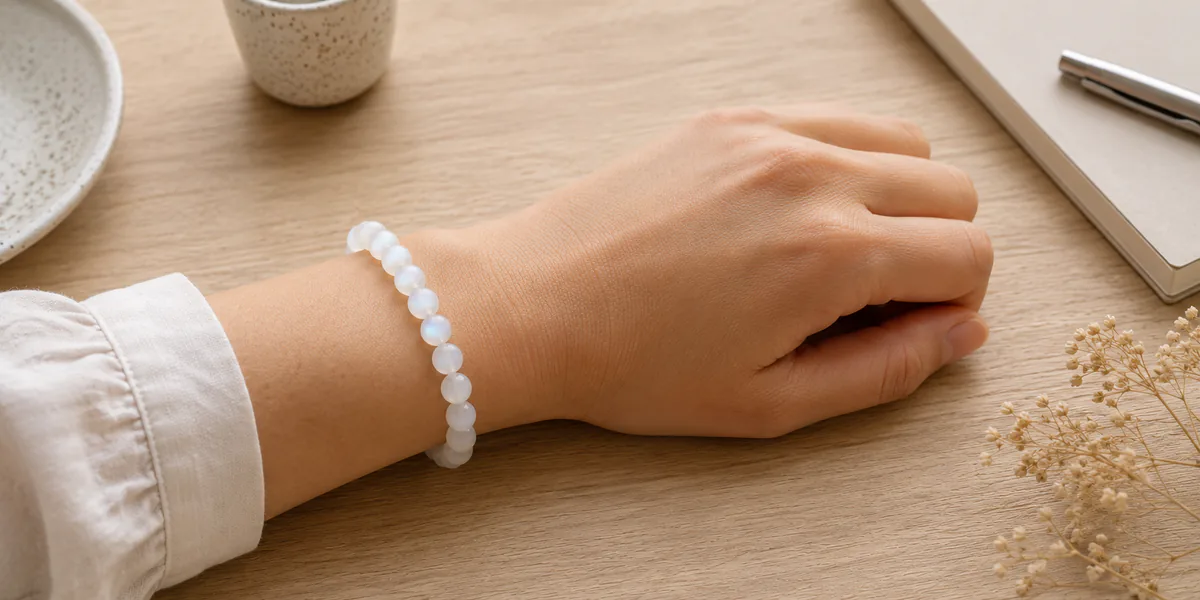
Choose the form that is simplest to live with. A bead bracelet or a pendant are worn without thinking about them. A ring has to be taken off several times a day. The full ranking is in how to wear moonstone.
Watch the pairings. Many bracelets sold for the cycle mix moonstone with rose quartz, amethyst or carnelian, all harder than it: they scratch it. See which stones not to pair it with.
Swallow nothing. No elixir, no water that has been sitting with stones in it. It is the one firm instruction on this site, and it is set out in the contraindications of moonstone.
And do not pay extra for a promise. A stone sold at a higher price because it is supposedly "specific to the cycle" is the same stone as the others.
The workshop bracelets, with no promise on the listing
The other sensitive pages on this site
This subject touches on two others, and I have chosen to keep them clearly separate rather than mixing everything on one page.
Fertility is far more delicate ground, because it concerns people who are trying to conceive and because promises there are particularly hurtful. Covered, in the conditional and without any promise, in moonstone and fertility.
Pregnancy raises another question, that of the gift and of wearing, and it is covered in which stone for a pregnant woman.
In both cases the position is the same as here: report what tradition says, date it, promise nothing, and refer to a health professional for anything to do with the body.
Frequently asked questions
Does moonstone have an effect on periods?
No. No effect on regularity, on how heavy they are or on the pain has been demonstrated, neither for this stone nor for any other. No health authority recognizes crystal healing as a treatment. Periods that stop you living call for a consultation.
Why is it so strongly associated with the female cycle, then?
For three reasons taken together: a lunar cycle of 29 and a half days close to an average menstrual cycle of 28 days, an etymology that links "menstruation" to the month and to the Moon, and the name of the stone. The chain is made of words, not of causes.
Do cycles synchronize with the Moon?
The research gave contradictory results on small numbers, and the recent analyses drawing on large sets of tracking data find no robust synchronization. And even if a link existed, it would say nothing about the effect of a piece of jewelry.
How long has this stone been said to accompany the cycle?
The explicit association between this particular stone and the cycle settles in the literature of the 1980s and 1990s, notably in Katrina Raphaell in 1985 and in Melody in 1995. The link between the Moon and the cycle is far older, but it did not involve a mineral.
What words should put me on alert with a seller?
Regulate, relieve, cure, and their disguised forms such as "helps with" or "rebalances". Any wording that implies an action on the body is a medical claim. It tells you about the seller, not about the stone.
Can I wear it during my period?
Of course, like any other day. It is an inert object worn against the skin, there is no reason to avoid it, and no reason to expect anything particular from it on that day rather than another.
Should certain stone pairings be avoided?
For mechanical reasons, yes. Many bracelets sold for the cycle mix moonstone with rose quartz, amethyst or carnelian, all at 6.5 or above on the Mohs scale: they scratch the cabochon. Put soft metal in between, or keep them on separate wrists.
When should I see someone?
If your periods stop you working, studying or sleeping, if they are very heavy, if they disappear for no known reason, or if they change markedly. Pain that puts you out of action is not normal, and endometriosis is still diagnosed several years late on average.
Where to go next
This page deals with a sensitive subject. The neighboring pages:
- The other delicate subjects: moonstone and fertility, which stone for a pregnant woman, the contraindications.
- What tradition says, and since when: virtues and benefits, the meaning, the myths and legends, the gods and goddesses of the Moon.
- Wearing it without damaging it: how to wear it, which stones not to pair it with, which wrist.
- The whole picture: the complete guide.
What I make is in the shop, without a single promise on the listings. If this page struck you as dry, that is deliberate: write to me, I would rather have a conversation than a formula.
My sources
The durations given, about 29 and a half days for the lunation and a common range of 21 to 35 days for the menstrual cycle, are widely established reference figures. The absence of robust synchronization between lunar phases and menstrual cycles is the result of the analyses drawing on large sets of cycle tracking data; the older work, on small numbers, was contradictory. I report that state of knowledge without claiming to settle it myself.
The etymology of "menstruation" from mensis, and the kinship between the words for month, measurement and the Moon, belong to ordinary historical linguistics.
The dating of the association between the stone and the cycle rests on two works that carry a name and a year: Crystal Enlightenment by Katrina Raphaell, 1985, and Love Is in the Earth by Melody, 1995.
The average delay in diagnosing endometriosis is regularly reported by learned societies and by patient associations. I mention it because it is a reason to see someone rather than wait, and not as an element of diagnosis.
I am neither a doctor nor a therapist. This page replaces no medical advice, and it is written to say exactly that.
Last updated: 19 August 2026. If you find an error in this article, let me know: I correct it and I note it.
✦ À porter, à offrir
Découvrez mes créations