

Description
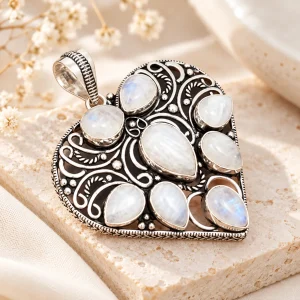
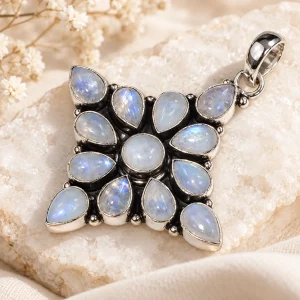
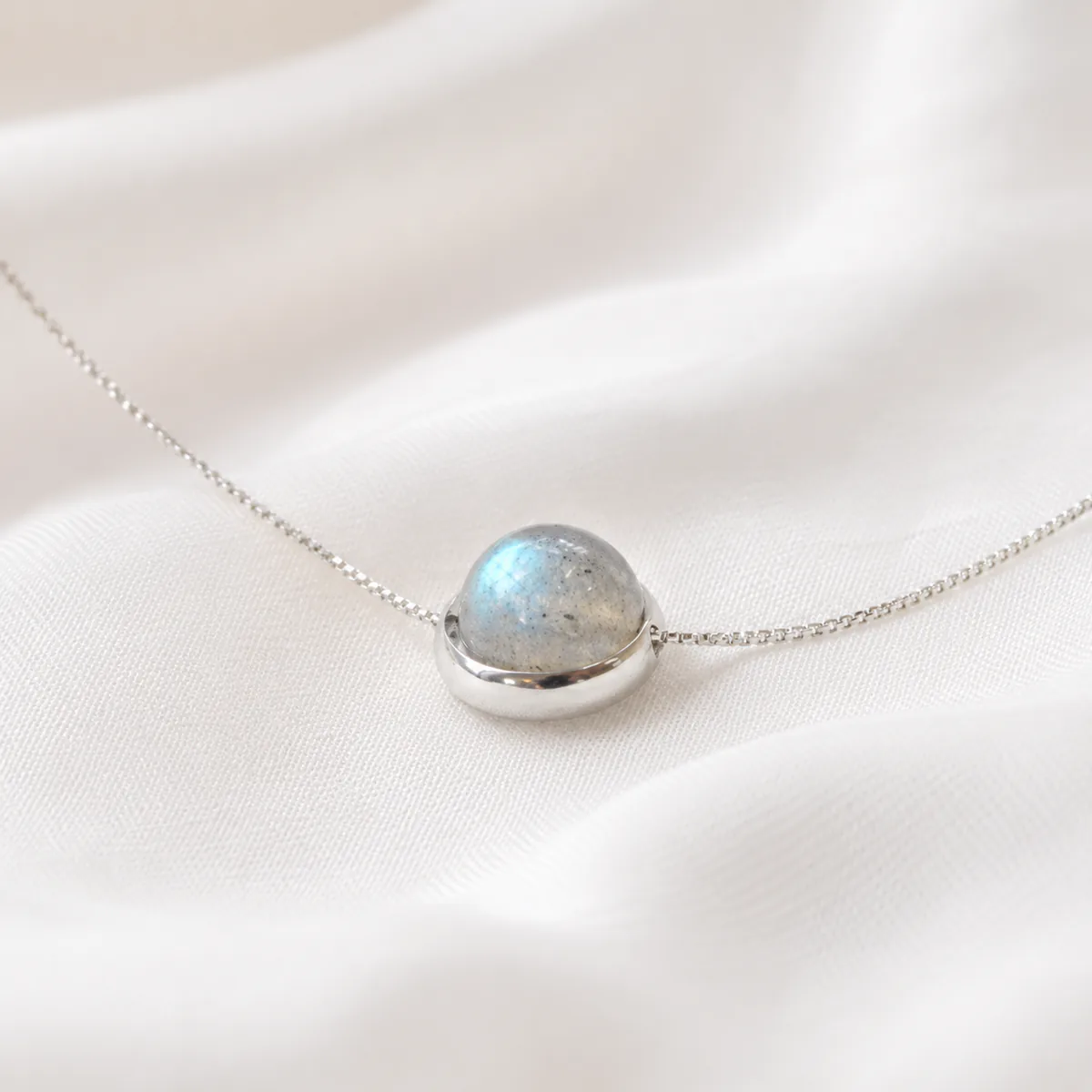
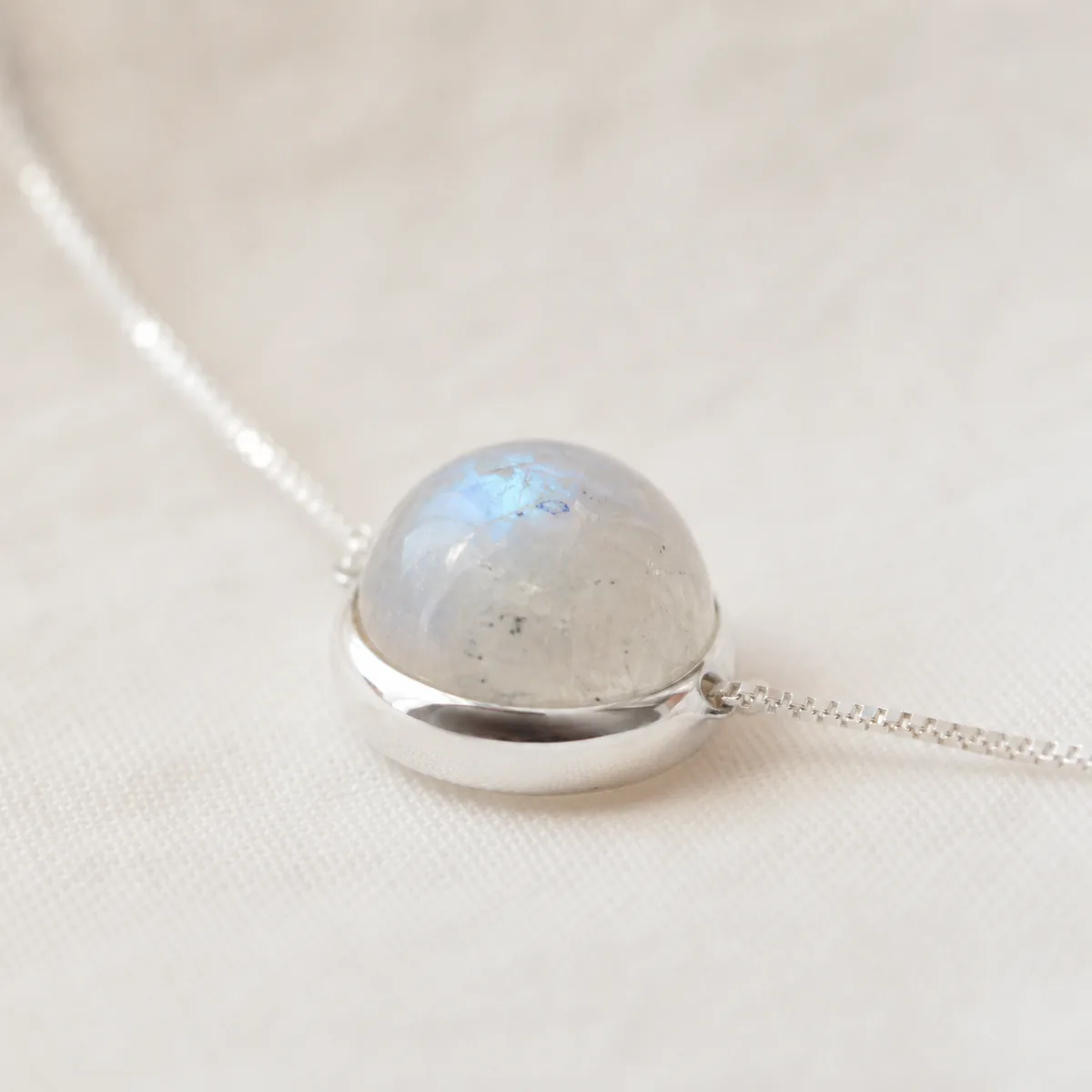
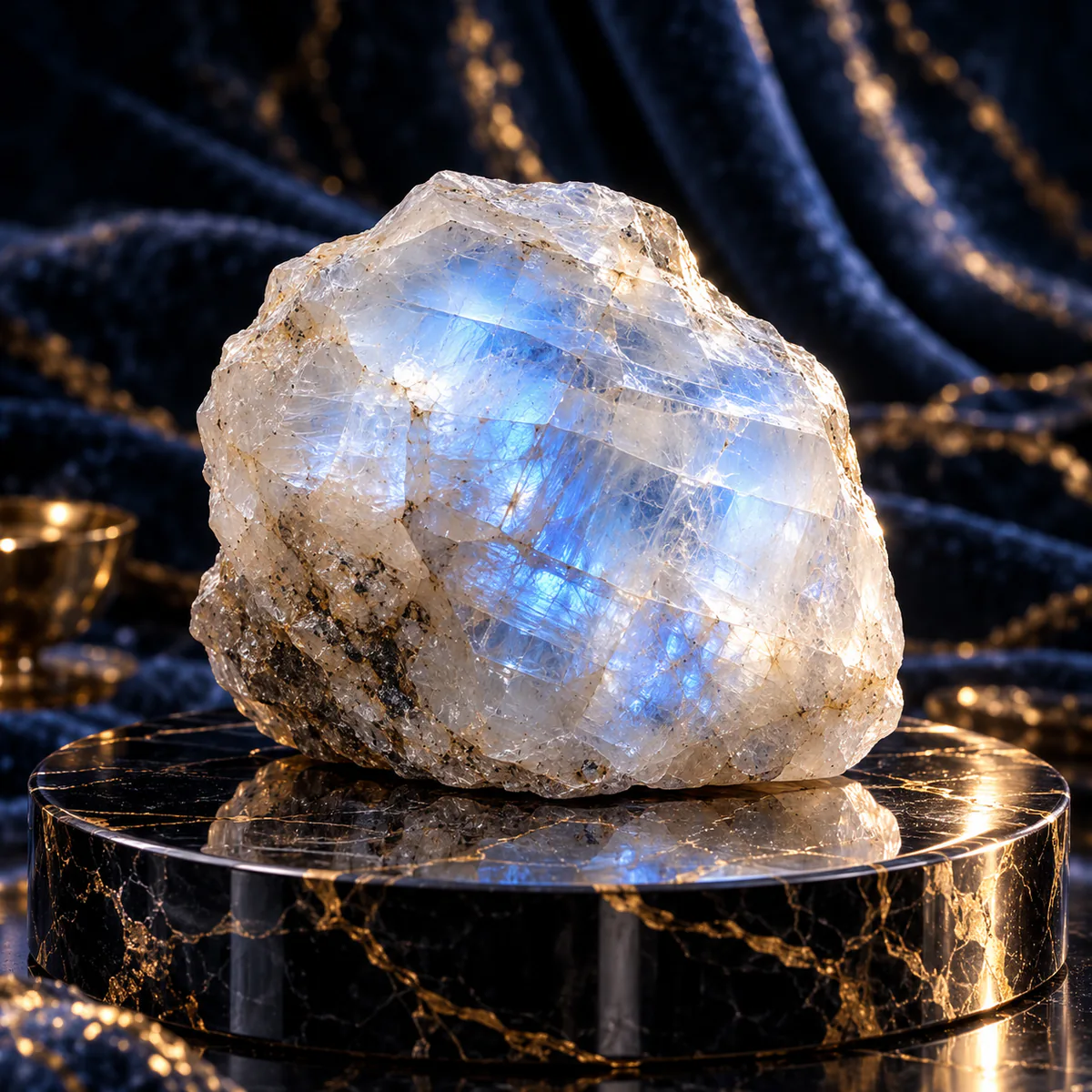
A round cabochon set in a solid silver bezel, no bail, no loop: the chain runs straight through the setting and the pendant slides on it. The stone is grey, speckled with dark points, and its dome lights up a clear blue the moment light falls right.
A pendant that runs through its own chain
Look at the construction: there is no bail, no suspension loop. The chain enters one side of the setting, runs through it, and exits the other, so the pendant is threaded onto it rather than hung beneath it. This is called a slide bail, and it solves two problems every other pendant in the catalog runs into.
The first is re-centering. A classic pendant slides along its chain as you move and regularly ends up off to one side, forcing you to reposition it. This one is pierced through its center, weighted where it is threaded, so it naturally finds the lowest point, which is the center. You will never have to adjust it.
The second is rotation. A pendant hung from a loop spins freely and regularly presents itself three-quarters turned or facing away. Here, the chain holds it at two opposite points and forces an axis on it: it always faces forward. That is a detail invisible in a photo and very noticeable in daily wear, especially on a stone where only one side matters. The shop’s other pendants are here.
What the chain goes through, and that nobody looks at
Here is this model’s particularity, and I have not read it written anywhere. A slide bail works on a simple principle: the chain runs through a metal tunnel. And it genuinely runs through it, with every movement, back and forth. Over years, that friction eventually thins the chain right at the passage point, and that is where it will fail, not at the clasp.
Two practical consequences. First: the pendant needs to slide freely. If it moves easily, wear spreads over a long stretch of chain and becomes negligible; if it catches, wear concentrates on two centimeters. Run a finger over it now and then: it should move without effort. If it sticks, a link has usually twisted or a bit of cream has dried inside, and a simple cleaning fixes it.
Second: you will not be able to put this pendant on just any chain. It needs to fit through the tunnel, so a fine, flexible chain, with a clasp that can be undone. A chain too thick will not go through, one with large links will catch at every pass. If you ever replace this one, bring the pendant to the jeweler rather than buying blind. The size guide explains how to choose a length.
The setting itself is a genuine closed bezel: a metal edge folded over the stone, holding it mechanically. That is not a wording detail. On cheap pendants, the stone is most often set in a cup with a spot of glue, and the metal surrounds it rather than holding it; that glue lets go one day, usually after a run under hot water, and it never sits back cleanly. A folded edge, on the other hand, does not let go. Moonstone chips on impact without scratching easily, and this bezel covers the whole rim to protect against exactly that.
Why a grey stone shows blue better
People readily pair moonstone with whiteness, and a grey stone can pass for second-best. It is the opposite, and the explanation fits in one image: you cannot see stars in broad daylight. A sheen is only noticed by contrast with what surrounds it.
On a milky white body, a pale blue veil blends into the mass and you have to search for it. On a grey, dark body, that same blue cuts through and looks twice as vivid, exactly like a traffic light at night. That is why the most spectacular sheens are almost always found on the darkest stones, and why I choose a grey background when I want a blue that reads from ten feet away.
Also look at the fine dark points scattered through the material: these are inclusions, and they are a good sign rather than a flaw, since imitation glass never has any. To be clear about it, as on every other piece where it applies: this grey stone with blue sheen is a labradorite, a direct cousin of moonstone sold everywhere under the same family name. The difference is explained in detail here, the mechanism behind the sheen is there, and the quality criteria are detailed here.
- Slide bail, no bail loop: the chain runs through the setting, the pendant self-centers and never rotates.
- It needs to slide freely: that is what spreads chain wear instead of concentrating it.
- A genuine closed bezel, edge folded over the stone. No glue at all.
- Shipped in two weeks with a cotton pouch, a handwritten note and a care card.
The specifications
- Stone
- Round grey cabochon with blue sheen, a labradorite
- Look
- Grey ground speckled with inclusions, moving blue sheen
- Metal
- 925 sterling silver
- Setting
- Closed bezel, folded edge, no glue
- Construction
- Slide bail: the chain runs through the setting
- Gender
- Women and men
- Brand
- Melissa Moon
Why I left off the bail
A bail would have been simpler to make and easier to sell, since it lets you swap chains in three seconds. I gave it up for a reason that comes down to the stone itself: a labradorite has only one good face. Its sheen is directional, it exists on one side only, and the back of the cabochon is a plain grey stone with nothing to it. A bail pendant spins, so it shows its back a good part of the time.
The slide bail removes the problem by forcing an axis. It is a more demanding construction, slower to make, and it commits you to one type of chain, but it guarantees that the face I chose is the one you see. On a stone whose whole appeal rests on a sheen, that seemed worth the constraint to me. The rest of the shop is here.
A bail leaves the choice of which face shows up to chance. Here, it is decided once and for all.
No salt, no ultrasonic tank, no hot water: all three damage the stone for good. Lukewarm water, a drop of mild soap, a soft cloth, a complete drying. On this model, remember to slide the pendant back and forth while rinsing and dry the inside of the passage thoroughly, where soapy water settles and eventually hinders the slide. A silver polishing cloth is for the metal only, it is mildly abrasive and has no business on a cabochon. Take the necklace off before the shower, the pool and sport, and hang it rather than leaving it in a pile. The detail is in cleaning a moonstone piece, and the safe methods in caring for it without harming it.