


Description
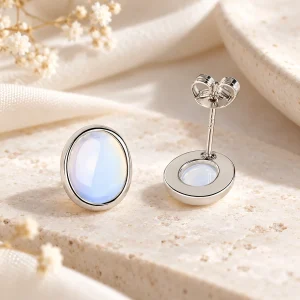
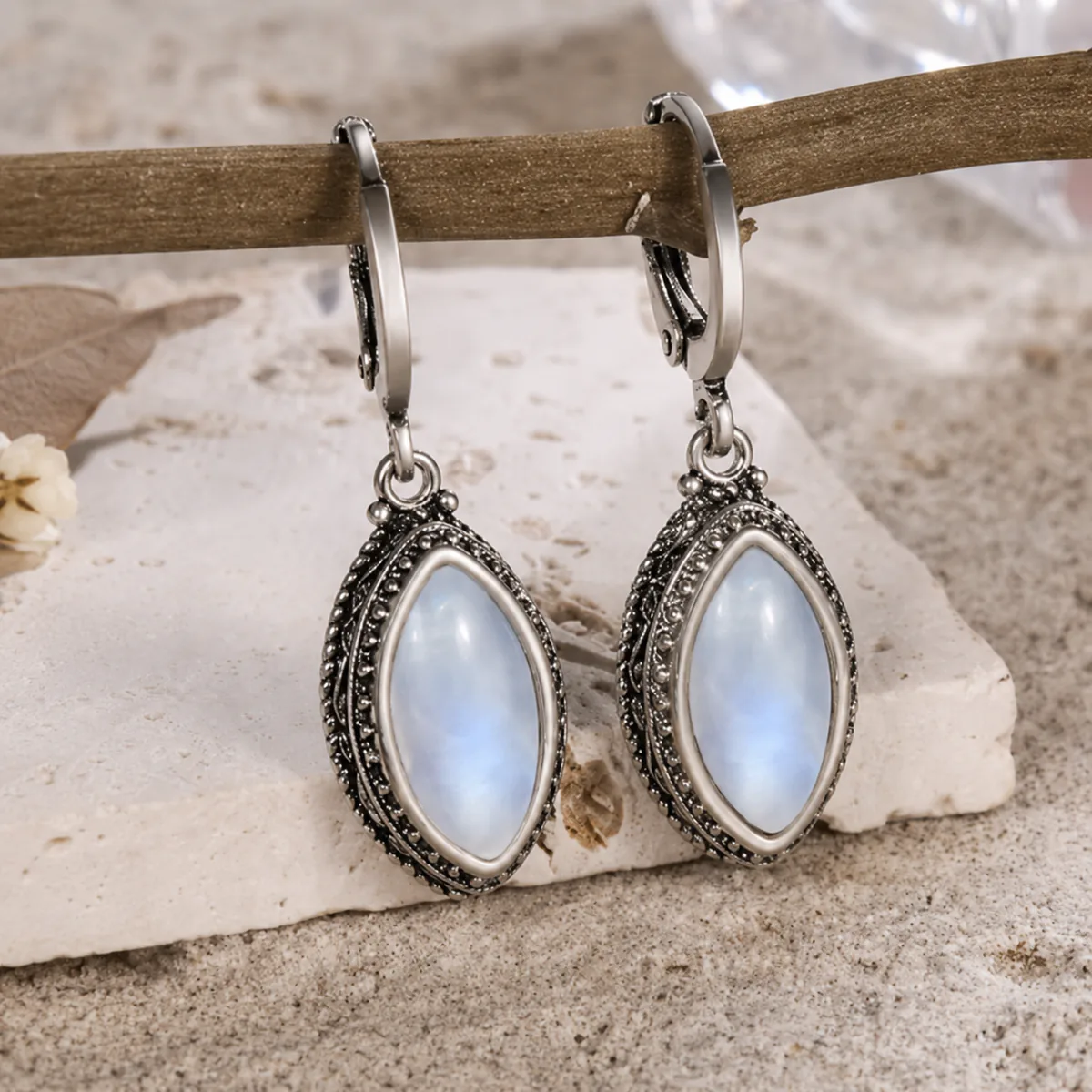
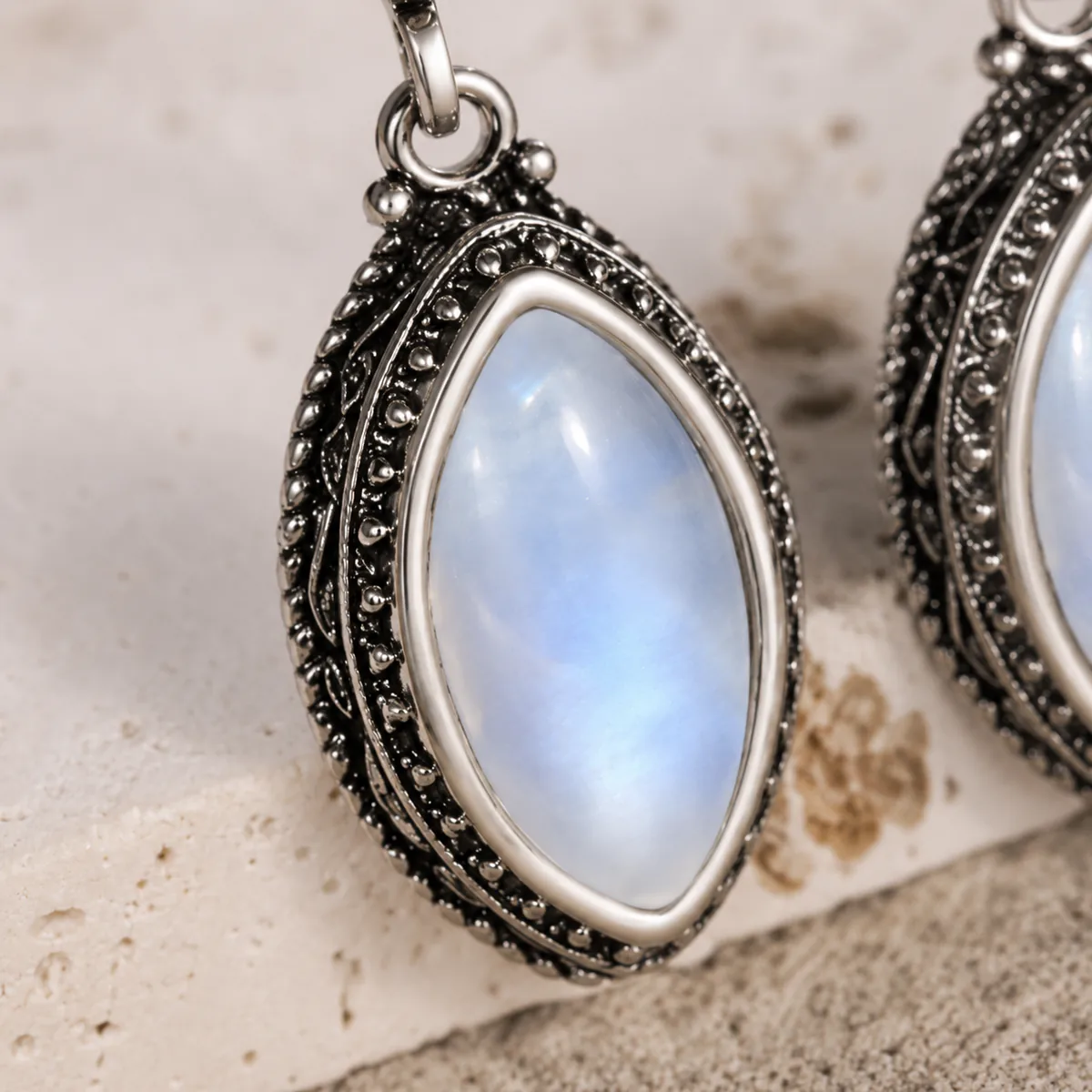
Two marquise-cut cabochons, white and crossed by a blue veil, each ringed by a beaded silver surround with blackened grooves, hanging from a hoop that closes with a small lever. These are the first earrings in the catalog, and the clasp matters here as much as the stone.
A lever back, and why that changes everything
Look at the closing mechanism: the hoop closes with a hinged tab that clips onto the back of the lobe. It is called a lever back, and it is by far the best of the common earring closures, for a reason that becomes obvious once you compare the three systems on the market.
The friction post, that small piece slid onto a straight pin, holds by friction alone: it loosens with wear, slips out in a scarf, and it is by far the leading cause of a lost earring. The fish hook does not close at all: it pops right back out the moment you pull a sweater over your head. The lever back locks: as long as the lever is clipped shut, nothing can come out.
There is only one thing to watch, and it is the piece’s single moving part: the lever should click firmly shut. Over the years the hinge and its spring fatigue, the click goes soft, then disappears, and the earring quietly becomes a fish hook without you noticing. Test it once a month, by ear: if the sound is gone, a jeweler can retension the mechanism in a few minutes. The shop’s other earrings are here.
Two stones that have to agree with each other
Here is the particularity of every piece of ear jewelry, and it completely changes how the stones are chosen. You need two, and they have to match: same size, same body, same density of veil, same orientation of the sheen. Finding one beautiful cabochon is already a matter of sorting; finding two that match is a different trade entirely, which is why a matched pair costs more than two isolated stones of the same quality.
What a matched pair does not promise, however, is something nobody ever says out loud. Your two earrings will almost never light up at the same time. A moonstone’s veil depends on the angle at which light reaches it, and your two ears do not face the same direction: when one catches the light, the other is at three-quarter angle. In a mirror, you will therefore often see one lively stone and one dull one.
This is neither a matching flaw nor a quality difference, it is geometry: turn your head, and the effect reverses. The only pairs that shine identically on both sides in every circumstance are the ones whose color does not shift at all, meaning the ones with no sheen whatsoever. The phenomenon is explained here, and the real quality criteria are detailed there.
What the lobe can carry
People readily think about the weight of a pendant, never about that of an earring, even though the lobe is a far thinner tissue than the back of the neck. A dangling pair worn daily for years eventually stretches the piercing, slowly and painlessly, until one day you notice the earring no longer sits the way it used to. It is a known, gradual, and entirely avoidable phenomenon.
Three habits are enough. Rotate with lighter models rather than wearing the same dangling pair every single day. Take them off at night, despite the closure’s name: a lever back lets you sleep with it, it does not require it, and an earring caught in a pillow pulls far harder than a whole day of wear. And favor exactly this kind of closure over hooks, since the hoop spreads the load over the back of the lobe instead of putting it all on a single wire.
These earrings stay a reasonable size and a moderate weight, but the principle is worth knowing before buying longer models. As for the stones, they are cut as marquises, a shape whose two points are the fragile part: I go into detail on what that silhouette means on the Moonstone Rainbow Pendant listing, and the stone chips on impact rather than scratching. The grooves of the pattern are deliberately blackened: I explain why you should never polish them out on the Men’s Moonstone Necklace listing.
- Marquise-cut cabochons bezel set, beaded surround with blackened grooves, lever-back closure.
- The lever should click: it is the piece’s only moving part, and its fatigue turns the earring into a hook.
- Your two stones will almost never light up together. It is geometry, not a flaw.
- Delivered in two weeks with a cotton pouch, a handwritten note and a care card.
The specifications
- Stones
- Two moonstone cabochons, marquise cut
- Look
- Translucent white, mobile blue veil
- Metal
- 925 sterling silver, blackened grooves
- Setting
- Bezel set, beaded surround
- Closure
- Lever-back
- Gender
- Women
- Brand
- Melissa Moon
What I look at to build a pair
Contrary to what people imagine, I am not looking for two stones of identical color. A difference in background tint goes unnoticed, because nobody ever sees your two ears side by side at the same instant, and the brain only compares the memory of one to the other. What does show, on the other hand, is geometry: two veils that do not sit at the same height on the dome, or where one sweeps lengthwise while the other sweeps crosswise.
So I sort by orientation before I sort by color. Two slightly different stones whose sheen sits in the same place make a convincing pair; two rigorously identical stones that are poorly oriented make two pieces of jewelry with nothing in common. It is a criterion no product listing ever mentions, and yet it is the entire difference between a successful pair and a mere assembly. The rest of the shop is here.
A pair is not two matching stones. It is two stones that light up in the same spot.
No salt, no ultrasonic tank, no hot water: moonstone is a feldspar, and all three damage it for good. The ultrasonic tank would also fatigue the lever-back hinge. On this model, one rule matters above all: nothing that polishes, no silver cloth, no paste, or you risk erasing the black that draws the beading. Lukewarm water, a drop of mild soap, a very soft brush, a rinse and a complete drying, drying the inside of the closure carefully, where moisture settles and eventually seizes the lever. Take them off before the shower, the pool, sport, and at night, and store them flat in their pouch rather than loose, since the marquise points are their most vulnerable part. The detail is in cleaning a moonstone piece, and the safe methods in caring for it without harming it.