


Description
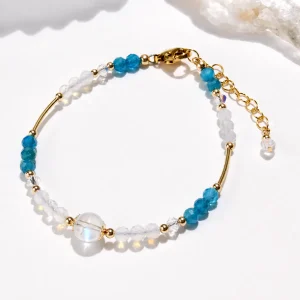
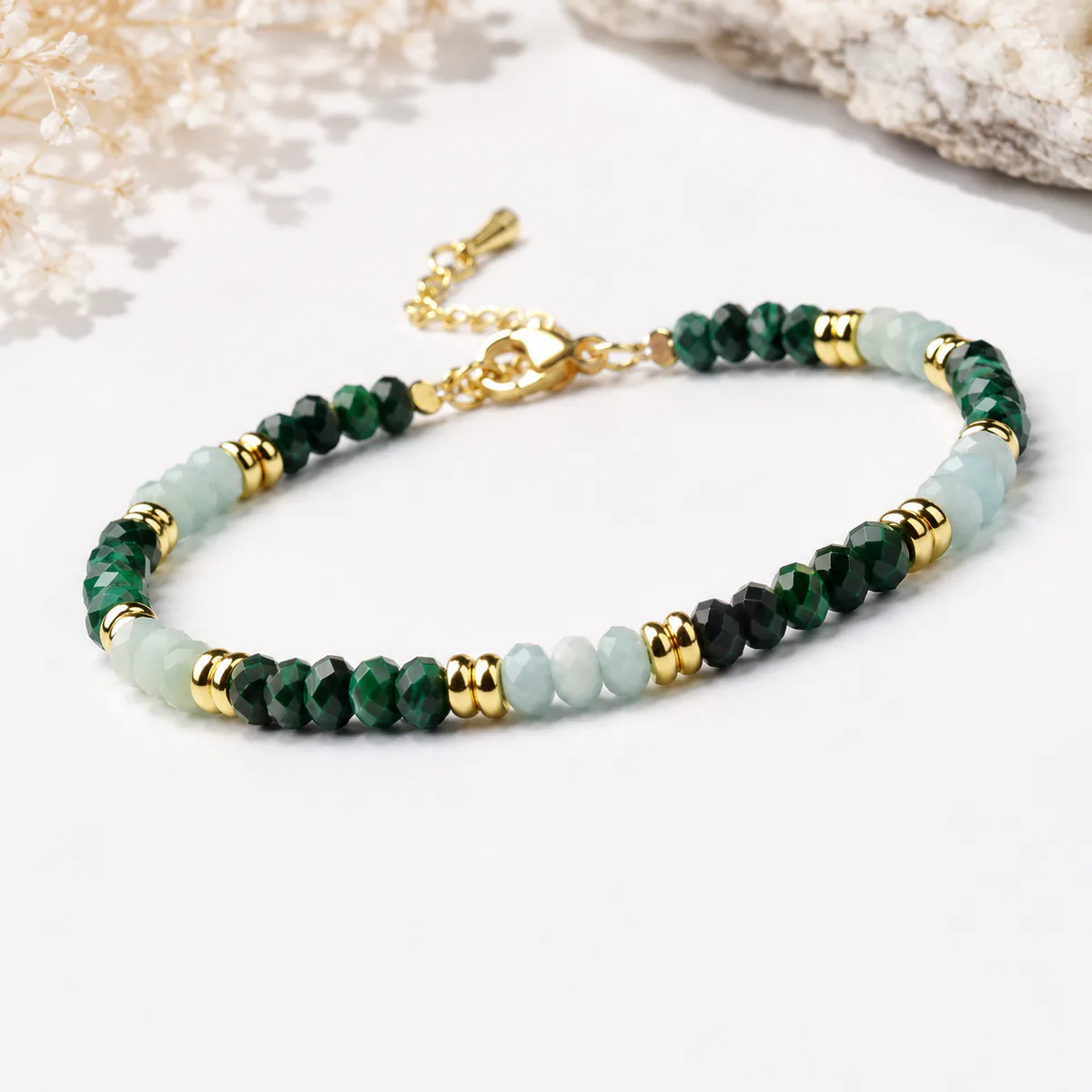
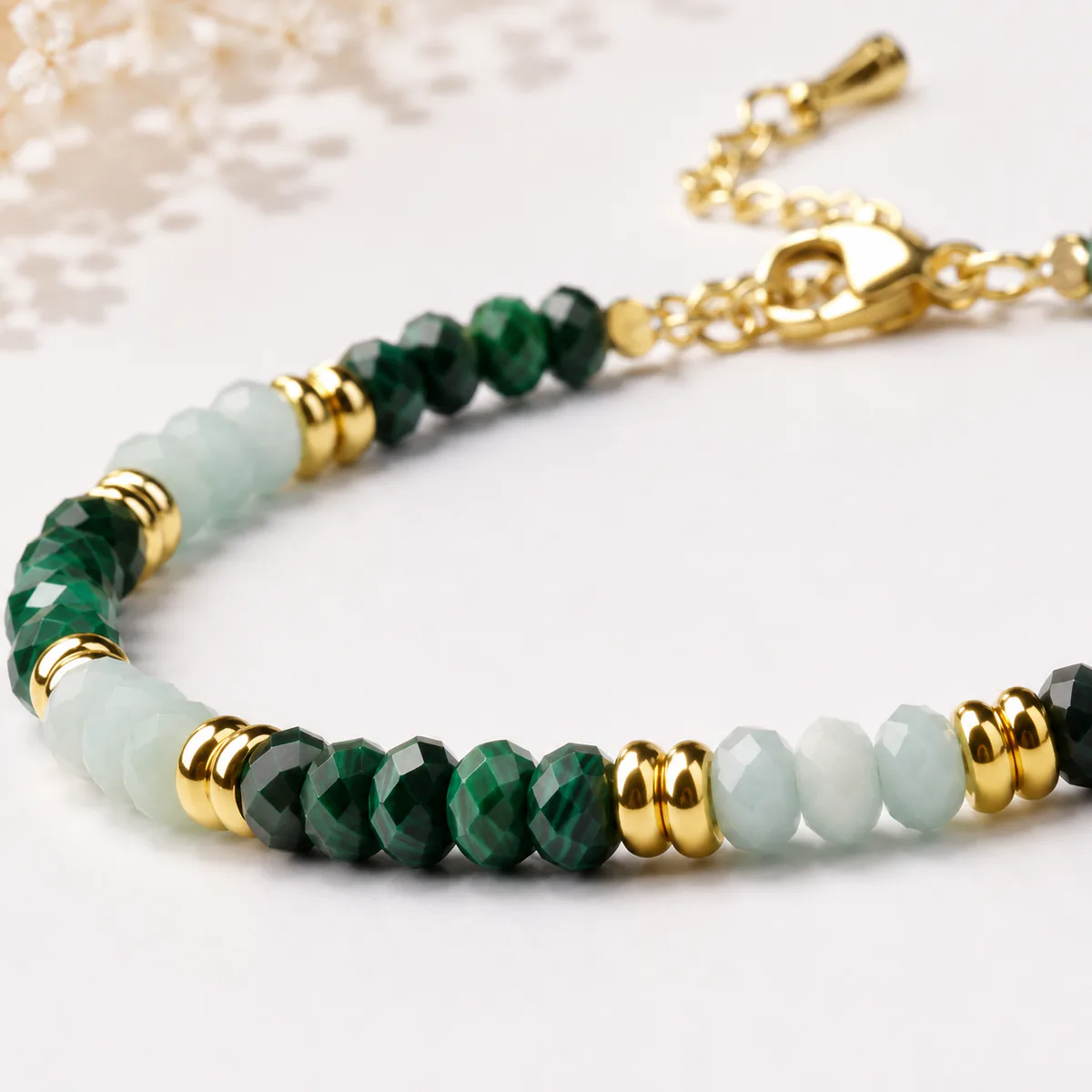
Faceted beads of deep green striped with lighter bands, alternating with almost translucent aqua beads, separated by thin gold-toned rondelles. This is the most contrasted bracelet in the catalog in terms of material, since it pairs the hardest stone in the shop with, by a wide margin, the softest.
Every bead is a slice through time
The green bands running through these beads are not decoration, they are growth layers. Malachite deposits slowly, layer after layer, in the cavities of copper deposits, somewhat the way a stalactite builds up drop by drop. Each band corresponds to a period when conditions shifted slightly, and the stack of those periods forms the material.
Which leads to a consequence obvious the moment you look closely at the bracelet: a bead’s pattern depends entirely on where it was cut from the mass. A bead cut across the layers shows parallel ribbons; a bead cut along the axis of a growth structure shows concentric circles, the “eyes” collectors look for. Two neighboring beads on your bracelet can therefore come from the same block and share no pattern at all.
The aqua beads that separate them play the opposite role: pale, plain, nearly translucent, letting a green that would otherwise be dense on its own breathe a little. It is a design meant to keep the malachite from overwhelming the wrist. The shop’s other bracelets are here.
What you should know about malachite’s toxicity
You may have read somewhere that this stone is toxic. That is both true and false, and since the question comes up constantly, it is worth addressing properly. Malachite is a copper carbonate. As dust, it is genuinely dangerous to breathe or ingest, which is why lapidaries cut it wet, under suction, wearing a mask.
A polished bead, however, is perfectly inert on the wrist. The copper is locked into a stable structure, it does not pass through skin, and contact carries no risk whatsoever. Wear this bracelet as much as you like, without a second thought.
Three simple rules keep you on the safe side. Never soak this stone in a drink, something certain practices call an elixir: putting a copper carbonate into water meant to be drunk is the one genuinely bad idea in the whole list. Do not sand, file, or drill a bead at home. And if a bead breaks, pick up the fragments without rubbing them, wipe with a damp cloth rather than sweeping, and wash your hands. That is all, and it is already more than most product listings bother to write.
Its real enemy is water
Here is this model’s particularity, and it dictates all of its care. Being a carbonate, malachite is attacked by acids: it is one of the few stones that a drop of vinegar makes fizz. Vinegar, household cleaners, jewelry cleaning solutions, but also acidic sweat, lemon juice, a spilled sip of soda: all of it slowly eats away the polish and leaves dull patches that do not come back.
Prolonged water and steam do the same job more slowly. So no showering with it, no pool, no sauna, and never an ultrasonic tank or a steam cleaner. It is also, ironically, the stone for which the most widespread purification methods are the most destructive: I explain elsewhere which ones are safe, and the question of water is covered in detail on the Moonstone in Water listing.
Add to that its softness: malachite sits around 3.5 to 4 on the hardness scale, against 6 to 6.5 for feldspars. It is the softest stone in the entire shop, and on this bracelet, it is the one that will take the marks. Wear it alone rather than stacked, and above all avoid the company of a quartz bracelet. I have gathered elsewhere the pairings that work and the ones to avoid.
The closure is a lobster clasp paired with an extension chain, which lengthens but never shortens: choose the closest fit, and the sizing guide is here.
- Deep green faceted beads with bands, alternating with aqua beads and gold-toned rondelles.
- Worn, it is risk-free. Malachite dust is a different matter, and this stone never goes in a drink.
- Acids, prolonged water, steam and ultrasonics: the four things to never expose it to.
- Lobster clasp and extension chain. Delivered in two weeks with a cotton pouch and a care card.
The specifications
- Stones
- Banded green malachite and aqua beads
- Cut
- Faceted rondelle beads
- Metal
- Gold-toned rondelles, clasp and chain
- Construction
- Lobster clasp with extension chain
- Hardness
- Malachite 3.5 to 4; moonstone 6 to 6.5
- Gender
- Women
- Brand
- Melissa Moon
Why malachite only exists as a bracelet here
You will not find a malachite ring in this shop, and it is not an oversight. A ring lives at the level of everything: door handles, keyboards, bags, sinks. A stone at 3.5 on the hardness scale, whose polish fades on contact with dish soap, would be dull within a season there. Selling a ring like that would amount to making a promise the material cannot keep.
On a round-bead bracelet, the equation changes: the beads roll against each other, they do not rub against the outside world, and the piece comes off in one motion before a shower or the dishes. It is the format that suits this stone, and I would rather have a catalog with acknowledged gaps than a complete one where three pieces disappoint. The rest of the shop is here.
A malachite ring is a beautiful photo and a promise the stone cannot keep. I chose not to make it.
This is the most demanding bracelet in the shop, and its rule fits in one sentence: nothing acidic, nothing hot, nothing prolonged in water. No salt, no ultrasonic tank, no steam, no jewelry cleaner, no hot water. A soft dry cloth is enough in most cases, and if the bracelet genuinely needs cleaning, a quick pass under lukewarm water, no scented soap, followed by immediate and complete drying. Take it off before the shower, the dishes, sport and the pool, without exception: on this stone, damage cannot be polished away. The detail is in cleaning a moonstone piece.