


Description
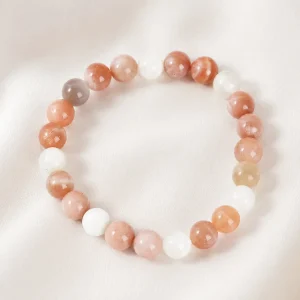
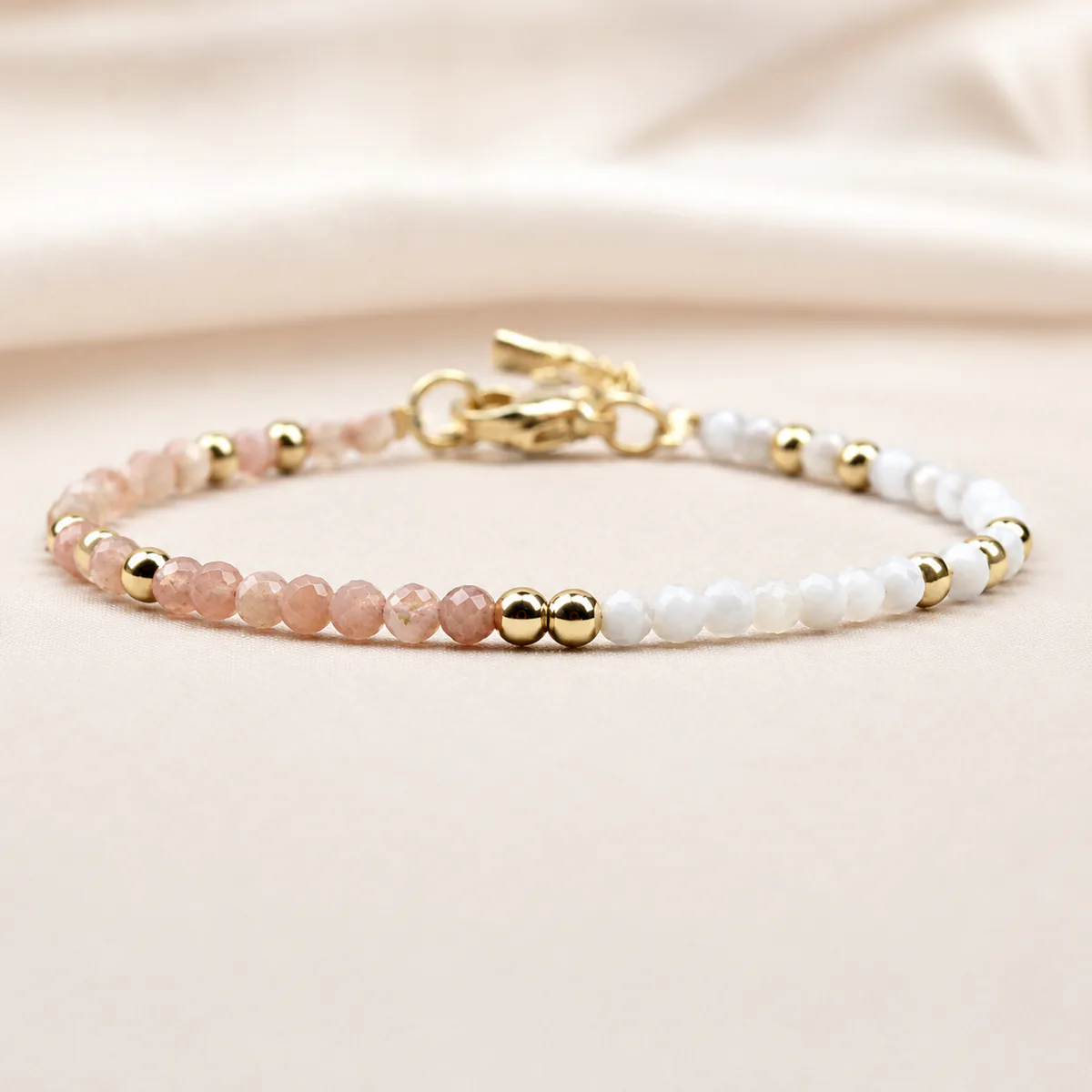
One half peach and glittering, one half white and milky, separated by gold beads. Small faceted beads, a real clasp with its adjustment chain. It is the finest bracelet in the shop, and the only one whose two stones are at once from the same family and exactly opposite.
Two feldspars, two opposite ways of returning light
Moonstone and sunstone both belong to the feldspars. They differ neither in hardness nor in general composition, but in the optical mechanism that makes them visible, and those two mechanisms are the inverse of one another.
On moonstone, light enters, scatters between stacked microscopic lamellae, and comes back out as a diffuse veil that seems to float above the surface: that is adularescence. Nothing shines, strictly speaking, a mist lights up. On sunstone, light bounces off tiny metallic platelets trapped in the crystal and comes back out as sharp coppery points: that is aventurescence. One dims in order to diffuse, the other reflects in order to sparkle.
In other words, the two names are not a merchant’s invention: they describe rather exactly what each stone does. A cool continuous glow on one side, a constellation of small warm flecks on the other. The shop’s other bracelets are here.
The beads are faceted, and that does not favor both stones
This is the main reservation about this model, and it follows directly from the above. A faceted cut serves aventurescence and disserves adularescence.
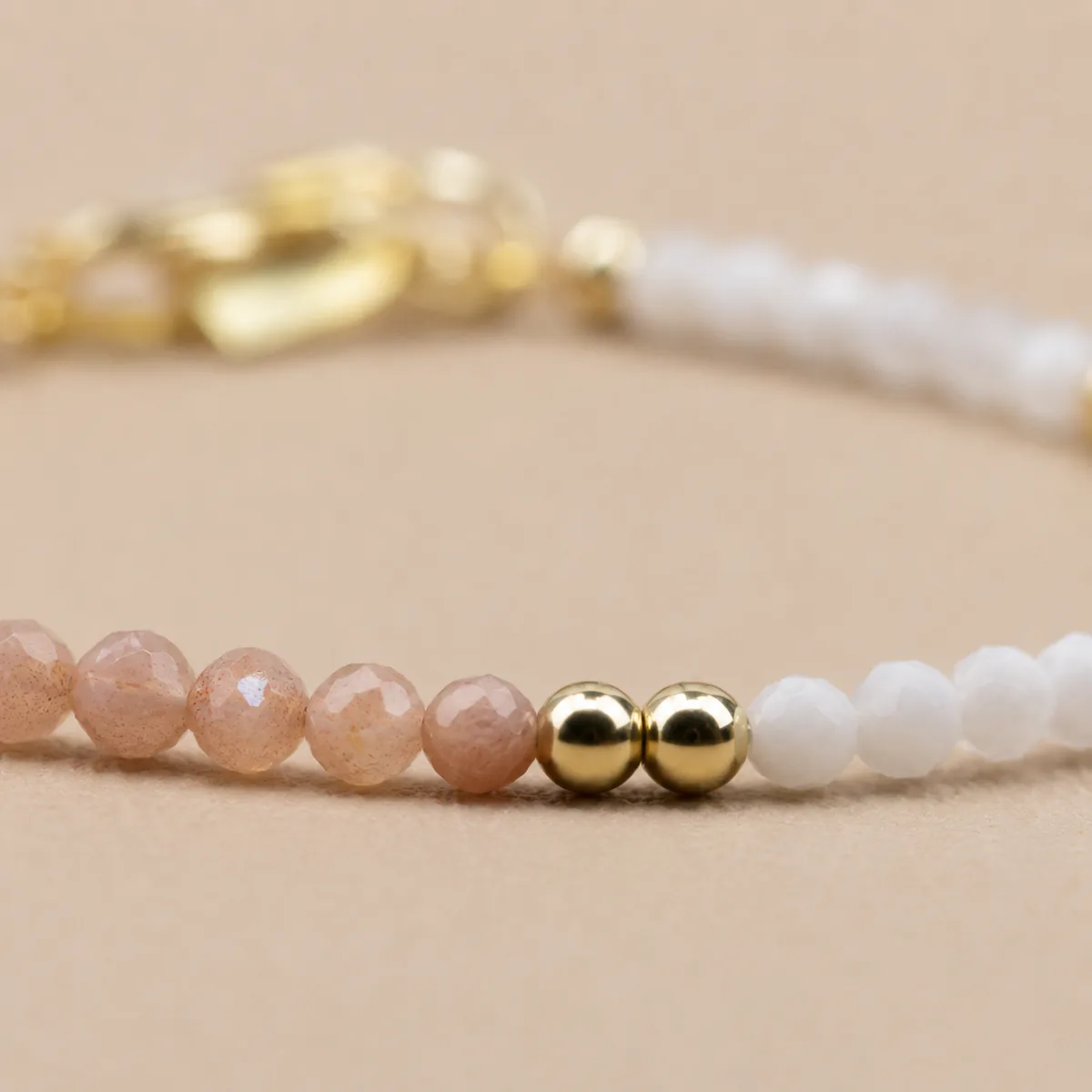
The platelets in sunstone reflect light whatever the angle: multiplying the facets multiplies the chances of seeing them light up, and the peach beads on this bracelet sparkle all the more for being cut. The veil of moonstone, by contrast, needs a continuous surface to spread across; on a small faceted bead it has room for nothing. So do not expect a floating blue sheen on the white beads of this bracelet: they play on transparency and cut brilliance, not on adularescence. If that veil is what you are after, you need a cabochon or polished round beads, and I would rather say so than let you find out.
A clasp, for the first time
Every other bead bracelet in the shop is strung on elastic cord. This one has a gold lobster clasp and an adjustment chain, and that changes three things.
First, there is no longer an elastic wear part: nothing to restring in two years. Second, the length adjusts over several centimeters thanks to the chain, which settles the question of size without having to measure to the millimeter. Third, a bracelet with a clasp cannot be put on one-handed, and that is the only complaint you can make about it: on a wrist, a lobster clasp of that size takes patience or a second person.
The clasp also becomes the point to watch. Check now and then that the spring comes back cleanly: on this kind of construction it is the clasp that gives way, never the cord.
As with the labradorite pairing, both stones are feldspars: same hardness, around 6 to 6.5, same behavior. Neither scratches the other, and the gold beads set between them are there for visual rhythm, not to separate them. They also share the same weakness: perfect cleavage, which means they chip on impact without scratching easily. On beads of this diameter the risk stays low. I have gathered elsewhere the pairings that work and the ones to avoid.
- Small faceted beads: glittering peach on one side, white on the other, gold beads between the two.
- Two feldspars, two opposite optical mechanisms: aventurescence against adularescence.
- Lobster clasp and adjustment chain: no elastic at all, adjustable length.
- Delivered in two weeks with a cotton pouch, a handwritten note and a care card.
The specifications
- Stones
- Moonstone and sunstone
- Mineral families
- Two feldspars, identical hardness
- Bead cut
- Faceted, small diameter
- Spacers
- Gold beads
- Construction
- Lobster clasp with adjustment chain
- Adjustment
- Length adjustable over several centimeters
- Gender
- Women
- Brand
- Melissa Moon
The only pairing I would defend to a mineralogist
The shop’s other combinations hold together through color and through the reputation of the stones. This one holds through something else: two members of the same mineral family that produce, from neighboring structures, two rigorously opposite light effects. It is not a symbolism pasted after the fact onto a pretty assembly, it is a real, observable opposition, and one that happens to coincide with the names they were given. That is rare, and it is why I keep it in the catalog even though its keyword carries little weight.
On this model in particular, I did not have to sort the sunstones for long: their glitter shows immediately and is judged in a second. It is the white beads that call for attention, because a small white faceted bead can be just about anything. The rest of the shop is here.
Two cousin stones that do the opposite of each other. There was no need to invent a story on top.
No salt, no ultrasonic tank, no hot water: both stones are feldspars and all three damage them the same way. The ultrasonic tank is all the more to be avoided here since the vibrations work on the facet edges, more fragile than a domed surface. Lukewarm water, a soft cloth, and careful drying, insisting around the clasp where soapy water settles. Check the clasp spring twice a year: on this construction it is the only part that can give way. The detail is in cleaning a moonstone piece, and the safe methods in caring for it without harming it.