


Description
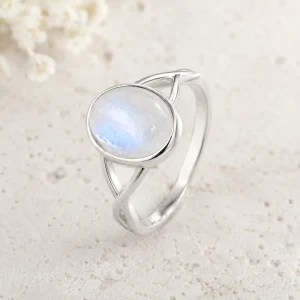
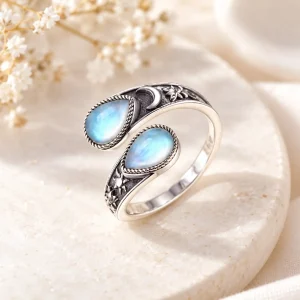
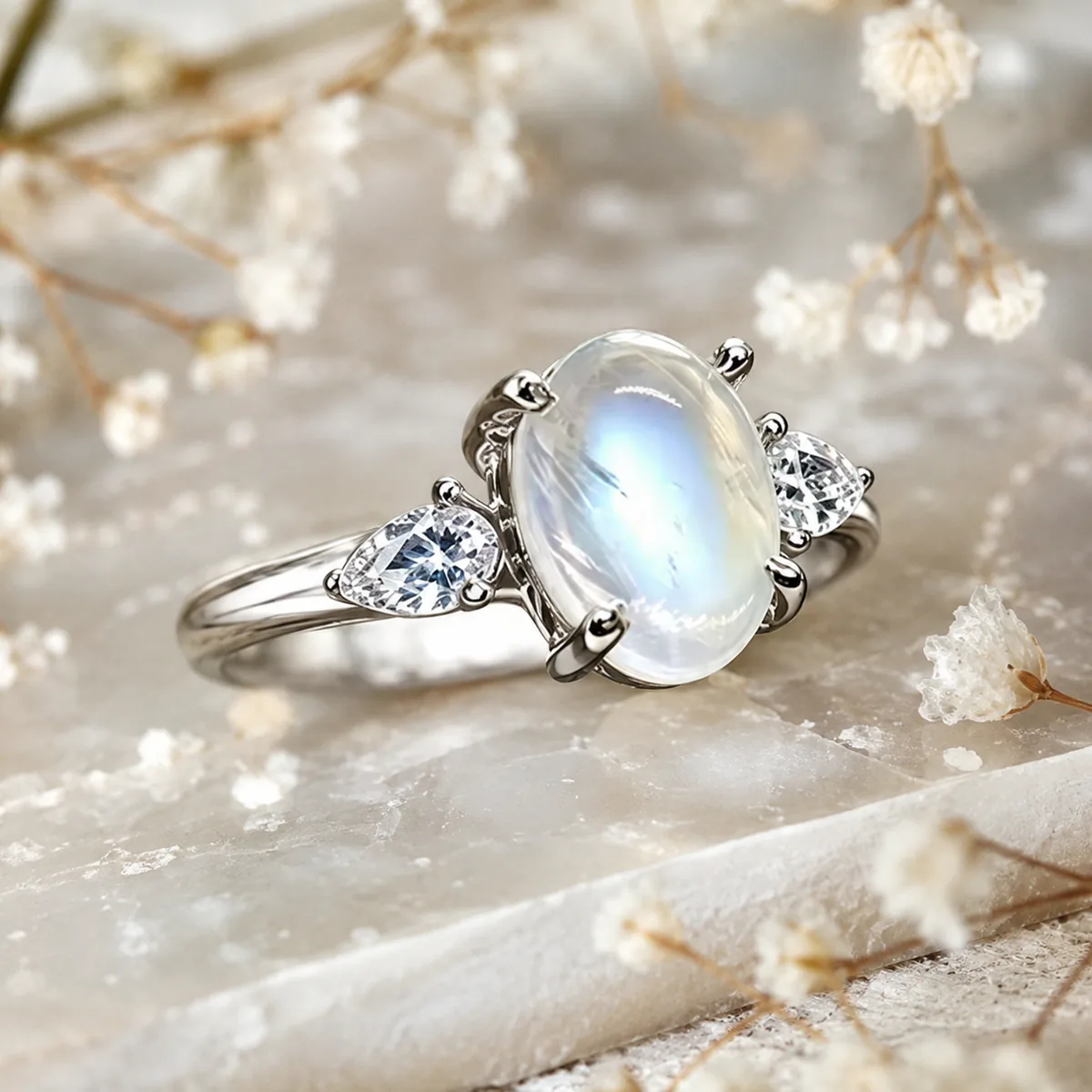
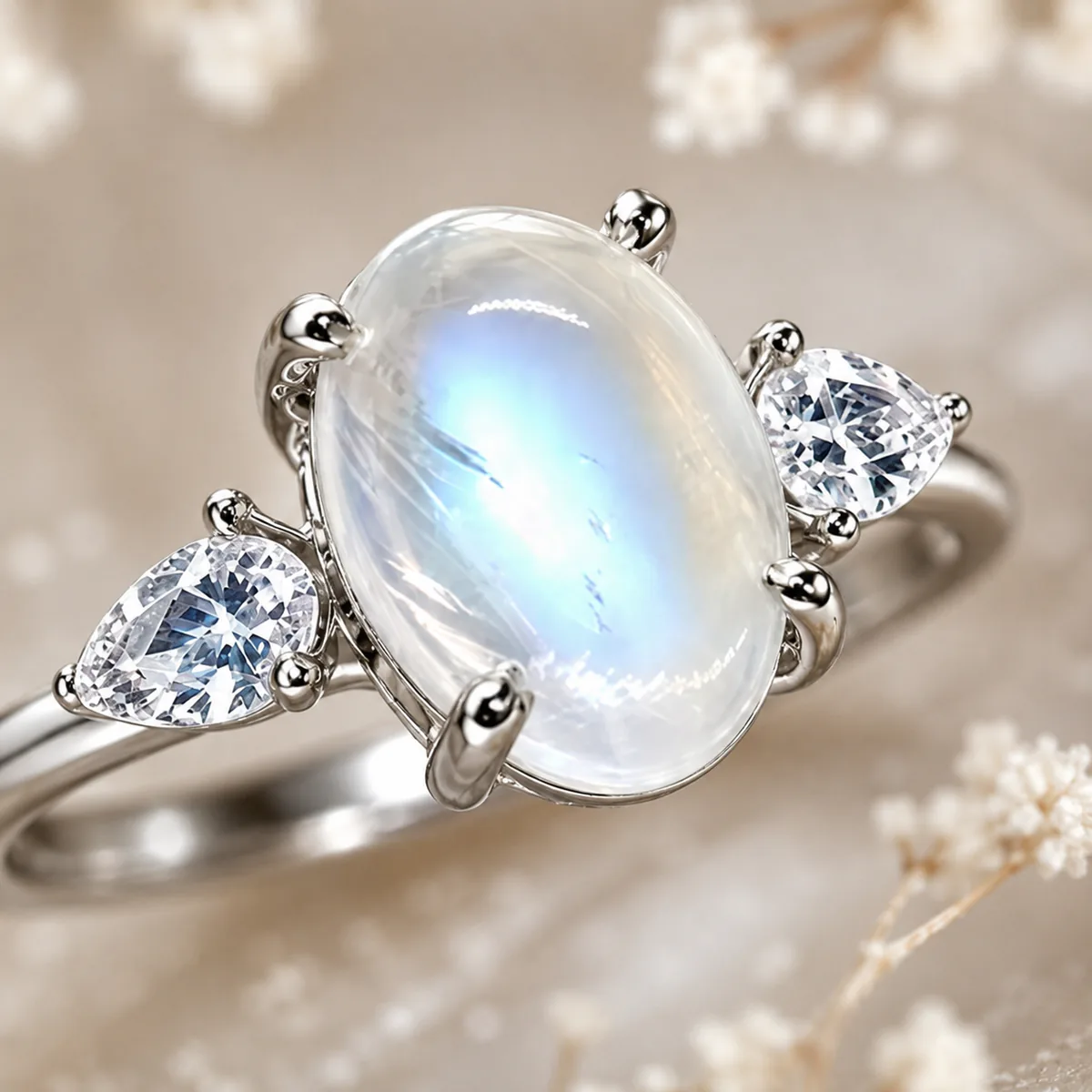
It is the only ring in the catalog whose stone is not the same species as the others, and I would rather say so straight away. A large oval cabochon crossed by a wide blue band, held by four prongs above an openwork gallery, between two clear drops. This is the one you choose for a reflection you can see from across a room.
The widest reflection in the catalog
Look at the dome: the light does not form a diffuse veil there but a clean blue band, which tips from one edge to the other as the hand turns. It is not quite the same phenomenon as on the shop’s other rings. On a classic moonstone we speak of adularescence, a milky halo that floats; here we speak of labradorescence, a reflection off far more contrasted internal planes. The result is sharper, bluer, and visible from a greater distance.
The setting is pronged, with an open gallery under the stone. It is the only setting of this type among my rings, and it has a reason: this cabochon is more translucent than the others, and the light coming from below lights up the body of the stone instead of leaving it gray. A bezel, closing the metal all around, would have dimmed it by half. On either side, two clear drops cut with facets serve as counterpoint: they shine with a fixed brilliance, where the central stone does not shine but lights up.
The clarification I keep repeating although it earns me nothing
Rainbow moonstone is not, mineralogically, a moonstone. Adularia, the stone in the other rings, is an orthoclase. Rainbow belongs to the plagioclases: it is a white labradorite. The trade has filed both under the same label for so long that the name has become the usage, and I sell it under that name because that is the one you search for. But I write it anyway, because a customer who learns it elsewhere will wonder what else I kept from her. I have set out what really separates the two stones, and gathered everything the shop offers in this variety.
The trade-off of a pronged setting
It is the least protective mount in the catalog. Four prongs hold the stone at four points and leave the whole edge exposed, whereas moonstone, rainbow included, has perfect cleavage: it chips on impact without scratching easily. On the shop’s other rings the metal runs all the way round and absorbs the knocks. Here it does not. This is not an everyday ring in the same way as the others, and if you want the same variety in a closed mount, the other rings are here.
Check the prongs once a year with a fingernail: they lift over time, and a stone that moves is a stone about to fall.
- Rainbow moonstone, that is to say a white labradorite. Wide, clean blue band.
- 925 sterling silver. Four-prong setting on an openwork gallery, two clear drops in accompaniment.
- Sizes 4 ½ to 10. Delivered in two weeks with a cotton pouch, a handwritten note and a care card.
- The most visible in the catalog, and the least protected. To be worn knowingly.
The specifications
- Stone
- Rainbow moonstone (white labradorite), oval cabochon cut
- Mineral species
- Plagioclase, and not orthoclase like adularia
- Accent stones
- Two clear faceted drops
- Metal
- 925 sterling silver
- Setting
- Four prongs on an openwork gallery, no glue
- Sizes
- 4 ½ to 10
- Gender
- Women
- Brand
- Melissa Moon
Why I sell a labradorite under the name moonstone
Because refusing the common name would serve nobody. If I titled this page “white labradorite ring”, nobody would find it: people search for a rainbow moonstone, suppliers sell it under that name, and jewelers have called it that for generations. Correcting the vocabulary of the whole world from an online shop would mostly be a way of selling nothing.
What seems right to me, on the other hand, is not to let anyone be misled. The commercial name stays, and the clarification is written in black and white three lines above. It is the same rule I apply to gold plating, which is not gold, and to the stones I removed from the catalog because they were not what I had been told. The rest of the shop is here.
A common name is not a lie. It becomes one if it is used to hide one.
No salt, no ultrasonic tank, no hot water: labradorite is a feldspar like adularia, and all three damage it the same way. Lukewarm water, a soft cloth. On this ring, add the habit specific to pronged settings: run a fingernail over the four points from time to time, and if one catches or if the stone moves, stop wearing the ring until it has been tightened. The detail is in cleaning a moonstone piece, and the safe methods in caring for it without harming it.