

Description
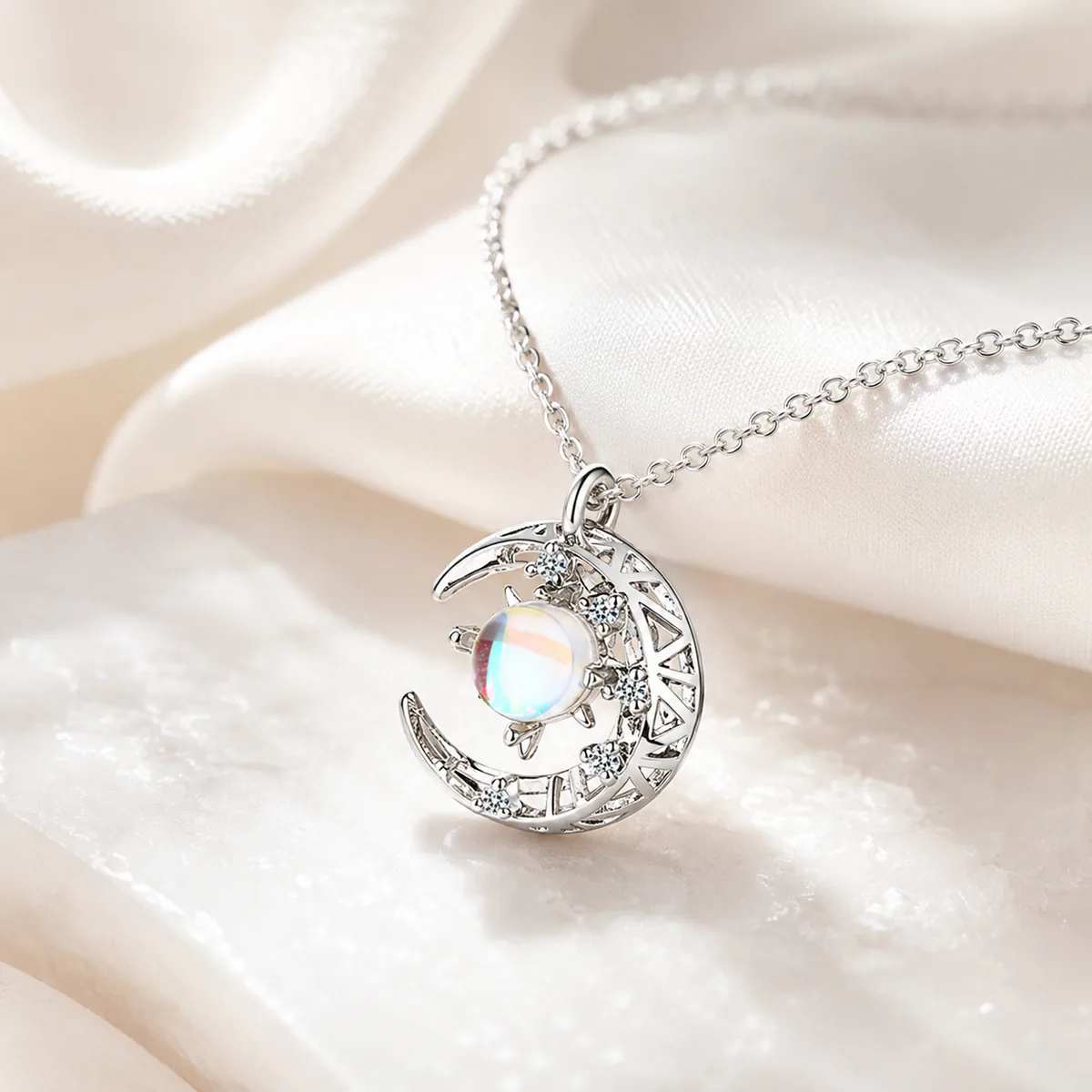
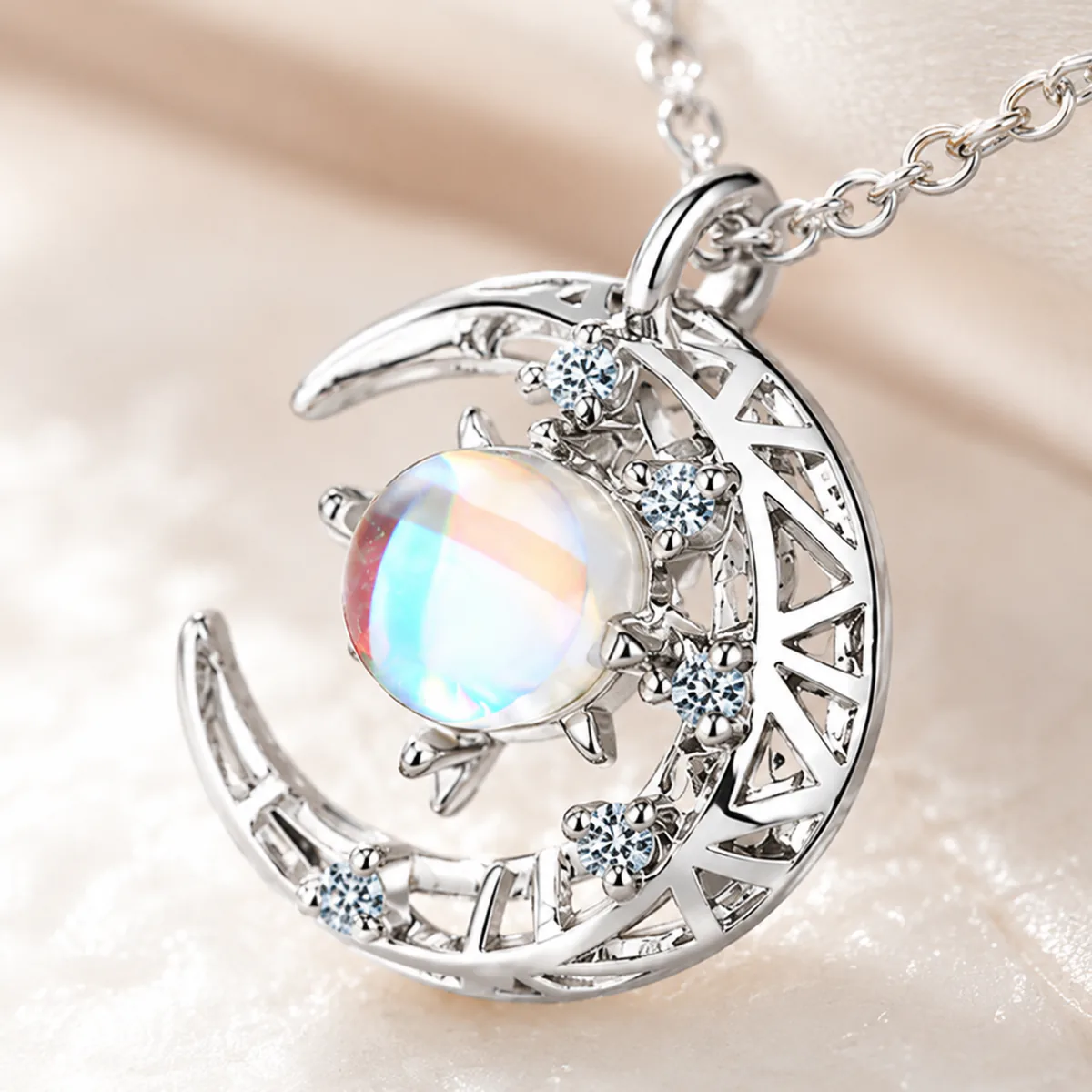
A silver crescent pierced with small triangles, a few clear stones set along its arc, and in the hollow of its curve a round iridescent bead held by claws arranged in a star. Nothing behind it: this is the only pendant in the catalogue whose stone sits in empty space.
A stone set in empty space
Look closely at the mount. The bead is not laid on a plate of metal nor enclosed in a bezel: it is held by a few fine claws, inside an opening. There is nothing behind it. And that detail of construction changes how the piece behaves once worn, in a way nobody thinks to write down.
A translucent stone with no metal backing borrows the colour of whatever is behind it, which is to say your clothes. On a dark jumper, the bead stands out clearly, its reflections come through, and the pendant is at its best. On a white shirt or pale skin, the background passes through and dilutes what iridescence it has: it looks paler, more discreet, almost extinguished.
It is neither a fault nor a quality, it is a characteristic: this necklace does not have one look, it has as many as your wardrobe. If you buy it for its reflections, wear it over something dark. If you want it discreet, pale colours will do the work on their own.
Openwork is fragile where it is thin
To pierce is to remove material. The advantage is immediate and it counts on a fine chain: the pendant is far lighter than a solid crescent of the same size, it weighs less on the neck, it bounces less and it wears the chain less. A solid crescent of this diameter would be heavy and would pull forward.
The trade-off is mechanical. Between the cutouts only thin bridges of metal remain, and the two points of the crescent are the thinnest places on the whole piece, as well as the most exposed. An openwork pendant caught in a bag handle or crushed at the bottom of a pocket bends in exactly those places.
The important point is that bent openwork cannot be straightened. On a solid piece, a jeweller can correct a deformation; here the metal has been thinned everywhere and it will break at the junction of two cutouts rather than return to shape. So no pocket bottoms, no heap in a dish with other pieces, and a pouch or a hook to store it. The shop’s other necklaces are here, and the sizing guide explains how to choose a length.
Claws that are part of the decoration
Here is this model’s particularity, and it calls for a different checking habit from the others. On most pieces, claws are visibly claws: four small functional prongs, and if one lifts, you see it. Here they draw a star, they are part of the motif, and a point that has moved still looks like decoration.
The check therefore cannot be visual, it has to be tactile. Once a month, place a fingertip on the bead and push it gently sideways, then upward. It should not move a hair, nor click. If you feel the slightest play, a claw has opened, and it can be tightened in a workshop in minutes while the stone is still there.
The small clear stones set along the arc follow the same logic: run a fingernail over them, it should not catch anywhere. They also impose stricter care, no ultrasonic tank, no alcohol, no jewellery cleaner, all of which give way on this kind of setting long before the rest. As for the bead itself, it remains sensitive to impact like every stone in the catalogue: it chips rather than scratches, and a stone held by claws is more exposed than one enclosed.
Crystal healing lends moonstone correspondences tied to the cycle and to intuition, and I have noted below an amusing contradiction between two of its instructions. I will go no further: none of it is proven and no piece of jewellery heals anything. Separately I have gathered what tradition lends this stone and what each colour changes.
- Openwork silver crescent, round iridescent bead held by star-set claws.
- Nothing behind the stone: it borrows the colour of your clothes. Superb on dark, discreet on pale.
- Bent openwork cannot be straightened. No pocket bottoms, no heap in a dish.
- Delivered in two weeks with a cotton pouch, a handwritten note and a care card.
The specifications
- Stone
- Moonstone, round bead
- Look
- Translucent, iridescent reflections depending on angle and background
- Metal
- 925 sterling silver
- Mount
- Openwork crescent, claws arranged in a star, small set stones
- Chain
- Oval link chain
- Gender
- Women
- Brand
- Melissa Moon
This crescent does not exist in the sky
People sometimes point out that the crescent on the piece is tilted oddly, and the remark is more accurate than it sounds. A real crescent turns its points away from the sun: depending on the hour and the season it looks like a C, a D, or a cup lying horizontally near the horizon, and it never has this jeweller’s tilt, chosen because it sits well in a circle and leaves room in the middle.
In other words, the crescent of jewellery is a sign, not a drawing from observation, and it has been so for millennia. That does not bother me, but I would rather say it than let anyone think there is astronomical accuracy here. The only place the moon of this necklace is faithful is in the name of the stone it holds. The rest of the shop is here.
Nobody has ever seen that crescent in the sky. It is a sign, and signs do not have to be accurate.
No salt, no ultrasonic tank, no hot water: all three damage the stone for good, and ultrasound would also loosen the claws and the setting of the small stones. Add, specific to this model: no alcohol and no jewellery cleaner. Lukewarm water, a drop of mild soap, a very soft brush for the cutouts, a rinse and a complete drying by dabbing, since water lingers in the openwork and leaves rings as it dries. A silver polishing cloth does not suit here: it would clean only the raised parts and leave the hollows black, which gives a half-clean piece. Take the necklace off before the shower, the pool and sport. The detail is in cleaning a moonstone piece, and the safe methods in caring for it without harming it.