

Description
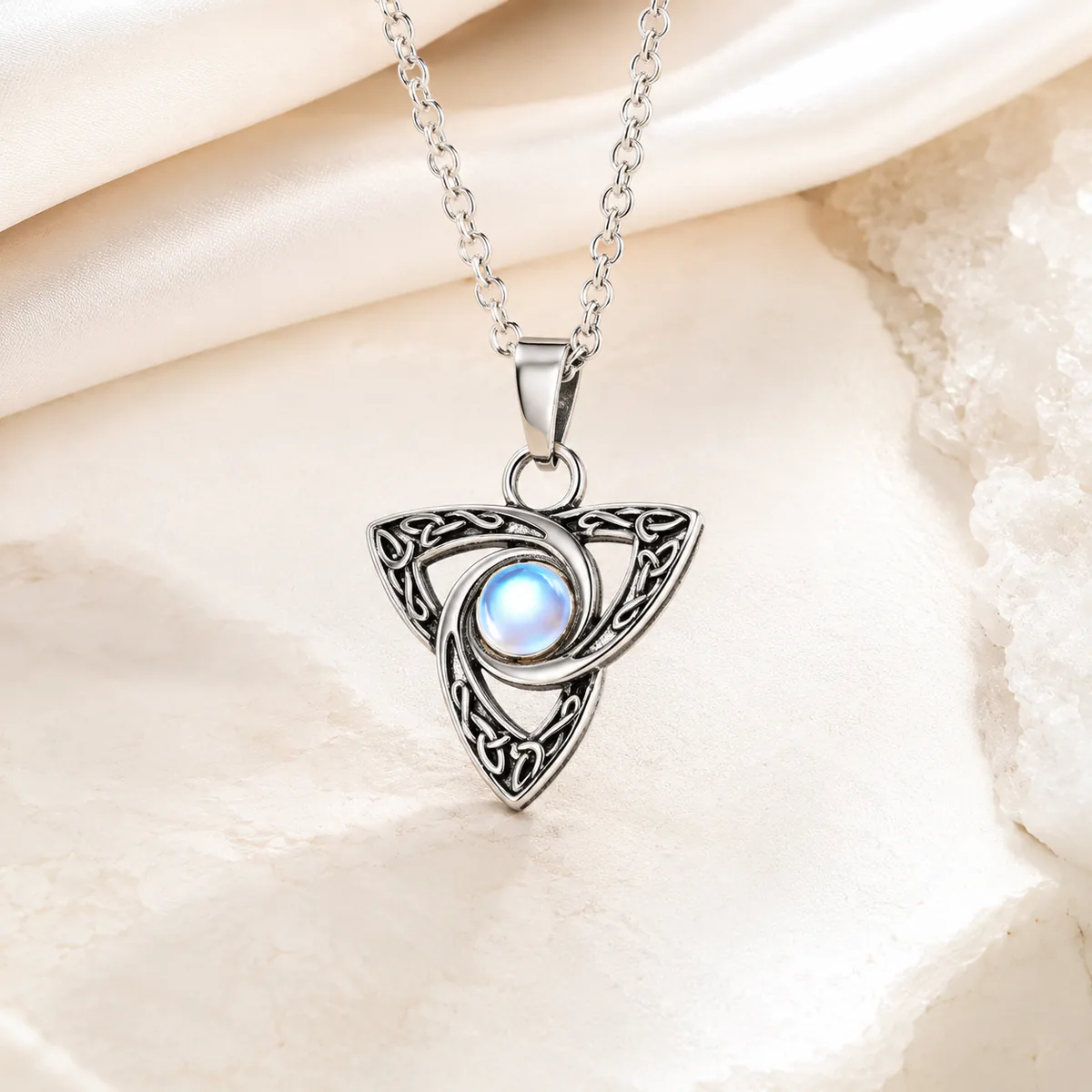
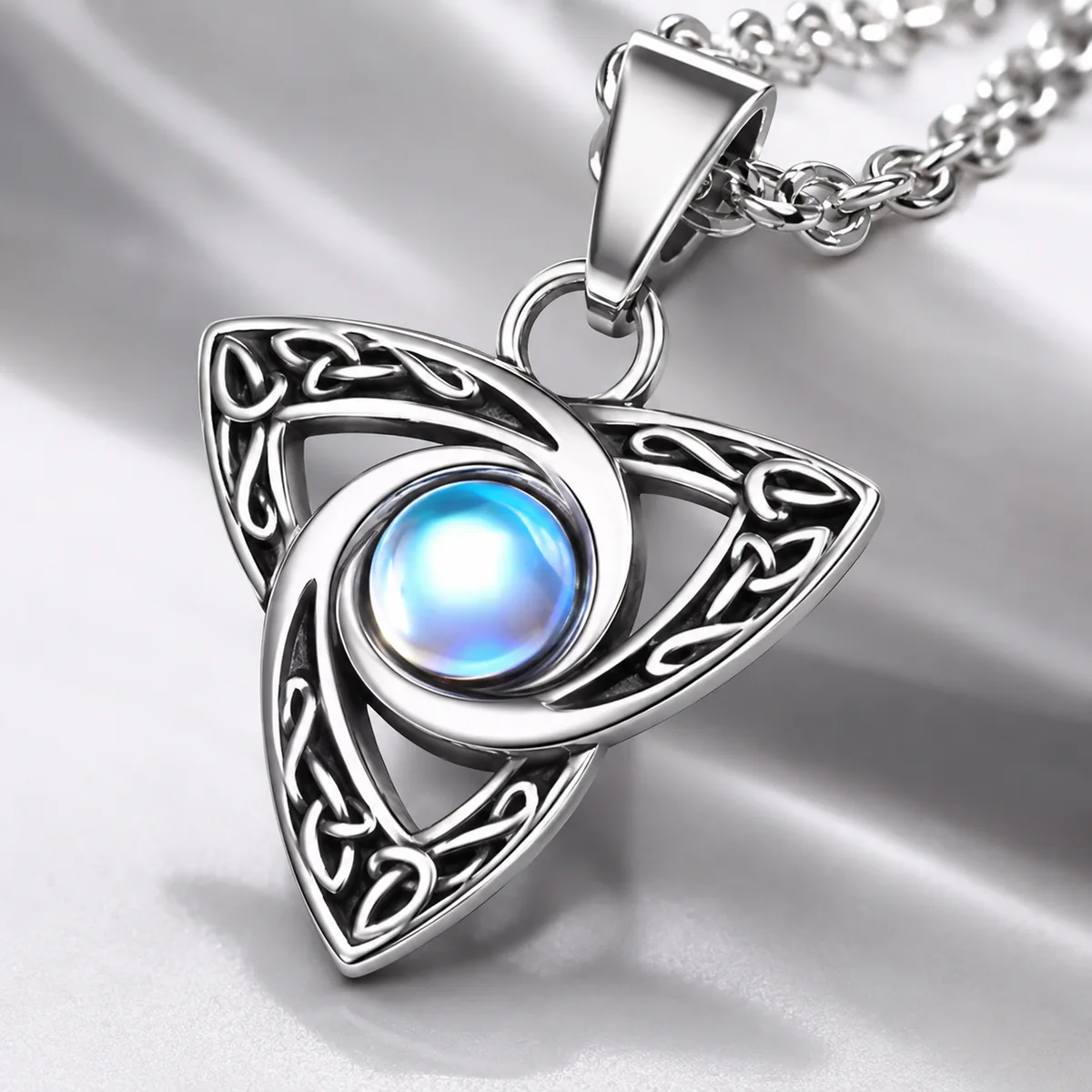
A silver triangle with rounded corners, entirely covered in interlace whose hollows are blackened, and at the centre a small round stone of pale blue, caught in a scroll. It is the most worked piece in the catalogue, and the only one whose black is deliberate.
The black on this pendant is not dirt
This is the first thing to know, and the one that will prevent the only irreparable accident this piece can suffer. The silver in the hollows was blackened deliberately before sale. It is neither dust, nor tarnish, nor a finishing fault: it is a patina applied on purpose, and without it you would see nothing of the motif.
The reason is purely optical. Interlace engraved in polished silver disappears: everything returns light the same way, hollows as much as raised parts, and the design drowns in reflections. By blackening the grounds, contrast is created, and the motif finally reads from a distance. Here the black is the ink of the drawing.
Hence the warning: never use a silver polishing cloth, polishing paste or a cleaning bath on this piece. Those products do exactly their job, they remove the black, and they take the design with it. It is also why you must warn a jeweller before handing this pendant over for a repair, failing which it will come back cleaned, uniformly bright, and unrecognisable.
Over the years the patina wears away on its own along the edges and high points, those that rub against the collar and clothing, while it stays at the bottom of the hollows. The motif gains relief rather than losing it, and it is one of the rare kinds of ageing I find frankly successful. If one day the contrast seems too weak, a jeweller reapplies a patina in minutes.
A pendant that lives under a shirt
Here is this model’s particularity, and it comes down to how a man’s necklace is actually worn. Most of the time it is under the fabric, in constant contact with a shirt or a tee, caught between skin and collar. That is not the regime of a pendant worn over a jumper, and it changes three things.
The rubbing of the collar is continuous, so the patina will wear faster on the front face, the one touching the fabric. That is normal and even desirable. Perspiration settles in the hollows, where it dries and deposits: an occasional rinse in lukewarm water, a very soft brush, and careful drying are enough to keep it from building up. And if you have hair on your chest, know that a fine chain catches it, especially at the clasp: a slightly wider link solves the problem better than any advice.
A word finally on the stone: it is small and lodged at the bottom of a scroll, that is to say set back relative to the metal around it. It is the most protective mount in the catalogue, because the relief absorbs impacts before it does. On a piece meant to be worn every day without thinking about it, that counts more than a large exposed cabochon. The stone chips on impact rather than scratching, and here it is sheltered.
A small stone in the middle of a large motif
You might think the stone is small for reasons of cost. That is a little true, and mostly false. It is small because it is the only smooth, pale element on the whole piece, and a single bright point in the middle of a dark textured surface draws the eye far more effectively than a large pale area.
It is the same principle of contrast I apply elsewhere, but turned around once more. On a grey cabochon it is the body of the stone that brings out its sheen; on an openwork crescent it is the clothing that plays that role; here, it is the mount itself, blackened and matte, that serves as the dark ground for the stone. Three ways of obtaining the same effect, and this one is the most reliable, since it depends neither on the stone nor on what you wear.
The shop’s other necklaces are here, and the sizing guide explains how to choose a length. On a man, count generally longer than the usual values given for a woman’s neck.
- Silver triangle with interlace, blackened hollows, small round stone set at the centre.
- The black is deliberate: no silver cloth, no paste, no cleaning bath. They would erase the design.
- Warn a jeweller before any repair, otherwise it will come back polished.
- Delivered in two weeks with a cotton pouch, a handwritten note and a care card.
The specifications
- Stone
- Moonstone, small round cabochon
- Look
- Translucent pale blue, mobile sheen
- Metal
- 925 sterling silver, hollows patinated black
- Motif
- Triangular interlace, stone set back in a scroll
- Chain
- Oval link chain
- Gender
- Men
- Brand
- Melissa Moon
The chain is the one thing I would change
I may as well write it plainly: on this kind of piece, the pendant is solid and the chain is markedly less so. A massive silver motif has weight, it swings when you lean forward, it catches as a collar passes, and it is almost always the chain that gives way, never the pendant. On a man’s piece worn every day under a shirt, a fine link is the weak link in the literal sense.
The bail is wide enough to take a thicker chain, and that is what I advise anyone who intends to wear it continuously: a slightly stronger cable link, or a curb chain, completely changes the longevity of the whole for a modest sum. It earns me nothing to tell you, and it will save you finding the pendant at the bottom of a sleeve one winter evening. The rest of the shop is here.
On a man’s piece, it is almost always the chain that gives way. Never the pendant.
No salt, no ultrasonic tank, no hot water: all three damage the stone for good. And on this model, one rule outranks all others: nothing that polishes. No silver cloth, no paste, no eraser, no silverware cleaning bath, on pain of erasing the black patina that draws the motif. Care is limited to lukewarm water, a drop of mild soap, a very soft brush run through the hollows to dislodge dried perspiration, a rinse and a complete drying. Take the necklace off before the shower, the pool and sport. The detail is in cleaning a moonstone piece, and the safe methods in caring for it without harming it.