


Description
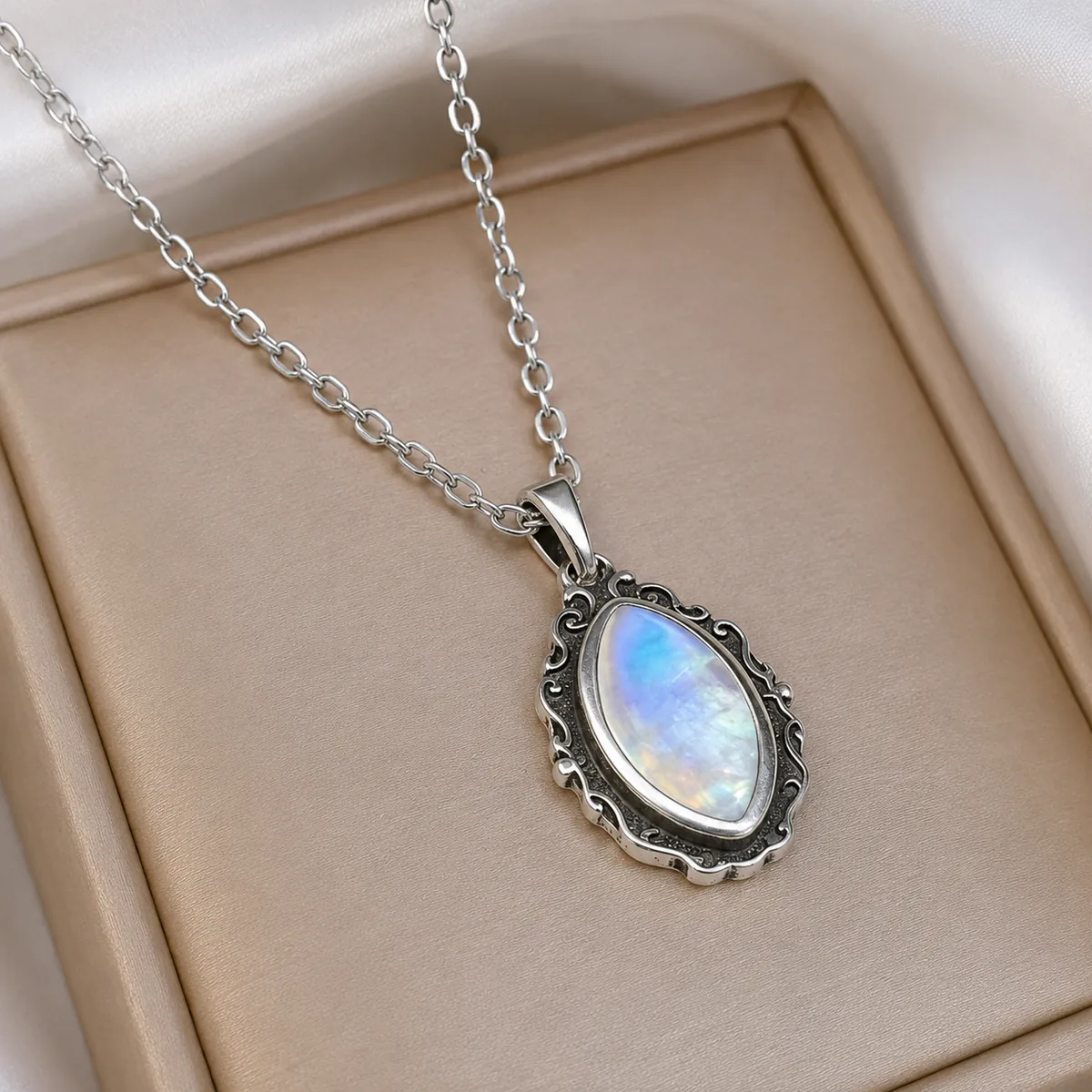
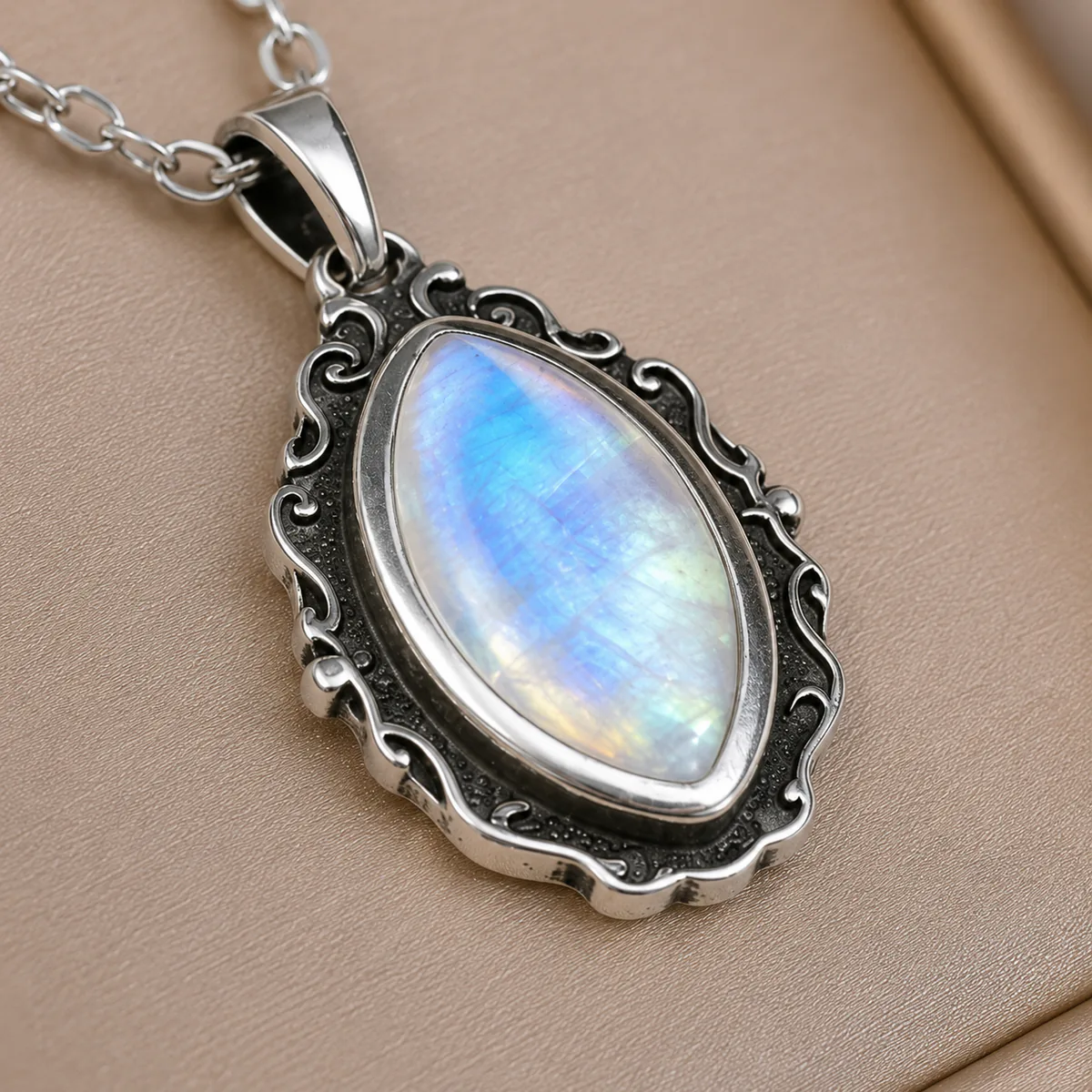
A marquise cabochon, tapering at both ends, crossed by a wide blue band that turns green and pink depending on the angle, set at the centre of a scrolled silver frame whose hollows have been blackened. An elongated shape, a busy setting, and a sheen that sweeps the stone lengthwise.
A marquise, and two points to protect
The shape of this stone is called a marquise, or a navette depending on the catalogue: a tapered oval, pointed at both ends. It is an elegant silhouette and it is also the most delicate geometry you can give a stone with perfect cleavage.
The reason is simple. A point is material thinning down to almost no weight at all, with nothing behind it for support. On a stone that chips on impact rather than scratching, those two ends concentrate the whole risk of the piece. That is precisely why the bezel always bites a little more over the points than over the flanks, which gives every set marquise that slightly rounded look at the ends: it is not a cutting fault, it is metal doing protection.
Now look at the scrolled frame: it widens at the sides and narrows at the ends, which means the flanks of the stone are well sheltered and its points less so. In use, that translates into a short instruction: this is a pendant you take off before handling hard objects at chest height, and that you store flat rather than in a heap, a point caught under another piece being exactly the situation to avoid. The shop’s other pendants are here.
On an elongated shape, the sheen stretches out
Here is this model’s particularity, and it comes from the meeting of this material with this shape. The sheen of a rainbow stone is born of internal layers stacked and oriented in a single direction: the lapidary places them parallel to the surface of the dome, failing which the colour would not appear at all. On an elongated stone, that sheet of colour stretches from one end to the other instead of gathering on a cap.
The result is visible at once: where a round cabochon shows a patch of colour wandering about, this one shows a long band running along the axis of the stone, lighting up all at once over its whole length, then going out entirely. There is no half measure, and that is what makes this shape spectacular when it catches the light.
The trade-off is of the same order: the effect is more binary than on a round stone. A round shape almost always keeps a little colour somewhere; a marquise is frankly lit or frankly dark, depending on the tilt. To see it at its best, turn toward daylight and rock the pendant back and forth rather than side to side. This variety is a pale labradorite, and the difference is explained here, the whole rainbow variety is gathered there, and the quality criteria are detailed here.
The blackened frame, and what must not be done to it
The hollows of the decoration have been blackened deliberately, as on the shop’s other pieces in relief: without that contrast, the scrolls would drown in the reflections of polished silver and the drawing would disappear. No silver cloth, no paste, no silver dip, on pain of erasing the motif along with the black.
One point I have never seen written anywhere and which concerns exactly this kind of frame: if someone once tried to clean the piece with a polishing paste, some of it always stays at the bottom of the scrolls, as a whitish dry deposit which shows all the more because the hollows are dark. It comes out with a very soft brush and lukewarm soapy water, patiently. If you buy this kind of piece secondhand, it is the first thing to look at.
For the rest, this frame does useful work: it overhangs all around the stone, so it is what meets the corners first, and a decoration in relief takes knocks better than a smooth surface, where the slightest mark reads. The sizing guide explains how to choose a length.
Crystal healing tradition treats this variety apart from classic moonstones, and further down I have noted a very simple experiment that nobody ever takes the trouble to run. I will go no further: none of it is demonstrated and no piece of jewellery heals anything. Separately, I have gathered what tradition lends this stone and what each colour changes.
- Marquise cabochon, bezel set, scrolled silver frame with blackened hollows.
- The sheen stretches along the axis: a long band that lights up all at once, then goes out entirely.
- The two points are the fragile part. Store flat, never in a heap.
- Delivered in two weeks with a cotton pouch, a handwritten note and a care card.
The specifications
- Stone
- Rainbow moonstone, marquise cabochon
- Look
- Iridescent blue band with green and pink flashes
- Metal
- 925 sterling silver, hollows patinated black
- Setting
- Bezel set, scrolled frame
- Chain
- Oval-link chain
- Gender
- Women
- Brand
- Melissa Moon
Why I prefer the marquise to the pear on this stone
Both shapes lengthen the stone and stretch its sheen, so you might think they are equivalent. In use, they are not. A pear is asymmetric: it has a wide end and a pointed end, and the sheet of colour necessarily masses on the wide side, leaving the point duller. The eye notices without knowing why, and the stone reads as unbalanced.
The marquise is symmetrical. Its band of colour is born in the middle and spreads equally toward both ends, so the stone lights up as one piece. You pay for that comfort with one extra point to protect, and I find the exchange favourable. It is a matter of taste as much as of craft, but it is a taste with a reason behind it. The rest of the shop is here.
Two points are better than one, provided they are symmetrical.
No salt, no ultrasonic tank, no hot water: all three damage the stone for good, and ultrasound would also attack the internal planes that make its sheen in the first place. On this model, one rule outranks all the others: nothing that polishes, so as not to erase the patina of the scrolls. Lukewarm water, a drop of mild soap, a very soft brush run into the hollows, a rinse and a complete drying by dabbing, since water lingers in the decoration and leaves pale rings. Take the necklace off before the shower, the pool and sport, and store it flat, the points of the stone being its most vulnerable part. The detail is in cleaning a moonstone piece, and the safe methods in caring for it without harming it.