


Description
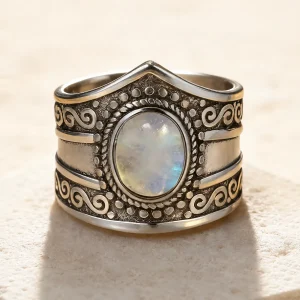
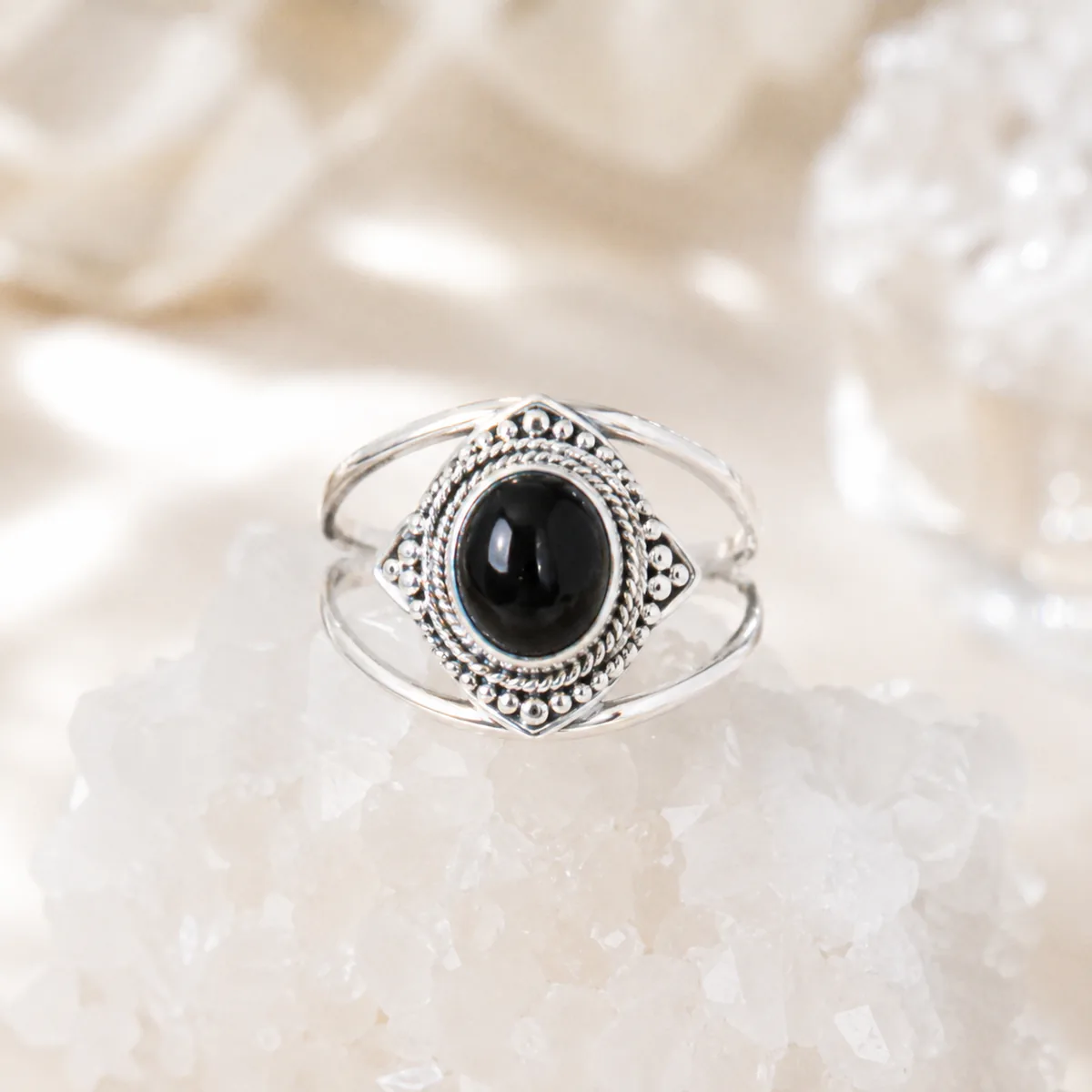
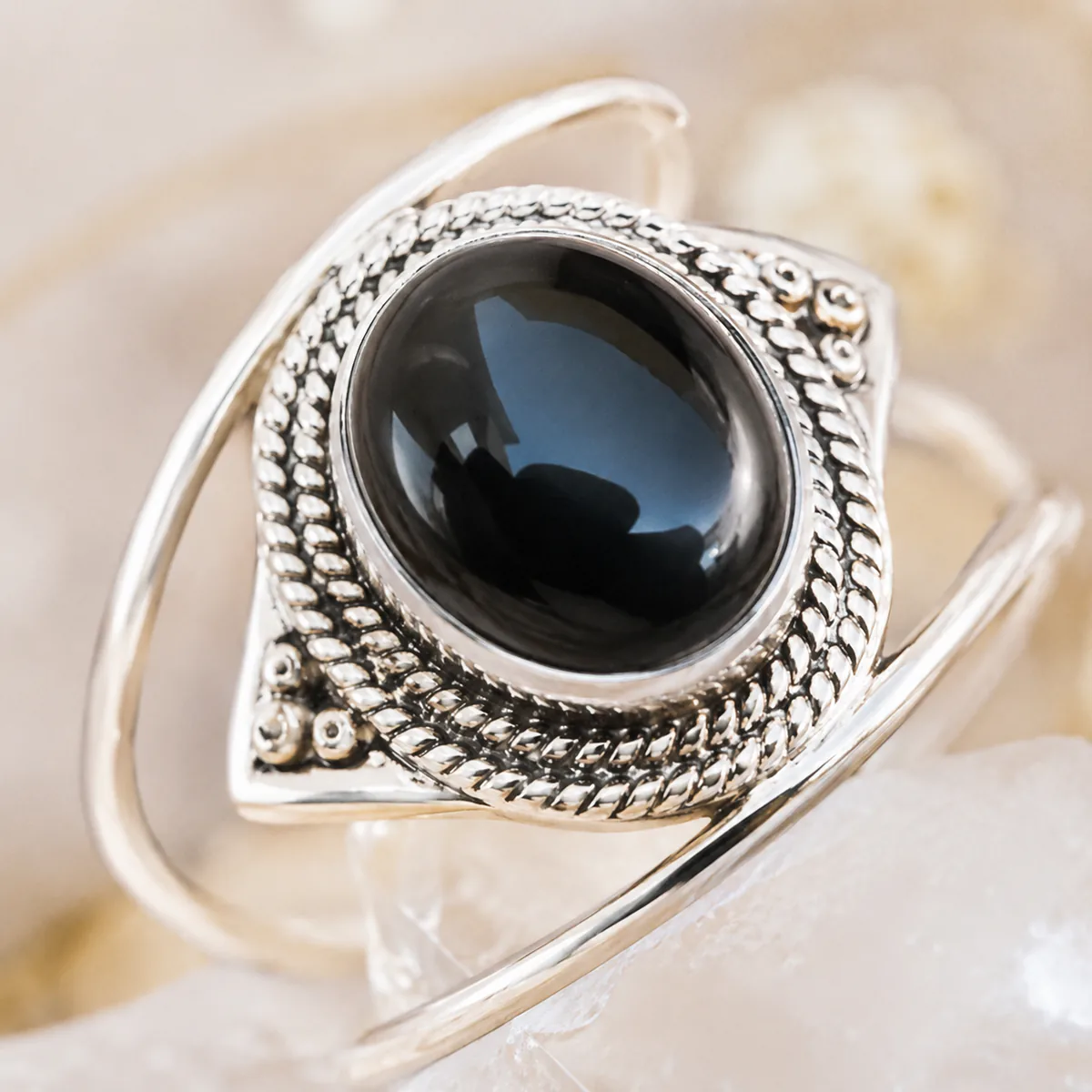
It is the only dark stone in the catalogue, and it changes the whole balance of the shop. A small deep black cabochon, polished like a mirror, set at the centre of a silver lozenge made of twisted wire and beads, on a band that splits into two strands. It is the one you wear when you love moonstone but not the milky look.
What a black moonstone really is
Let us begin by naming it correctly, because that is what makes the rest legible. Black moonstone is not adularia, the mineral of the white and bluish cabochons in the rest of the shop. It belongs to the plagioclases: it is a labradorite, the same family as the rainbow variety, but on a dark body instead of a pale one. The trade has filed all three under one name for so long that usage has won, and I sell it under that name because it is the one you search for. I would still rather write it down.
On a black ground, the sheen does not behave the way it does on a pale stone. There is no milky veil floating across the dome, but a silver or bluish flash that glides over the surface, far more contrasted since it has nothing pale around it to dilute it. It is more directional in exchange: it appears at certain angles and vanishes at others. That is the very nature of this variety, and I come back to it below because it is what surprises people most on arrival. Everything the shop offers in black is here.
A bright setting around a dark stone
The mounting plays the contrast all the way. Around the stone, a twisted wire, then a row of granulation, the whole arranged in a lozenge whose four points are marked with larger beads. Everything is in bright polished silver, and that is deliberate: on a dark stone, a blackened mounting would have made one solid block, whereas here the decoration cuts a luminous lattice around the black.
The band splits into two strands that frame the lozenge and meet again under the finger, which lightens the piece without weakening it. It is also what keeps this ring wearable every day despite the relief: nothing catches, nothing stands proud enough to snag a sleeve. The shop’s other rings are here.
What to know before you order
Now the part that holds for every black moonstone, not only for mine. Do not expect fireworks. The sheen of a black moonstone is discreet: it takes daylight, an angle, and often a turn of the wrist to make it appear. Shop photographs always show it at its best, which is to say at the exact angle where it gives itself. When your ring arrives, look for it near a window, tilting the piece slowly, and not under a ceiling light. If it does not move at all, whatever the angle, the stone is not what it claims to be: that is the one criterion no imitation knows how to fake. Add that this stone has perfect cleavage like its cousins and chips on impact, and that the sizing guide will save you a return.
Crystal healing tradition lends the black variety correspondences quite different from those of the pale ones, turned towards grounding rather than intuition, and I have kept them apart below. I will go no further: none of it is demonstrated and no piece of jewellery heals anything. If the subject interests you, I have gathered what tradition lends this stone and what each colour changes.
- Black moonstone, that is to say a labradorite on a dark body. Silver sheen, discreet and directional.
- Bright polished sterling silver. Twisted wire and granulation arranged in a lozenge, split band.
- The only dark stone in the catalogue. Contrast is the whole subject of this ring.
- Sizes I½ to T½. Delivered in two weeks, with a cotton pouch, a handwritten note and a care card.
The specifications
- Stone
- Black moonstone, oval cabochon cut
- Mineral species
- Plagioclase, like the rainbow variety, and not orthoclase like adularia
- Metal
- 925 sterling silver
- Setting
- Plain bezel setting, no glue
- Decoration
- Twisted wire and granulation in a lozenge, split band
- Sizes
- I½ to T½
- Gender
- Women
- Brand
- Melissa Moon
Why a dark stone in a catalogue of pale ones
Because the milky look does not suit everyone. It is as simple as that. On some skins and with some wardrobes, a white and bluish cabochon disappears, whereas a black one holds the distance. The black variety is not a moonstone at a discount, nor a curiosity: it is the same mineral family as the rainbow, mounted for another taste.
It is, on the other hand, the variety I look at longest before buying. On a pale stone, a fault in the sheen shows at once. On a black polished cabochon, everything shines, and you have to tilt patiently to tell a true gliding flash from a plain surface reflection. It is the sorting that takes me the most time, and it is also the one where people are most easily taken in. The rest of the shop is here, including what I have taken off the catalogue.
On a white stone you see the sheen. On a black stone you have to go looking for it. Perhaps that is why people grow more attached to it.
No salt, no ultrasonic tank, no hot water: labradorite is a feldspar like adularia, and all three damage it the same way. Lukewarm water, a soft cloth, and take the ring off before the shower, the pool and the housework. One point specific to dark polished stones: they hold fingerprints far more than pale ones, and a wipe with a dry cloth is enough to give them their depth back. The detail is in cleaning a moonstone piece, and the safe methods in caring for it without harming it.