

Description
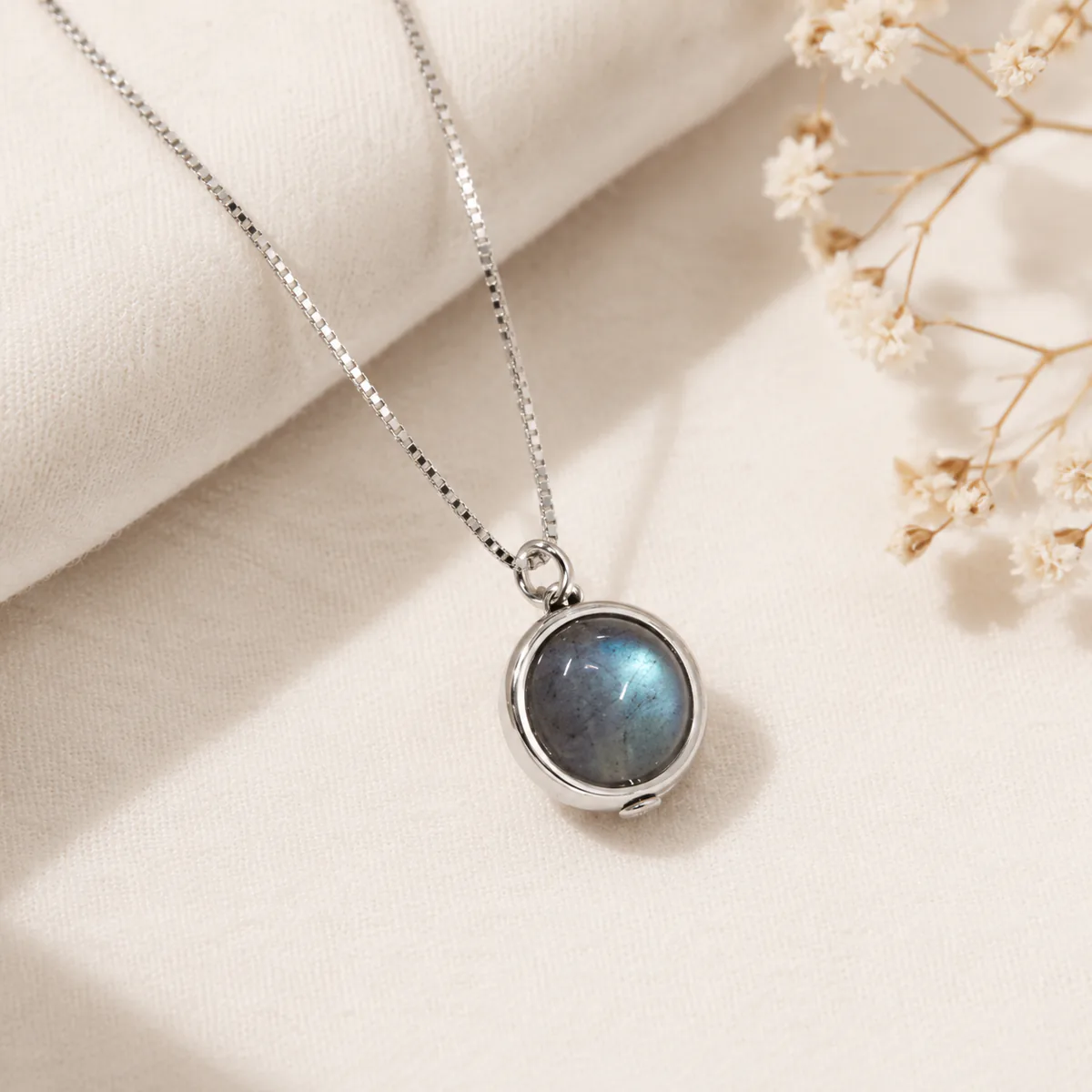
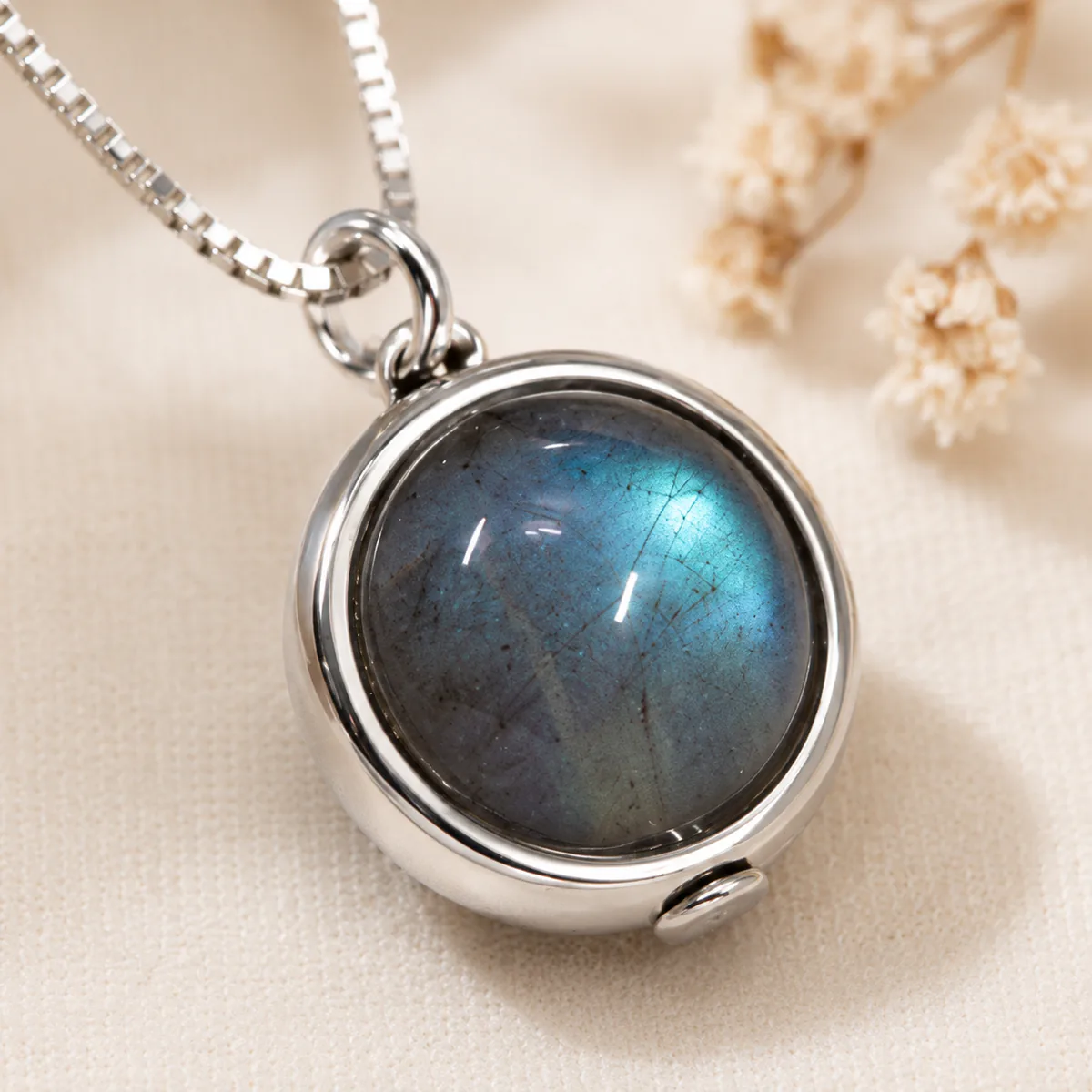
A small round cabochon on a dark gray ground, crossed by a blue-green flash, bezel set in a thick silver collar and hung on a square-link chain. Nothing else. It is the quietest necklace in the catalog, and probably the one that will be worn most often.
The smaller the stone, the narrower the angle
Let us begin with what explains nearly every disappointment on unpacking a dark stone, and which has nothing to do with its quality. The flash of a black moonstone is directional: it exists only when light strikes the dome at a certain angle, and it disappears entirely outside that window.
That window depends on the size of the stone. A large cabochon offers a wide domed surface, so a comfortable range of angles; a small cabochon offers exactly the opposite. On a stone of this diameter, a few degrees are often enough to go from a dull gray to a frank blue, and a few degrees more to come back to gray. It is not a less lively stone than a large one, it is a stone more demanding about the angle.
Hence three very simple instructions when you open the box. Do not judge it still, sitting in its case: it will be gray, inevitably. Do not judge it in the evening under a warm lamp. Stand near a window with the light behind you and tip the pendant slowly back and forth: the blue will appear all at once, frankly, then fade. That behavior is what you are looking for. The quality criteria are set out here.
The one stone that goes with everything
Here is what is particular about this model, and it is a wardrobe argument nobody makes. A dark stone does not read as a color, it reads as a point. It is therefore not trying to match anything, it punctuates, which makes it compatible with absolutely everything you wear.
Compare it with the rest of the catalog: a white stone disappears on a white shirt, a pale stone dilutes on pale skin, a frankly colored stone quarrels with a print. The black one stands out against pale, stands out against bright, and blends only against black, where it becomes a discreet piece rather than an invisible one, since its flash still comes through.
It is also what makes it legible from a distance despite its small size. A strongly contrasted object catches the eye far more than a larger, paler one: the white variety runs into the opposite problem, where the whole job of the mounting is precisely to keep the stone from melting into its own decoration. The shop’s other necklaces are here.
A small pendant on a stiff chain
The chain is a square link, made of cubic links fitted together. It has one property that soft chains do not, and it counts for a lot on a light pendant: it is stiff, so it holds its curve. A fine, limp chain collapses into an accordion as soon as the pendant is too light to draw it taut, and the piece ends up sitting crooked; this one keeps its line on its own and brings the pendant back to the center. The only point of articulation is the ring joining the bail to the chain, so that is the part that works. On this model there is only one, which cuts the risk right down. The sizing guide is here.
A word on the stone itself, as on the other pieces concerned: black moonstone with a blue flash is a labradorite, a direct cousin of adularia and sold everywhere under the same family name. The difference is explained here, and everything the shop offers in black is gathered there. The small dark specks visible in the material are inclusions, and they are rather a good sign. The cabochon is enclosed in a thick collar that protects its whole rim: the stone chips on impact rather than scratching, and here it is well sheltered.
Crystal healing tradition lends dark stones correspondences different from those of the pale varieties. I have kept them apart below. I will go no further: none of it is demonstrated and no piece of jewelry heals anything. Separately, I have gathered what tradition lends this stone and what each color changes.
- Small dark cabochon, bezel set in a thick silver collar, on a square-link chain.
- Do not judge it still: on a small stone, the window of angles where the blue appears is narrow.
- A dark stone reads as a point, not as a color. It goes with everything.
- Delivered in two weeks, with a cotton pouch, a handwritten note and a care card.
The specifications
- Stone
- Black moonstone, a labradorite, round cabochon
- Appearance
- Speckled dark gray ground, directional blue-green flash
- Metal
- 925 sterling silver
- Setting
- Bezel set, thick collar
- Chain
- Square link, 925 sterling silver
- Gender
- Women and men
- Brand
- Melissa Moon
The one I recommend when you have no idea what to give
Of the whole catalog, this is the piece that asks the least information about the person receiving it. No ring size to know, unlike a ring. No neck measurement to guess, unlike a choker. No particular wardrobe required, unlike a large piece. No gendered reading, no symbol to interpret, nothing that can land wide of the mark.
You should know the trade-off, and it is an honest one: a piece that risks nothing will not surprise anyone either. If you know the person’s taste well, this shop holds pieces with far more character, and they will make a truer gift. This necklace is made for the other case, the one where you want to give something good without the faintest idea of what will be worn. The rest of the shop is here.
A safe piece is not a bland piece. It is a piece that asks nothing of the person receiving it.
No salt, no ultrasonic tank, no hot water: this stone is a feldspar, and all three damage it for good. Lukewarm water, a drop of mild soap, a soft cloth, and thorough drying with attention to the rim of the setting, where water lodges between metal and stone. A silver polishing cloth suits the collar and the chain, which are smooth and undecorated, but never the cabochon: it is slightly abrasive. On a dark polished stone, fingerprints show more than on a pale one and put out the flash: a wipe with a dry cloth is enough to light it again, and it is often all that is missing from a necklace people believe has tarnished. Take it off before the shower, the pool and sport. The detail is in cleaning a moonstone piece, and the safe methods in caring for it without harming it.