


Description
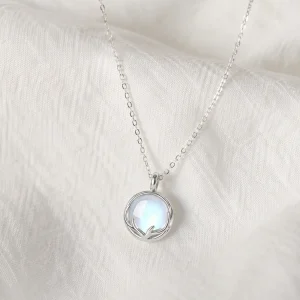
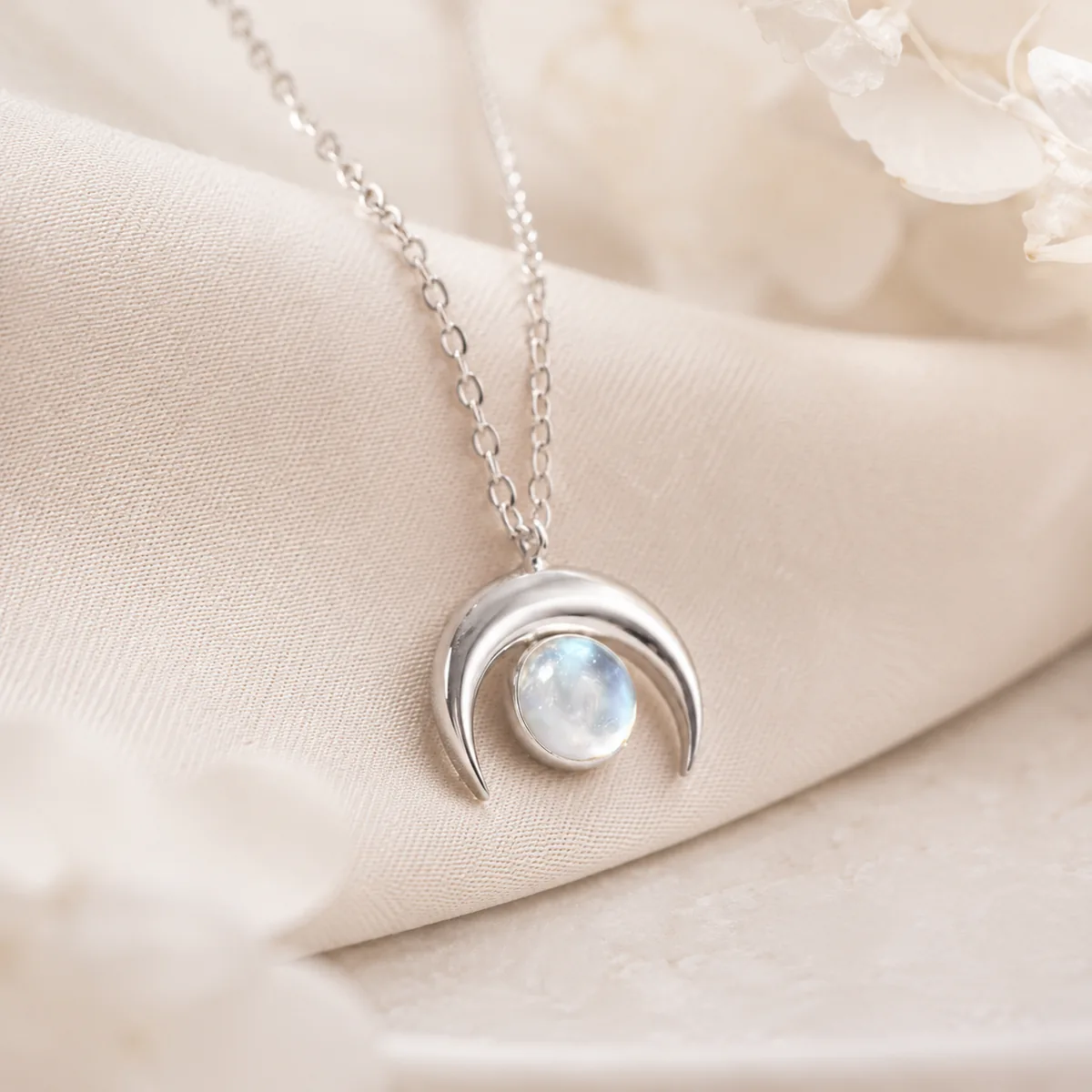
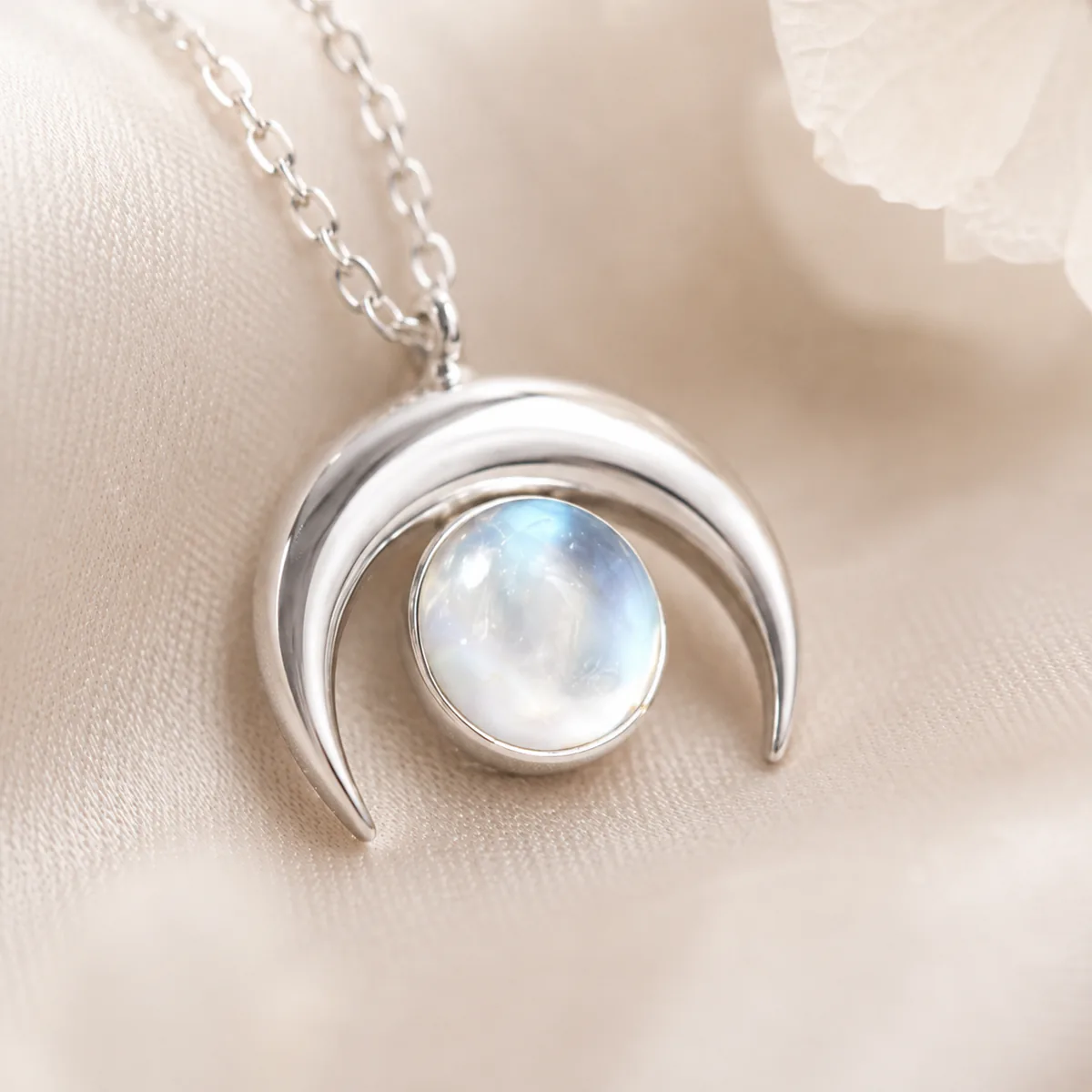
A solid silver crescent, mirror polished, its two points running downward, and in the hollow of its curve a round white cabochon crossed by a blue veil. No openwork, no engraving, no patina: two surfaces, one that reflects, one that diffuses.
Milky white and transparent white are not the same stone
White moonstone is sold as though there were only one of it, and it is the worst described variety on the market. Two very different behaviors exist, and knowing which one you are buying completely changes what you receive.
The milky white has a dense, clouded body. Its light is soft and widely spread: the blue veil covers a large part of the dome, but it is pale, mixed with the white of the ground, and it looks more like mist than like a flash. From a distance, it is a pretty white stone.
The transparent white has a clear body, almost colorless, in which the blue concentrates instead of diluting. The veil is narrower, sharper, more frankly blue, and it moves fast when you tilt the stone. From a distance, it is a stone that lights up. It is also the more sought after and the more expensive of the two, size for size.
Neither is a defect, they are two materials and two effects. The useful rule is this: if you are looking for a white stone, take the milky one; if you are looking for a blue sheen, take the transparent one, and know that it will look grayer and less white at rest, which disappoints anyone expecting whiteness. The cabochon on this page belongs to the second group. The whole white variety is gathered here, the mechanism of the sheen is explained there, and the quality criteria are set out here.
A mirror polish forgives nothing, and always recovers
Here is what is particular about this model. The crescent is solid, smooth, without the least decoration to distract the eye: it is the most demanding finish there is, because a mirror surface hides nothing. The slightest micro-scratch shows on it, and on a curved form it does not show as a scratch but as a veil, a slightly milky zone that dulls the reflection.
Add fingerprints: a mirror-polished chest piece catches them constantly, and the greasy film is enough to put out the shine. The good news is that it comes off in two seconds with a dry cloth, and that most necklaces people believe have tarnished are simply greasy.
The very good news is structural: of all the pieces in the catalog, this one is the easiest to bring back to new. An openwork piece cleans badly, a patinated piece cannot be polished without erasing its design, a gold-plated metal loses its layer as soon as you touch it. Here there is nothing but solid silver and a simple surface: a jeweler restores it to its original state in a few minutes, as many times as you like, and you can even keep it up yourself with a silver polishing cloth, on the metal only.
White on white
A problem arises when a white stone is mounted on a white metal and worn on pale skin: everything sits at the same value, nothing stands out, and the piece can literally disappear at a meter’s distance. It is the risk of every tone-on-tone.
The mounting answers it simply: a mirror polish has no value of its own. It does not send back white, it sends back whatever is around it, so it is almost always darker or more contrasted than the stone, whatever the setting. That is what holds the whole together where a matte or sandblasted metal would have melted into the cabochon. The shop’s other necklaces are here, and the sizing guide is there.
The stone remains sensitive to impact, like every stone in the catalog: it chips rather than scratches. Here it is bezel set, so protected all around its rim, and lodged in the hollow of the crescent, which shelters it from side rubbing. Crystal healing tradition lends moonstone correspondences tied to cycles and intuition, and I note below what exactly that reputation rests on. I will go no further: none of it is demonstrated and no piece of jewelry heals anything. Separately, I have gathered what tradition lends this stone and what each color changes.
- Solid mirror-polished silver crescent, round cabochon bezel set in its hollow.
- Two whites exist: the milky one gives a white stone, the transparent one gives a blue sheen.
- A polished necklace people think has tarnished is most often simply greasy. Dry cloth.
- Delivered in two weeks, with a cotton pouch, a handwritten note and a care card.
The specifications
- Stone
- White moonstone, round cabochon
- Appearance
- Clear body, mobile bluish veil
- Metal
- 925 sterling silver, mirror polished
- Setting
- Bezel set, no prongs
- Motif
- Solid crescent, stone lodged in the hollow
- Gender
- Women
- Brand
- Melissa Moon
What I look at on a white stone
Contrary to what people think, I do not sort these stones on the intensity of the blue. I sort them on where the sheen settles. On a round cabochon, the veil should be centered, occupy the top of the dome and sweep symmetrically when you tilt the stone. If it settles on an edge, if it appears on one side only or if it slips away under the collar, the block was cut in the wrong direction, and no quality of material makes up for that.
It is the criterion buyers know least and the most decisive in use, because an off-center sheen gives the impression that the stone is dirty or badly polished, when it is simply badly oriented. On a parcel, it makes the difference between three stones kept and twenty set aside. The rest of the shop is here.
On a white stone it is not the color of the sheen that counts. It is where it settles.
No salt, no ultrasonic tank, no hot water: moonstone is a feldspar, and all three damage it for good. Lukewarm water, a drop of mild soap, a soft cloth, and thorough drying with attention to the rim of the setting, where water lodges between metal and stone. A silver polishing cloth suits the crescent perfectly, since it is smooth and undecorated, but never the stone: it is slightly abrasive. Day to day, a simple wipe with a dry cloth on the polished metal is enough to give it back its shine, fingerprints being its chief enemy. Take the necklace off before the shower, the pool and sport. The detail is in cleaning a moonstone piece, and the safe methods in caring for it without harming it.