


Description
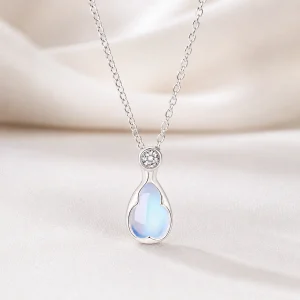
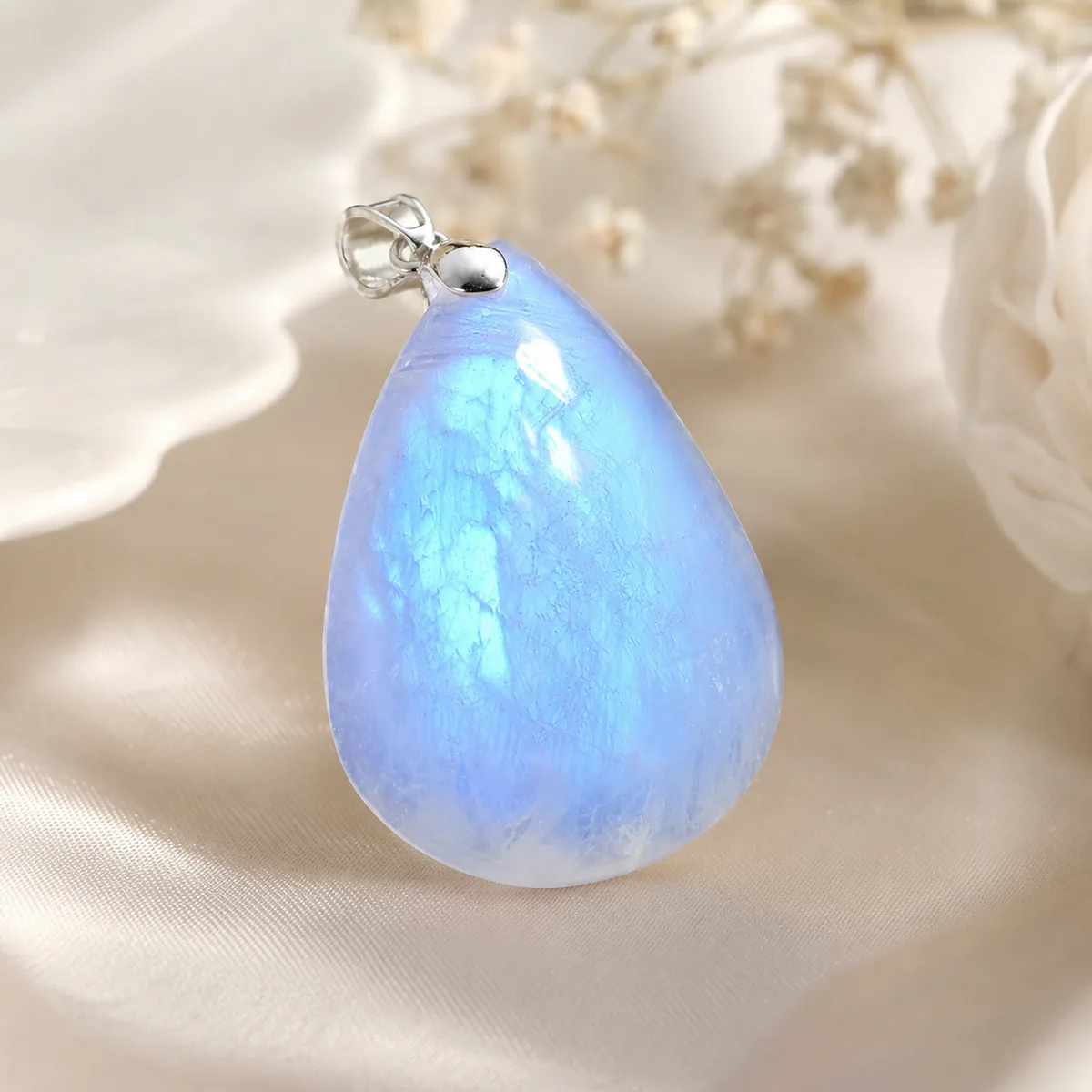
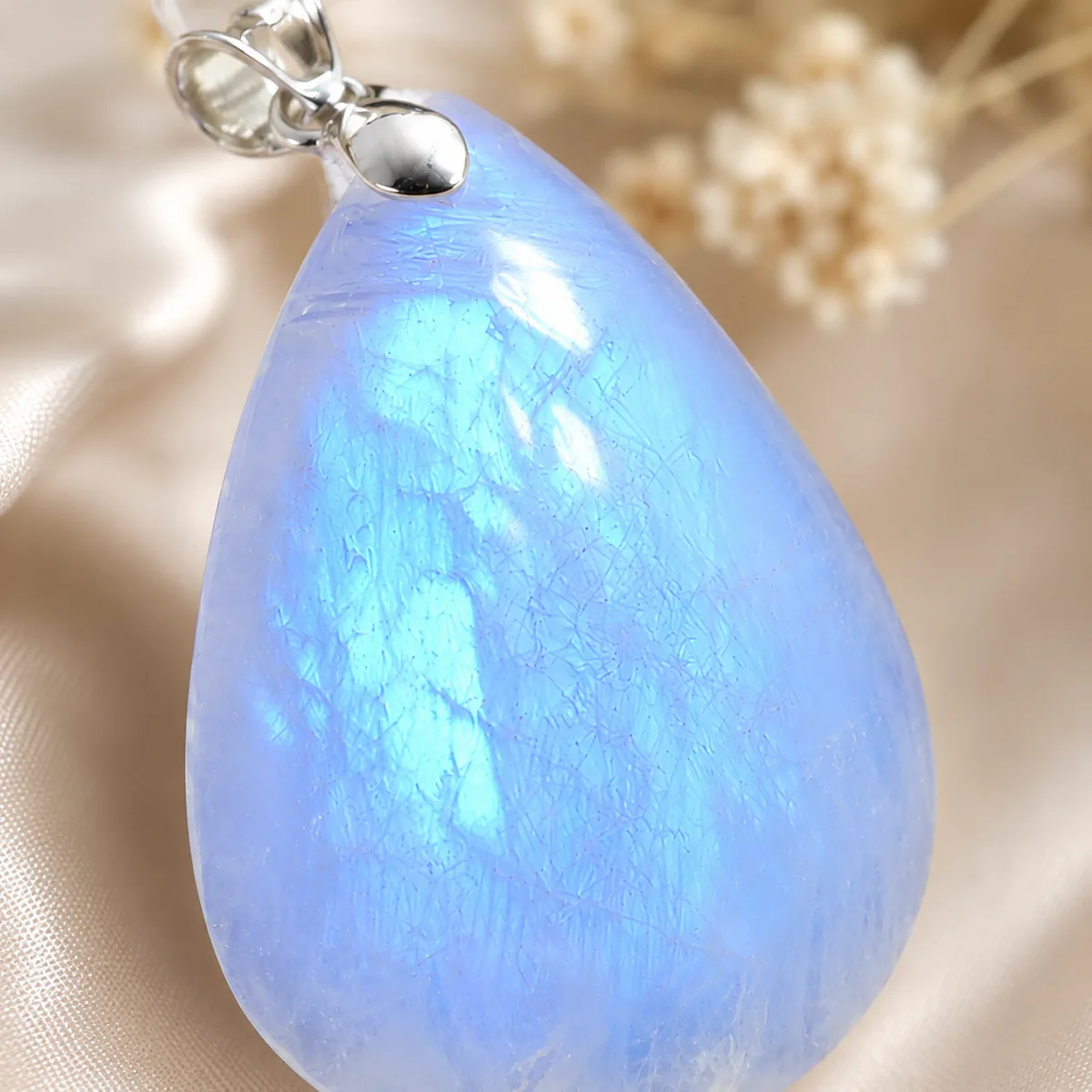
A large polished drop, almost transparent, whose whole dome lights up with a frank blue when the light falls right, with a small bail closed over its point for all the metal there is. Nothing to surround it, nothing to hide it.
What makes the price of a blue moonstone
The market sells this variety as though it formed one homogeneous group, when in fact there is a precise hierarchy, known to professionals and rarely explained to buyers. It comes down to four criteria, and they multiply one another rather than add up.
The color of the veil first. Many moonstones have a white or silvery sheen, milky, that glides prettily over the dome without ever leaning toward blue. That is the most common case, by a long way. A frank blue is the exception. The extent next: a veil may occupy only a narrow band, appear on one side alone, or cover the entire dome as it does here. The transparency of the body: a milky ground dilutes the sheen, a clear ground lets it concentrate. The centering last: the veil should occupy the top of the dome and sweep symmetrically when you tilt the stone, failing which it looks dirty rather than lively.
A stone that unites all four is rare, and its price does not follow a gentle curve: it climbs in steps. That is why two cabochons of the same size, laid side by side, can differ by a considerable factor without an unprepared eye understanding why. The quality criteria are set out here, and what each color changes is there.
Why blue is rarer than white
Here is what is particular about this stone, and the explanation is more satisfying than you might expect. The sheen comes from stacked internal layers, born of two materials separating very slowly as the mineral cooled. Light bounces between those layers, and the color that comes out depends directly on their thickness.
Relatively thick layers send back a silvery white; markedly finer layers are needed for blue to appear. That fineness supposes particular cooling conditions, within a narrow bracket, and nothing guarantees that a deposit will bring them together. That is why white is commonplace and blue sought after: it is not a question of purity or of quality of polish, it is a question of what happened in the rock a very long time ago.
Two useful consequences follow. This blue is not a treatment, it cannot be dyed, heated or added: it is there or it is not. And it does not wear off, unlike the iridescence laid on the surface of certain stones in the trade, since it comes from the structure of the material itself. The full mechanism is explained here.
The trade-off nobody agrees to state
Look at this stone closely and you will see, beneath the surface, fine feathery figures, veils, zones more structured than others. Many buyers take them for cracks and worry. They are the direct counterpart of what you came looking for.
The reasoning is simple once laid out: the blue veil comes from the internal structure of the stone, so a stone heavily structured inside is a stone with a great deal of sheen, and a perfectly limpid one has little. You cannot have at the same time a body with nothing in it and a dome entirely lit, at least not at a reasonable price. You have to choose what you would rather see, and know that you are giving up the other.
For my part I prefer a stone that shows how it works. One thing stays true whichever way you choose: this stone chips on impact rather than scratching, and this one is entirely bare, with no collar to cover its rim. It is a pendant you take off for anything that presses against the chest. The shop’s other pendants are here, and the sizing guide is there.
Crystal healing tradition lends this stone correspondences tied to cycles and intuition, and I have given the last card below to a very real phenomenon that these practices often mistake for proof. I will go no further: none of it is demonstrated and no piece of jewelry heals anything. Separately, I have gathered what tradition lends this stone.
- Large polished drop, blue veil covering the whole dome, a discreet bail and nothing else.
- Four criteria make the price: the color of the veil, its extent, the transparency of the body, its centering.
- The blue is neither treated nor worn away: it comes from the internal structure of the stone.
- Delivered in two weeks, with a cotton pouch, a handwritten note and a care card.
The specifications
- Stone
- Blue moonstone, large drop cabochon
- Appearance
- Clear body, covering blue veil, visible internal figures
- Metal
- 925 sterling silver
- Construction
- Bail, no collar around the stone
- Chain
- Sold separately
- Gender
- Women
- Brand
- Melissa Moon
Why this one has no mounting
It is a rule I hold to and it runs against commercial instinct: the finer a stone, the less metal I put around it. A frame, scrollwork, paving, all of it occupies the eye and takes light from what it surrounds. On an ordinary stone that is even the point: the mounting does the work the stone does not. On this one there is nothing to make up for.
There is a second reason, less flattering to the trade. A collar covers the rim of a cabochon, which is to say the place where the veil weakens, where the material is thinnest, and where a chip would show. Putting nothing around it therefore means showing everything, including what a mounting would have quietly hidden. On a stone you do not have to defend, that seems to me the simplest way of being clear. The rest of the shop is here.
On a fine stone, metal is only there to hold it. Everything else takes light away from it.
No salt, no ultrasonic tank, no hot water: moonstone is a feldspar, and all three damage it for good. Ultrasonics are particularly to be banned here, since they make the material vibrate along the very internal planes that produce this blue. Lukewarm water, a drop of mild soap, a soft cloth, thorough drying with attention under the bail. On a polished surface this size, a greasy film is enough to put the veil out: most stones people believe have dulled need nothing but a dry cloth. Take the pendant off before the shower, the pool and sport, and store it on its own, flat. The detail is in cleaning a moonstone piece, and the safe methods in caring for it without harming it.