


Description
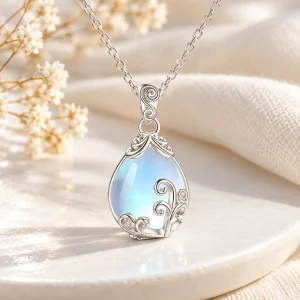
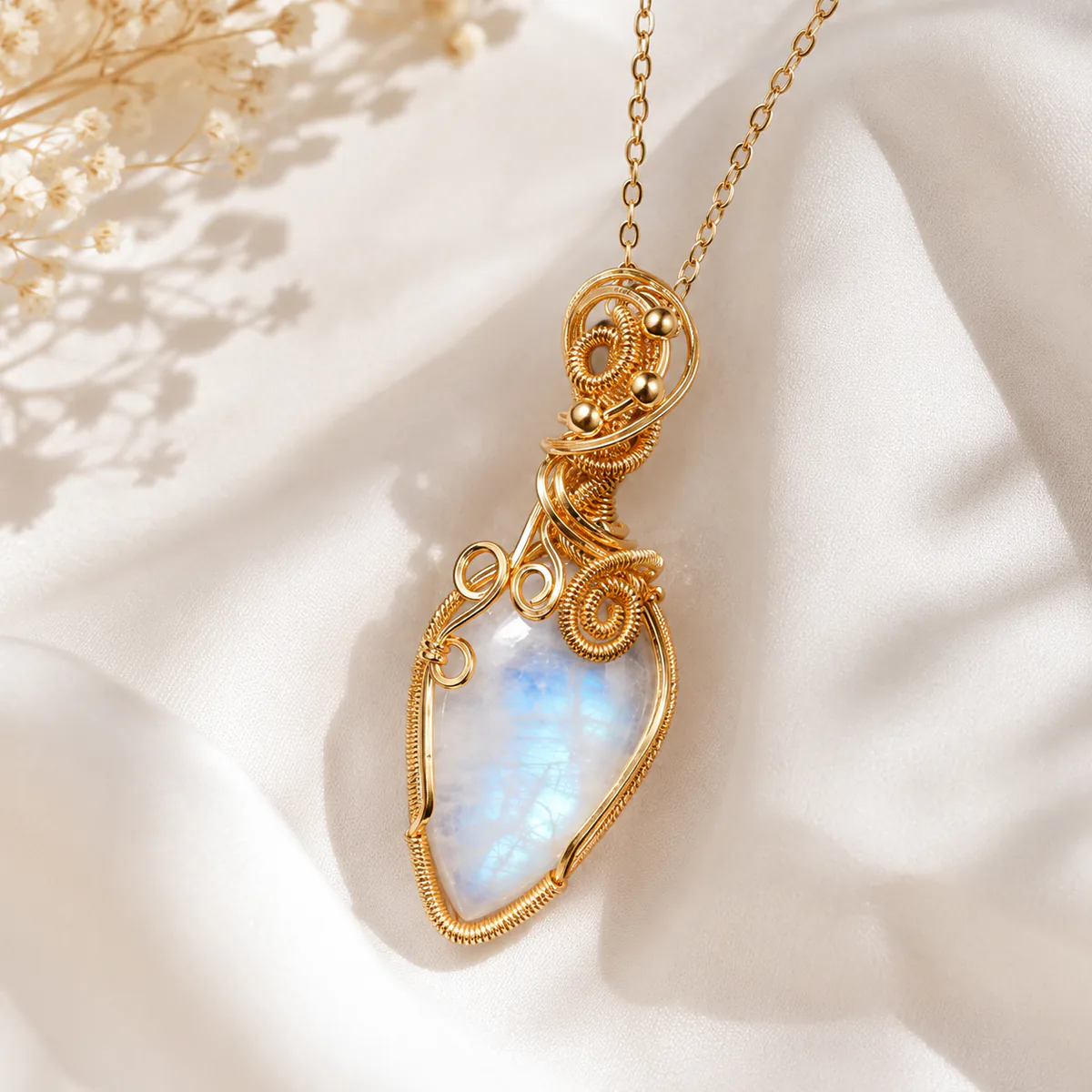
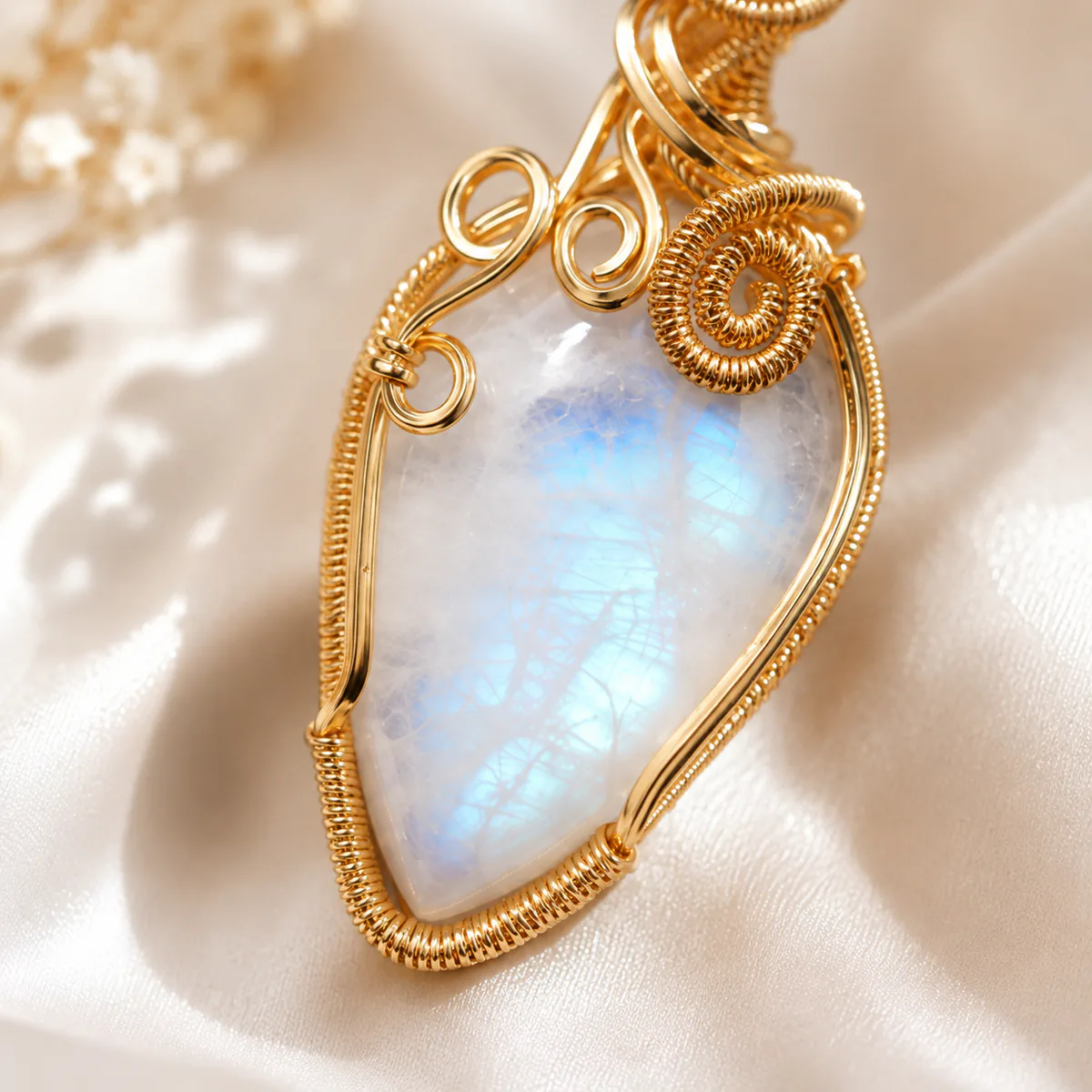
A large shield-shaped cabochon, white and translucent, crossed by a wide blue veil, held by a lacework of gilt wires coiled, looped and spiralled. No collar, no set ring: the stone is caught in a cage, and it is the geometry of the wire that holds it.
Neither drilled nor set: caught in a cage of wire
It is the third method of mounting in the catalogue, and the only one that does not touch the stone. A bezel folds metal over its edge. A hanging drop is drilled right through, which weakens it for good. Here the stone has been neither drilled, nor glued, nor enclosed: wires pass in front of it and behind it and cross over its edges.
The first advantage is structural. An undrilled stone keeps all its cohesion: no internal tension has been created around a hole, and on a material with perfect cleavage that is far from a detail. Moonstone chips on impact rather than scratching, and a drill hole is always the most likely starting point for a crack.
The second advantage is rarer and I find it remarkable: this mounting comes apart. The day the wires are tired or the gilding gone, a jeweller frees the stone in a few minutes, intact, exactly as it left the lapidary. It can then be remounted differently, on a silver bezel for instance. It is the only piece in the shop whose stone can outlive its mounting without having lost anything.
The trade-off is obvious: it is held by points of support, not by a continuous border. A sharp knock can spread a wire and free the cabochon. The check is simple and worth doing every month: take the stone between thumb and forefinger and gently try to pivot it in its cage. It must have no play at all, neither turning nor clicking against the metal.
A coil is made by hand, and it shows
Here is what is particular about this model. This kind of work cannot be cast: each spiral was coiled wire by wire, one loop after another, with pliers. There is no machine that produces this drawing in a single go, and that is why this mounting costs a great deal in time and nothing in material.
One direct consequence deserves stating before you buy rather than after: the coils will never be perfectly symmetrical. One spiral will be a little tighter than its neighbour, a crossing a little higher, a loop slightly different on the other side. These are not faults, they are the signature of the technique, and mechanical regularity would on the contrary be the sign that this is not that work at all.
What you should look at, though: the wire ends. Every strand finishes somewhere, and a wire end must be tucked in, flattened and smoothed, never left as a point. Run a fingertip all around the pendant: nothing should catch or prick. It is the only true manufacturing fault possible on this kind of piece, and it is detected by touch in five seconds.
Where the gilding goes on a wire piece
The gilding of a solid piece wears in predictable places: the face that rubs on skin and the point where it bends. On wirework the mechanics are different and nobody writes it down. Here the metal rubs against itself: every crossing of two strands is a point of contact, and there are dozens of them.
Wear therefore shows not in zones but in a dotted pattern, on the ridges of the coils and at every crossing, which over time gives a slightly pitted look rather than a lightened flat. It is more discreet, and it is also more final: wirework cannot be repolished at all, no cloth passing between the strands. On a gilt piece it would make no sense anyway, since polishing amounts to removing the layer of gold.
Care therefore comes down to prevention, and prevention works: the piece goes on last, after cream and perfume, comes off before the shower, the pool and sport, and is stored on its own rather than loose with other pieces that would rub the coils. The shop’s other necklaces are here, and the sizing guide is there: this pendant is tall and heavy, so allow a length that lets it hang freely rather than a short chain that would press it flat.
As for the stone, its blue veil is wide and well centred on the dome, which is the real quality criterion of a cabochon: the others are set out here, and the mechanism of the sheen is explained there. Crystal healing tradition lends moonstone correspondences tied to cycles and intuition, and handmade work drags a reputation of its own that I have looked at closely, below. I will go no further: none of it is demonstrated and no piece of jewellery heals anything. Separately, I have gathered what tradition lends this stone and what each colour changes.
- Large cabochon held by a cage of gilt wires coiled by hand.
- Neither drilled, nor glued, nor set: the stone is intact, and it can be recovered as it is.
- The spirals are not symmetrical: that is the technique, not a fault.
- Delivered in two weeks, with a cotton pouch, a handwritten note and a care card.
The specifications
- Stone
- Moonstone, large free-form cabochon
- Appearance
- Translucent white, wide centred blue veil
- Metal
- Gilt metal, hand-coiled wire
- Construction
- Wire cage, no drilling, no gluing, no soldering around the stone
- Chain
- Oval link
- Gender
- Women
- Brand
- Melissa Moon
The only stone in the catalogue you will be able to recover
Here is how I would like this necklace to be looked at: the mounting is what will wear out, and the stone is what will remain. A gilt wire has a lifespan of a few years depending on skin and habits. The cabochon has been through nothing: no hole, no glue, no metal folded over its edges. The day the gilding is gone you will not have a dead piece, you will have a fine loose stone and the choice of what to do with it.
It is the exact opposite of a drilled stone, which keeps its hole all its life, and of a glued stone, which is never recovered cleanly. So if you are hesitating between this model and another, the honest argument is this one: buy this one for its stone, not for its mounting. The rest of the shop is here.
The mounting is what will wear out. The stone will outlive the piece, and that is the whole point.
No salt, no ultrasonic tank, no hot water: all three damage the stone for good, and ultrasonics would loosen a cage held by the tension of the wires alone. For the gilt metal, no abrasion: no paste, no brush, no polishing cloth, all of which take the gilding off without ever reaching the bottom of the coils. A soft dry cloth is enough in almost every case. If a cleaning is called for, lukewarm water, a drop of mild soap, a short rinse and immediate drying by dabbing, without letting water sit between the strands, where it marks as it dries. Take the necklace off before the shower, the pool and sport. The detail is in cleaning a moonstone piece, and the safe methods in caring for it without harming it.