


Description
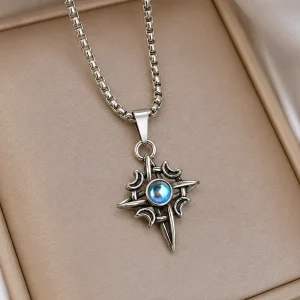
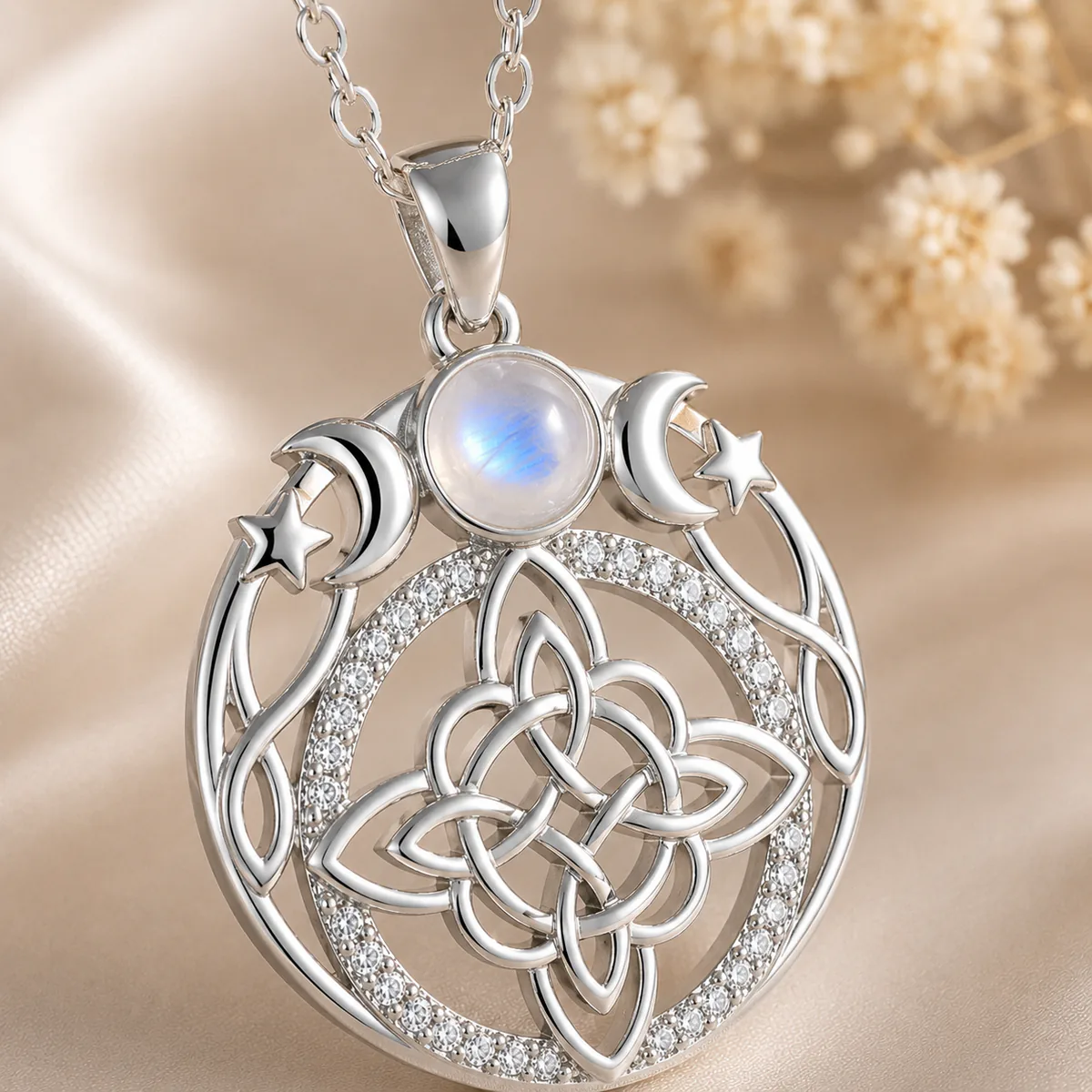
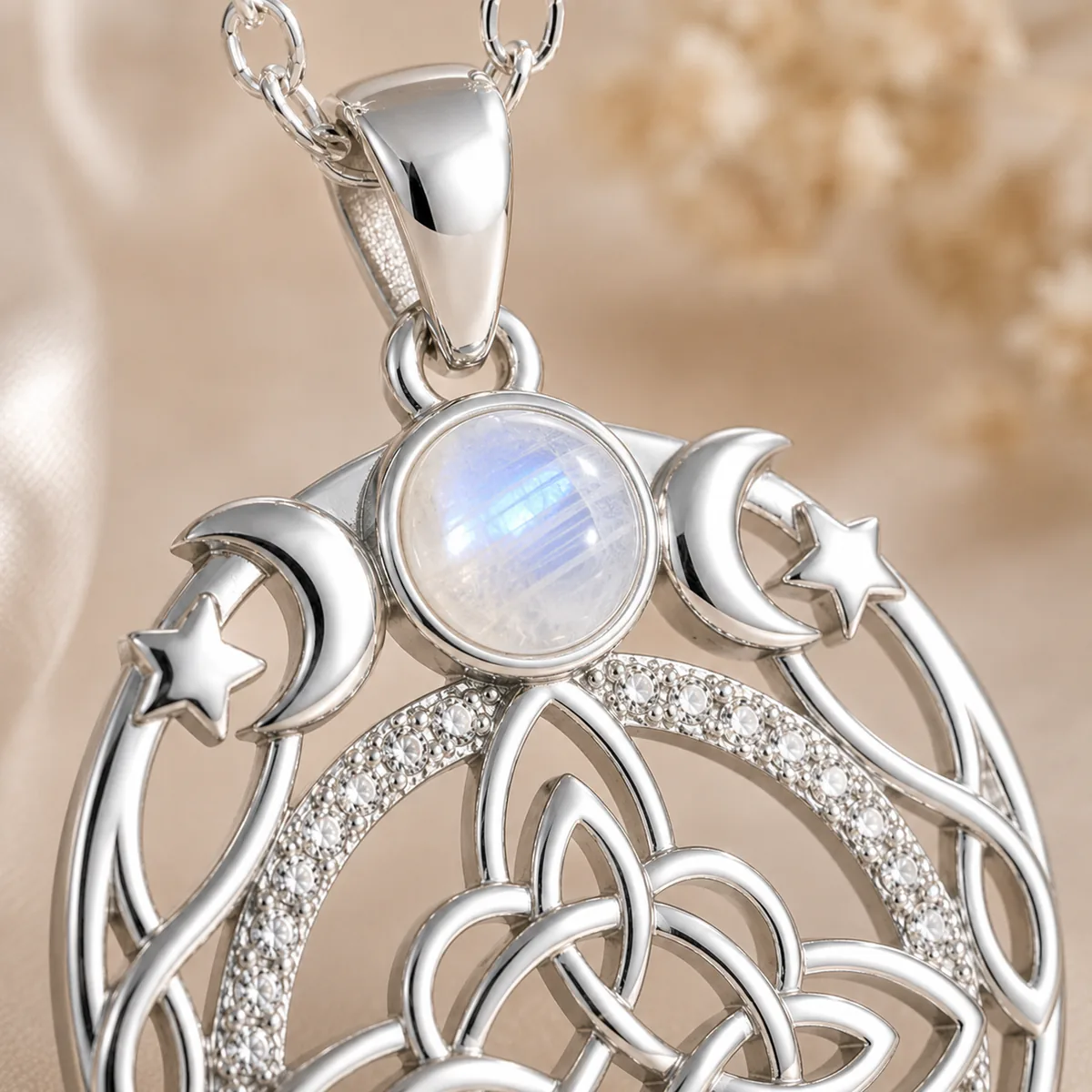
A large openwork disc of polished silver, two crescents and two stars along the top, a circle of small clear stones, and at the centre a four-loop knot fully interlaced. At the summit, a round stone throwing off green, pink and blue patches. It is the widest pendant in the catalogue, and the most loaded in drawing.
Two very different ways of making colour
The stone set at the top of this pendant does not behave like the cabochons in the rest of the shop, and the difference is worth pausing on, because it holds for everything iridescent you will ever see.
A moonstone produces a veil: a single sheet, without a clean outline, of one tone at a time, gliding over the dome as you tilt the stone and going out at certain angles. This one produces patches: areas of different colours, side by side, with fairly clean limits, changing tone and place as you move. That phenomenon is called play of colour, and it is the signature of opal.
Both effects come from an internal structure, but not the same one: one from stacked layers, the other from a regular stacking of microscopic spheres that diffract light the way a grating would. You never confuse them again once you have seen both: a veil moves as one block, patches reorganise themselves. The veil of moonstone is explained here, and the quality criteria are set out there.
An interlace is not sawn, it is cast
Here is what is particular about this model, and it explains its look as much as its weak points. Look at the central knot: the strands pass alternately over and under. This drawing cannot be cut out of a sheet, since it is not flat: it has to be sculpted in volume, made into a model, and cast in metal.
Three concrete consequences. The edges are softer than on sawn openwork, where the blade leaves frank borders: that is normal on a cast piece and it is not a sign of sloppy finishing. The bridges are fine, and a cast openwork piece twists or cracks at those junctions rather than bending: not for the bottom of a pocket, not for a heap in a dish. And the inside cannot be polished, no tool reaching under the strands, which makes it all the more important never to let polishing paste lodge in there.
The circle of small stones is set on a narrow band, itself pierced behind: you therefore see the backs of the settings through the disc. It is pretty when well done, and it gives you an unusual means of checking: hold the pendant against the light, and every small stone should sit properly in its seat, with no gap and no offset. Then run a fingernail over the circle: nothing should catch. The shop’s other pendants are here.
Large, and yet light
It is the paradox of openwork pieces, and here it plays in your favour. A disc of this size in solid metal would be frankly heavy, it would pull on the neck, it would swing and it would wear the chain out fast. Emptied of its material, it keeps all its presence and weighs almost nothing.
It is exactly the opposite of what I advise looking at on a man’s piece, where mass makes half the impression. Here, lightness is not a disguised economy, it is the whole point of the technique: openwork gives the maximum of visible surface for the minimum of metal, and that is what makes a large pendant wearable all day.
The downside concerns cleanliness, and it is concrete: everything airborne settles right through it. Dust, dried soap, cream and clothing fibres pass through the openings and settle behind the strands, where nobody thinks to look. On a solid piece, dirt stays on the surface and comes off with a cloth; here it takes lukewarm water, a drop of mild soap and a very soft brush, working from both sides. The stone, for its part, stays sensitive to impact like all those in the catalogue: it chips rather than scratches, but here it is bezel set and placed back from the edge of the disc, so well protected. The sizing guide is here.
Tradition lends these motifs all sorts of meanings, and below I have looked at what the very shape of a protective piece has that stays constant across cultures. I will go no further: none of it is demonstrated and no piece of jewellery heals anything. Separately, I have gathered what tradition lends this stone and what each colour changes.
- Large openwork disc in 925 sterling silver, interlaced knot, crescents, stars and a circle of clear stones.
- A veil moves as one block, patches reorganise themselves: two different optical phenomena.
- Openwork so light, and openwork so passed through: clean both sides, with a soft brush.
- Delivered in two weeks, with a cotton pouch, a handwritten note and a care card.
The specifications
- Main stone
- Round cabochon with a play of colour
- Appearance
- Translucent white, mobile green, pink and blue patches
- Accent stones
- Colourless cubic zirconia, bead set
- Metal
- Polished 925 sterling silver
- Motif
- Openwork disc, interlaced knot, crescents and stars
- Gender
- Women
- Brand
- Melissa Moon
What a large pendant asks of whoever wears it
I may as well say it before you buy: a piece of this diameter is not added to an outfit, it decides it. It needs a simple, open neckline, a plain top, and nothing else around the neck. Worn over a printed collar, over a scarf or with a second necklace, it becomes illegible and the work of the drawing disappears. It is also the category of jewellery people buy most readily and take out least often.
So the honest advice is this: look at your wardrobe before you look at the pendant. If you mostly wear polo necks and prints, a smaller piece will serve you ten times more. If you live in plain tee-shirts and open shirts, this one will find its place every day. A piece that gets worn is worth more than a piece admired in a box. The rest of the shop is here.
A large pendant is not worn with a complicated neckline. It is the neckline.
No salt, no ultrasonic tank, no hot water: all three damage the stone for good, and ultrasonics would tire the beads holding the pavé and the fine bridges of the openwork besides. Lukewarm water, a drop of mild soap, a very soft brush passed on both sides of the disc, a rinse and thorough drying by dabbing, water lingering behind the strands and leaving rings as it dries. A silver polishing cloth suits the smooth open surfaces, never the stone and never the depth of an opening, which it would only half reach. Take the necklace off before the shower, the pool and sport, and hang it up rather than laying it in a heap. The detail is in cleaning a moonstone piece, and the safe methods in caring for it without harming it.